




by Redazione 23/11/2026


Categories: Exhibitions / Disclaimer
For months, painter Pietro Manzo rode his motorcycle through the industrial outskirts of Prato, carrying an easel and a sketchbook, even climbing onto rooftops. This resulted in about forty works—ranging from small oil paintings on paper to four-meter canvases—which are on display through December 6 at Villa Rospigliosi.

For months, the painter Pietro Manzo (Sala Consilina, 1981) rode his motorcycle through the industrial outskirts of Prato, carrying an easel and a sketchbook. Sometimes he would stop for entire days; other times, just for a few minutes. He observed warehouses, streets, and signs—those places we pass by constantly without ever really stopping to look at them. Then he climbed onto the roofs of buildings to see the landscape from above, all at once. From this long journey—undertaken first at street level and then from an elevated vantage point—emerges *Lontano, vicino, dentro* (Far, Near, Inside), the solo exhibition through which the painter brings the Prato of industrial warehouses into the 18th-century halls of Villa Rospigliosi, on view through December 6.
At the heart of this unprecedented project is Macrolotto 2, which Manzo takes as the archetype of Prato’s industrial landscape. It is a place where infrastructure, labor, and the traces left by humans overlap to the point of becoming indistinguishable. The exhibition, organized and curated by the ChorAsis – Lo spazio della Visione association, brings together some forty works, including drawings, small paintings, and large-format pieces. Manzo does not use the industrial landscape merely as a backdrop; he treats it as a complex cultural fabric, rich with meaning.


The dimensions of the works already give an idea of his method. *Ovunque* is an oil on paper measuring ten by fifteen centimeters—little more than a postcard. *Ombre cinesi*, also from 2026, is an oil on canvas measuring approximately four meters by two. All of his work moves between these two extremes, and the exhibition’s title captures this: looking from afar, drawing closer, stepping inside. The “distant” perspective is the analytical, almost cartographic gaze of someone observing the territory as an outsider. The “close” is the direct outdoor experience, consisting of sketches, drawings, small paintings, and impressions gathered on site. The “inside” is the studio work, where Manzo reworks what he has seen through memory and thought.


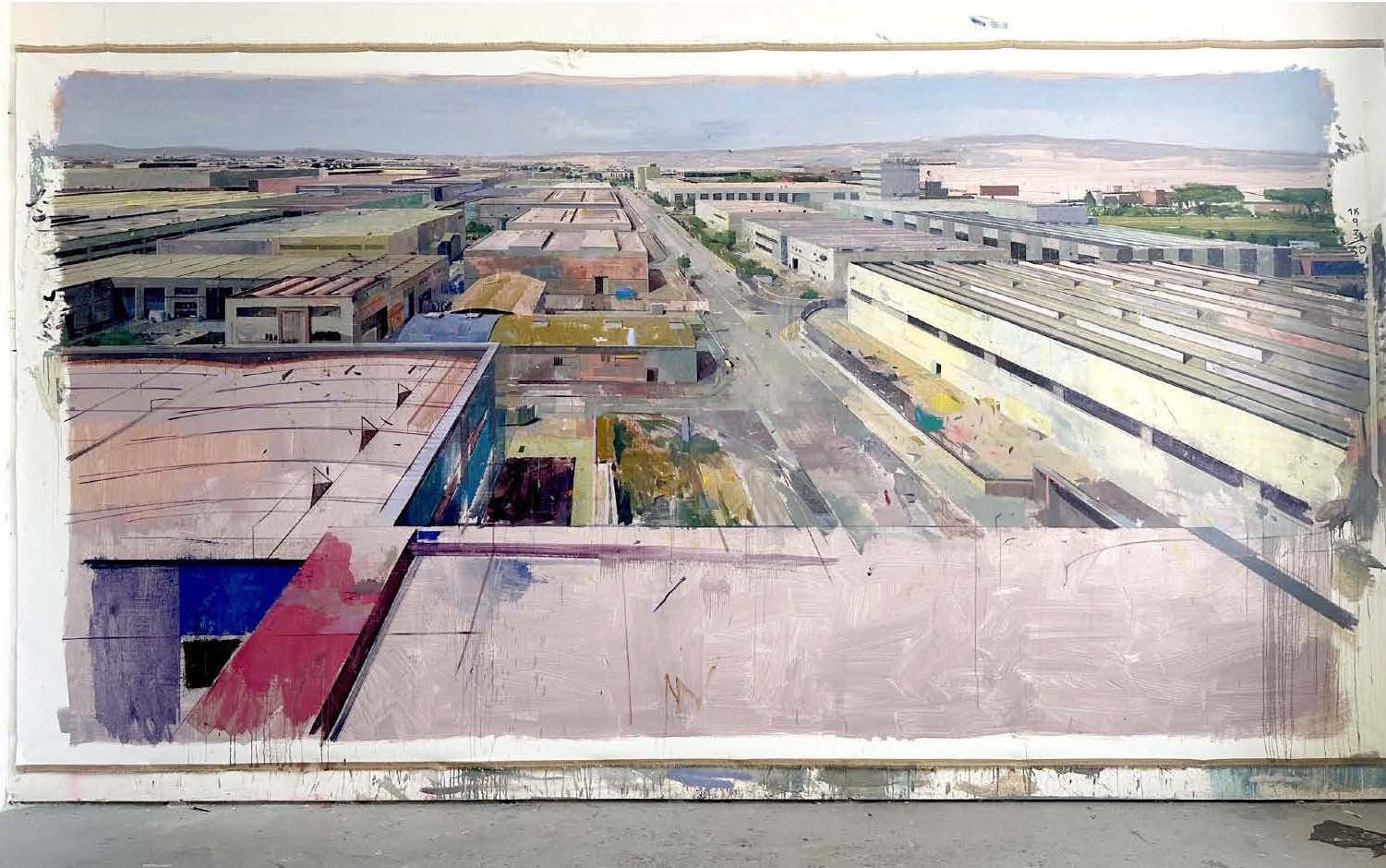
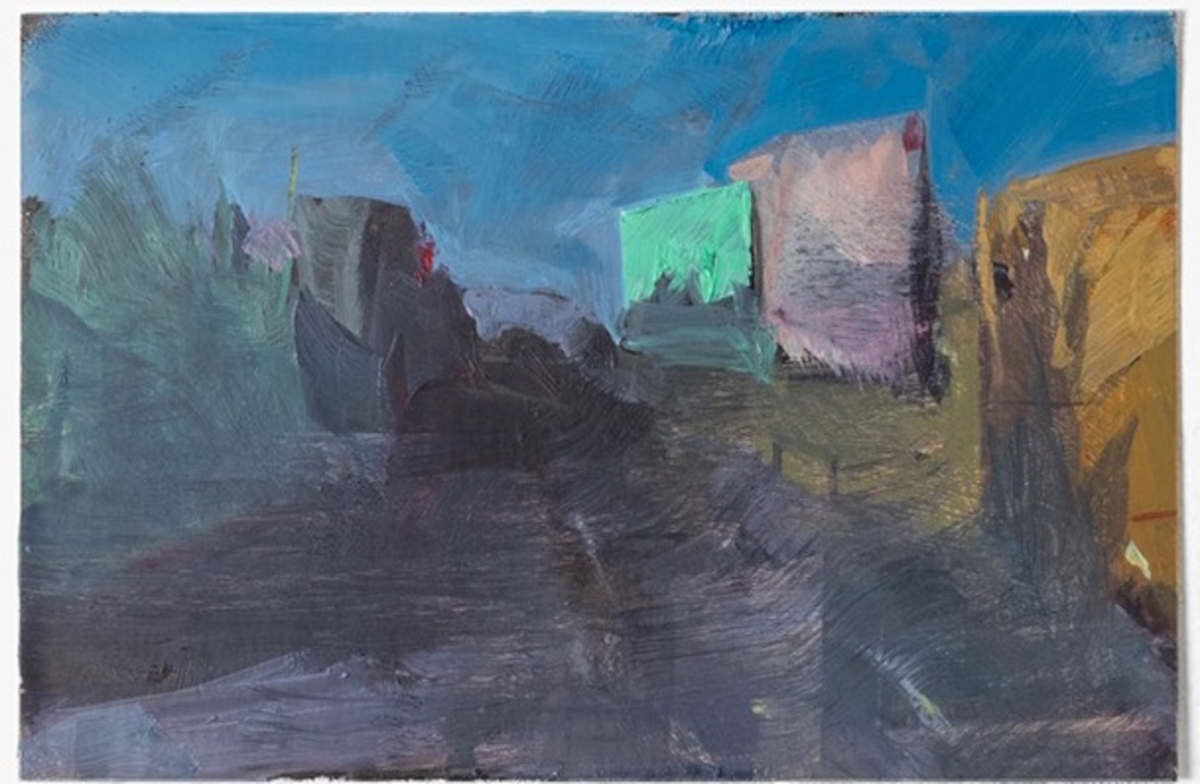
It is in this third phase that the landscape changes its nature. Stripped of any documentary intent, the industrial landscape becomes a liminal space, an autonomous pictorial surface in which abstraction and figuration, testimony and invention remain in tension. The exhibition’s introductory text describes the survey from rooftops as an “almost Goethean” stance—that of someone seeking a vantage point from which the gaze can extend beyond and embrace the whole. The periphery thus becomes, in the project’s intent, a potential center of meaning.
The contrast with the venue hosting the exhibition is intentional. Villa Rospigliosi, formerly Villa Aldobrandini, is an 18th-century residence. Its rooms now house a landscape characterized by an ordinary, standardized, functional aesthetic—one that is identical everywhere in the world and stratified to the extreme. The dialogue between the villa’s noble scale and the industrial outskirts is intended to be dissonant—and precisely for this reason, fruitful.
Guiding the interpretation of the exhibition is a text by Simone Mangani, an expert on the social and cultural reality of Prato. Mangani begins with the motorcycle—a BMW—which barely fits in the artist’s studio, located next to the Circolo di Legnaia in Florence. He then lists the actions that make up the painter’s work: “Strolling, lingering, walking, looking, observing, memorizing, reworking, climbing, choosing, surrendering, painting, looking again, recognizing oneself or getting lost, setting out again.” For Mangani, the recognizable landscape—the industrial area with hills in the background—is merely the starting point. “The landscape born from the encounter between man and nature changes along the eye-brain-hand-eye path,” he writes. He adds that the true subject of the exhibition “is the act and the very process of painting through a personal, individual, cultured, and libertarian gaze—that of the artist who does not impose his knowledge and rejects hyper-signification in favor of an encounter with the viewer’s perspective.”
People do not appear in Manzo’s paintings. Mangani points out, however, that this absence “is not apocalyptic”: “rather, it is the essence of the encounter that it proposes—from afar, up close, and within: how we look at the world, how we look at the landscape, how we look at things, how we look at absences (and therefore also at the human being who is never—portrayed—present).” In his interpretation, Macrolotto is a place that is both similar to and different from any other industrial zone—a landscape that becomes an existential condition and in which humanity, though absent, remains an implied presence. The text concludes by taking up a famous phrase and applying it to painting: “As always, the medium is the message: and Pietro Manzo’s medium is a frenzied study and exploration—open to error—of the very meaning of painting and, therefore, of things.”
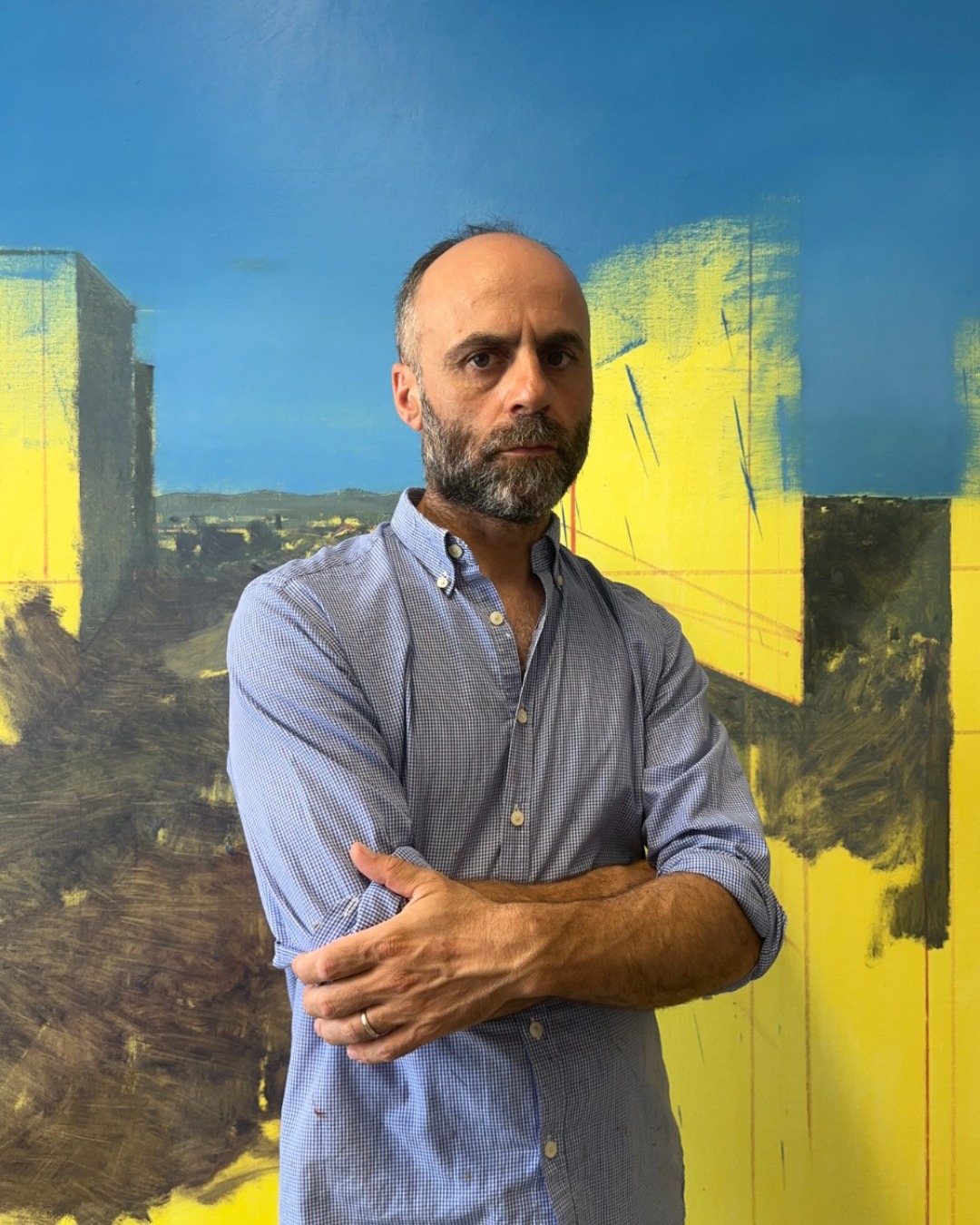
Pietro Manzo was born in Sala Consilina, in the province of Salerno, in 1981, and lives and works in Florence. He graduated with a degree in Painting from the Academy of Fine Arts in Florence in 2006, having studied under Maurizio Canale. In 2009, he won the Accademia delle Arti del Disegno award, which allowed him to work for five years in Tito Conti’s historic studio in Florence. He has been exhibiting since 2005. His solo exhibitions include *Interni* at the Falteri Gallery in Florence (2010), *Under Construction* at the PAH Project Gallery in Freiburg (2011), *Grand Tour* at the Accademia delle Arti del Disegno (2014), *ri-Costruire (intro)* at the Lyceum in Florence, and *Momento zero* at the White Noise Gallery in Rome (both in 2017), and, in 2023, BRUTAL OR BEAUTIFUL. The Indiscreet Charm of Matter at the Church of the Holy Trinity in Polla. She has participated, among others, in the group exhibitions *The State of Art* at the Accademies Pavilion of the Venice Biennale (2011), *POINT OF VIEW. “Imperfect Paintings” at the Galleria Fuori Campo in Siena and “From Michelangelo to the Contemporary” at the State Archives of Florence (2014), “TU 35/2016 – Geographies of Emerging Art in Tuscany” at the Officina Giovani in Prato (2016), SPETTRI DEL VISIBILE at Studio MDT in Prato and Terapie d’urto – Toni at LUISS Guido Carli in Rome (2017), REAZIONE A CATENA. Differenti vie della pittura #2 at the Giovanni Bonelli Gallery in Milan (2018), WERDEN. From Michelangelo to... at the Ferdinandeum Regional Museum in Innsbruck (2022) and Florilegio Italiano at the Mo.C.A. in Montecatini Terme (2024).
The exhibition is organized by ChorAsis – Lo spazio della Visione, a social promotion association based in the villa that supports research, experimentation, and the production of contemporary art, exploring the relationship between past and present, and between art, nature, and history. Since 2019, it has invited artists to freely engage with the villa’s rooms and the park, creating site-specific works, installations, performances, and workshops.
|
| Riding a Motorcycle Through the Warehouses of Prato: Pietro Manzo Brings Macrolotto 2 to Villa Rospigliosi |
Warning: the translation into English of the original Italian article was created using automatic tools. We undertake to review all articles, but we do not guarantee the total absence of inaccuracies in the translation due to the program. You can find the original by clicking on the ITA button. If you find any mistake,please contact us.