



by Redazione 10/11/2026


Categories: Exhibitions / Disclaimer
From December 10, 2026, to April 20, 2027, the Segantini Museum in St. Moritz, Switzerland, will juxtapose the Divisionist painter’s Alpine landscapes with four works by Anselm Kiefer, created between 2010 and 2025 and inspired by the last words attributed to Segantini.


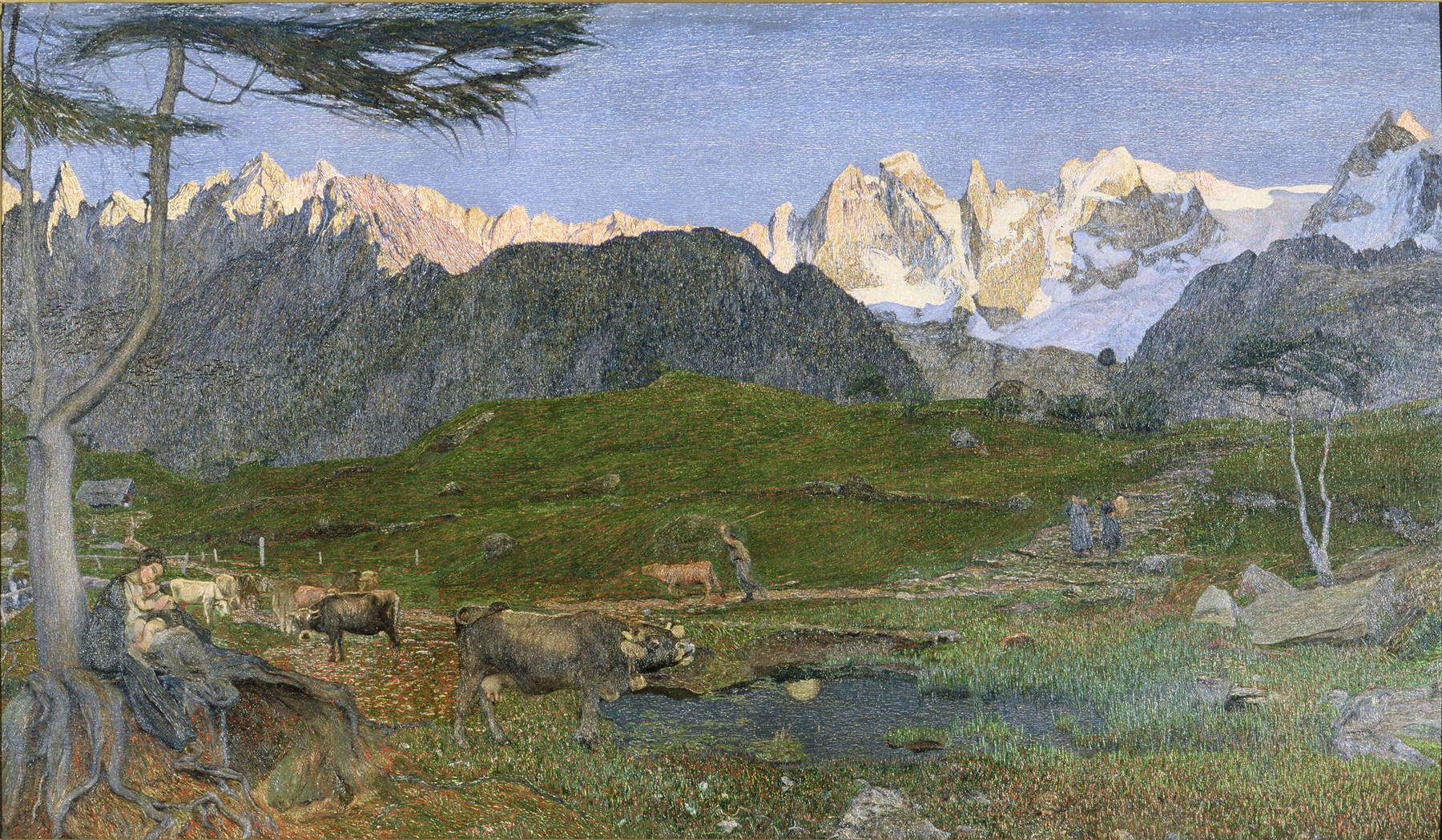
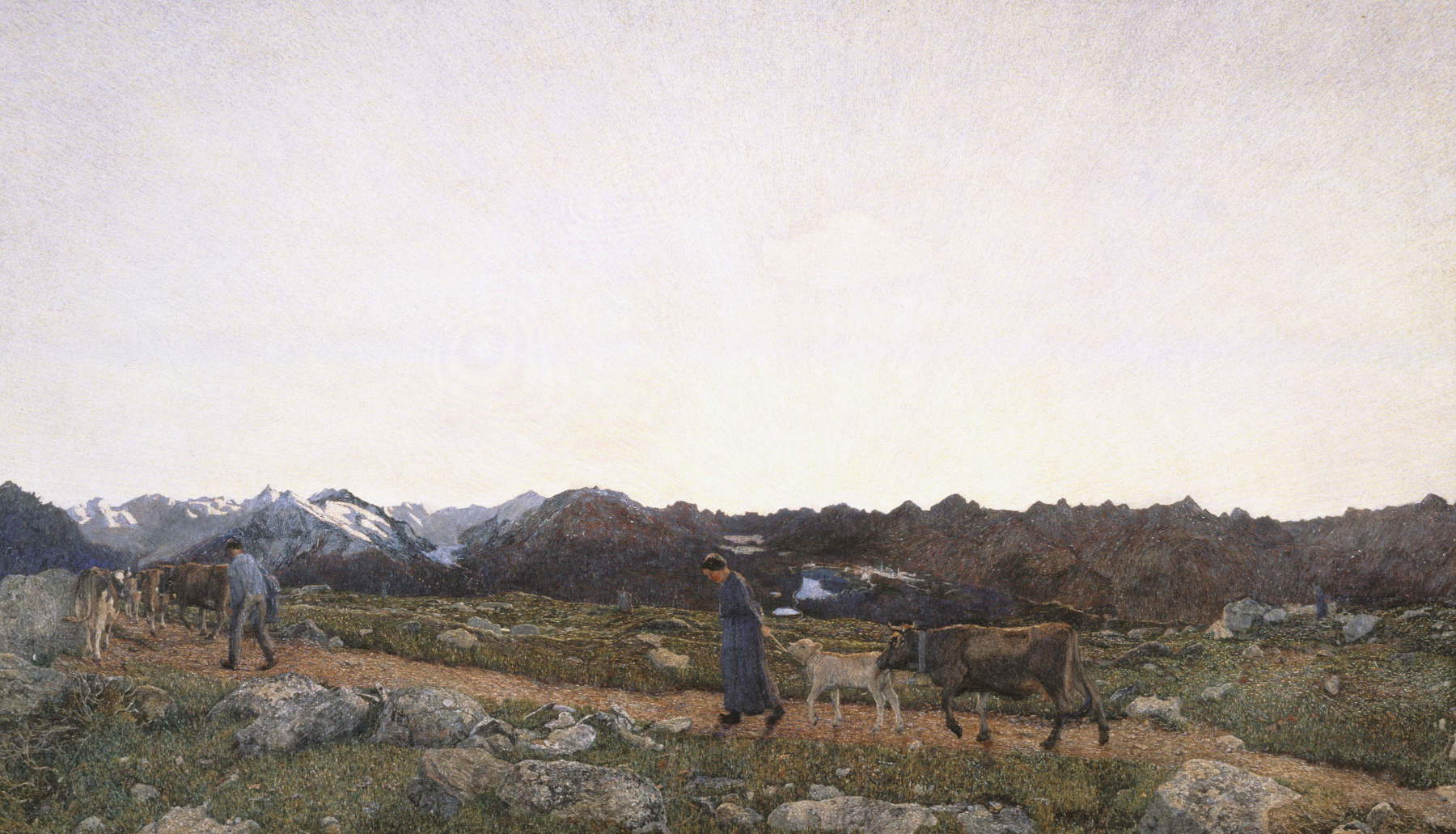
What do mountains represent when they cease to be merely a subject to be painted and become the place where memory, desire, and reflections on existence converge? This is the starting point for “... le mie montagne” – Giovanni Segantini and Anselm Kiefer, the exhibition presented by the Segantini Museum in St. Moritz, Switzerland, from December 10, 2026, to April 20, 2027. The exhibition brings together the landscapes of Giovanni Segantini—with particular reference to his views of Savognin and the Engadine— and four paintings by Anselm Kiefer—one of Germany’s leading contemporary artists—from the series “I Want to See My Mountains,” created between 2010 and 2025.


The works of the two artists are separated by more than a century and belong to profoundly different biographical and sociocultural contexts. Segantini spent the last thirteen years of his life in the Grisons Alps, where his relationship with the mountain landscape served as a constant source of inspiration and repeatedly influenced his creative process. In his mature works, however, the landscape is not merely the subject of the depiction but, above all, takes on a symbolic function. Through nature, the painter addresses some of the great themes of existence: birth, motherhood, the hardships of daily life, death, and cosmic unity.


Even in Kiefer’s body of work—characterized by an extraordinary variety of subjects and artistic languages—there are numerous depictions of natural landscapes, ranging from fields to rivers to wooded scenes. These are not, however, faithful reproductions of reality. Nature becomes a space imbued with symbolic meanings, often linked to German history—particularly World War II and the Holocaust—but also to German culture, mythology, and collective memory.


The comparison between the two artists stems precisely from this shared conception of landscape as a vehicle for meanings that transcend the visual dimension. Kiefer’s mountains, in particular, do not correspond to recognizable geographical locations but evoke a primordial nature, traversed by forces still in motion.
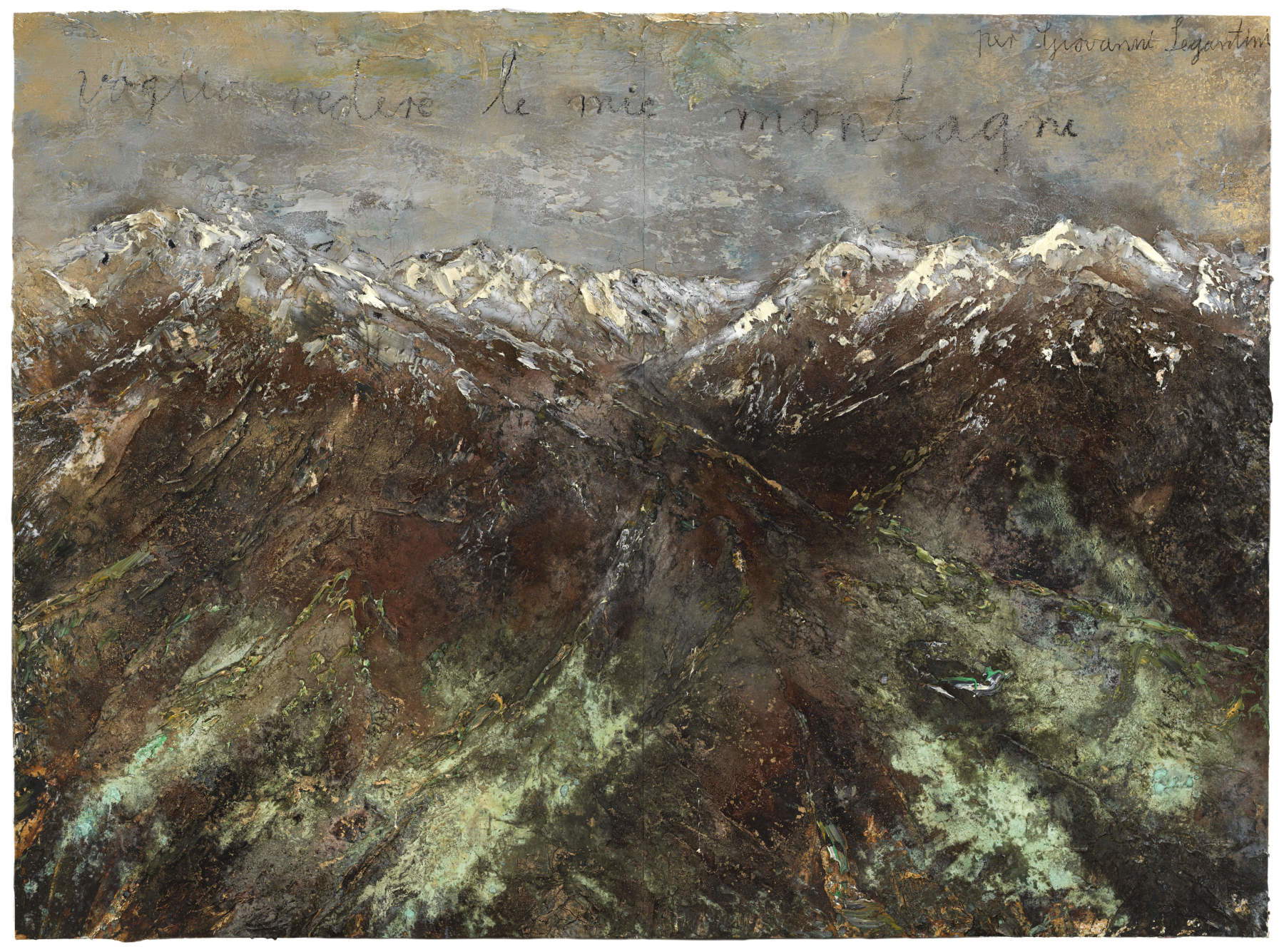
Segantini’s Last Words and Kiefer’s Interpretation
The title of Kiefer’s series echoes the words that, according to tradition, Giovanni Segantini is said to have uttered on his deathbed: “I want to see my mountains.” The artist himself recounted the origin of the works in a 2023 letter addressed to his longtime gallerist Lia Rumma, on the occasion of an exhibition then scheduled at her gallery in Naples.
“You know, my paintings are never finished. I keep reworking them: after a long time, I take them out of the storage containers and let them be reborn.”
Kiefer explains that he revisited some older paintings, working on them with a blowtorch, exposing them to storms, and subjecting them to electrolysis. These processes have transformed the works, as the artist writes, “in a marvelous way” into paintings of mountains, in which the rock “has crystallized from the flow of color.” The result is a style of painting that does not seek to depict real Alpine landscapes, but rather to construct images of a primal nature, charged with energy, bubbling like magma and still appearing to be in the process of formation.
In Kiefer’s interpretation, the last words attributed to Segantini do not merely express the regret of a man who, nearing death, longs to see once more the places to which he is bound. Rather, they contain a broader reflection on the distance between desire and its fulfillment. “The ‘fulfillment’ of a desire never lives up to the dream. It always remains a NOT-YET. What we desire, once realized, never coincides with the desire itself.”
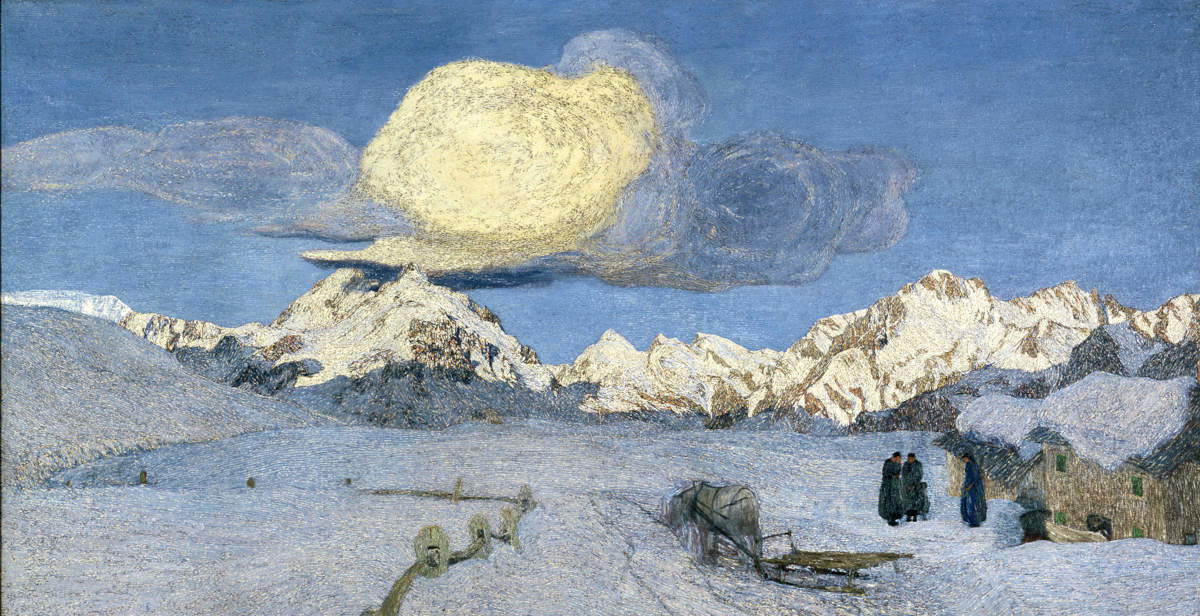
The artist also applies this insight to the creative process: every work of art, just like every fulfilled desire, inevitably falls short of perfection. This perspective contrasts with that of Segantini, who was convinced, on the contrary, that he could achieve a form of completeness through painting. An example of this is the monumental “Triptych of the Alps,” composed of the three sections “Life, ” “Nature, ” and “Death, ” and on permanent display at the Segantini Museum. With this work, the painter sought to capture “all the harmonious beauty that lives in and gives life to nature.”

The reference to Segantini’s words also intertwines with the history of contemporary art. In fact, the title of Kiefer’s series also alludes to an installation of the same name created by Joseph Beuys in 1971, which was likewise conceived as a tribute to the painter. Kiefer had met Beuys during his years at the Düsseldorf Academy and continues to regard him as a pivotal figure in his own artistic development. The phrase “I want to see my mountains,” handwritten by Kiefer himself, also appears on several of the canvases on display, introducing a textual element into the paintings that further challenges their illusionistic quality.
The exhibition is part of an exhibition series already pursued by the Segantini Museum, which in recent years has presented comparisons between the painter and contemporary artists. In the winter of 2023–2024, for example, Engadine landscapes and Gerhard Richter’s overpainted photographs were juxtaposed with the large paintings from the Maloja period. This dialogue between different eras and sensibilities had refocused attention on the relevance of Segantini’s artistic exploration today.
The exhibition dedicated to Kiefer is organized in collaboration with the Lia Rumma Gallery in Milan and Naples.
 |
| Segantini and Kiefer: The Mountains Become a Reflection on Desire and Memory |
Warning: the translation into English of the original Italian article was created using automatic tools. We undertake to review all articles, but we do not guarantee the total absence of inaccuracies in the translation due to the program. You can find the original by clicking on the ITA button. If you find any mistake,please contact us.