




by Redazione 29/11/2026



Categories: Exhibitions / Disclaimer
From December 5, 2026, to January 6, 2027, at The Project Space gallery in Pietrasanta, approximately twenty sculptures by artist Stefano Russo explore the relationship between individual consciousness, technology, and identity through Raku ceramics, an ancient Japanese technique that relies on fire to transform the material.


In an age when technology and algorithms increasingly influence the way we perceive reality, sculpture can become a tool for questioning one’s own identity and reclaiming a more direct relationship with the world. This is the central theme of DAIMON, Stefano Russo’s new solo exhibition, which opens on Saturday, December 5, at 6:00 p.m. at Annalisa Bugliani’s The Project Space gallery, located at Via Garibaldi 46 in Pietrasanta (Lucca). The exhibition will remain open to the public through January 6, 2027. Conceived specifically for the gallery spaces, the project brings together approximately twenty sculptural works of varying sizes, creating a journey in which experimentation with materials, artistic exploration, and sensory perception take center stage.


The exhibition explores the relationship between individual consciousness and the influences of contemporary life, focusing on the impact of technology and artificial intelligence on daily life. Through the transformation of materials, Russo invites reflection on the possibility of breaking free from external constraints and rediscovering a more authentic dimension of existence.
“Beyond the algorithms and patterns that shape our existence, rediscovering one’s most authentic nature. Shedding one’s skin, transforming matter, and opening oneself to a new consciousness—in harmony with oneself, others, and the planet,” explains the artist in presenting the project.




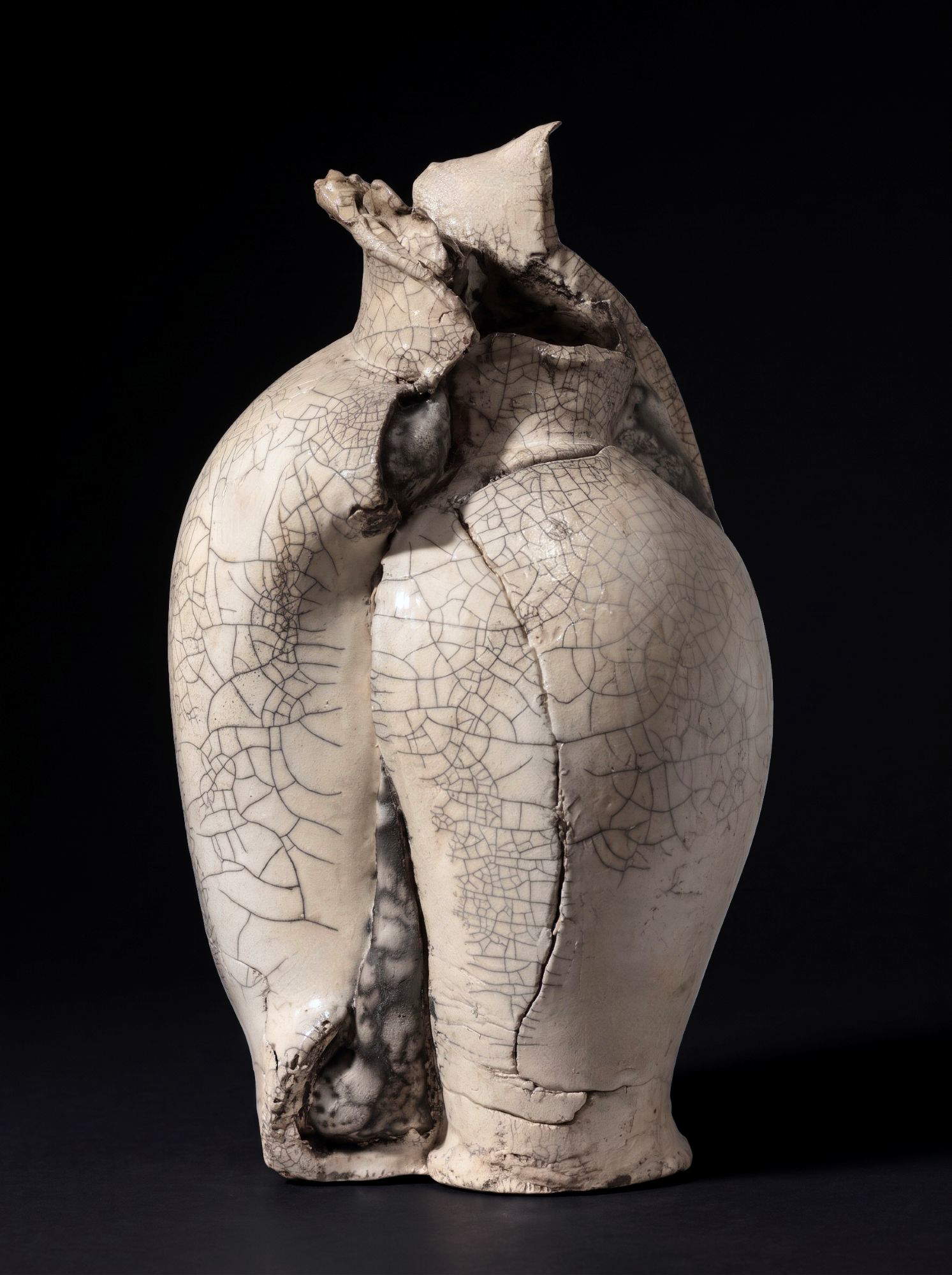
The title DAIMON refers to the Socratic philosophical tradition and the Aristotelian concept of eudaimonia. The reference is to an inner guide, a voice of conscience that accompanies the individual on the path to self-knowledge. In Russo’s interpretation, the Daimon represents the possibility of gradually freeing oneself from external conditioning, shedding superstructures, and rediscovering a direct relationship with one’s own nature. Even the numbers appearing on the sculptures contribute to this reflection: they symbolically evoke the language of algorithms, from which the forms seem to seek their own autonomy.
The project is part of the research path that Russo has developed over the years through international experiences and collaborations, constructing a language in which sculpture, design, imagination, and experimentation converge toward a unified vision of art and existence. In DAIMON, a fundamental role is played by Raku ceramics, an ancient Japanese technique whose name translates as “living in harmony.” The artist deepened his understanding of this technique during a trip to Japan, where he encountered a practice rooted in Zen philosophy, in which fire directly intervenes in the creative process and becomes an active part of the work’s creation.
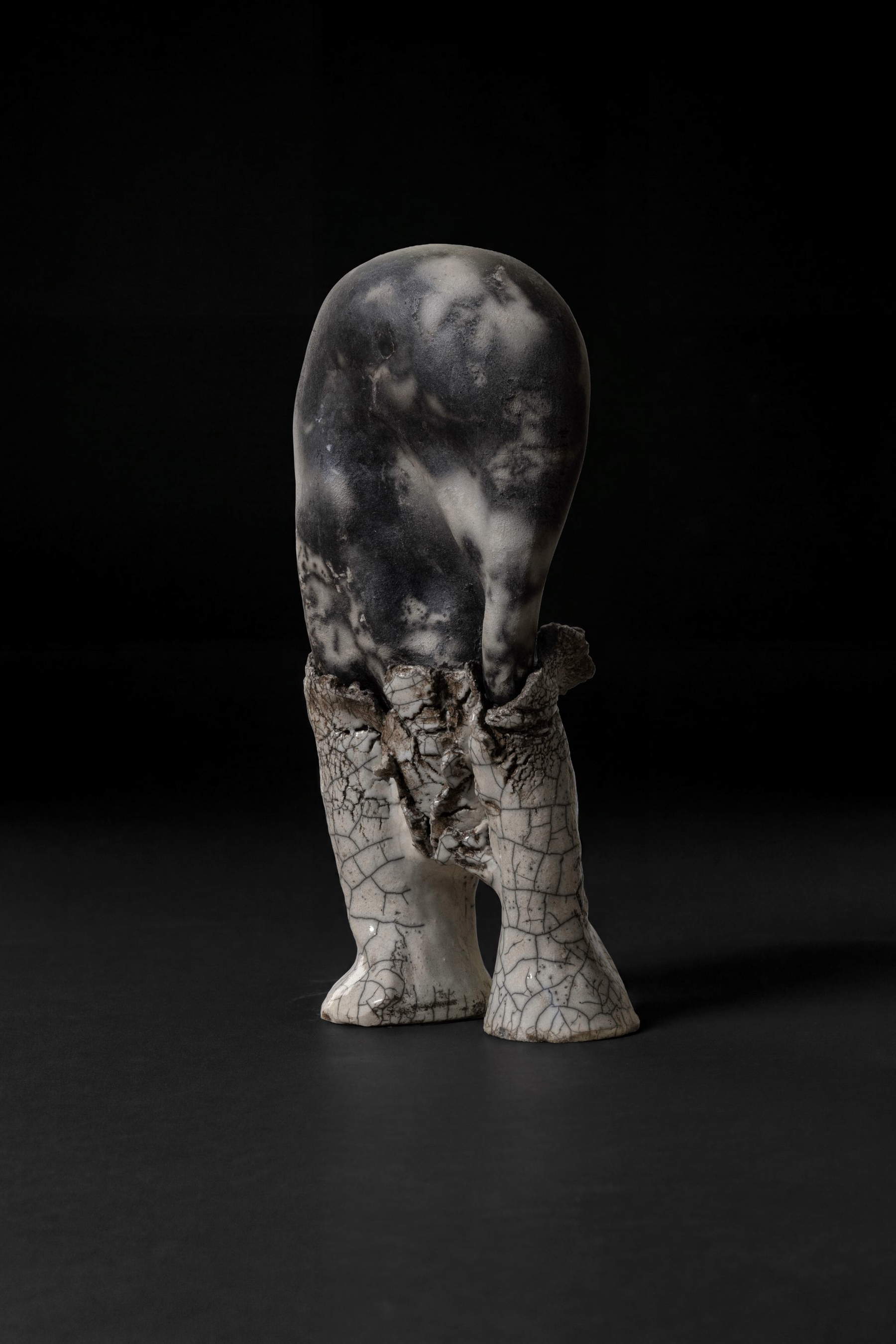
The transformation of matter, with its not always predictable outcomes, is in fact one of the central elements of his artistic exploration. Russo embraces the unpredictability of the process, recognizing even in error an opportunity for discovery and understanding. The sculptures feature smooth, glossy outer surfaces, contrasted by rough, corrugated inner cores. This contrast unfolds through the interplay of solids and voids, light and darkness, visually conveying the tension between what appears and what remains hidden.
The sculptural dimension is complemented by a sensory one. DAIMON is conceived as an immersive, multisensory experience in which the sculptures interact with an original soundscape—designed as an integral part of the installation—and with an olfactory dimension created using natural wood-based essences. Sounds, scents, and forms thus combine to define an environment that invites the public to move beyond mere visual observation and engage with the works through a broader perception. The exhibition is accompanied by a critical essay by Alessandro Romanini.
“Imagination is understood as a repertoire of potential, of the hypothetical—of what has not been and perhaps never will be, but could have been,” emphasizes Alessandro Romanini. “Stefano Russo’s work revives the value of making and of direct engagement with the material, restoring a cognitive and ritual dimension to the artistic experience. A creative process that, through the unpredictability of natural elements and the freedom of the imagination, helps to ‘re-enchant the world’ and rediscover the capacity for wonder.”
 |
| Stefano Russo brings Raku ceramics to Pietrasanta to explore the human conscience in the age of algorithms |
Warning: the translation into English of the original Italian article was created using automatic tools. We undertake to review all articles, but we do not guarantee the total absence of inaccuracies in the translation due to the program. You can find the original by clicking on the ITA button. If you find any mistake,please contact us.