





In 1668, Louis XIV commissioned the Parisian Savonnerie workshop to undertake a project that would go down in art history: to create the largest carpet ever woven up to that point. The project called for the production of no fewer than 92 separate pieces, intended to form a single monumental carpet to cover the entire Grand Gallery of the Louvre. The planned dimensions were impressive: overall, the carpet was to reach 440 meters in length—a length roughly six times that of the Hall of Mirrors at Versailles. A work of exceptional proportions, conceived to celebrate the prestige of the French monarchy while also showcasing the extraordinary technical and artistic skills achieved by the workshop.
“A Carpet fit for a King: Louis XIV and the Savonnerie” is the first exhibition in the United States entirely dedicated to this ambitious project. The exhibition, on view in the Wrightsman Galleries at the Metropolitan Museum of Art, focuses on the museum’s three carpets connected to the undertaking commissioned by the French monarch and traces their complex historical story.
The exhibition narrative tells the story of a project born of unprecedented ambition, yet marked from the outset by production difficulties and an equally turbulent subsequent history. From the conception of the designs to the creation of the individual elements, right up to the dispersal of the works after the French Revolution, the exhibition reconstructs the various phases in the life of these extraordinary textile artifacts.
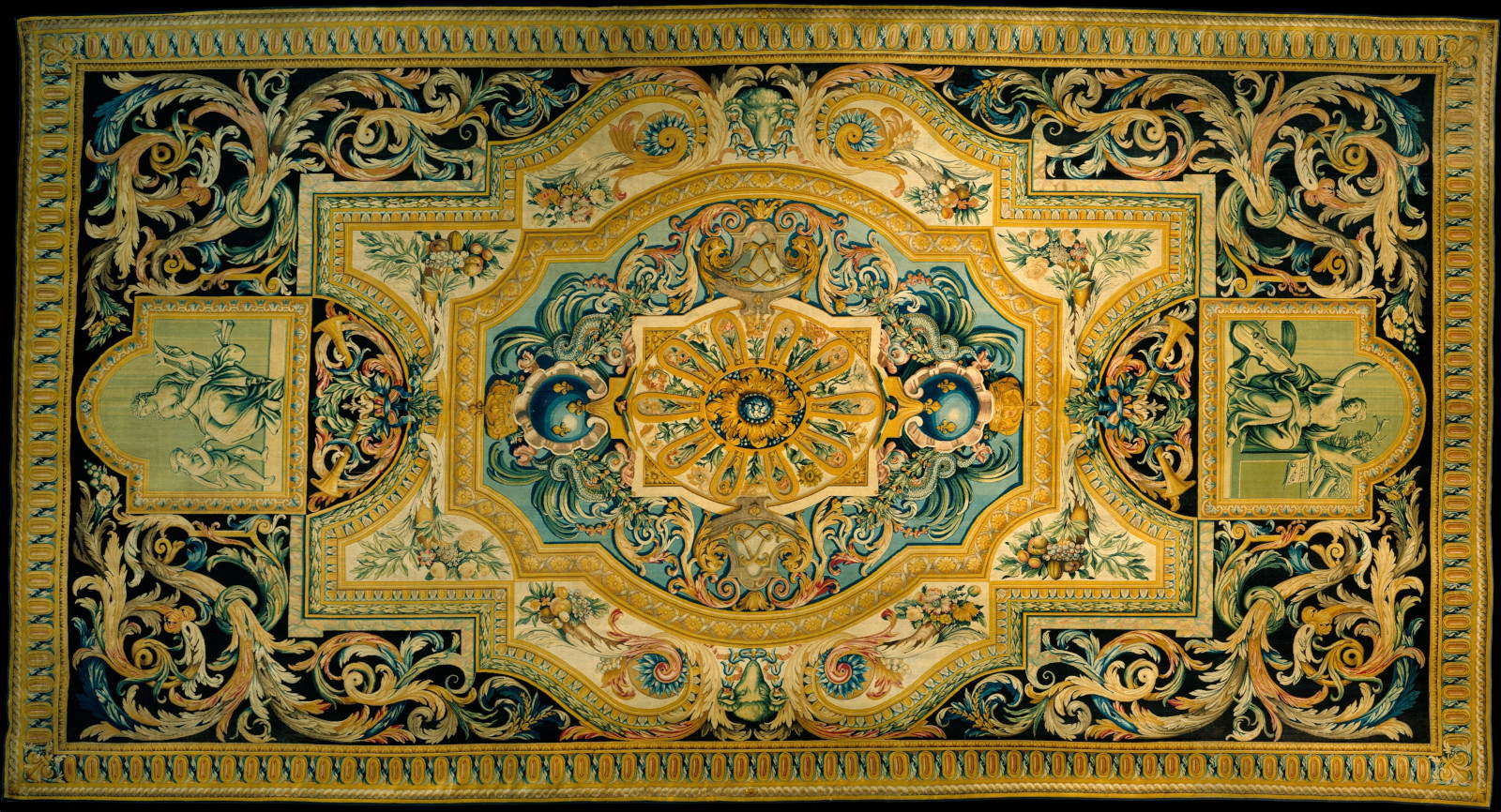
The creation of the 92 panels required more than twenty years of work and necessitated the organization of production facilities of exceptional scale. To carry out this enormous commission, vast workshops were set up and a workforce was assembled that included orphans and adolescents, chosen for their ability to perform extremely precise work thanks to their keen eyesight and dexterous fingers. Despite the enormous investment of time and resources, the carpets were never unrolled in the space for which they had been intended. Over the years, in fact, Louis XIV’s attention gradually shifted from the Louvre to the Palace of Versailles, which became the primary venue for the display of monarchical power.
The Savonnerie tapestries were therefore never assembled and unfurled in the Grand Gallery of the Louvre as originally planned. Their history continued in a fragmented manner until the events of the French Revolution, when many of them were stripped of their monarchical emblems or sold off. This dispersion contributed to some of these artifacts leaving France. Over time, various carpets and fragments found their way into important private collections, including in the United States, where they were acquired by prominent figures in American high society and the collecting world, such as J. P. Morgan and Alva Vanderbilt.
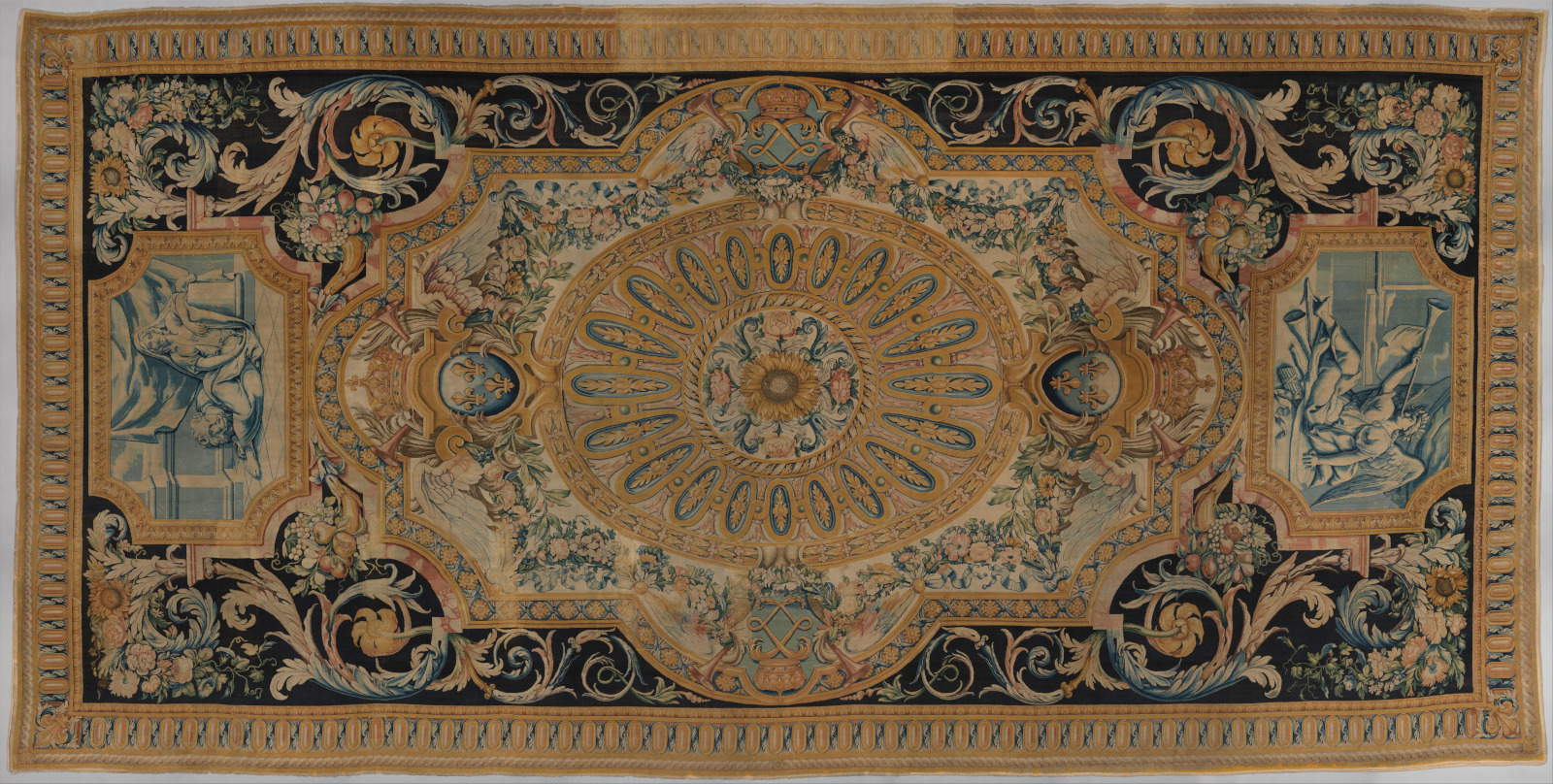
The Met’s exhibition now offers the opportunity to ideologically reconstruct the history of this project through the display of four complete carpets, accompanied by a selection of fragments ( click this link to view the installation of the Grande Galerie No. 11 carpet (Music, reweaving)). The decision to juxtapose intact pieces with fragments is particularly significant: the surviving elements reveal not only the artistic quality of the works but also the complex system through which they were conceived and produced. The fragments thus serve as concrete evidence of the segmentation of the original project and the subsequent dispersal of the tapestries. The exhibition also offers the public the opportunity to directly observe textile conservators at work in a temporary conservation workshop set up inside the gallery.
“A King’s Carpet: Louis XIV and the Savonnerie” is on view at the Metropolitan Museum of Art in New York from September 8, 2026, through March 5, 2028. The exhibition is made possible thanks to the support of John C. and Catherine Armitage and Hubert and Mireille Goldschmidt. Additional support is provided by Adrian Sassoon and Edmund Burke, Beatrice Stern, Marilyn and Lawrence Friedland, and the Vanguard Council.
|
| The Largest Carpet Ever Woven: An Exhibition at the Metropolitan Museum of Art in New York on the Project Commissioned by Louis XIV |

Warning: the translation into English of the original Italian article was created using automatic tools. We undertake to review all articles, but we do not guarantee the total absence of inaccuracies in the translation due to the program. You can find the original by clicking on the ITA button. If you find any mistake,please contact us.

























 IT
IT FR
FR DE
DE ES
ES CN
CN


