



by Redazione 27/11/2026



Categories: Market / Disclaimer
On December 1, 2026, Villa Carrega Cataldi in Genoa will host a Wannenes auction featuring furniture, sculptures, and works of art: from a table by Federico Zeri to a plate from Napoleon’s “Service particulier,” and from chests of drawers by Criaerd and Maggiolini to certified Roman marbles.


On December 1, 2026, the halls of Villa Carrega Cataldi—the Genoa headquarters of the Wannenes auction house—will host an auction dedicated to furnishings, sculptures, and works of art. The event, titled “Forms of Time,” presents a curated collection featuring Napoleonic imperial porcelain and historic furnishings of exceptional provenance. The auction is based on the work of specialists from the auction house’s departments and was coordinated and supervised by Giuseppe Beretti. The catalog brings together objects that vary widely in terms of period, materials, and geographic regions—from 17th-century Trapani to Lombard Neoclassicism, from Parisian cabinetmaking to Roman Imperial-era sculpture—and presents them as testaments to a history of taste and patronage spanning nearly two thousand years.


“This first issue, published in conjunction with the auctions at the end of 2026,” explains Guido Wannenes, CEO of the auction house, “brings together the first part of a refined collection of European dynastic mementos, including biscuit porcelain, French miniatures and gold and silver works, works of art, and furniture spanning the long period from the Renaissance to the late 19th century, as well as two fragments of Roman statuary restored and reinterpreted during the Renaissance. A collection in which the variety of the works offers an opportunity to recognize the continuity of artistic exploration and the infinite richness of Europe’s artistic heritage.”


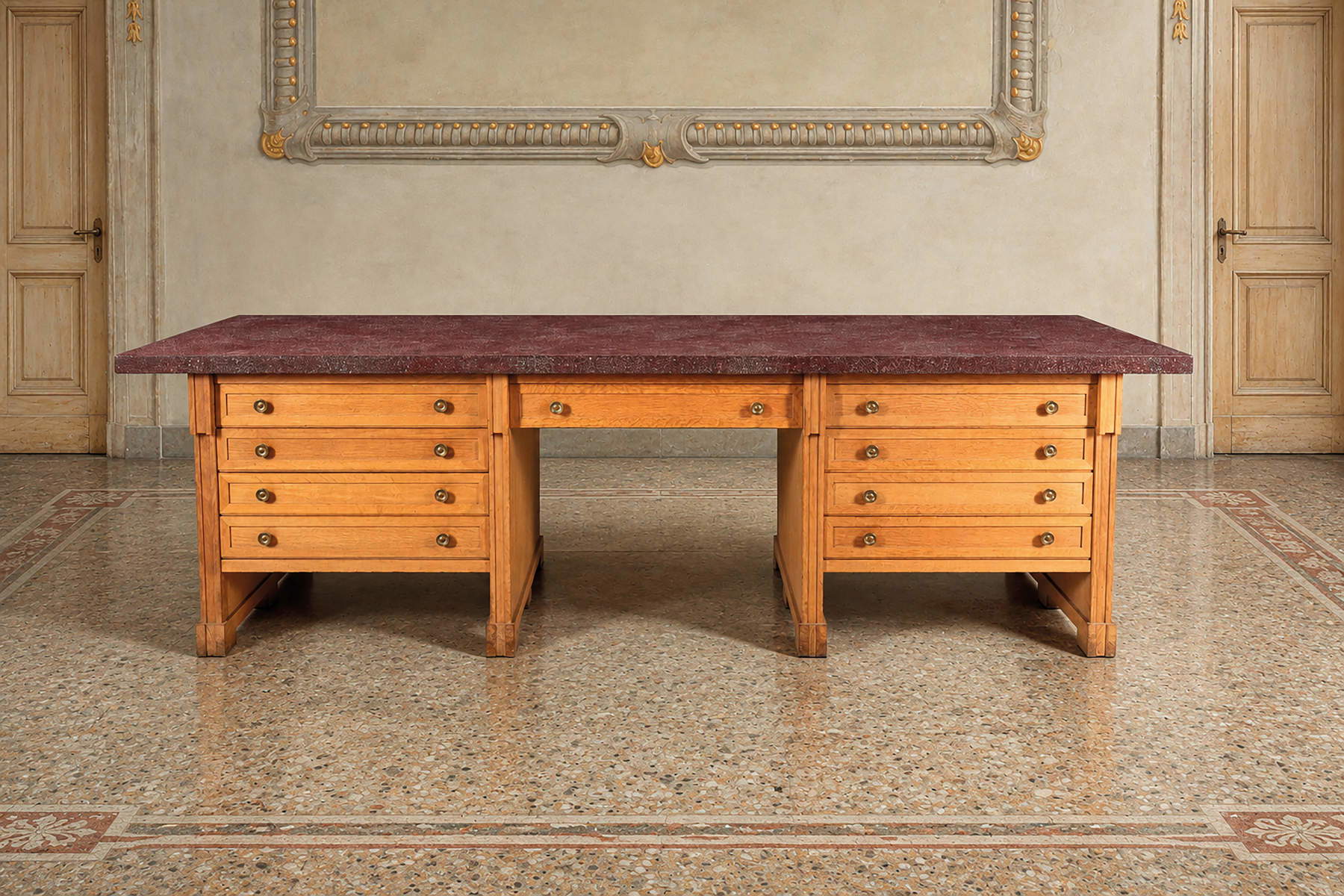
The catalog opens, as it were, with the monumental oak work table featuring a porphyry-veneered top, created around 1960 by Andrea Busiri Vici for the study-library of Federico Zeri’s villa in Mentana. Lot 1 is estimated at 25,000 to 30,000 euros. The piece was custom-designed by the architect and art historian as the centerpiece of a veritable visual laboratory. The proportions were designed to allow the scholar to lay out and compare dozens of photographs, catalogs, and research notes. The table is thus a working tool linked to the methodology of one of the leading art historians of the 20th century, who based his research on the direct comparison of images.


Busiri Vici’s table opens the catalog with a choice that speaks volumes about the auction’s approach: Lot 1 is not a work of art in the traditional sense, but an object linked to the daily practice of research. The piece was designed around 1960 for the study-library of the villa in Mentana, which is thus the context for which it was created. The combination of oak and a porphyry top reflects the concept of a large work surface, suitable for holding photographs, catalogs, and index cards all at once, in a space dedicated to study and visual comparison.
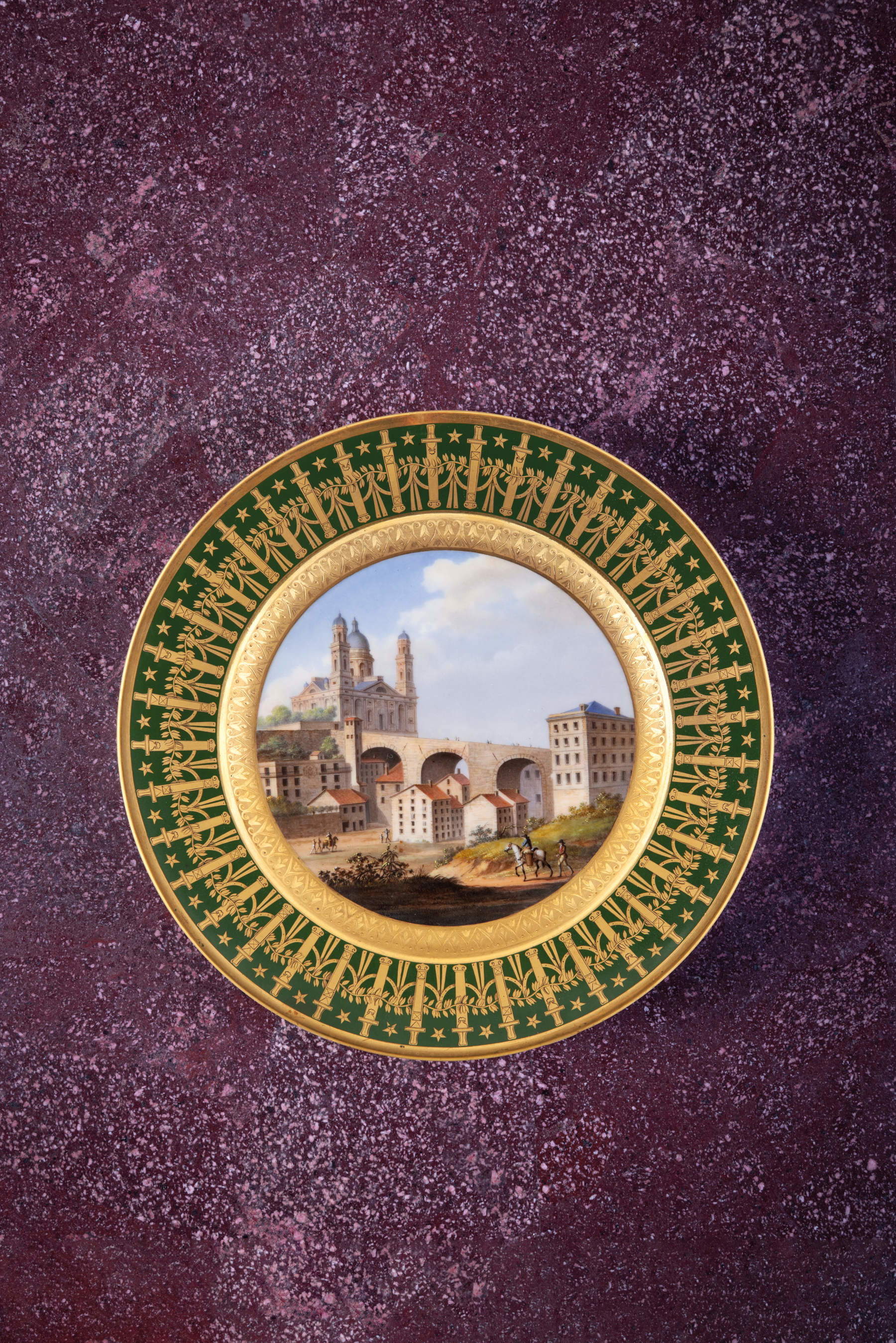
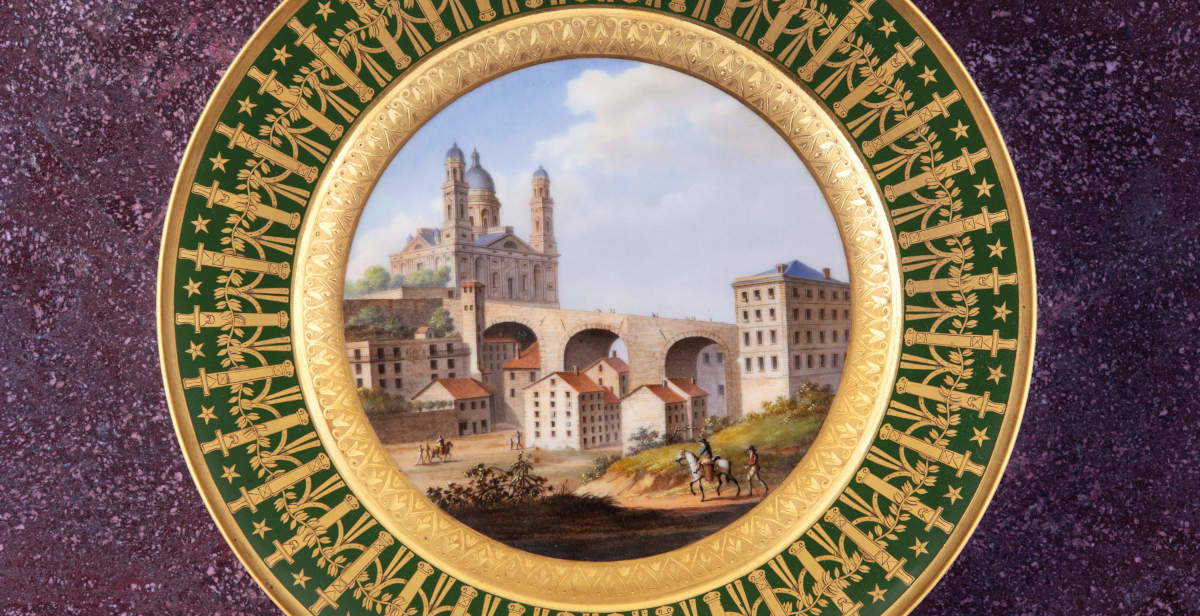
Next, of historical interest, is the polychrome porcelain plate from the Imperial Porcelain Manufactory of Sèvres, dated 1808 and offered as Lot 4 with an estimate of 30,000 to 40,000 euros. The plate was part of the *Service particulier de l’Empereur*, the table service commissioned by Napoleon Bonaparte in 1807 and delivered to the Tuileries in 1810, on the occasion of his marriage to Marie Louise of Austria. This piece is distinguished by its green rim, developed by the chemist Vauquelin and decorated with military trophies, and it retains the original marks of the imperial manufactory. In the center is a topographical view of the Carignano Bridge in Genoa, which, according to the catalog entry, likely refers to the Genoa Armistice of June 1800. The subject, linked to the city hosting the sale, adds a specific historical reference to the piece, set during the years of Napoleon’s campaign in Italy.
The dates indicated in the catalog entry allow us to trace the service’s history: the commission by Napoleon in 1807, the plate’s creation in 1808, and its delivery to the Tuileries in 1810, the year of his marriage to Marie Louise of Austria. The reference to the Genoa Armistice of June 1800, however, places the view of the Carignano Bridge in an earlier chronological context—that of the years when Genoa was involved in Napoleonic military events. The plate thus links an imperial ceremonial service to an episode that directly concerned the city where it is now on display.
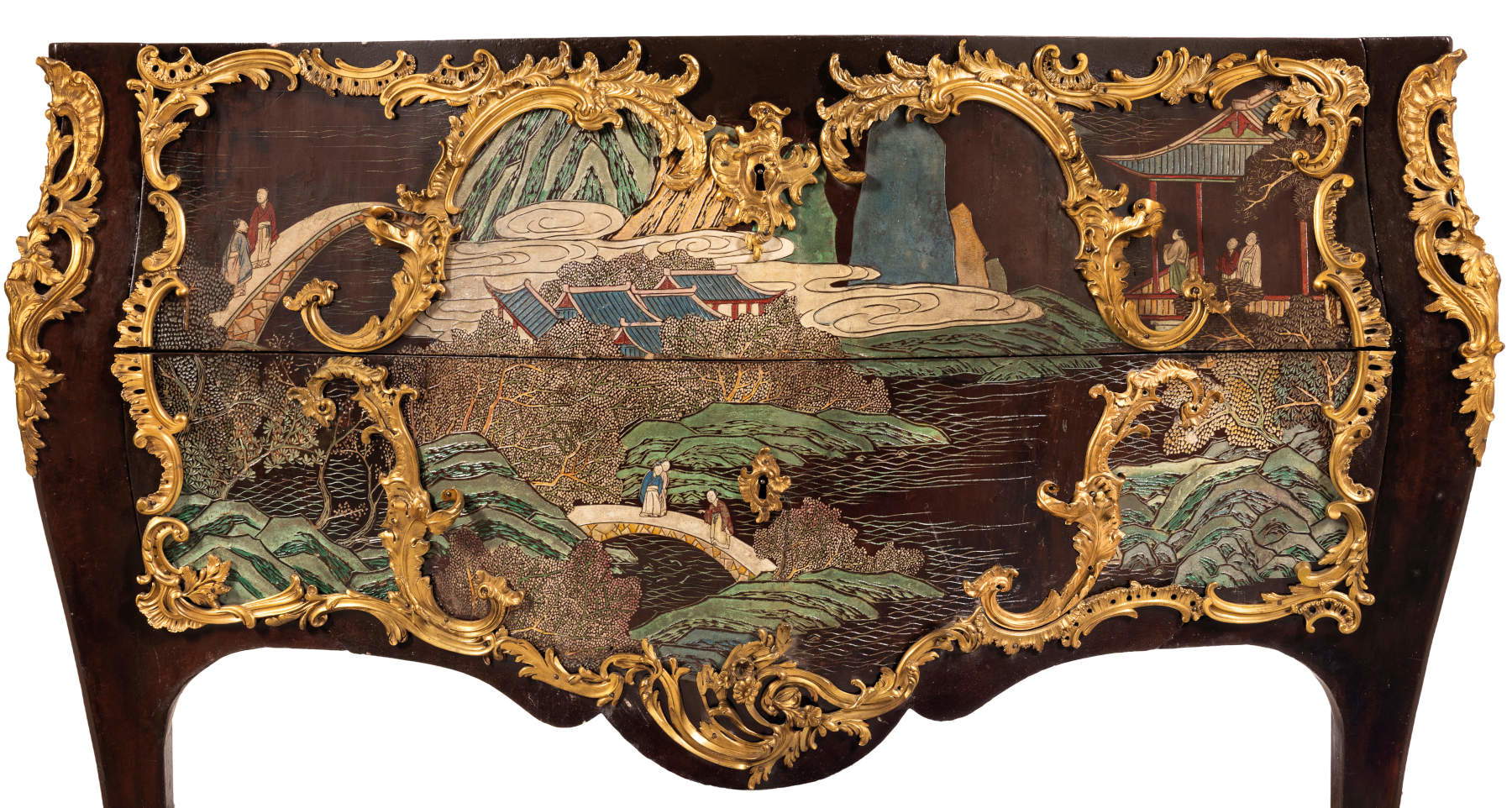
The section dedicated to18th-century fine cabinetmaking, on the other hand, features two works that the auction house describes as masterpieces of European taste. The first comes from France: it is a Louis XV commode (chest of drawers) signed by Mathieu Criaerd, made in Paris between 1745 and 1749 and offered as lot 40 with an estimate of 80,000 to 120,000 euros. The piece is finished in Coromandel lacquer featuring dramatic landscapes in the Chinese style, has a top in Brèche d’Alep marble, and is adorned with gilded and chiseled bronze fittings. It also retains its original interior lining of silk brocade. According to Wannenes, the piece attests to the virtuosity of one of the greatest masters of the French court, in a period when Parisian cabinetmaking engaged with materials and iconography of Eastern inspiration.
Italian excellence, on the other hand, is represented by a previously unseen neoclassical commode crafted by Giuseppe Maggiolini in Parabiago (Milan) around 1775, based on Agostino Gerli’s designs for musical trophies. Lot 39 is estimated at 30,000 to 50,000 euros. The piece is characterized by straight lines inspired by the Parisian “goût grec” (an early expression of the Neoclassical style) and is veneered with fine woods and exotic woods from the Antilles. It features inlays of musical trophies and a top in antique green marble. The piece stands in direct dialogue with the designs preserved in the Workshop Drawings Collection and with the chest of drawers made for the Duke of Modena, a fact that allows us to place the piece within the documented output of the Lombard cabinetmaker and his workshop.
When compared, the two chests of drawers reveal different design approaches. Criaerd’s Parisian piece relies on Coromandel lacquer, gilded and chiseled bronze, and Brèche d’Alep marble; Maggiolini’s Lombard piece focuses on straight lines, inlays of musical trophies, and antique green marble. The estimates also reflect this difference: 80,000 to 120,000 euros for the French chest of drawers, and 30,000 to 50,000 euros for the Italian one.
Another section of the catalog is dedicated to miniature portraiture and objects related to European dynasties. Among these are two French snuffboxes featuring portraits of members of the Bourbon family: the first, made of tortoiseshell, depicts Louis Antoine de Bourbon-France, Duke of Angoulême, based on a 1796 painting by Henry-Pierre Danloux, with a miniature traditionally attributed to Louis Ami Arlaud-June; the second, made of thuja wood and tortoiseshell, depicts Charles Philip of Bourbon, Count of Artois and the future Charles X, based on a model by François-Louis Gounod, with a miniature attributed to Daniel Saint. The dynastic portraiture continues with a porcelain plaque signed by Louise Girard and dated 1820, depicting Louis Philippe d’Orléans, and a miniature of Maria Carolina of Bourbon-Two Sicilies created by Auguste Garneray in 1823.
Two paperweights (desk accessories) associated with the French court round out this collection. The first, produced by the Fossin workshop in 1844, bears a portrait of the young Louis Philippe Albert d’Orléans, Count of Paris, based on a painting by Franz Xaver Winterhalter and commissioned by Helena of Mecklenburg-Schwerin. The second, attributed to Jules Wièse and dating from around 1865, depicts a cherub on a lapis lazuli base, set with rubies, diamonds, and enamel. The catalog also includes portraits of Ferdinand I, Francis I, and Joseph II, comprising paintings, watercolors, and miniatures. Taken together, these works document the circulation of portraiture styles and the role of imagery in the representation of European dynasties.
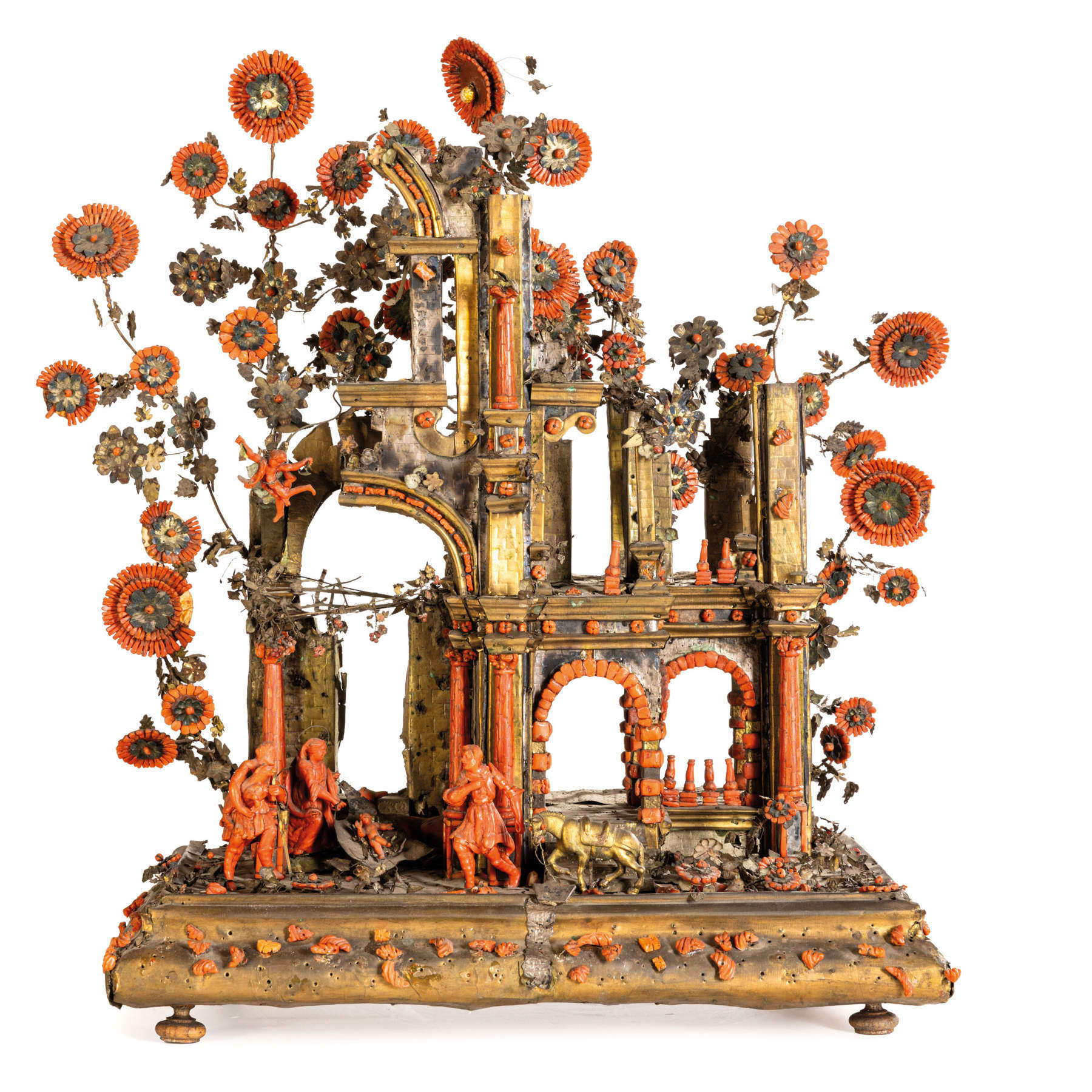
Among the objects of greatest historical interest is a pastiglia box made in Padua in the first half of the 16th century, decorated with scenes inspired by the Punic Wars and attributed to the workshop known as the “Moral and Amorous Themes.” A chapter of the catalog is also devoted to 17th-century Trapani craftsmanship and coral work, represented at auction by two pieces: the first is a Baroque nativity scene made of wood, copper, coral, and filigree, offered as Lot 30. The composition depicts the Nativity amidst classical ruins, enveloped by a profusion of radiant red coral blossoms. According to the description, the work follows models common among Sicilian artisans of the late 17th century. The ruined architecture, evoking antiquity, combines with the richness of the materials—coral, copper, and filigree—in a creation that brought together diverse artisanal skills in objects intended for devotional use and collecting.
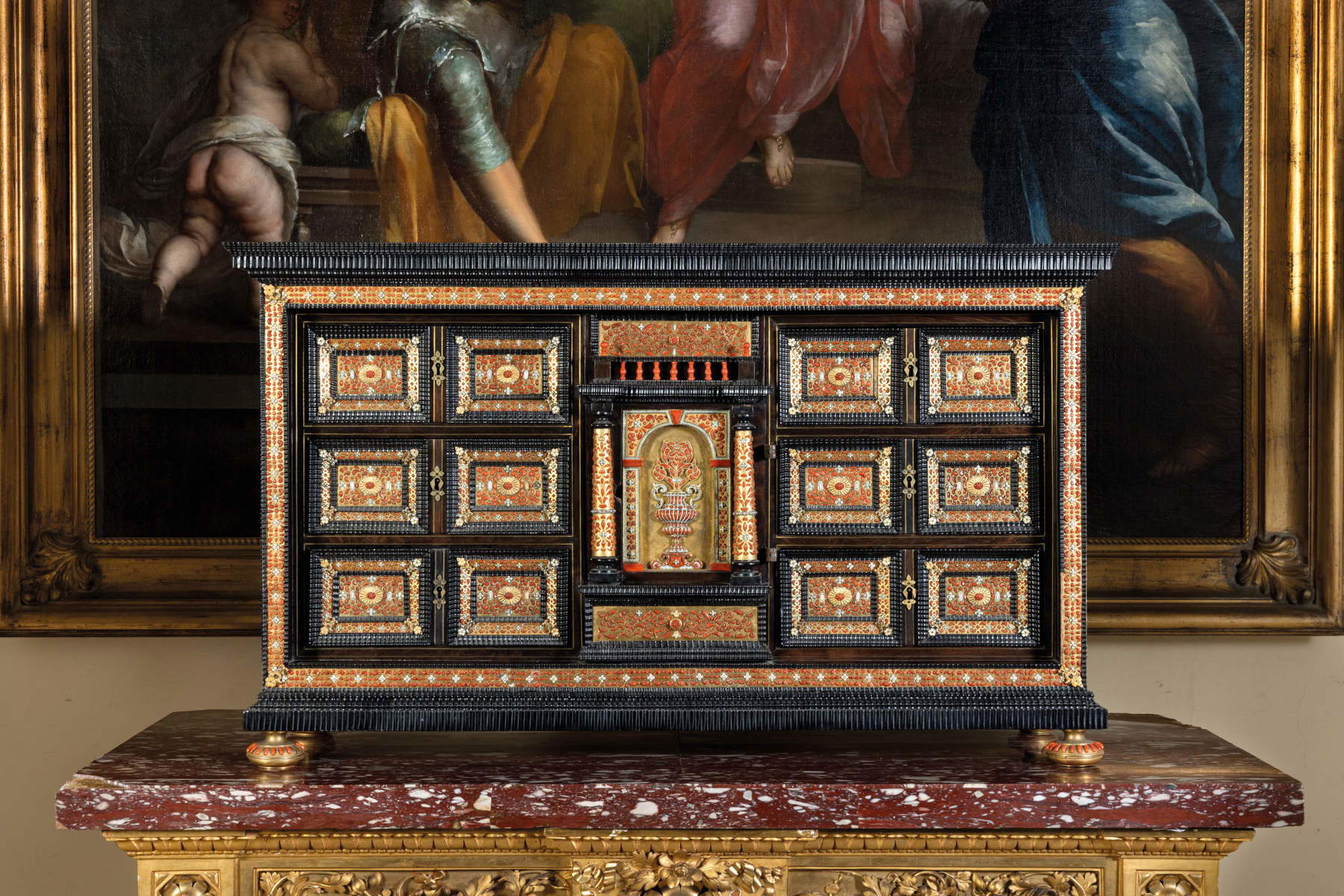
Next to the nativity scene is the rare coin cabinet from lot 31, dating to the first half of the 17th century and crafted from black and red ebony with guilloché engraving (an ornamental technique typically applied to metal surfaces), gilded copper, enamel, and coral. The object is conceived as a monumental miniature architecture, featuring six drawers and a central portal-style door. Due to its characteristics, it has been subject to a notification regime—a measure by which the State recognizes an object as having particularly significant cultural value and mandates its protection. In this coin box, the function of a container—intended for storing coins and small precious objects—is combined with an architectural design that makes it a ceremonial piece, in which the variety of materials is an integral part of the design.
Among the objects linked to the history of collecting in southern Italy is also a Neapolitan box made around 1830 of tortoiseshell with piqué decorations. Originating from a Bourbon collection, it preserves a handwritten note in German regarding its provenance and features views of Naples and its surroundings, including Capodimonte, Portici, and the Favorita in Palermo, along with a scene of a tarantella. The selection also includes a French ebony frame, dating from around 1840 and inspired by the designs of Andrea Brustolon, and a late 16th-century Roman walnut chest from the collection of Attilio Simonetti, characterized by a faux bronze patina decoration.
The furnishings also include a mid-18th-century Roman crucifix in gilded bronze on a rosewood and bois de violette base, associated with the coat of arms of Cardinal Andrea Negroni, and a Roman Baroque table from around 1670, featuring a phytomorphic mask and a top made of coral breccia and verde antico. Added to these is a bust of Antinous with Dionysian attributes, dating from between the 16th and 17th centuries and derived from the Grimani Antinous type.
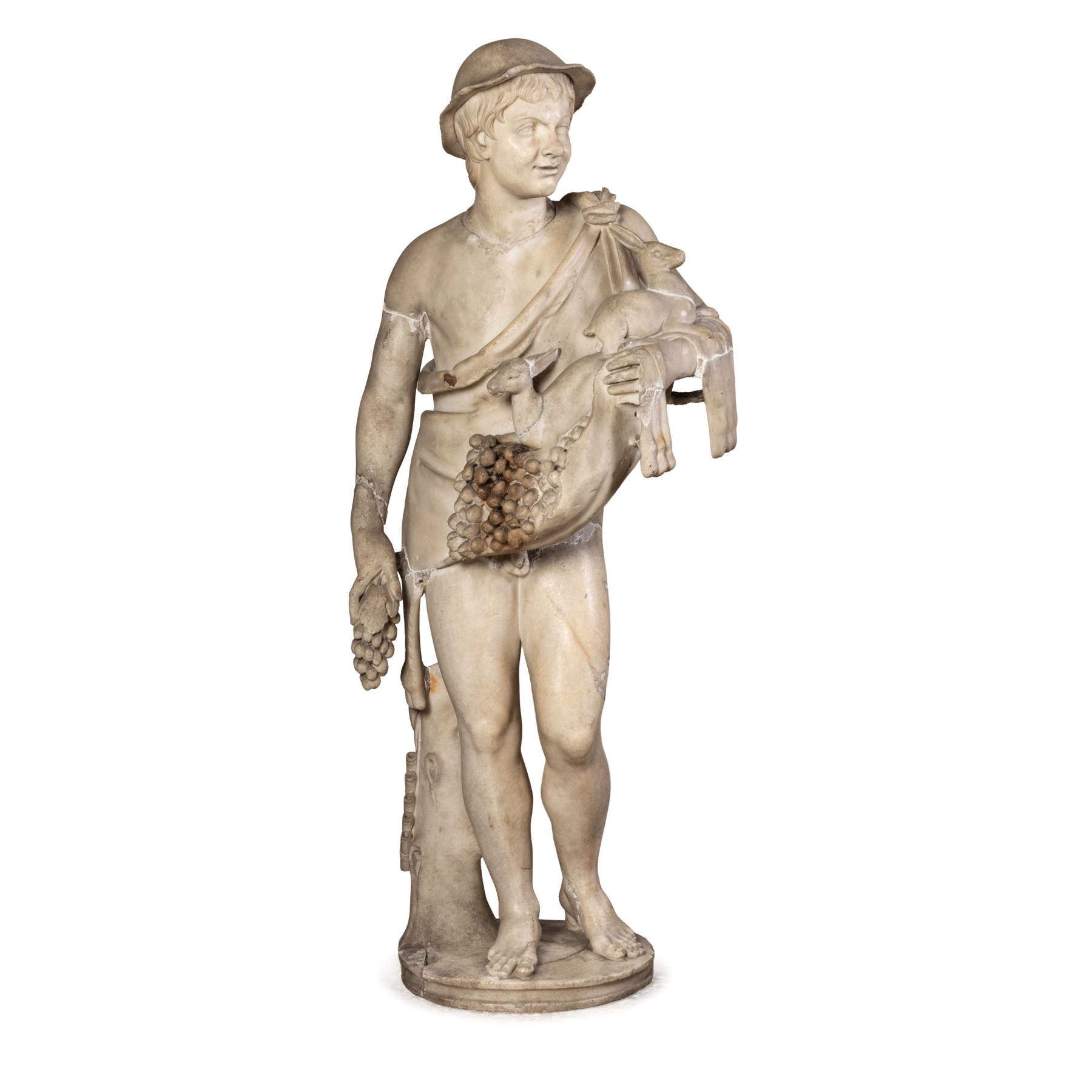
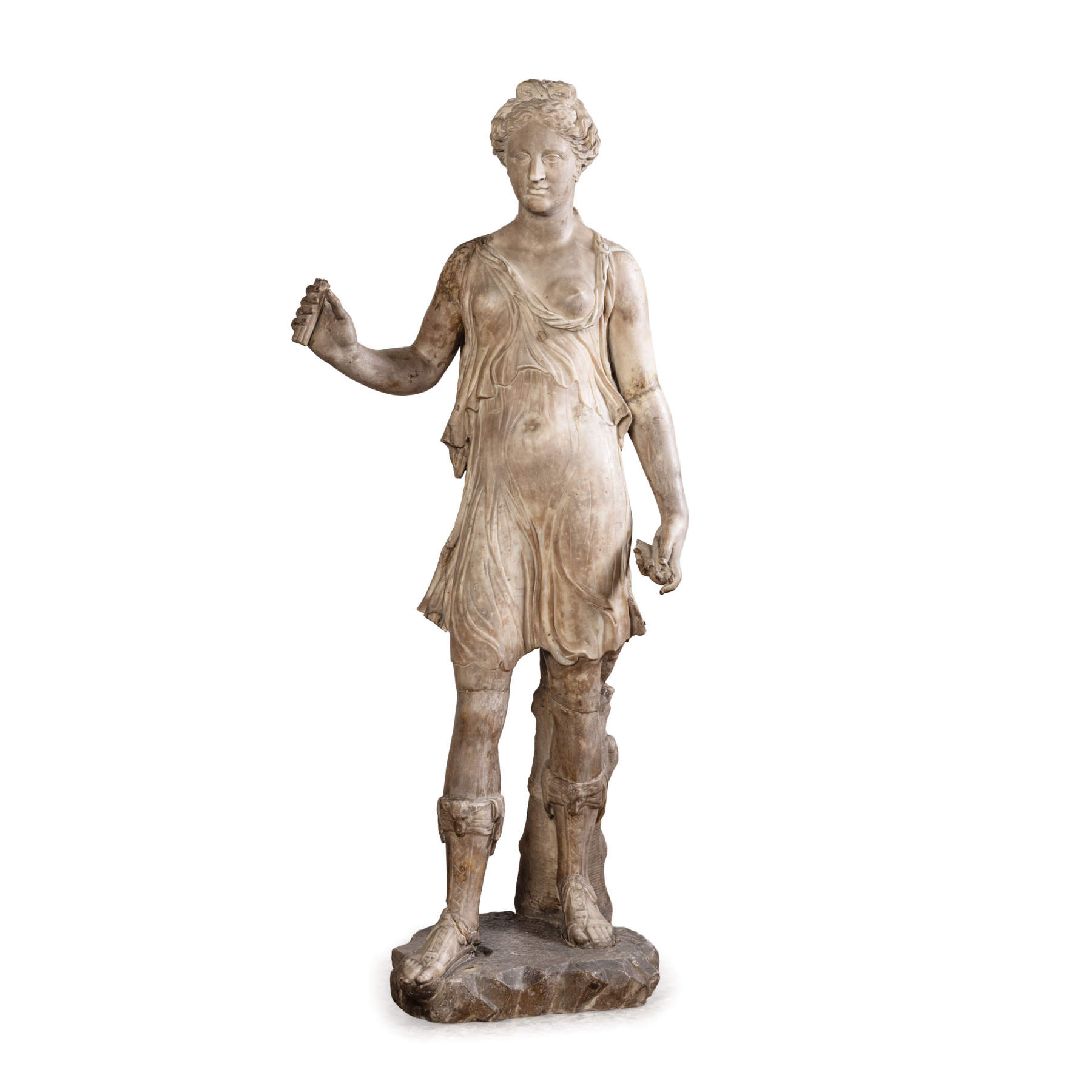
The selection concludes with two sculptures in white Italic marble from the Roman Imperial period. Both have been declared of historical and artistic interest and are therefore subject to notification. They come from historic Florentine collections and were exhibited at the 1963 International Antiques Fair in Florence. The first, Lot 27, is a statue depicting the young Bacchus standing with a petasos, a animal-skin cloak, bunches of grapes, and small hares. The ancient torso of the sculpture, dating to the 1st–2nd centuries A.D., has been preserved and is complemented by refined 19th-century restorations. The use of restorations made after the discovery is a common practice in the history of antiquities collecting, and the catalog notes this as part of the work’s history.
The second sculpture, lot 38, is a standing female figure in a short pleated tunic, identifiable as either a dancer or an Amazon. The work dates to the 2nd century A.D. and features fine Renaissance restorations, dating to the second half of the 16th century and attributed by scholars to Francesco Camilliani, a pupil of Baccio Bandinelli. In the case of this statue, therefore, the restoration work was carried out by a 16th-century sculptor whose name has been identified by critics, and the ancient marble bears traces of a later era of interest in antiquity. Given their provenance, exhibition history, and restoration history, the two sculptures offer a glimpse into Florentine antiquities collecting.
For collectors, scholars, and enthusiasts, the auction on December 1, 2026, represents—in the words of the auction house—a landmark event. The selection is presented as rigorous, and the works are united by their craftsmanship, rarity, and historical prestige. It will be up to the auction results to determine how well these attributions and estimates resonate with the public, while, from a documentary perspective, the catalog offers a series of objects—from Zeri’s table to the documented marbles—that allow one to trace the relationship between furniture, collecting, and art-historical research from the ancient world through the second half of the 20th century.
Notes on Wannenes
The auction takes place in Genoa, in one of the city’s historic palaces, which serves as Wannenes’s Genoese headquarters. Founded in 2001, the auction house combines tradition with an innovative vision to meet the needs of an increasingly international and sophisticated market. The company’s structure includes experts and departments specializing in various categories, with offices in Milan, Genoa, Rome, Turin, and Monte Carlo. Wannenes has attracted the interest of leading international collectors and curators and has helped redefine the concept of the art market, establishing itself as one of the sector’s leading players.
 |
| A coral nativity scene, a Napoleon plate, and Zeri’s table: the Wannenes auction in Genoa |
Warning: the translation into English of the original Italian article was created using automatic tools. We undertake to review all articles, but we do not guarantee the total absence of inaccuracies in the translation due to the program. You can find the original by clicking on the ITA button. If you find any mistake,please contact us.