



by Redazione 18/11/2026


Categories: Modern Art / Disclaimer
*Betonte Ecken*, painted by Wassily Kandinsky at the Bauhaus between 1922 and 1923 and the first oil painting by Kandinsky purchased by Hilla Rebay, set an all-time record for the abstract artist: it sold at Christie’s in New York for $85.8 million.


Auction record for a painting by Wassily Kandinsky: the record was set by a painting, *Betonte Ecken* ( “Accentuated Corners”), sold last night in New York at Christie’s for $85.8 million (78.25 million euros), nearly double the artist’s previous auction record of $44.8 million (the estimate had been $60–80 million, or 54.7–73 million euros). The work is one of fifty Kandinsky paintings that the Solomon R. Guggenheim Foundation put up for auction in 1964: it was a historic sale, one of the first auctions dedicated to a single artist and one of the first to be broadcast on television. Among those paintings was *Betonte Ecken*, a canvas painted in Weimar between 1922 and 1923, during Kandinsky’s early months at the Bauhaus. It was the first oil painting by the artist purchased by Hilla Rebay, Solomon R. Guggenheim’s advisor, who did more than anyone else to introduce abstract art to the United States.

*Betonte Ecken* was the highlight of the 20th Century Evening Sale, the auction dedicated to the 20th century with which Christie’s opened its fall auction week at Rockefeller Center. According to the auction house, the painting was the subject of a lengthy bidding war among multiple clients, both on the phone and in the auction room. In total, the auction—featuring over seventy lots spanning five hundred years of art history—generated $626,621,400, with 92% of the lots sold and 95% of the estimated value realized. Christie’s reports bids from around the world, many of them from Asia, and six auction records for individual artists: in addition to Kandinsky, records were set for Wifredo Lam, Cornelis Corneliszoon van Haarlem, Fernando Botero, Hans Bellmer, and a bronze by Joan Miró. With this single evening, the auction house explains, 2026 sales in the 20th- and 21st-century art sector in the Americas have already surpassed those of all of 2025.


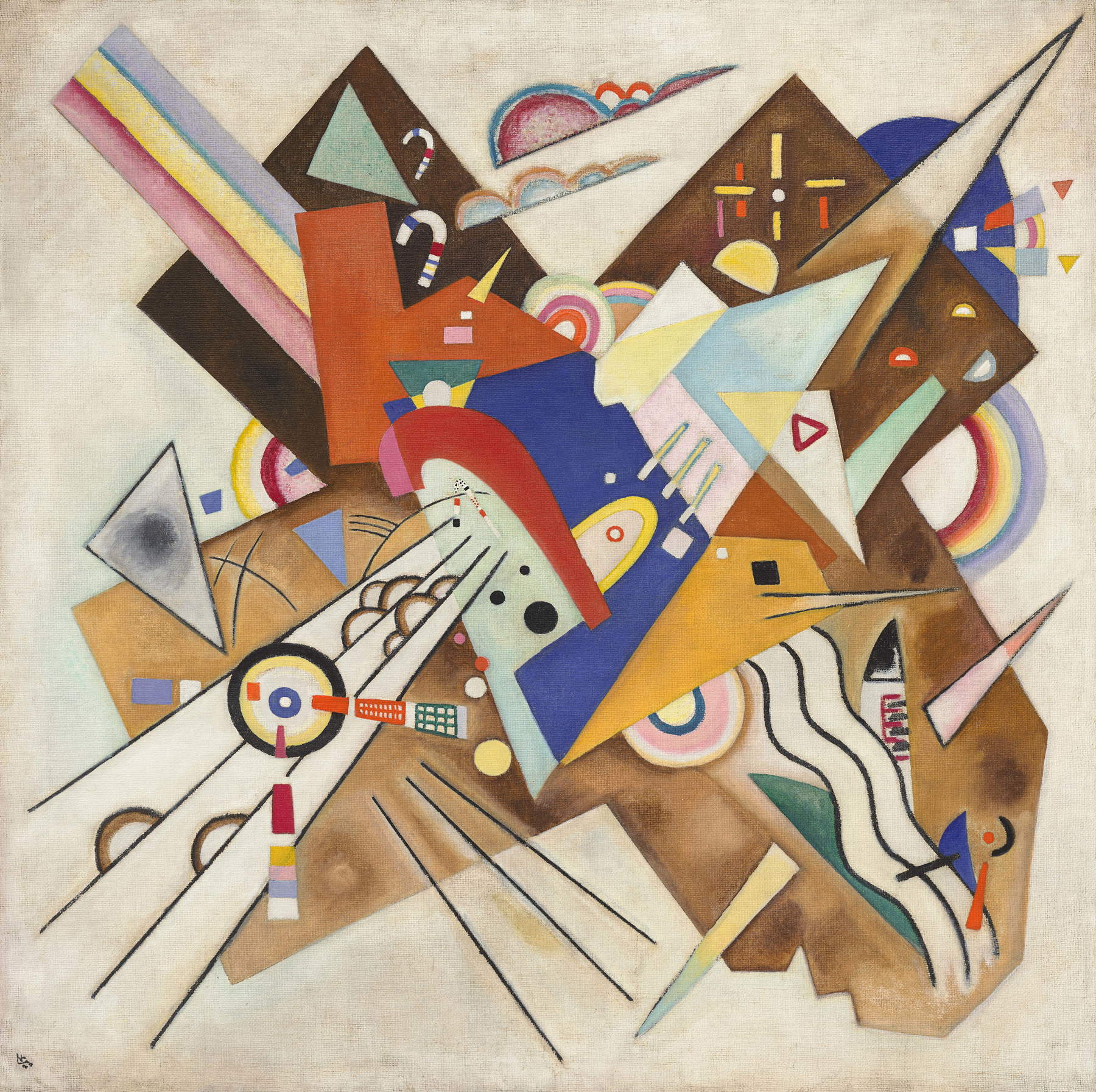
The painting is an example of the artistic shift Kandinsky underwent at the Bauhaus: brightly colored geometric shapes radiate from a large ultramarine blue polygon at the center of the canvas. Two diagonals extend from the corners and intersect precisely at that blue nucleus, from which black lines, circles, triangles, and colored rectangles branch out. These elements create distinct planes that suggest depth, yet at the same time appear flat. It is a contradictory effect—and a deliberate one. “Clashes of discord, loss of balance, overturned ‘principles’… opposites and contradictions: this is our harmony,” Kandinsky wrote in 1912 in *The Spiritual in Art*. The title draws attention to the artist’s focus on the edges of the painting: as early as works such as *Weißer Strich* (1920) and *Roter Fleck II* (1921), Kandinsky had used corners as a starting point for lines or areas of concentrated color. In his treatise *Point, Line, Plane*, published in 1926, he would explain that constructing a work on two diagonals creates additional tension, pushing the composition toward the corners.


To understand the painting, we must go back a few years. At the outbreak of World War I, Kandinsky, who was born in Russia, had to leave Munich in a hurry and returned to Moscow. Those were difficult years: in 1915 he did not paint a single picture, and the following year only a few. In early 1917, he married Nina Andreevskaya, but with the Bolshevik Revolution, the couple lost their possessions and lived for years amid cold, hunger, and deprivation. Kandinsky nevertheless remained in touch with developments in Russian art, particularly with Kazimir Malevich and Aleksandr Rodchenko, whose Constructivism had a strong influence on him. On Christmas Eve 1921, the Kandinskys arrived in Berlin and never returned to Russia.
In Germany, the artist found an environment brimming with utopian hopes and public investment in culture. In 1922, he exhibited in Berlin and Munich, and Walter Gropius invited him to teach at the Bauhaus. Kandinsky arrived in Weimar in June 1922, just as the school—where Johannes Itten, Lyonel Feininger, Paul Klee, and Oskar Schlemmer were already teaching—was shifting toward a more Constructivist and technological orientation, in line with his own artistic path. Gropius wanted the Bauhaus to unite all the arts into a single work—the Gesamtkunstwerk, the total work of art—which Kandinsky had been pursuing for years.
The first major opportunity came in 1922 with a series of four enormous murals for the lobby of the Juryfreie Kunstschau in Berlin, designed to surround and immerse the viewer. After that exhibition, in November, Kandinsky painted a preparatory watercolor for *Betonte Ecken*, now in the Montreal Museum of Fine Arts, and in December he began the canvas. Compared to the five paintings he had created earlier in 1922—which were still tied to the style of his Russian years—this painting already displays the linear precision and graphic clarity that would characterize his entire Bauhaus period. The ovals become perfect circles, the checkerboards transform into grids receding into the distance, and the irregular polygons become more rigid geometric shapes. Triangles take on greater importance, often juxtaposed with circles: for Kandinsky, this was the most visually powerful combination. Color, too, is used with greater precision, at a time when the artist was leading a seminar on color theory at the Bauhaus. Yellow and blue, at the center of the composition, are colors that, for him, advance and recede, charged with opposing tensions.
With this painting, Kandinsky also experimented with a new method of preparing the canvas: ever since his Expressionist years, he had preferred to paint on raw jute and prepare the ground himself, whereas for *Betonte Ecken* he used —perhaps for the first time—a lightly colored ground with minimal variations in tone, which conceals every trace of the artist’s hand on the surface. The same ground reappeared in July 1923 in Composition VIII, now at the Guggenheim in New York.
The painting’s American history begins with Hilla Rebay. Born into a German aristocratic family in Alsace—and a painter in her own right—she had discovered Kandinsky in 1912 at Otto Feldmann’s Rheinischer Kunstsalon and was so impressed that she moved to Paris to immerse herself in the avant-garde. In 1915, in Zurich, she was living with Hans Arp, who introduced her to the almanac *Der Blaue Reiter* and *The Spiritual in Art*. In 1927, she moved to New York, where she met Solomon R. Guggenheim while painting his portrait. She convinced him to collect what she called “non-objective art” and selected many of the works for his collection. On August 15, 1929, she wrote to the painter Rudolf Bauer that she had just sent *Betonte Ecken* to his home in New York: she liked it very much, she said, and it was beautiful in the light. The following year, she arranged for the Guggenheims to travel to Dessau, where the Bauhaus had relocated, to meet Kandinsky. In her first letter to the painter, she introduced herself precisely as the owner of the painting “Angoli accentuati.”
That meeting marked the beginning of a friendship that lasted for decades. Kandinsky began his letters with “My esteemed Baroness von Rebay.” She translated his writings into English and exhibited his works throughout the United States. *Betonte Ecken* then became part of the Guggenheim collection and entered the foundation in 1941, when Rebay was directing the Museum of Non-Objective Painting, the future Guggenheim Museum. It was one of the first Kandinsky paintings seen by a wide American audience. Rebay loaned it to exhibitions in Charleston and Philadelphia and included it in the 1939 “Art of Tomorrow” exhibition. In 1945, a few months after the painter’s death on December 13, 1944, she exhibited it in the Kandinsky Memorial Exhibition. According to art historian Brenda Richardson, as cited by Christie’s, that exhibition played an important role in the career of Barnett Newman, one of the early leading figures of Abstract Expressionism. The painting was subsequently exhibited in major international exhibitions, including in Toronto, Brussels, Paris, London, and the National Gallery of Modern Art in Rome.
After the 1964 auction, *Betonte Ecken* changed hands several times. The last owner purchased it in 1986 and kept it for forty years, often lending it to exhibitions. Last year, it was among the key works in an exhibition on 20th-century geometric abstraction at the Museum Barberini in Potsdam, and it was recently displayed in Paris as part of the exhibition *Calder. Rêver en équilibre*.
For Kandinsky, who had studied law, it all began with music. In 1896, at the Bolshoi in Moscow, he heard Wagner’s *Lohengrin* and said he “saw all the colors” before his eyes. That same year, he saw one of Monet’s *Haystacks* for the first time and did not recognize the subject until he read the catalog; it was then that he sensed the abstract possibilities of painting. Around 1911, Arnold Schönberg’s atonal music definitively paved the way for him toward abstraction. *Betonte Ecken*, painted ten years later, marks the point where those intuitions became a precise geometric language: for Christie’s, a model of total abstraction.
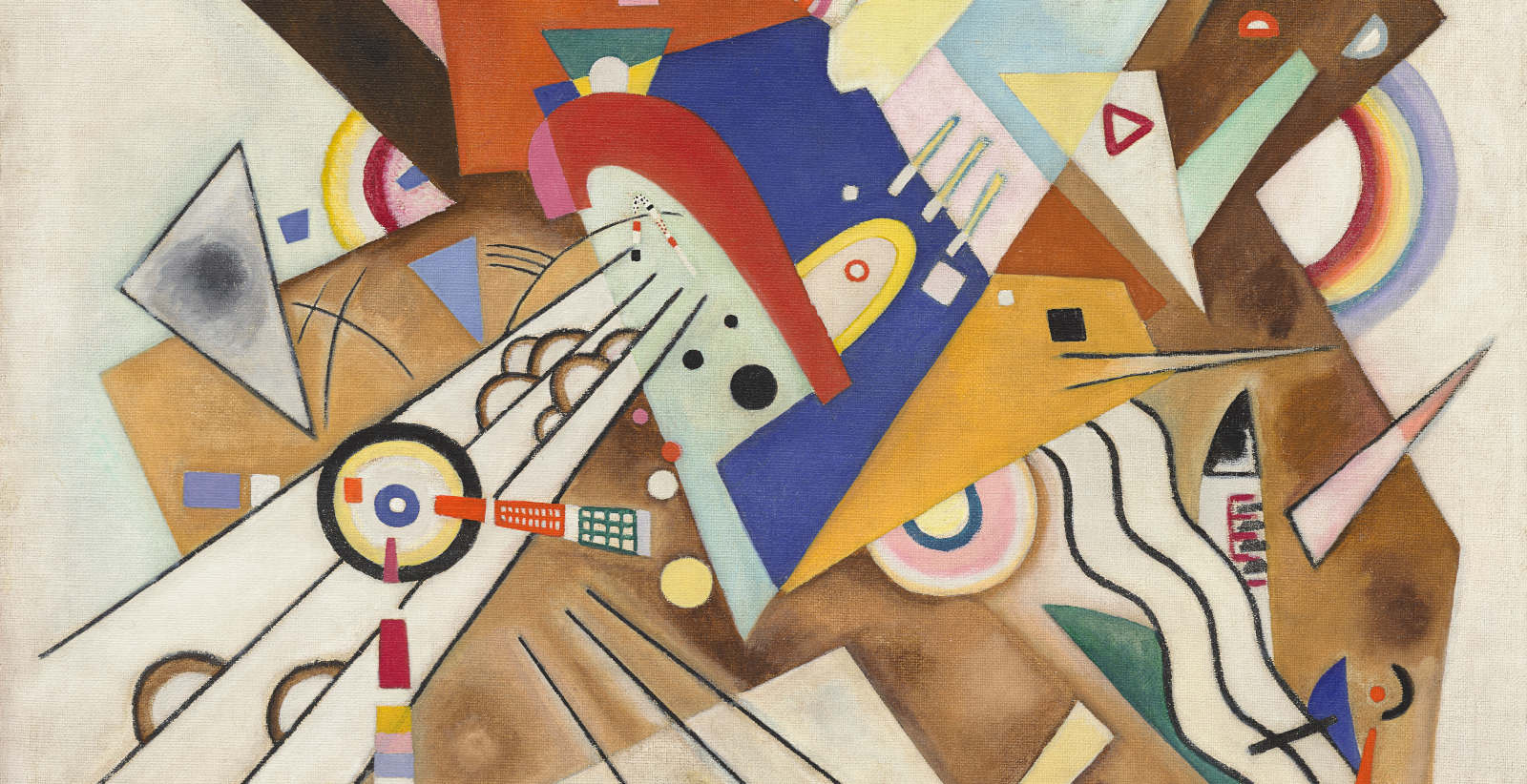 |
| The Kandinsky sold by the Guggenheim in 1964 is now worth 85.8 million: a record for the artist |
Warning: the translation into English of the original Italian article was created using automatic tools. We undertake to review all articles, but we do not guarantee the total absence of inaccuracies in the translation due to the program. You can find the original by clicking on the ITA button. If you find any mistake,please contact us.