





Turin’s OGR is preparing for a new transformation: its large courtyards, currently characterized by predominantly paved surfaces, will become an urban landscape where nature, architecture, and culture intertwine. The project, sponsored by the CRT Foundation and OGR Turin and designed by the Turin-based firm lamatilde, aims to transform the complex’s outdoor spaces into an urban biosphere, featuring new green spaces, bodies of water, gathering places, and art installations. Following the 2017 redevelopment, which returned 35,000 square meters of the former railway workshops to the city, a new project will focus on the East and West Courtyards. The goal is to enhance the OGR’s industrial heritage while simultaneously addressing the environmental and social needs of the contemporary city by counteracting the heat island effect, promoting biodiversity, and expanding the possibilities for using outdoor spaces.
Construction will begin in early November 2026 and is expected to be completed in the spring of 2027. The project engages with the history of the OGR— a monumental industrial complex dating back to 1895—by reinterpreting its original elements through a new architectural and environmental system. The geometry of the old railroad tracks at the railway workshops serves as the starting point for designing an artificial topography, composed of volumes of varying sizes and heights. The forms evoke the carts used to transport materials along the tracks, transforming an element of industrial heritage into a structure designed to accommodate vegetation, seating, water features, and spaces for social interaction.
The Corti will thus be organized into a succession of green spaces and rest areas, each with distinct yet interconnected functions. The architecture will not merely organize these spaces but will become an integral part of the environmental infrastructure, helping to improve the microclimate and make the OGR more accessible and livable. The transformation also aims to strengthen the complex’s relationship with the surrounding neighborhoods, creating urban continuity between Corso Castelfidardo and the Via Borsellino area. The Corti thus take shape as a new gateway to the OGR: a space to pass through, frequent daily, and rediscover even outside of cultural activities and events.
The regeneration of the Corti addresses climate challenges and the need to rethink urban public spaces, introducing solutions capable of reducing temperatures and fostering new environmental balances. The landscaping plan calls for a complex system of perennial herbaceous plants, shrubs, and trees, distributed across new planters and integrated with areas for rest and socializing. The combination of vegetation, shade, and water will help mitigate heat and create more comfortable conditions during the summer months.
Particular attention will be given to water management. The new soil layers are designed to retain moisture and reduce the need for irrigation, while the various plant species will help create habitats conducive to micro-biodiversity, providing shelter, food, and resources for pollinating insects and small birds. Greenery thus becomes a structural component of the project—not merely a decorative element—capable of improving environmental conditions and expanding the ways in which the spaces can be enjoyed.
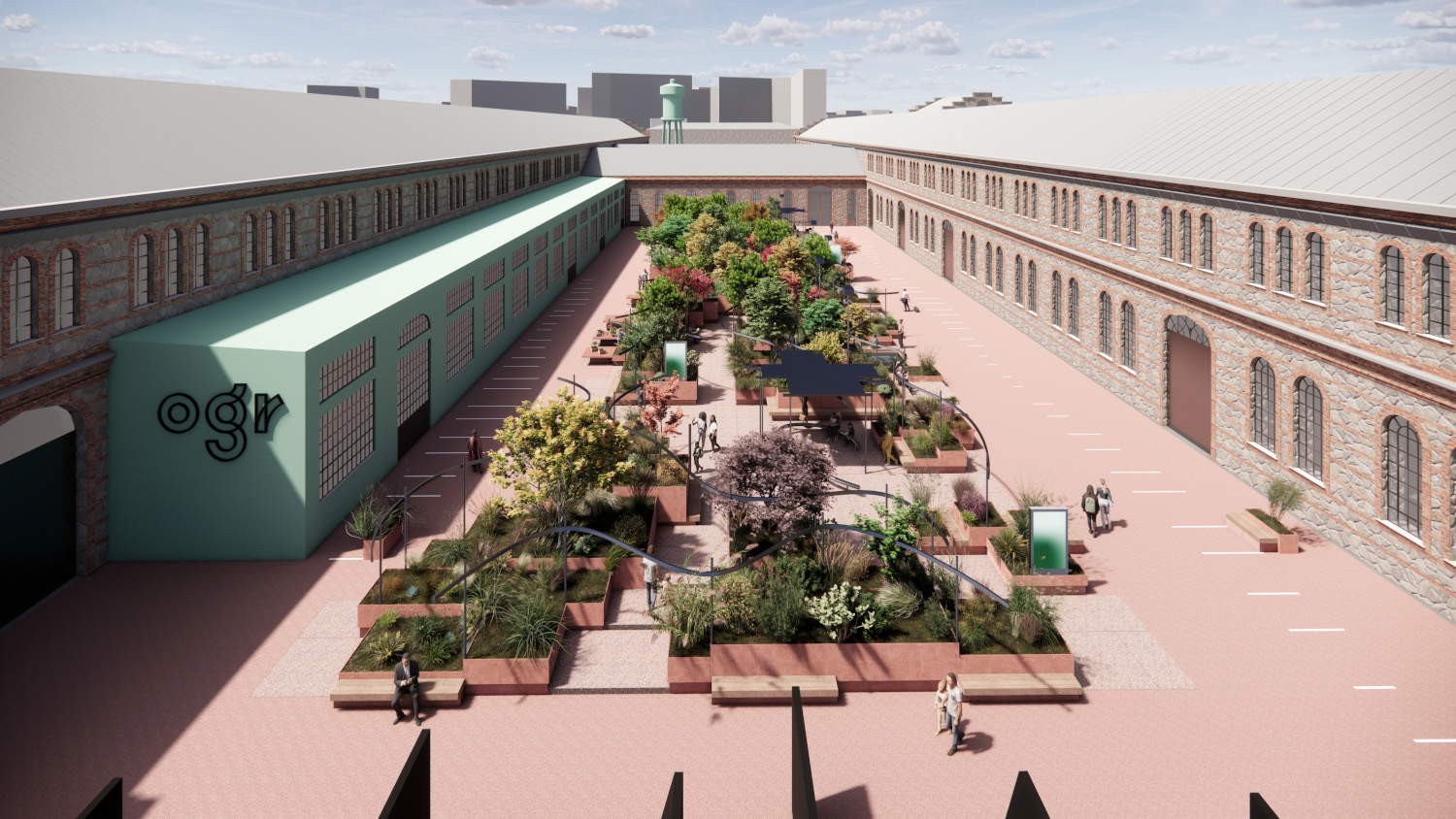
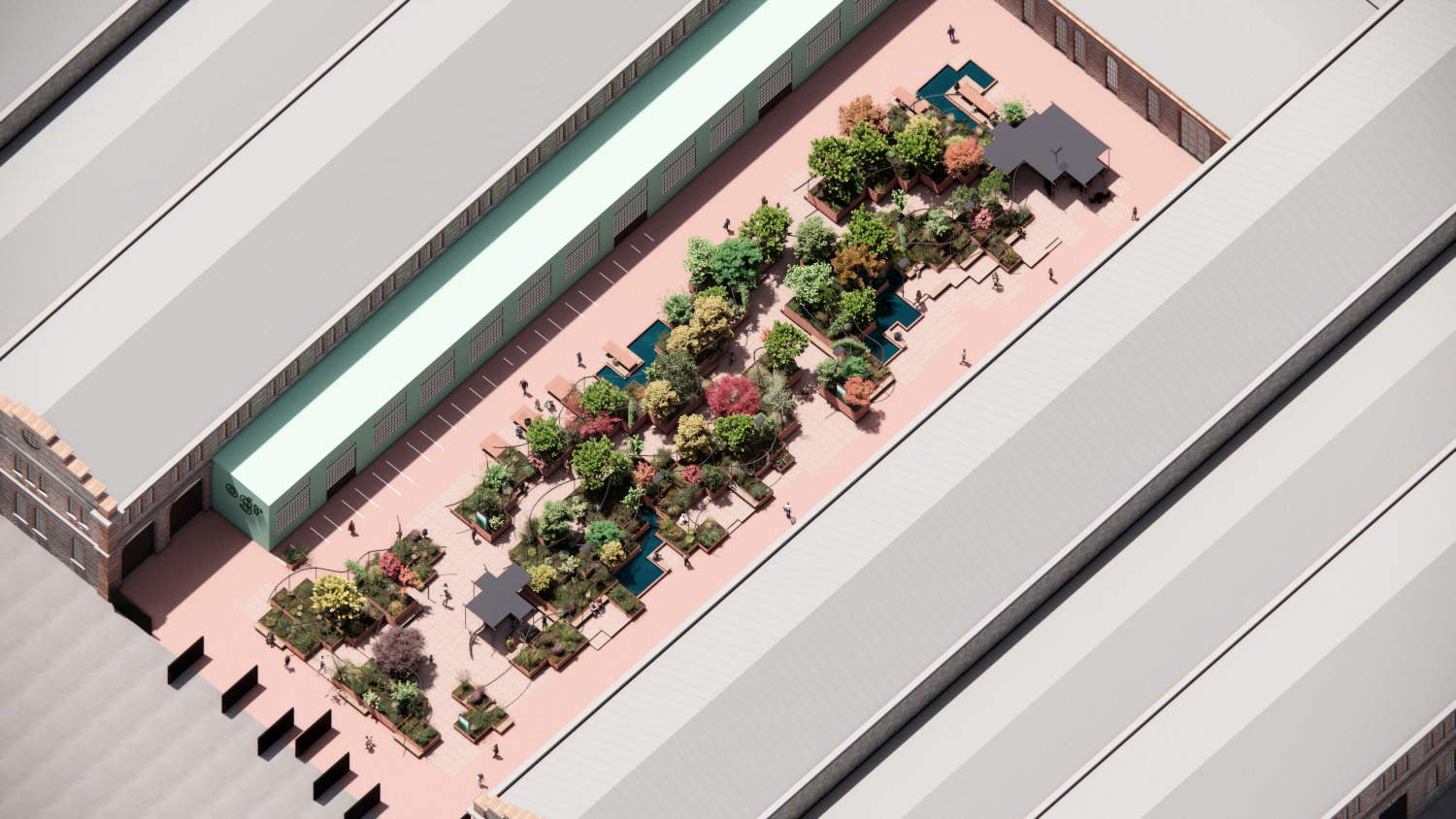
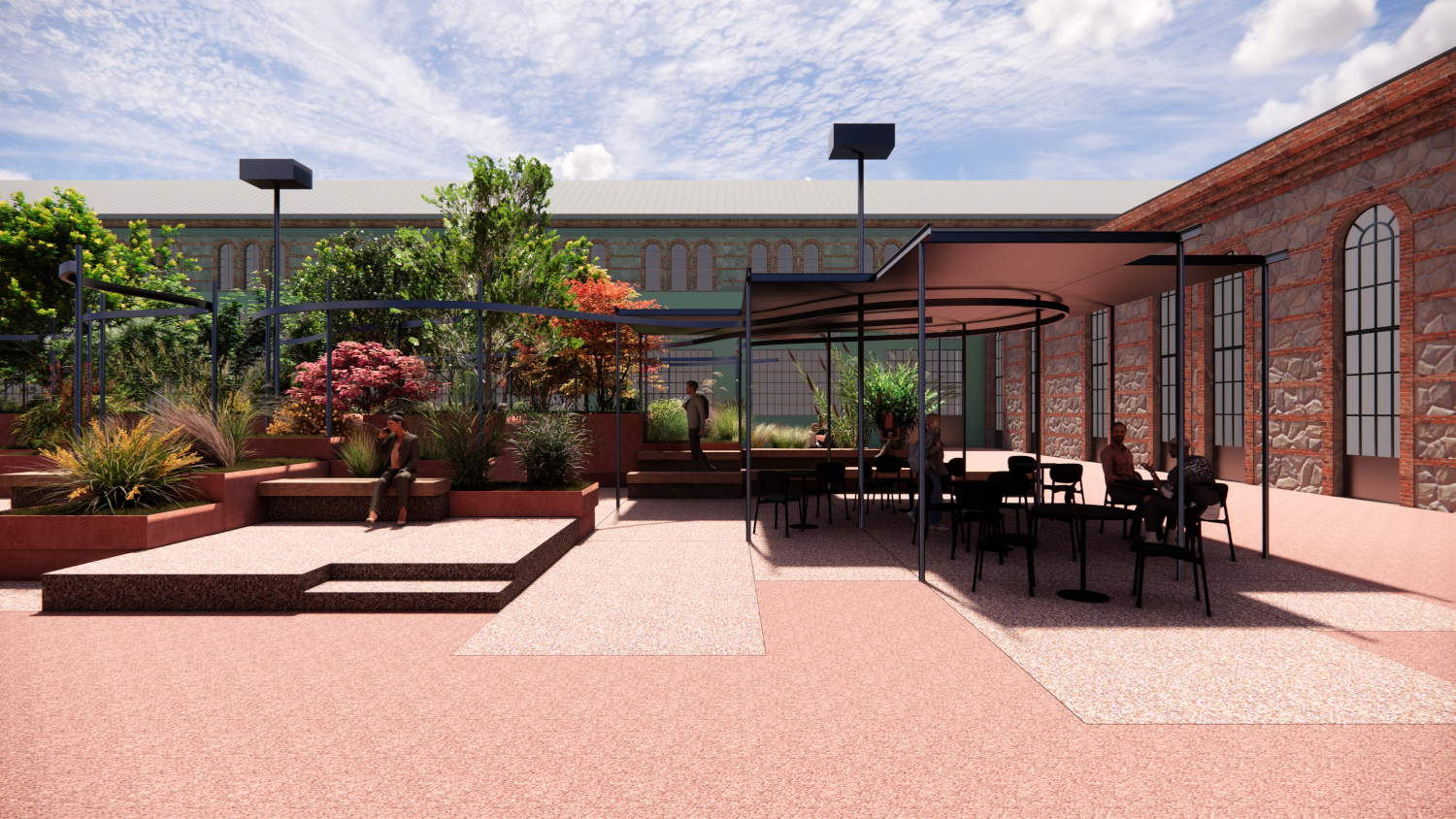
Overlooking Corso Castelfidardo, the East Courtyard will be designed as a large, multi-level green plaza, traversed by the path leading into the OGR complex. The new architectural modules will organize the space into areas dedicated to vegetation, shade, and relaxation, featuring seating and water features. Connecting the various elements will be an organically shaped infrastructure that will incorporate programmable LED lighting, misting systems for summer cooling, and sound systems, also designed to accommodate artistic and musical installations. At the entrance on Corso Castelfidardo, this same structure will take on a more playful role, welcoming visitors of all ages and transforming a technical element into an interactive experience. The East Courtyard will thus present itself as an open, traversable space where the character of a garden blends with that of a public square and cultural activities.
The West Courtyard, on the other hand, will have a more productive, convivial, and educational focus. The modules will house vegetable gardens and urban agroforestry systems dedicated to the cultivation of herbs, vegetables, and small fruits. The area will also be used for educational activities and workshops aimed at young people and local communities, while tables and equipped spaces will offer new opportunities for students, workers, and visitors to gather. The Corte will thus become a place for socializing and sharing within the OGR community, extending its function beyond dining and engaging those who visit the complex daily to work, study, or participate in innovation-related activities. The redesign of the spaces will also make it possible to expand and enhance the area dedicated to entertainment, creating a more flexible and well-equipped environment for concerts, live performances, and events. The new layout aims to enhance the quality of the outdoor experience and make the Courtyards accessible year-round, in line with the OGR’s various activities.
The transformation of the outdoor spaces will be accompanied by an arts program that will reinforce the OGR’s role as an open cultural platform accessible free of charge. Thanks to a collaboration with the Fondazione Arte CRT, the new Corti will gradually be enriched with temporary and permanent artworks, commissioned or acquired to engage with the architecture and landscape. The first permanent work will be unveiled at the inauguration of the Courtyards in the spring of 2027, while a second installation will be unveiled in the fall of the same year, during Art Week. The program will continue over the years with new commissions and installations, making the Courtyards yet another space for the creation and enjoyment of contemporary art.
The project will be developed under the artistic direction of lamatilde and carried out by MAT Srl, based on the detailed design, permitting, and construction supervision provided by ICIS Srl. Safety management will be entrusted to Studio Pellegrin, while the agronomic design of the green spaces will be overseen by Carmelo Fruscione. With the regeneration of the Corti, OGR Torino is thus embarking on a new phase in its history: the legacy of the railway workshops intertwines with green spaces, sustainability, and art, transforming the open spaces into a new urban infrastructure dedicated to culture, social interaction, and everyday life.
“The new Corti project represents a strategic step in the evolution of OGR Torino, the CRT Foundation’s most significant investment in the city, which—ever since its rebirth—has been conceived as an architectural entity capable of continually reinventing and regenerating itself,” states Anna Maria Poggi, President of the CRT Foundation. “We want these spaces to connect the industrial heritage of the former railway workshops—originally built as places of work and production—with the needs of the present, becoming a living landscape and environmental infrastructure at the service of the community. At the heart of this new transformation is greenery: a presence capable of redesigning the courtyards, promoting biodiversity, contributing to climate mitigation, and making these spaces more welcoming and livable. This is the essence of the new urban biosphere we want to restore to the city: a new green lung in the heart of Turin, where nature, architecture, and daily life can coexist.”
“The OGR Turin is, by its very nature, a place of transformation. The Corti project builds on this identity and represents a strategic step in its evolution: not a break with the past, but a new chapter in a story that continues to renew itself. We want these spaces to bridge the industrial heritage of the former workshops with the needs of the present, becoming a new infrastructure for the city. With this urban park, the OGR will become increasingly open, accessible, and inclusive, strengthening the connection between the local area and its people,” states Davide Canavesio, CEO of OGR Turin. “Transforming the Courtyards into an urban biosphere is a project in environmental engineering and climate regeneration, confirming the OGR’s ability to evolve and demonstrating how industrial archaeology can become a contemporary, technological, and resilient urban resource.”
“The Fondazione Arte CRT is honored to take part in this new phase of the OGR’s transformation, renewing a collaboration that is now well-established. Through a program of acquisitions and productions involving internationally renowned artists, the Foundation aims to help strengthen the OGR’s role as a cultural platform open to the city and to contemporary culture,” says Patrizia Sandretto Re Rebaudengo, President of the Fondazione Arte CRT. “We believe that the new Courtyards will become a true open-air museum, where art, architecture, and public space interact, offering new opportunities for encounter, learning, and engagement with contemporary art, and contributing to Turin’s cultural growth.”
|
| OGR Turin: The Courtyards Will Become an Urban Biosphere—More Green Space for the City |

Warning: the translation into English of the original Italian article was created using automatic tools. We undertake to review all articles, but we do not guarantee the total absence of inaccuracies in the translation due to the program. You can find the original by clicking on the ITA button. If you find any mistake,please contact us.






















 IT
IT FR
FR DE
DE ES
ES CN
CN


