



by Daniele Rocca 17/11/2026


Categories: News Focus / Disclaimer
Introducing “Cultural Initiatives,” a new section of “Finestre sull’Arte” designed to highlight the work of banking foundations and the cultural life of local communities: from rediscovered collections to restorations, from new exhibitions to acquisitions—a new section dedicated to all these stories.


Anyone involved in the art world in Italy is well acquainted with a landscape made up of a few easily recognizable centers—such as Rome, Milan, Florence, Venice, Turin, and Naples—the places where major exhibitions are usually held, or where controversial appointments are made, or where controversies bounce from one newspaper to another. But then there’s everything else—which makes up the bulk of the country: small and medium-sized cities, provinces, and historic centers where a restoration, an acquisition, or a well-curated exhibition can transform the way a community views its cultural heritage. At the national level, these stories are rarely discussed. And often, the same type of entity is behind them: a banking foundation. It is to bring these stories to light that we are launching “Cultural Initiatives,” the section that Finestre sull’Arte is dedicating starting today to the activities of banking foundations.

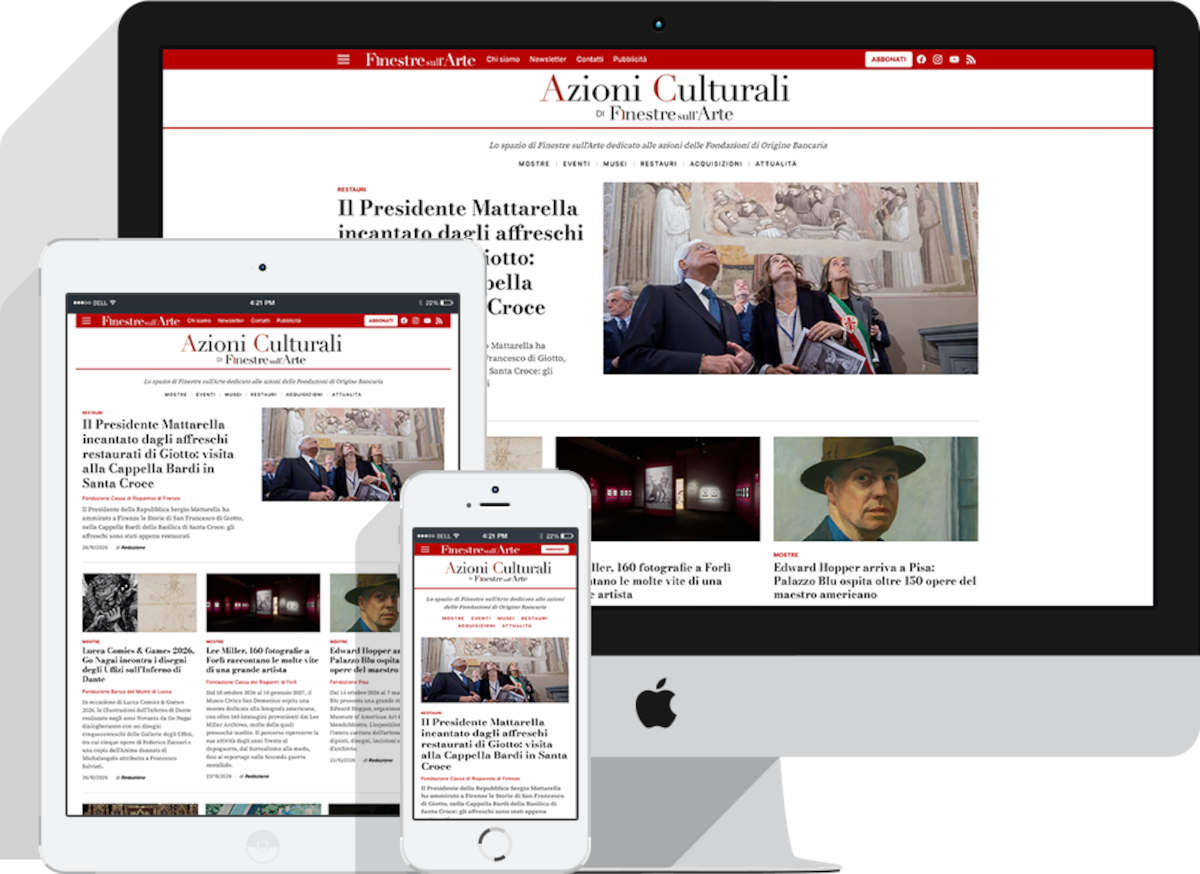
A section dedicated to banking foundations within our publication, where you’ll find news about exhibitions, restorations, acquisitions, enhancement projects, and research initiatives from all over Italy, organized like a magazine, with sections dedicated to the main areas of our interest (exhibitions, events, museums, restorations, acquisitions, current events), and featuring a dedicated section for each of the more than 80 banking foundations operating in Italy (clicking on the name of each one will open its dedicated page). The approach is the one we’ve always followed: art at the center—the works, the places, the people who work there, and what changes when a project is completed. For example, a painting that becomes legible again after restoration, a major exhibition, a collection emerging from storage, or a museum being redesigned. These are all stories that deserve a wider audience than that of a single city.


And there are many such stories. Banking foundations are behind thousands of initiatives every year in Italy (Acri’s 2026 annual report recorded over 26,000, and the bulk of investments—about 21%—is concentrated precisely in the arts, cultural activities, and cultural heritage sector). Yet the public that reads about art often knows little about banking foundations, partly because each one operates within its own territory—usually the province or region where it is headquartered. However, this deep local roots also represent their strength. Furthermore, many foundations own collections—often inherited from the old savings banks—that have been studied, cataloged, exhibited, and even expanded over time. Some have opened exhibition spaces that have become important landmarks for their cities; others acquire works to bring them back to the local area from which they had originated, perhaps after decades spent in private collections or abroad: these are all endeavors that require expertise, time, and relationships with cultural heritage authorities, museums, and universities, and to describe them merely as contributions or funding is to overlook almost everything that makes them interesting.

Obviously, this isn’t about promotion: foundations are, in fact, entities that play a significant public role, manage important cultural assets, and make decisions that impact the cultural life of their regions—and precisely for this reason, it is right that their work be discussed, with the same attention given to a state museum or a major private institution, because telling their stories well also means understanding which projects succeed, which ones leave a lasting impact after they conclude, and which models could be replicated elsewhere.
Finally, there is a reason that concerns us closely. For years, Finestre sull’Arte has sought to demonstrate that there is room on the web for in-depth analysis and that the art world is far more diverse and dynamic than it appears from the few news items that make it into national publications. Bank-affiliated foundations are an extremely significant part of this diversity (indeed, they are a vital element), but they are also a little-covered aspect. “Cultural Activities” was launched with the aim of trying to fill this gap. The rest will be left to the stories—and there is certainly no shortage of them; we just need to seek them out and tell them. And that is exactly what we will do on these pages.
Warning: the translation into English of the original Italian article was created using automatic tools. We undertake to review all articles, but we do not guarantee the total absence of inaccuracies in the translation due to the program. You can find the original by clicking on the ITA button. If you find any mistake,please contact us.