



by Redazione 26/11/2026



Categories: News / Disclaimer
Thanks to the support of Friends of Florence, the lengthy restoration—which lasted nearly twenty years—of the Chapel of the Madonna del Soccorso has been completed. Giambologna designed the chapel as a burial place for himself and for the Flemish artists working in Florence. The restoration project began in 2008 at the Basilica of the Santissima Annunziata.


The restoration of the Chapel of the Madonna del Soccorso, also known as the Giambologna Chapel, has finally been completed after nearly twenty years: the extensive restoration project in the Basilica of the Santissima Annunziata in Florence was completed thanks to the support of Friends of Florence and involved the sculptures, the marble altar, the paintings, and the stone decorations. The restoration process began in 2008.


The chapel, conceived by the Flemish sculptor as a personal funerary monument and burial site for his fellow Flemish artists working in Florence, represents a collection of great historical and artistic value. The recent restoration allows visitors to once again appreciate its overall richness, highlighting the interplay between the various works and decorations that define its identity.
The contribution of Friends of Florence has supported various phases of the project: from the restoration of Giambologna’s large bronze Crucifix, carried out in 2010–2011, to the bronze reliefs depicting scenes from the Passion of Christ, restored in 2013, and finally the panel painting of the Madonna del Soccorso, restored in 2016. With this final phase, work was also completed on the sculptural elements, the marble altar, Giovan Battista Paggi’s Nativity, the lunettes, and the pietra serena cladding.




The work was carried out under the direction of the Fine Arts and Palazzo Vecchio Maintenance Service of the City of Florence, with the oversight of the ABAP Superintendency for the Metropolitan City of Florence and the Province of Prato. The project required constant collaboration among art historians, diagnostic specialists, and conservators with expertise in the various techniques and materials found in the chapel: paintings on canvas and panel, frescoes, bronzes, marbles, and stones.
The presentation of the restoration was attended by Giovanni Bettarini, the City of Florence’s Councilor for Culture; Simonetta Brandolini d’Adda, president of Friends of Florence; and Father Paolo Orlandini, prior of the Santissima Annunziata, along with municipal officials, representatives from the Superintendency, and the restorers involved.
Giambologna’s Funeral Chapel in the Heart of the Santissima Annunziata
The Chapel of the Madonna del Soccorso is located at the center of the ambulatory surrounding the choir of the Basilica of the Santissima Annunziata, in a position of particular significance within the religious complex. Giambologna secured the use of the space through an agreement with the convent, signed on December 4, 1594, transforming a space that had belonged to the Dolci family into his own funerary monument. The sculptor designed the architecture and created the main bronze sculptures, collaborating with some of the most important painters of his time. The walls feature the Nativity by Giovan Battista Paggi, the Lamentation by Jacopo Ligozzi, and the Resurrection by Domenico Cresti, known as il Passignano. The dome, on the other hand, was decorated by Bernardino Poccetti with scenes of paradise and allegorical figures.
At the center of the ensemble stands Giambologna’s large bronze Crucified Christ, mounted on a cypress wood cross. Six bronze reliefs depict episodes from the Passion, while the polychrome marble altar features the panel painting of the Madonna del Soccorso, donated to the sculptor by the Falconieri family.
The chapel was inaugurated on Christmas Day in 1598. Upon Giambologna’s death in 1608, his body was buried here on August 14, the day after his passing. The funerary inscription also notes that the site was intended for Flemish artists residing in Florence, giving the monument a function that is not only personal but also collective.
This choice finds a parallel, within the same complex of the Santissima Annunziata, in the Chapel of San Luca, known as the Painters’ Chapel. Commissioned by Giovannangelo Montorsoli as a shared burial place for artists, it is closely linked to the founding of the Accademia del Disegno.
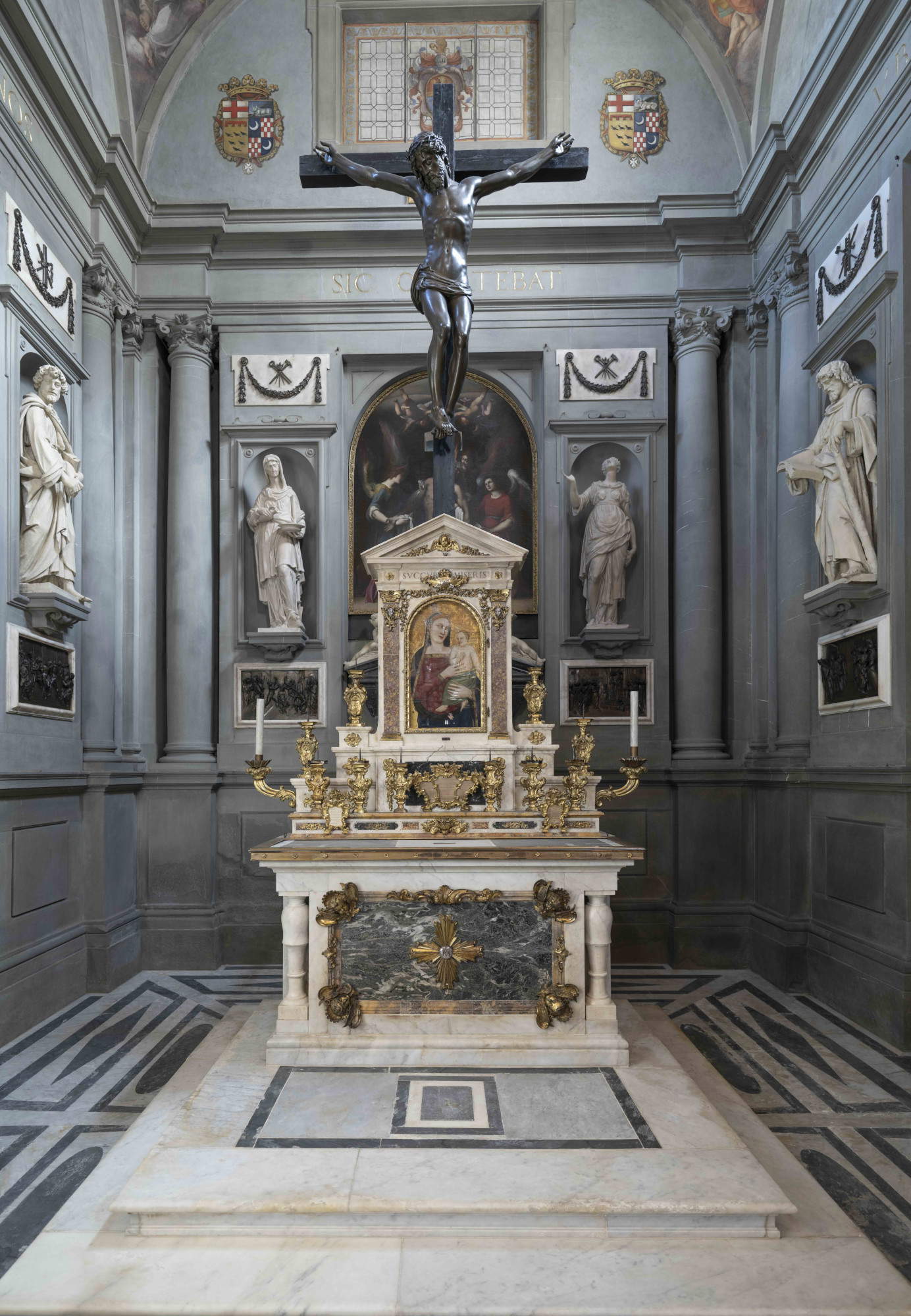
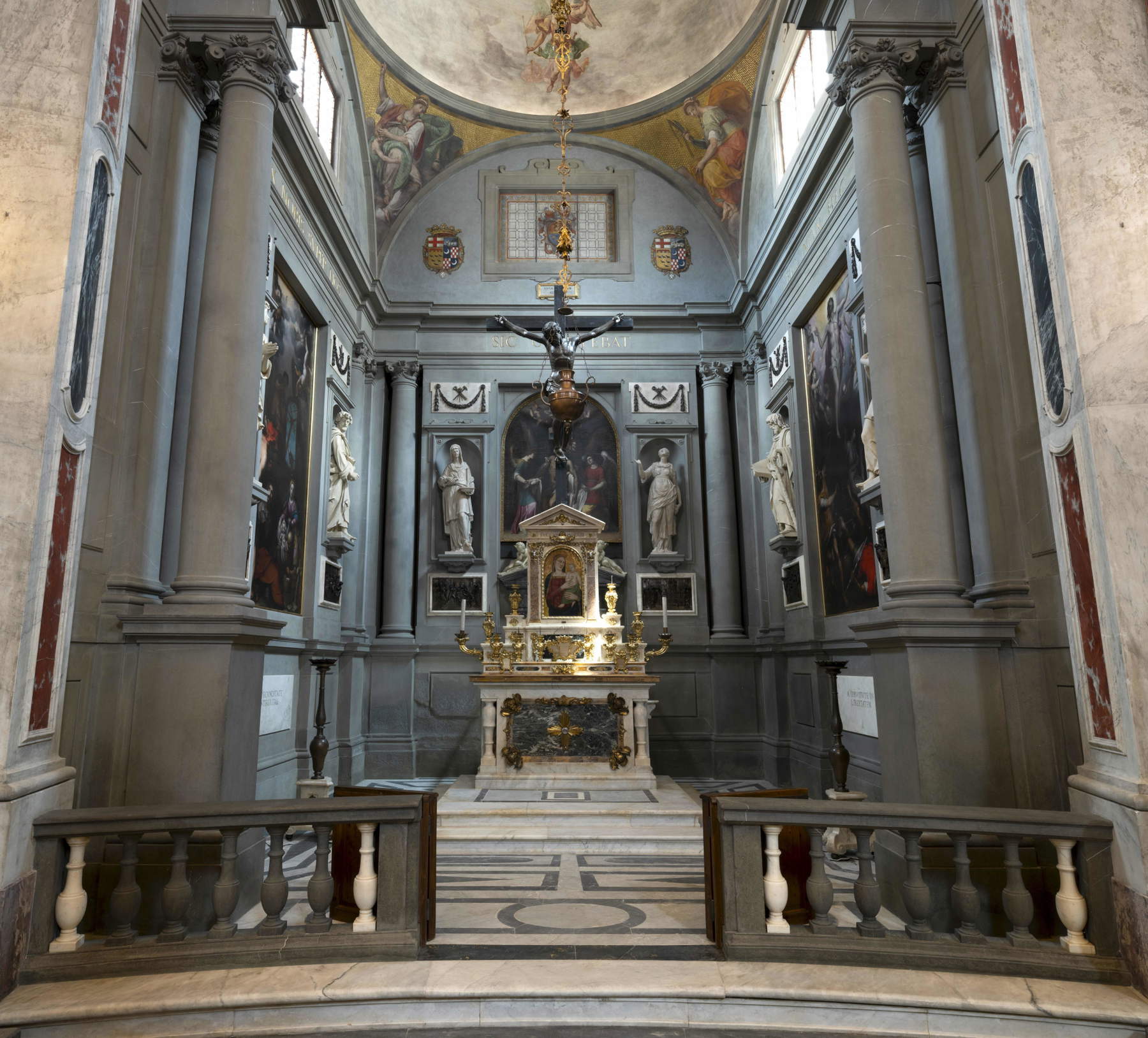
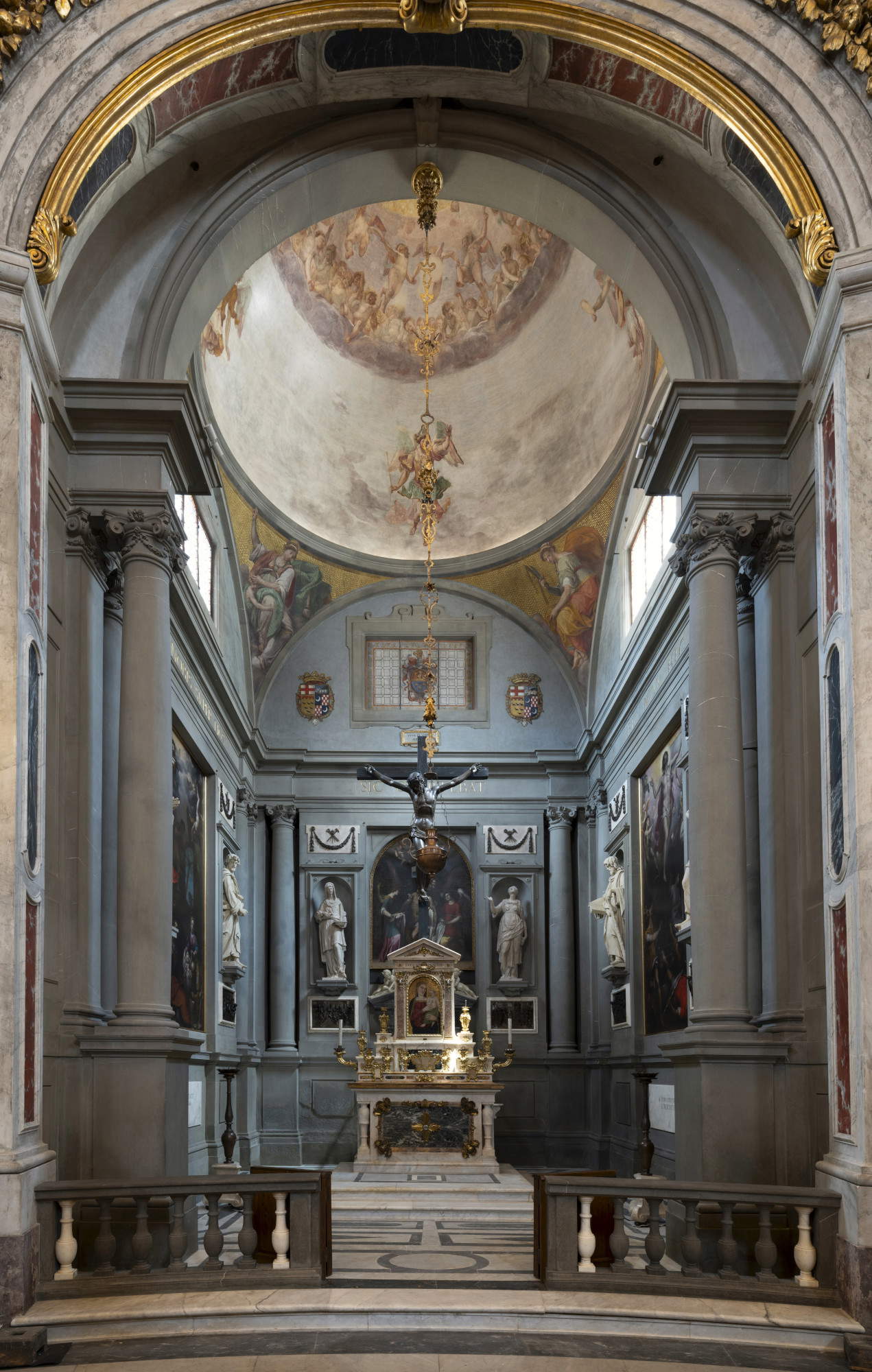
A restoration that began in 2008 and was completed in several phases
The restoration of the chapel took place over the course of nearly twenty years and was made possible by contributions from various organizations and supporters. The first phase, in 2008–2009, focused on the dome and the pendentives, thanks to a bequest from the Servite Fathers earmarked for the restoration. The work made it possible to restore colors and figures that had been obscured by soot, making the decorations legible once again.
In 2010–2011, Friends of Florence supported the restoration of Giambologna’s large bronze Crucifix. Subsequently, the Foundation contributed to the restoration of the bronze reliefs depicting scenes from the Passion of Christ. During the same period, the candelabra were also restored, thanks to funding from Abercrombie & Kent Europe. Between 2014 and 2015, work focused on the back wall, with support from the Fondazione CR Firenze, the Centro Associazioni Culturali Fiorentine, and several private U.S. donors from the WPO Houston group.
In 2016, restoration work focused on part of the eastern wall: Passignano’s painting was restored thanks to contributions from Intesa Sanpaolo and the FAI – Fondo per l’Ambiente Italiano, while Friends of Florence funded the restoration of the panel depicting the Madonna del Soccorso. Finally, the last phase allowed for the completion of the restoration of the stone and bronze sculptures, the marble altar, Giovan Battista Paggi’s Nativity, the lunettes, and the elements in pietra serena. Thanks to the support of Friends of Florence, the chapel has now been restored to its artistic integrity, and its extraordinary heritage is fully showcased.
“The Giambologna Chapel is a place that holds an extraordinary history, a space of great beauty where the genius of one of the greatest sculptors in our history meets the work of many artists who have contributed to making it unique. With the completion of this restoration, we are restoring a unified vision of the chapel and allowing citizens and visitors to fully appreciate every detail,” said Giovanni Bettarini, Florence’s Councilor for Culture. “It has been a long journey, one that began many years ago, demonstrating just how much the preservation of cultural heritage requires time, expertise, and above all, a lasting collaboration. For this reason, great recognition goes to Friends of Florence, which, with generosity and consistency, has supported this project through to its conclusion, together with the Fondazione CR Firenze, the FAI —the Italian Environment Fund—Intesa Sanpaolo, Abercrombie & Kent Europe, the Center for Florentine Cultural Associations, and all the private donors who, at various stages, helped make this important achievement possible. Thanks also go to the professionals, conservators, and institutions that worked on this wonderful project. Thanks to everyone’s hard work, passion, and dedication, the chapel can now tell its story even more effectively.”
“Giambologna holds a special place in the history of Friends of Florence and in the hearts of our donors: it was precisely through support for the restoration of The Rape of the Sabine Women, beneath the Loggia dei Lanzi, that the Foundation’s mission began in 1998. Since then, we have continued to follow his works with particular attention, as well as the Basilica of the Santissima Annunziata, to which we are bound by a long-standing relationship of care,” stated Simonetta Brandolini d’Adda, President of Friends of Florence. “Our commitment to the Giambologna Chapel began in 2010 with the restoration of the bronze Crucifix that the master commissioned and created for his own burial, thanks to a donor deeply connected—both spiritually and emotionally—to the Madonna del Soccorso. We then extended our support to the bronze reliefs of the Passion and, in 2016, to the panel painting of the Madonna del Soccorso. In the years that followed, we hoped that new institutions and other donors would join us on this journey. Finally, together with our Board, we decided to take on the commitment to complete the restoration of the chapel. Seeing the entire space fully restored to its former beauty today is deeply moving. We thank the Servite Fathers, the Superintendency, the City of Florence, the professionals and restorers who guided this long process, along with all the institutions and supporters who made the various phases possible. Special thanks go to our donors—Robert & Kathy Craine, Sarah Wiggins, Christine Torretti, and our entire Board—who shared with us the value of this commitment. We are delighted that the chapel can once again fully serve as a place of prayer, comfort, and beauty for the community and for anyone who enters it.”
|
| Bronzes, marbles, and paintings: Giambologna’s Chapel in Florence has been restored following a project that lasted nearly twenty years |
Warning: the translation into English of the original Italian article was created using automatic tools. We undertake to review all articles, but we do not guarantee the total absence of inaccuracies in the translation due to the program. You can find the original by clicking on the ITA button. If you find any mistake,please contact us.