


by
Federico Giannini  @federicogiannini1
19/10/2026


Categories: Opinions / Disclaimer
The appointment of Francesco Bonami as artistic director of GES-2, a contemporary art center in Moscow, has gone almost unnoticed in Italy. Can a cultural appointment carry political weight—especially in Russia, where credentials of cultural respectability are required—even without implying complicity or direct influence?


A simple and harmless exercise to gauge the relevance of the visual arts sector in Italian public discourse: open the newspapers and count how many articles have been devoted to the appointment of Francesco Bonami as artistic director of GES-2, the contemporary art center that opened in Moscow in late 2021 with funding from a gas oligarch. You’ll easily find that the attention given to this generic bit of news—this trivial little story, really—is practically nonexistent: most outlets treated it, as is customary on such occasions, with the usual verbatim transcription of the press release sent from Russia, while a few felt it appropriate to venture into brief reconstructions of GES-2’s history—and then nothing else, aside from a few tweets in Italy and Ukraine. Faced with such listless, distracted indifference, some will note that the dust generally kicks up when the flow is reversed—that is, people tend to make a fuss whenever some regime lackey happens to be sent our way disguised as a harmless and disinterested bearer of culture: stuffy opera singers, talkative conductors, folk musicians—unknown even to their own mothers—who lend themselves to cultural “core sampling” at the Venice Biennale, naturally with the approval of its president. In situations like these, it’s common to expect those corrective slaps that the cultural milieu and the press occasionally remember to dish out to those who come to sing, dance, and play with impunity in our part of the world, pretending that culture is some sort of perpetual “Miss Italy,” a continuous, colorful, insistent appeal for world peace.

Some might note that when we, on the other hand, export talent to Russia, we tend to pay less attention to it. That’s true, but perhaps not quite so much. It’s probably true because our cultural exchanges with Russia, after the war, have all but ceased: at most, we’ve sent over a few veterans of our pop music scene who still enjoy some popularity between the Volga and the Urals. And it’s true that we’d hear about it when the war in Ukraine had just begun, as people tried to urge the Albano or Pupo of the moment to offer more reasoned advice, but they legitimately couldn’t care less about any complaints and continued to tour between Moscow and Novosibirsk, organizing increasingly implausible “concerts for peace” three bus stops from the Kremlin—which is a bit like holding a demonstration on a California beach to ask the great white shark to finally switch to a vegetarian diet. So, faced with such obstinacy, our press probably did what one does with those who, in a discussion—however poorly equipped they may be for debate—insist on being right at all costs: a couple of light taps on the shoulders, and then we can finally turn our attention to slightly more serious matters.


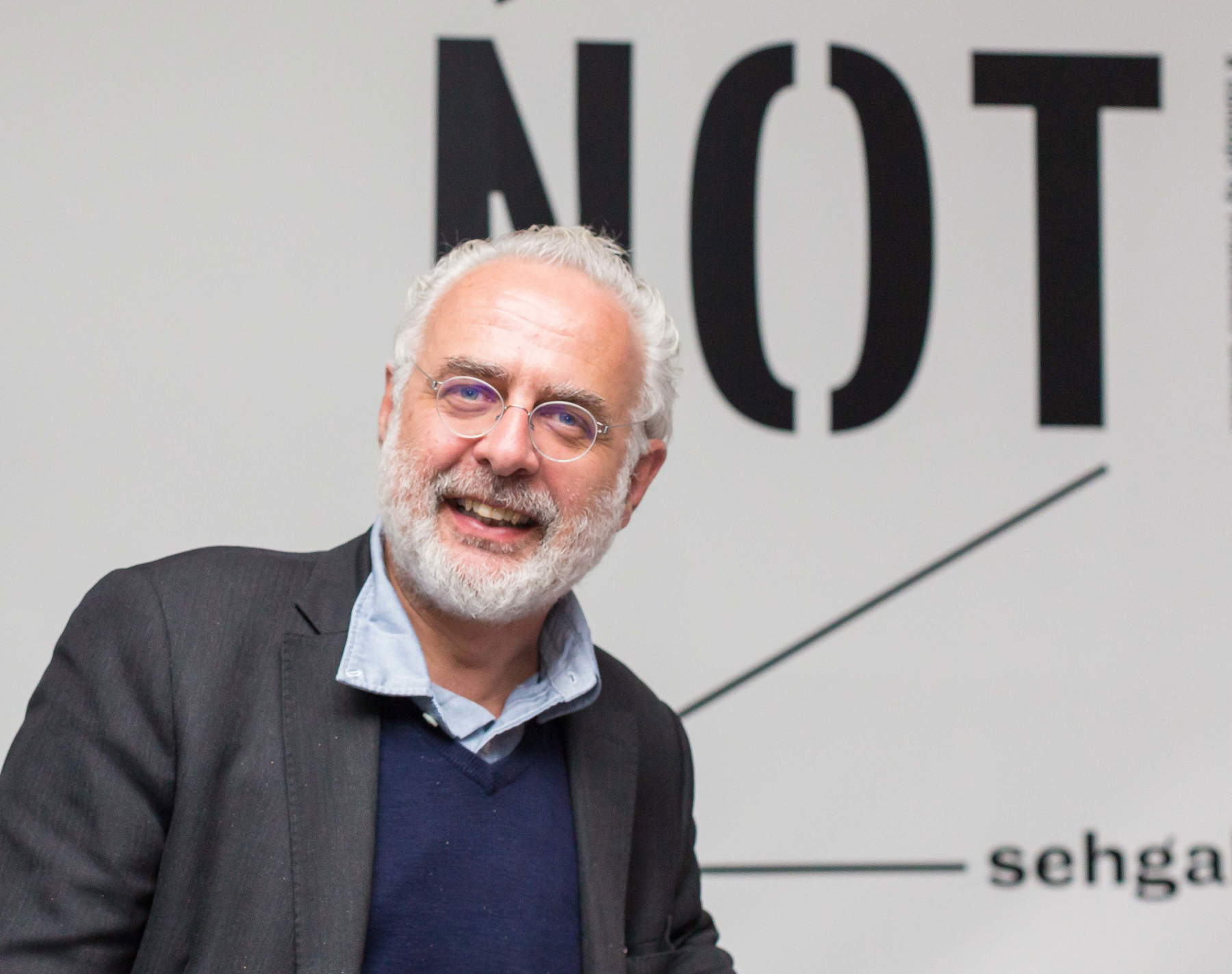
Something like that must have happened with Bonami. Italian newspapers surely noticed the parallel between him and the remnants of the music industry from forty years ago, and decided it wasn’t worth commenting on. In accepting the position, Bonami did nothing more than polish up the usual stock phrases of conventional wisdom: “The role of the artistic director is to catalyze artistic energy,” “our goal is to seek out the best projects for GES-2, and my experience should help,” “Today, interesting people are those capable of building a world within themselves and then sharing it with the rest of the world,” “I see artists and young curators in Russia developing a perspective that transcends local or national contexts,” and so on. In short, the usual stories: the best projects, the young people, the context—and if you add dialogue to the mix (after all, in the past, Bonami had already stepped out of his social-media clown persona for a few minutes to say that sanctioning culture is a crime and, more recently, during the opening days of the last Biennale, to say that art has no barriers: all he was missing was the Miss Smile tiara)—and perhaps even his long-standing experience in Russia and the friendships he’s forged there, the repertoire becomes the same as that of those singers we here use as a synonym for outdated 33-rpm records. In short, Francesco Bonami is the “Pupo” of contemporary art. And Bonami would surely be delighted by the comparison. There is, for one thing, a trivial geographical overlap. Then there is the unyielding determination to maintain the illusion of a dialogue with today’s Russia. There is the fact that both were at their best some time ago (for instance, the most recent Bonami is the one from the last Quadriennale, where he curated the most lackluster and sluggish section of the exhibition—or the most predictable and reassuring, if one wishes to use Luca Rossi’s adjectives). The fact that, under certain circumstances, the desire to maintain illusions of dialogue, predictability, and reassurance are also the most sophisticated forms of audacity is a hypothesis that perhaps deserves further exploration—and it is here that Bonami reaches the heights of his irreverence.
Then again, it’s obvious: one chooses the employers one prefers. And then one might say, to be precise, that the controversial oligarch—the one sanctioned by the United Kingdom, Canada, Australia, and New Zealand—no longer heads GES-2, because ownership has been transferred to his daughter. But, in any case, one can serve as the steward for whomever one pleases, especially if the formalities are maintained, conventions are respected, and appearances remain solid (since we’re talking about Russians, Chekhov’s clerk taught us that formalities must be obsessively observed until death). It is equally legitimate for someone to decide to exercise their cultural freedom as they see fit. It is equally legitimate to believe that a collaboration with a Russian institution does not automatically amount to a form of complicity. Equally legitimately, the political significance of an assignment does not necessarily coincide with the intentions of the person accepting it. Indeed, there may even be a legitimate divergence, because the political effect of a choice may not align with the motivations of the person making it. And there may even be a case where an assignment is free from any form of direct influence—one that provides the broadest possible scope and the most acceptable conditions imaginable (no control over content, no interference in artistic choices, complete transparency): that does not mean the choice would suddenly become politically irrelevant.
In any case, there’s no need to worry too much about the fact that people in Moscow and the surrounding area are rejoicing at the news: *The Art Newspaper* reports on a Russian TV host who was gloating because their contemporary art center is now headed by an Italian who also holds U.S. citizenship. In short, if Russian artists are exhibiting at the Venice Biennale and if now even an Italian is heading one of their cultural centers, it must mean that Russia is not culturally isolated: it’s a matter of relational capital, institutional continuity, and cultural respectability. One can’t help but suspect, however, that over there they’re satisfied with next to nothing: sometimes all it takes to satisfy them is a curator who, having long since exhausted any further capacity to mean anything, limits himself to playing the ham on social media with tiny videos in which he stubbornly stages the daily pantomime of his own aphasia. They’re easily satisfied, as long as he has a passport different from theirs. This time, however, there are no institutions involved; there’s no Venice Biennale to remind us that we Italians must always make ourselves known. There’s just a private individual going to work for another private individual—and so what if it ends up becoming semi-public? no one will notice: it’s just that we’re so used to our marginality that if anyone takes notice of our existence, we’ll immediately think it’s a protocol error, a case of mistaken identity, or an administrative misunderstanding.
Warning: the translation into English of the original Italian article was created using automatic tools. We undertake to review all articles, but we do not guarantee the total absence of inaccuracies in the translation due to the program. You can find the original by clicking on the ITA button. If you find any mistake,please contact us.