



by Redazione 27/11/2026



Categories: Photography / Disclaimer
To mark the bicentennial of the invention of photography, Casa Robegan in Treviso will host “Human Atlas” from November 29, 2026, to February 28, 2027. Two Centuries of Photography from the Mario Trevisan Collection: 80 works, spanning from the 19th century to the present day, trace the evolution of the representation of the human figure through five thematic sections.


In 1826, Joseph Nicéphore Niépce created *View from the Window at Le Gras*, the heliograph considered to be the first photographic image in history. Two centuries later, to mark the bicentennial of that experiment, Treviso is dedicating an exhibition to the evolution of the photographic language and the ways in which it has represented human beings, their bodies, their places, and their identities. From November 29, 2026, to February 28, 2027, Casa Robegan will host *Human Atlas: Two Centuries of Photography from the Mario Trevisan Collection*, an exhibition curated by Carlo Sala and sponsored by the Mazzotti Foundation and the City of Treviso.


The project brings together 80 works from Mario Trevisan’s collection in Venice—one of Italy’s most renowned private collections—through which visitors can trace some of photography’s major historical, social, and aesthetic transformations. The exhibition spans the 19th century, modernism, and the contemporary era, connecting documentary photography, formal experimentation, and artistic exploration. The exhibition is accompanied by a catalog published by Silvana Editoriale and was developed in collaboration with the City of Senigallia, where a second stop is planned. During the exhibition, there will also be meetings, talks, and book presentations featuring scholars and photographers from the contemporary scene.


The exhibition is divided into five thematic sections, each exploring different ways of representing the individual and their relationship with the world. The first, “Plural Humanities,” traces the history of the portrait from its nineteenth-century origins—when photography was primarily the preserve of the wealthy classes—to its use as a tool for social documentation and advocacy in the twentieth century. Images by Lewis Carroll and Julia Margaret Cameron document the earliest experiments in photographic portraiture, while later works address issues related to minorities and marginalized identities. Among these is Gordon Parks’s *American Gothic* (1942), an image that has become emblematic of the denunciation of racial discrimination in the United States. The section also includes Lisetta Carmi’s explorations of the drag community in Genoa during the 1960s and Nan Goldin’s photographs dedicated to the queer community.


Postwar Italian daily life is captured in the photographs of Piergiorgio Branzi, Mario Giacomelli, and Nino Migliori, the photographer behind the famous *Il tuffatore* (1951). The selection also includes works by some of the key figures in the history of photography, including Edward Weston, Henri Cartier-Bresson, Diane Arbus, Ferdinando Scianna, and Sebastião Salgado.
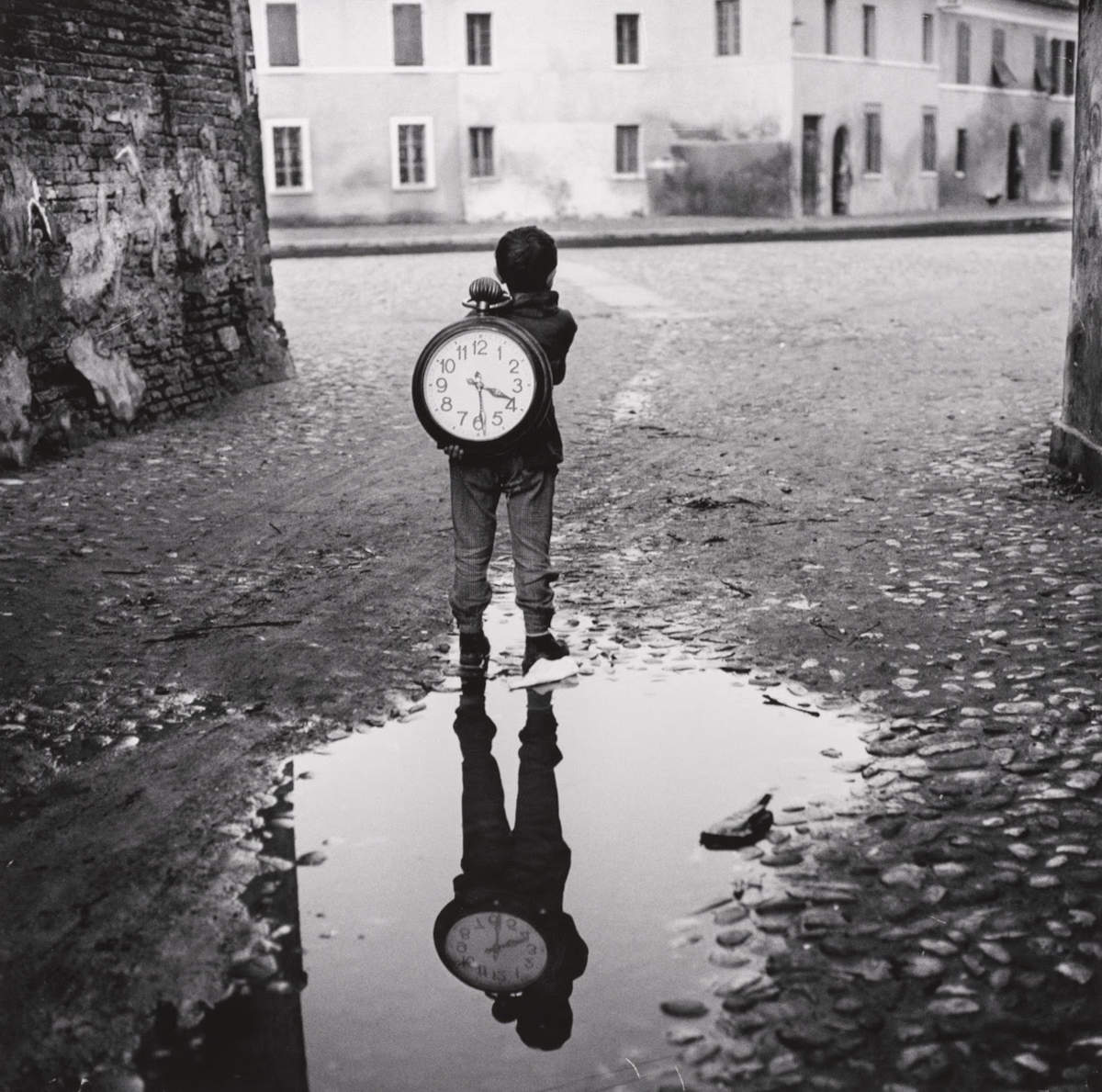
The second section, “Bodies,” is dedicated to the nude, one of the recurring themes in the history of Western art. The exhibition begins with a rare albumen print from 1853 by Félix-Jacques Antoine Moulin and progresses to 20th-century experiments with the body and its expressive possibilities. The images by Bill Brandt and Horst P. Horst illustrate some of the formal explorations developed over the course of the century, while André Kertész’s Surrealist Distortions investigate the possibilities of deformation and transformation of the figure.
The body also becomes an image of popular culture in Bert Stern’s photographs of Marilyn Monroe, including *M.M., Crucifix II*. Other works explore its plastic and symbolic dimensions: from the compositions of Helmut Newton and Robert Mapplethorpe to the images of David LaChapelle, and on to the performative and conceptual explorations of Francesca Woodman and Vanessa Beecroft, who address the theme of identity through physical representation.
The third section focuses on the uncanny, a concept developed by Sigmund Freud to describe what lies on the border between the familiar and the unconscious. The theme is explored through the figures of the automaton, the mannequin, and the doll—recurring subjects in the avant-garde movements of the interwar period and in Surrealist work. The exhibition features works by Paul Citroen, Hans Bellmer’s series on dolls, and Man Ray’s enigmatic solarizations. Rounding out the section are Brassaï’s Parisian graffiti and Roger Ballen’s disfigured and unsettling sculptures.
The fourth section, “Crossings,” explores photography as a space for staged composition, disguise, and artistic and literary allusion. It begins with William Lake Price, portrayed as Don Quixote in 1851, and culminates in Luigi Ontani’s “Indian Saint Sebastian.” The exhibition continues with reinterpretations by Yasumasa Morimura and Cindy Sherman, with Silvia Camporesi’s work evoking John Everett Millais’s *Ophelia*, and with Vik Muniz, creator of a reconstruction of Vincent van Gogh’s *The Sower* made from organic materials.
The exhibition concludes with “Absences,” a section dedicated to the landscape and to a representation of the human being that manifests itself through the traces left in the environment or, conversely, through one’s own absence. From Gustave Le Gray’s images of the sky to the Grand Tour landscapes photographed by Robert Macpherson, the exhibition then moves on to Italian photography by Luigi Ghirri, Franco Fontana, and Francesco Jodice. Also featured are the constructed atmospheres of American staged photography, represented by the works of James Casebere and Gregory Crewdson.
Practical Information
Hours: Friday through Sunday, 10:00 a.m. – 6:00 p.m.
Closed: December 25, 2026, and January 1, 2027; Last admission at 5:00 PM
Admission: full price 8 euros, reduced price 5 euros
 |
| How has our view of humanity changed? 80 photographs in Treviso tell the story |
Warning: the translation into English of the original Italian article was created using automatic tools. We undertake to review all articles, but we do not guarantee the total absence of inaccuracies in the translation due to the program. You can find the original by clicking on the ITA button. If you find any mistake,please contact us.