



by
Federico Giannini  @federicogiannini1
30/08/2026
@federicogiannini1
30/08/2026



Categories: Travel / Disclaimer
Dante used it to measure the difficulty of a climb. Today, Noli—an ancient maritime republic in western Liguria—is grappling with tourism, its towers, its waterfront, its empty houses, and a history that keeps changing every time someone tries to tell it. A new article from Federico Giannini’s column “Le vie del silenzio” (The Paths of Silence).


To help his readers understand just how steep and arduous the ascent of Antipurgatory was, Dante suggested they imagine a whole range of inaccessible places, starting with Noli, which—if we are to trust the fourth canto of *Purgatory*— must have been exceptionally arduous, since—when compared to other stubbornly remote places, so hidden as to be almost wild, not even touched by the roads of the time—such as the fortress of San Leo, the rock of Bismantova, and Mount Cacume in the Lepini Mountains—it stood out as a prime example of difficulty. I have no idea how one reached Noli in Dante’s time: I presume that the most comfortable way would have involved a journey by sea, because the alternative, following Dante’s topography, would have entailed the hassle of having to descend toward the town by taking some steep ridge mule track that started from who knows where, given that the nearest Roman road, the Iulia Augusta—which continued to be used even in the Middle Ages—most likely stopped following the coastline once it reached Vado, passed through the inland woods, bypassing Noli, and then plunged back into the sea near Finale. Noli, isolated and prosperous, enclosed between Mount Ursino and the headland of barren, rugged, white cliffs that separate it from Varigotti: that’s more or less how it must have looked. A row of towers and stone and brick houses wedged between two promontories, where dusk begins to fall when it’s still light elsewhere, where a mischievous breeze blows—a breeze that lulls one into laziness, that meddles with the cove as soon as the sun sets. But that’s all right: Noli seems built specifically to await the shadows.

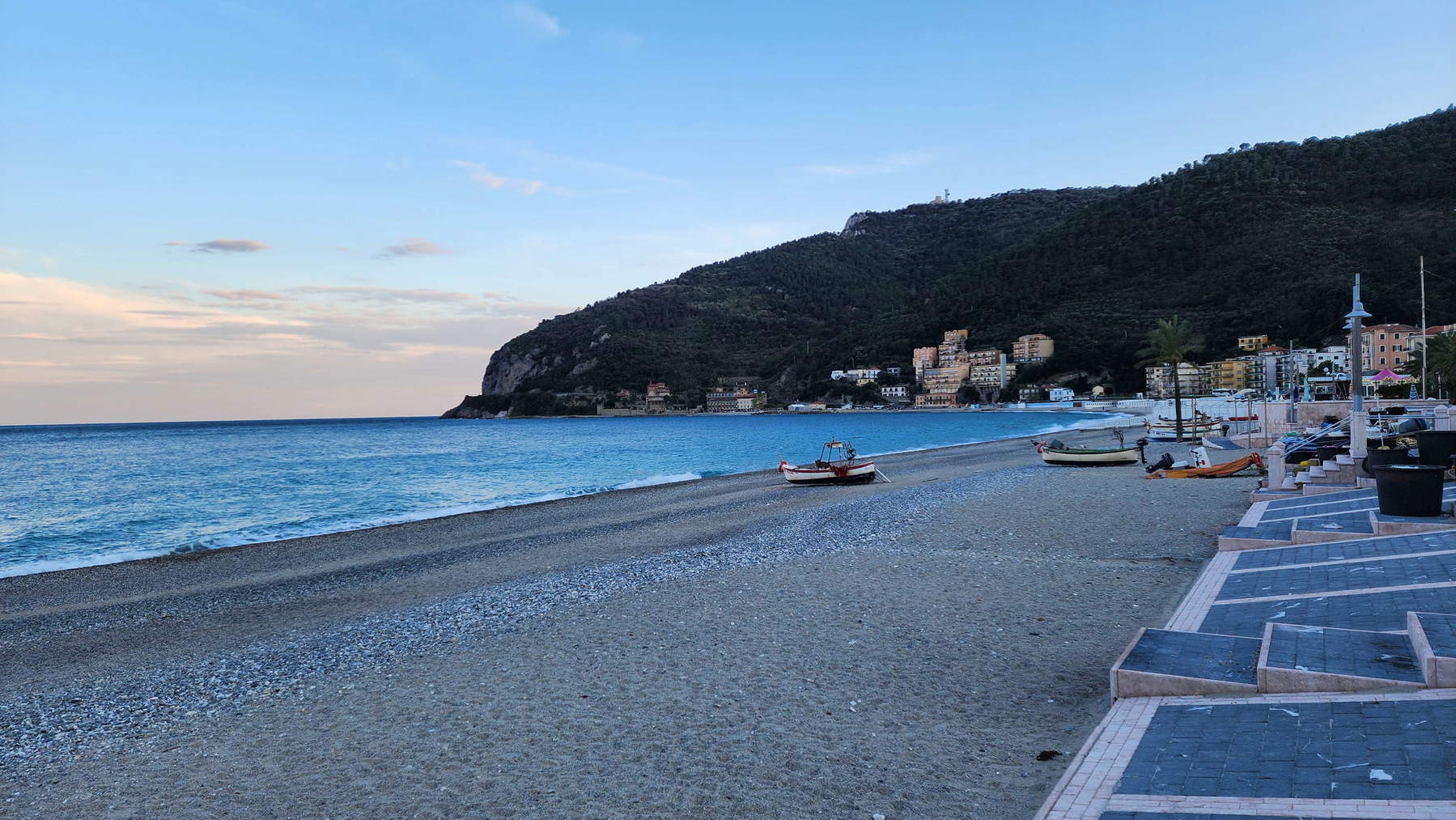
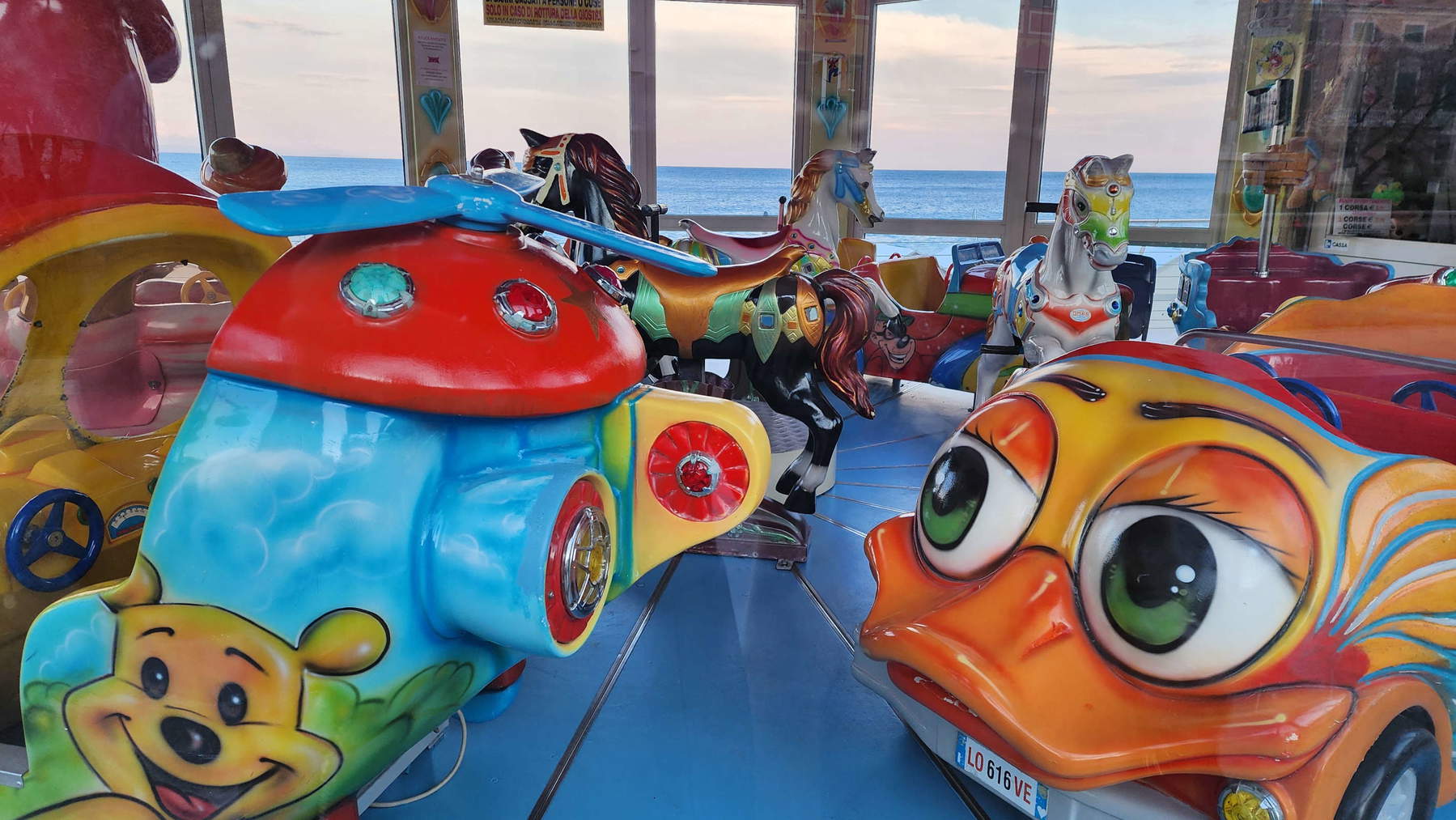
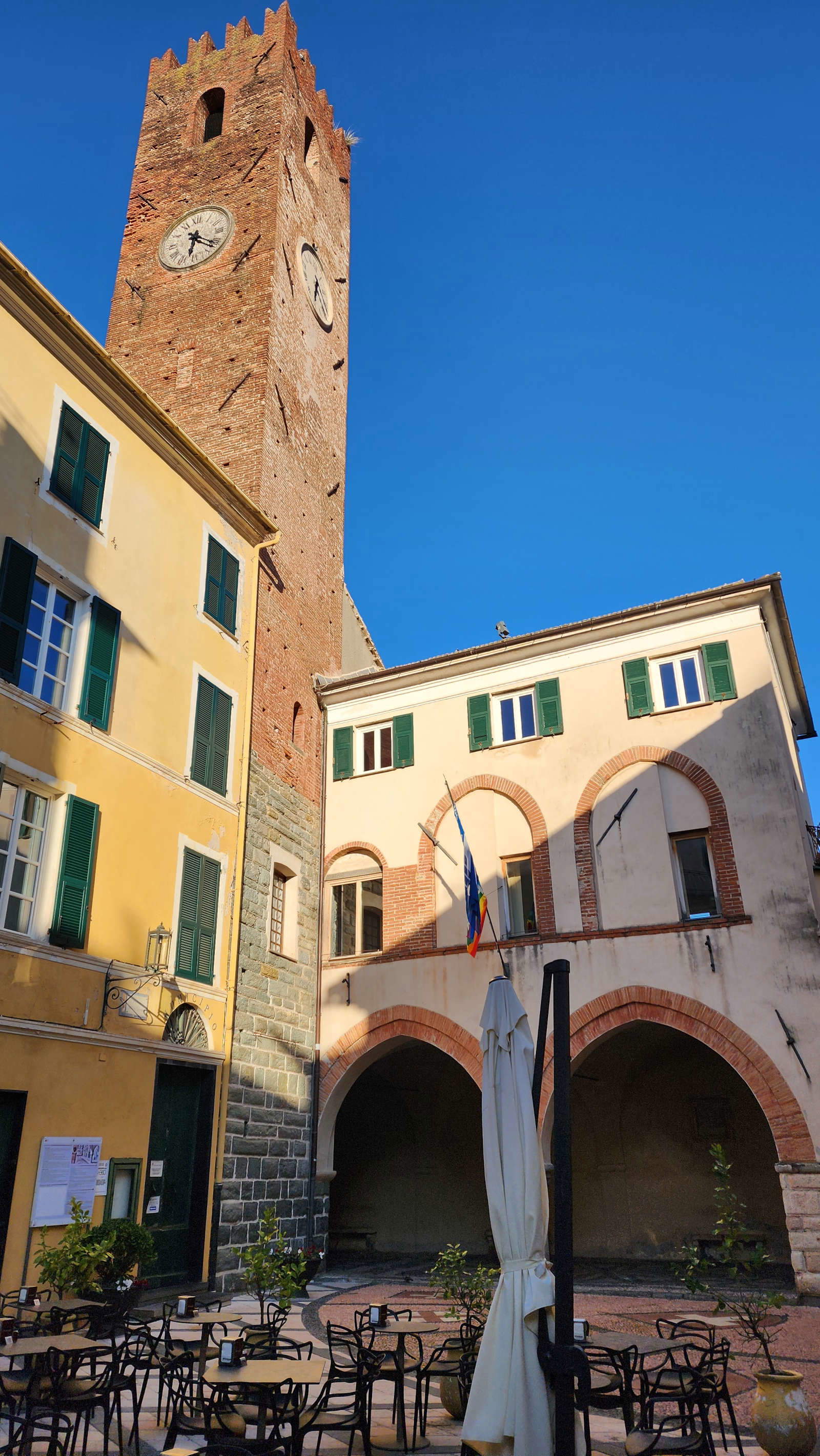
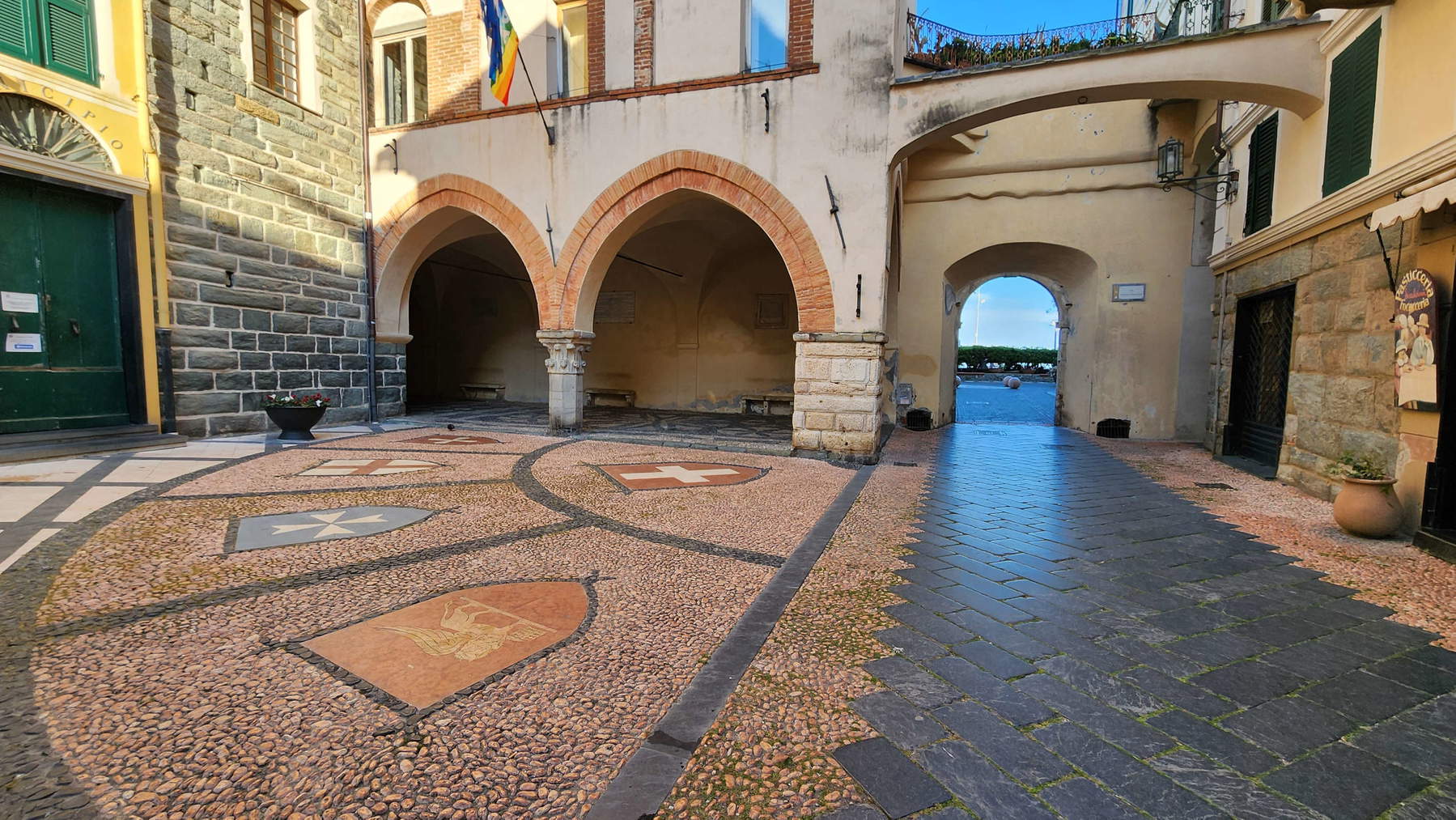
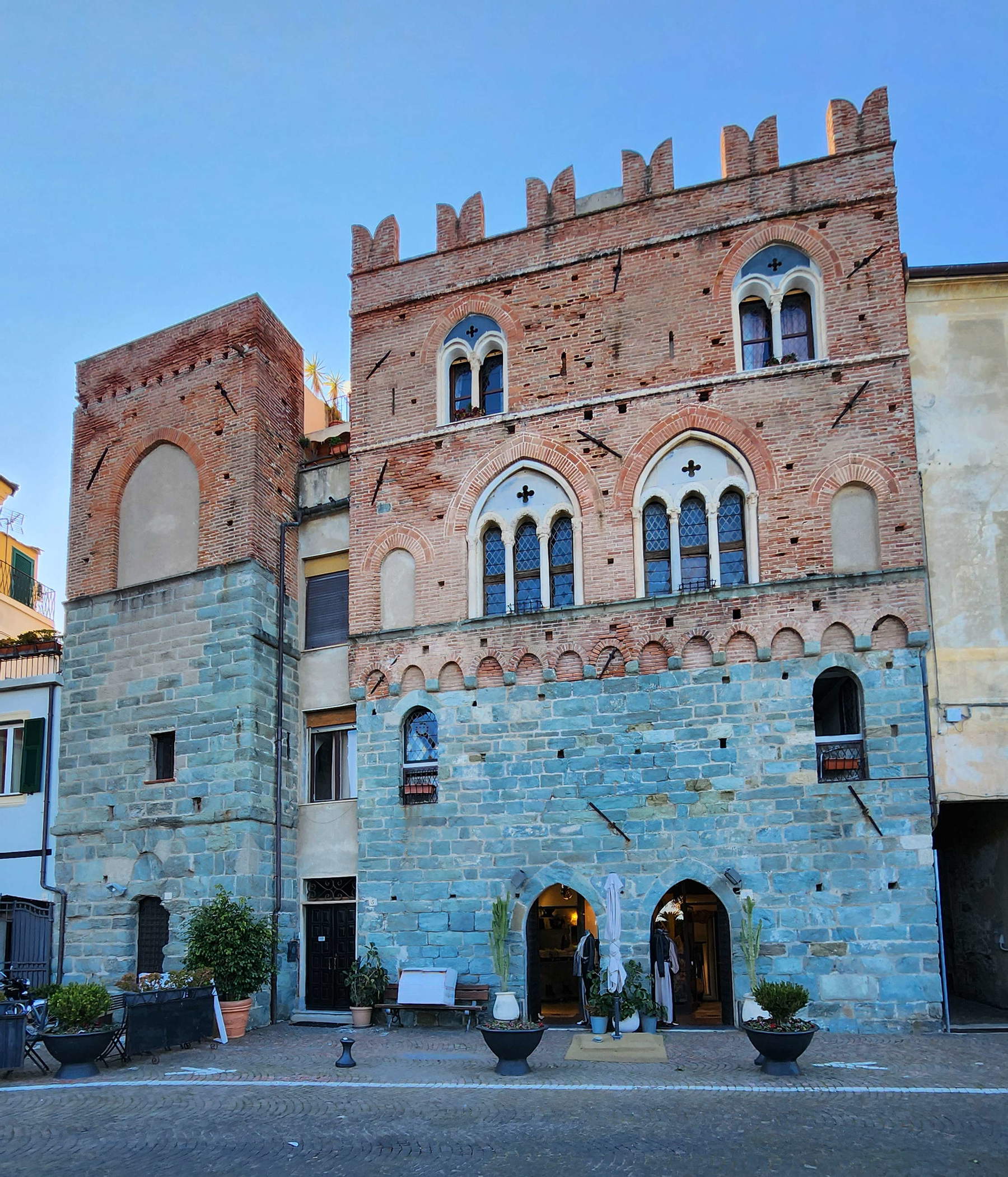
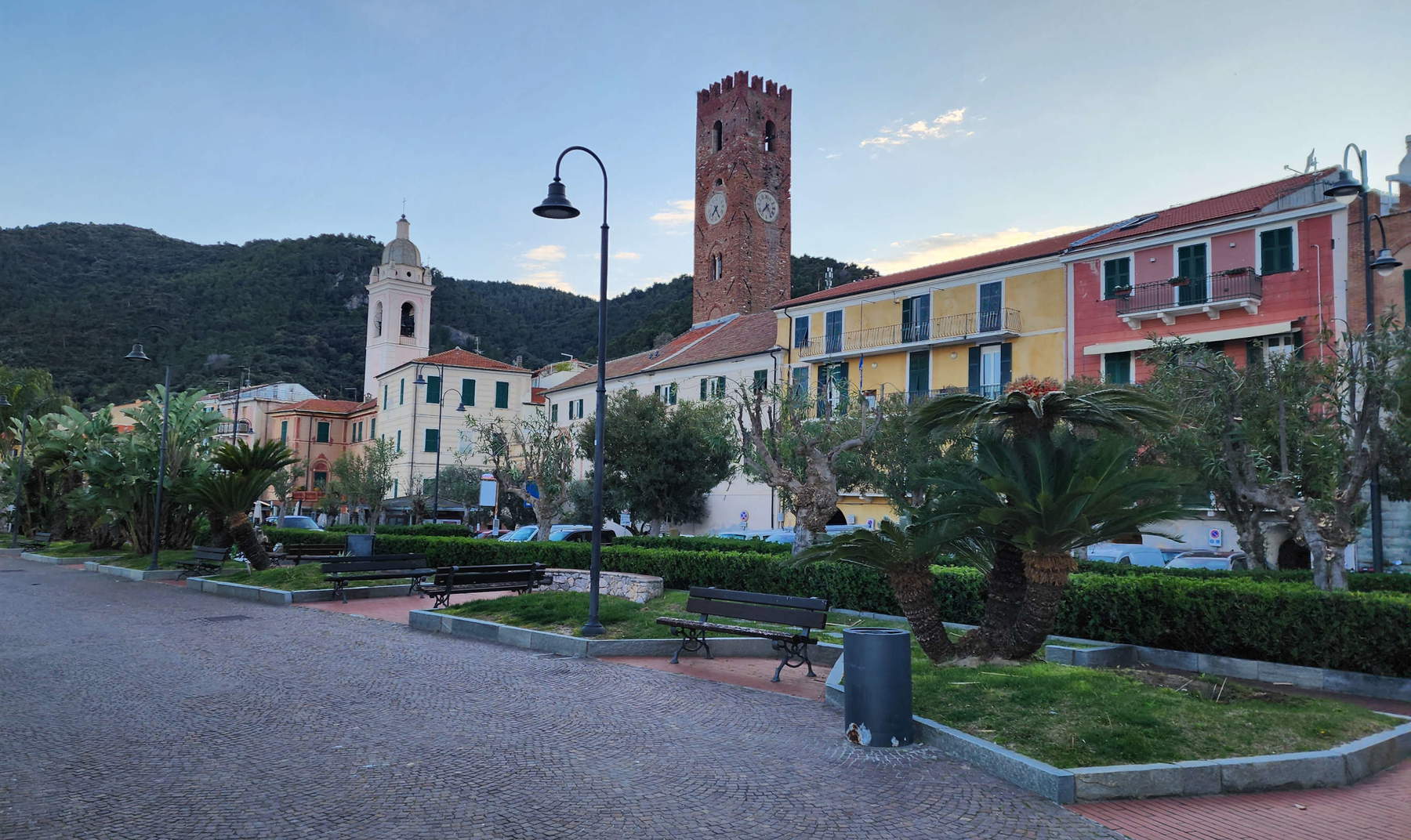
Today, the road network has become more practical: the Aurelia Highway handles the flow of vacationers from Brianza and Turin in the summer, unloading them onto that timid strip of beach that stubbornly remains, in part, the domain of fishermen who keep their boats beached, and partly for beachgoers—a strip of fine sand mixed with gravel that, according to local tourism agencies, offers a wide selection of well-equipped beach resorts, ideal for a relaxing vacation, ideal for families with children, and a sea of crystal-clear waters awarded the Blue Flag. On the boardwalk, a merry-go-round set directly across from the medieval buildings—the kind you used to see everywhere in the 1990s, with spaceships spray-painted with cartoon characters—immediately reveals the town’s current identity. Most people, then, go to Noli to take their children to the beach, and there’s no reason why it should be any different. And yet, if you happen to visit out of season, Noli, brimming with ingenuity, reimagines itself as the fifth maritime republic. Just like Gaeta, just like Ancona, just like Ragusa in Dalmatia, just like all those coastal cities that, around the 13th and 14th centuries, had autonomous charters and, five or six centuries later, had the misfortune of being left out of the official canon—of being excluded from the Italian Navy’s coat of arms and from the map lessons taught in elementary school. The residents, then, sought to assert their opposition to the official historical narrative by placing the city’s coat of arms right in front of those of Venice, Amalfi, Genoa, and Pisa on the cobblestone square in front of City Hall, and seeing that jumble of stones, it’s natural to think the matter is serious. But perhaps to realize this, it’s enough simply to cast your eyes upon those two large pointed arches of the building, upon the blind arches that surmount them, and upon the massive, square structure of City Hall: practically nothing remains from the 13th–14th centuries, but the people of Noli throughout the centuries have worked tirelessly to ensure that at least its façade was preserved and continued to harmonize with the Civic Tower standing beside it—a tower that has remained more or less intact since the days when Dante lamented the arduous journey down to Noli.


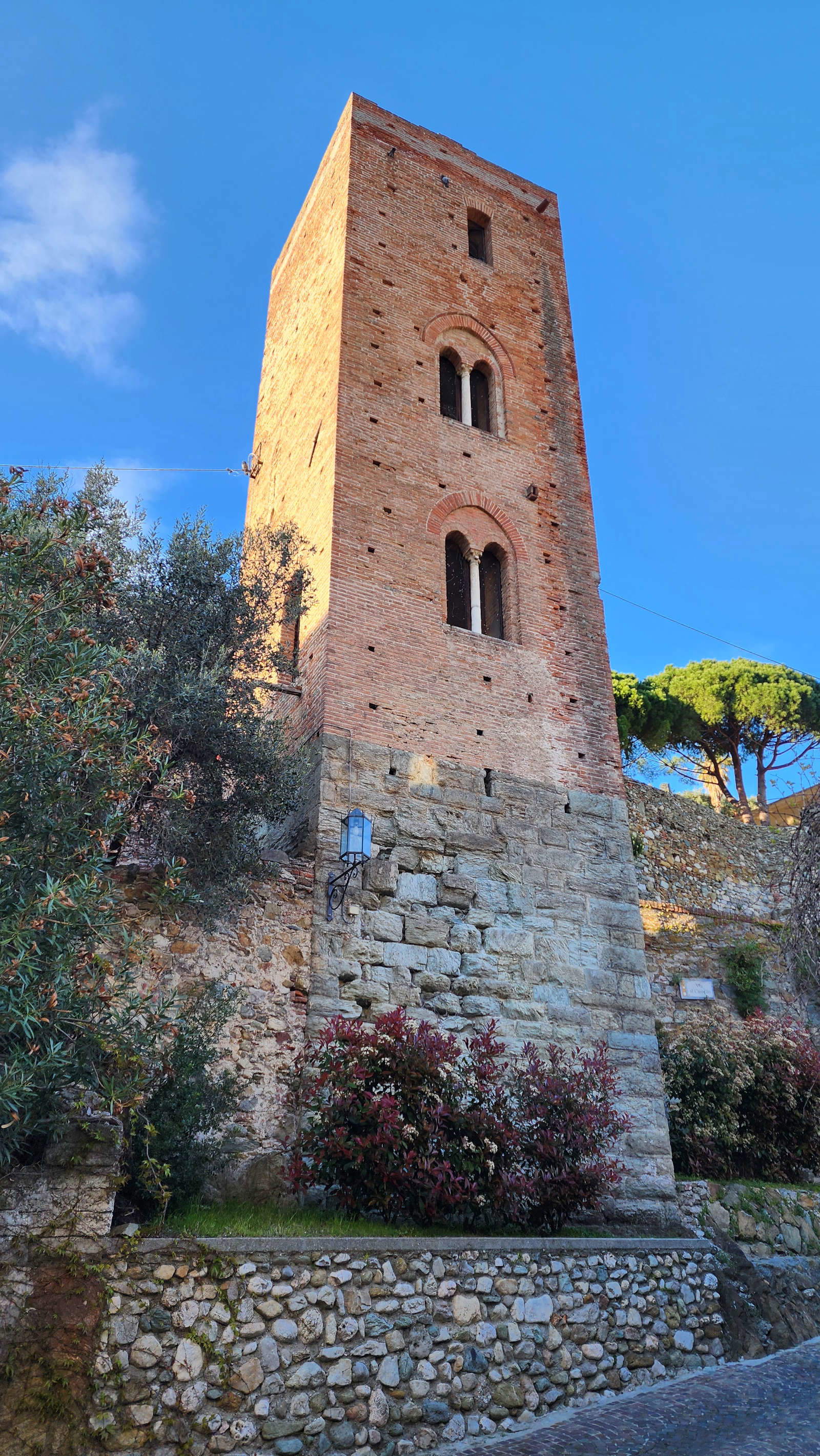
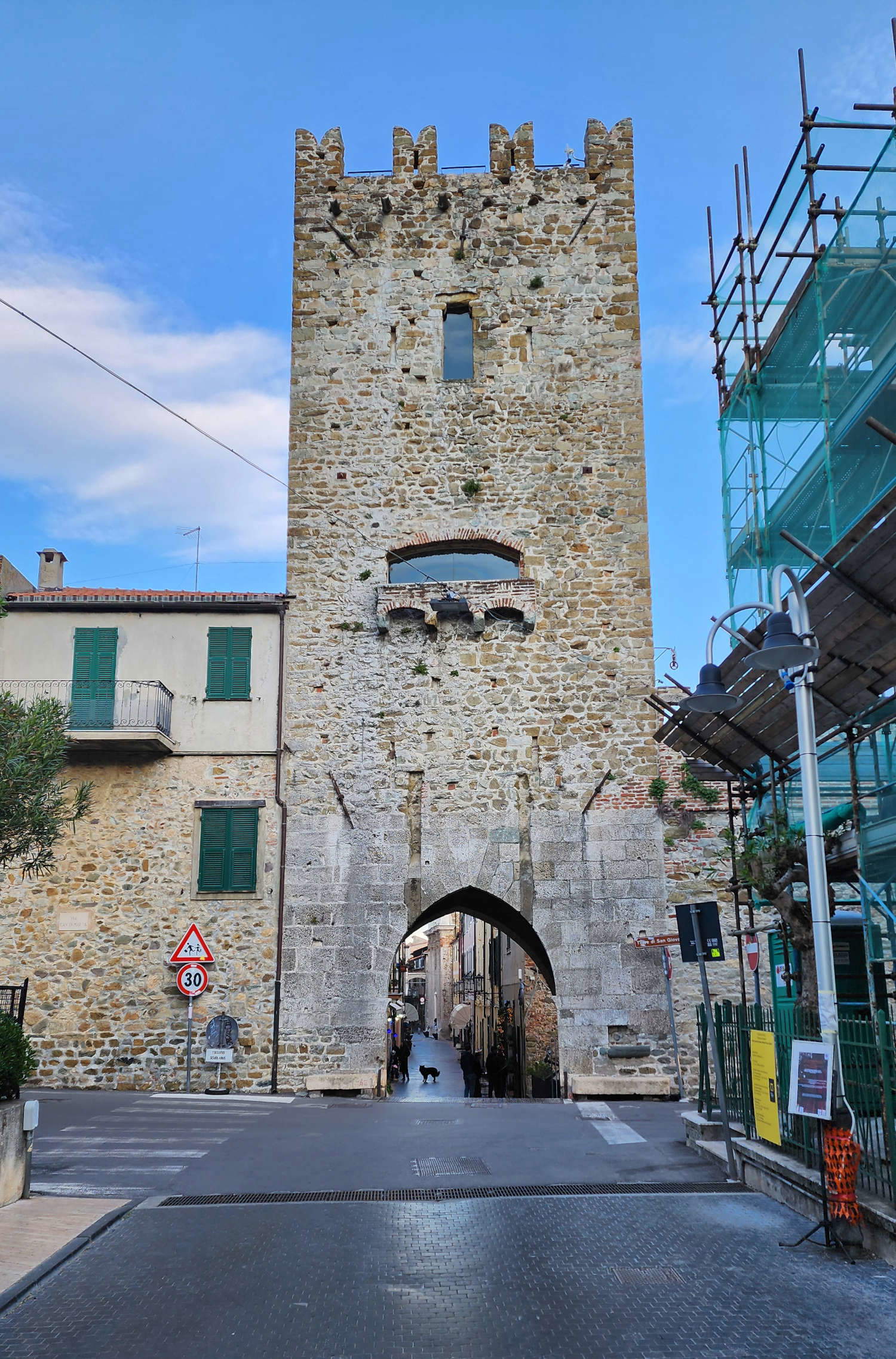
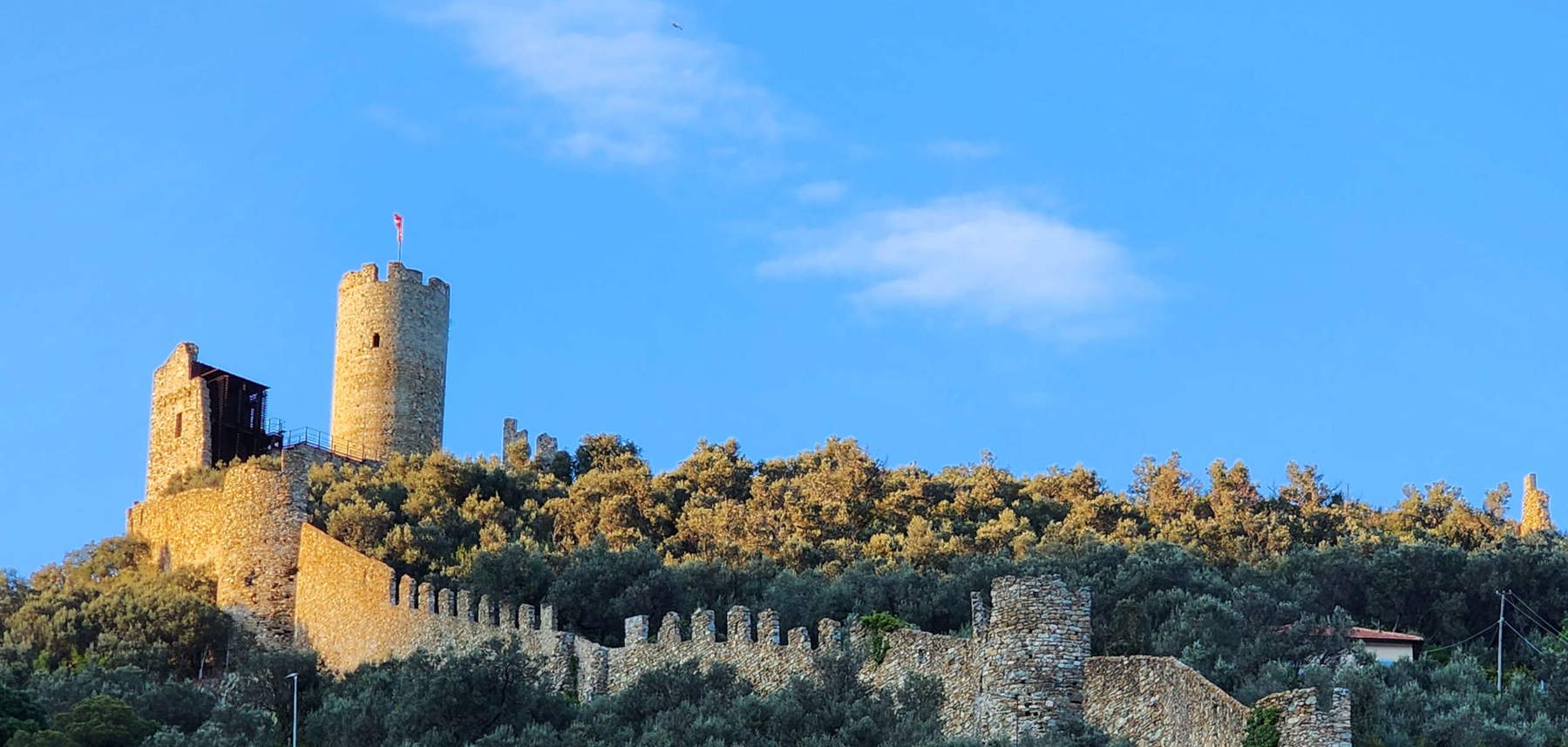
The towers are among the few things remaining in Noli from Dante’s time. Using my imagination—and making the obvious, well-worn appeal to local mythology (as with all myths, here too a single verse is enough to stir the imagination)—one could picture the poet, on his way to France, from some hill around Noli, manages to catch a glimpse of the town’s silhouette: he would have seen, nestled between the woods and the sea, some seventy tapered brick towers, signaling even from afar the prosperity of a town that thrived on its maritime trade. Sources confirm that in the 13th century there were seventy-two towers in Noli, and we must imagine a fleet of equal size, since according to municipal laws, anyone wishing to erect a tower—whether a noble or a wealthy merchant (these were the categories that owned the towers)— had to own a ship. A merchant ship or a warship—it didn’t matter: but a ship was required. Today there are no more ships in Noli: at most, you see fishermen’s rowboats, good only for souvenir photos. And four towers remain: the Town Hall tower, and two of the towers that once stood above the city’s entrance gates (the Porta Papona Tower, the only one that remains as it was in the 13th century even on the inside, since it was never inhabited, and the Torre San Giovanni: both were erected at the behest of the town council when it was decided to encircle the city with a wall, just in case the ruggedness of its mountains wasn’t enough to deter anyone who might try to take it from the ground), and then the Quattro Canti Tower, thirty-eight meters tall, the highest of them all. For those already inside Noli, they are hard to spot, because Noli likes to hide itself. It is a town that dislikes geometry; it is a dark and introverted town; it is a town that has remembered every moment of its history and shrouded it in the silence of its narrow alleys, in the darkness of the tiny squares that open up just where you thought an alley ended, with the shouts of children playing with a ball in who knows what nook, with the tolling of a bell whose location you can’t quite pinpoint. Noli itself is a shadow.


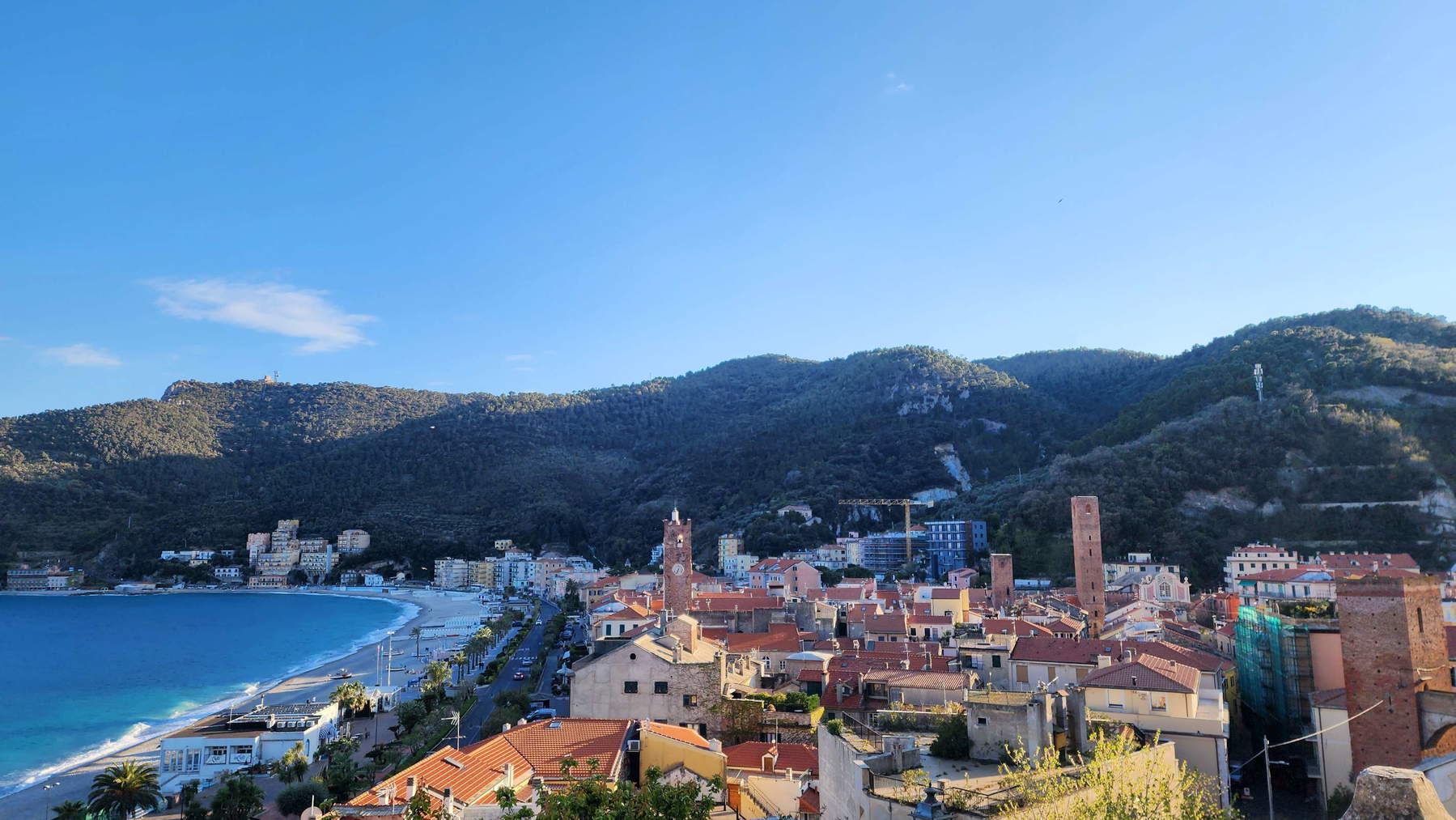
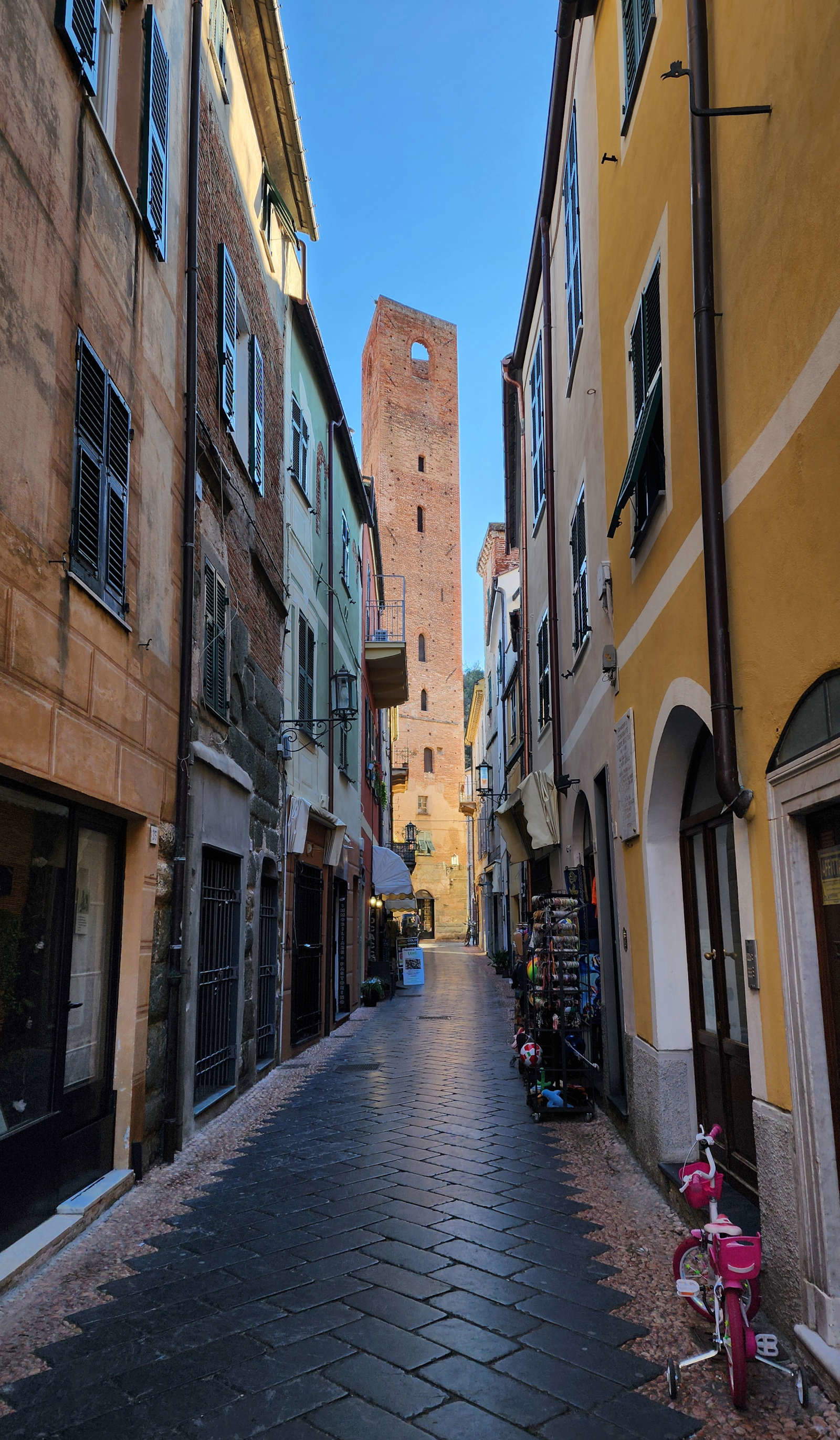
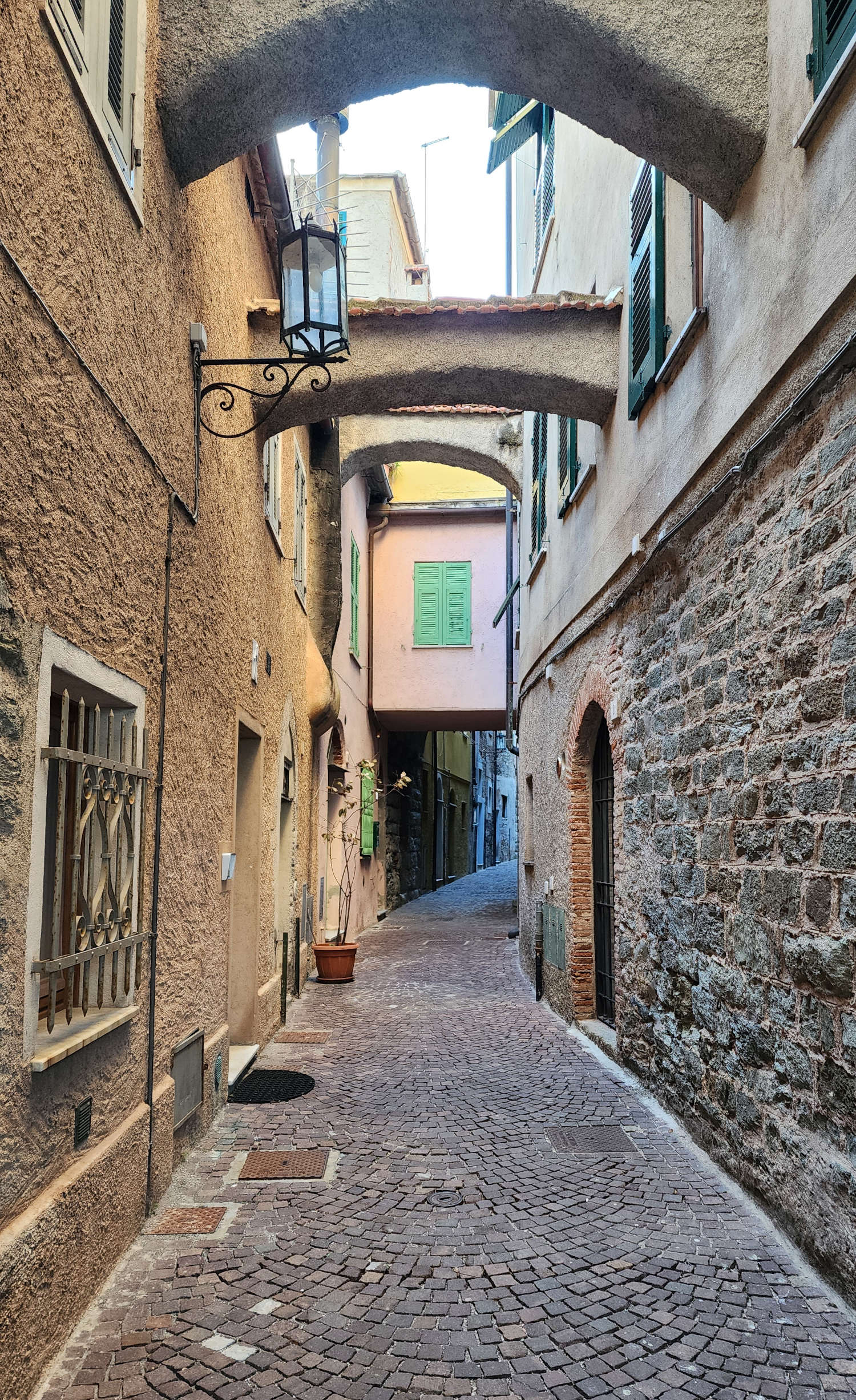
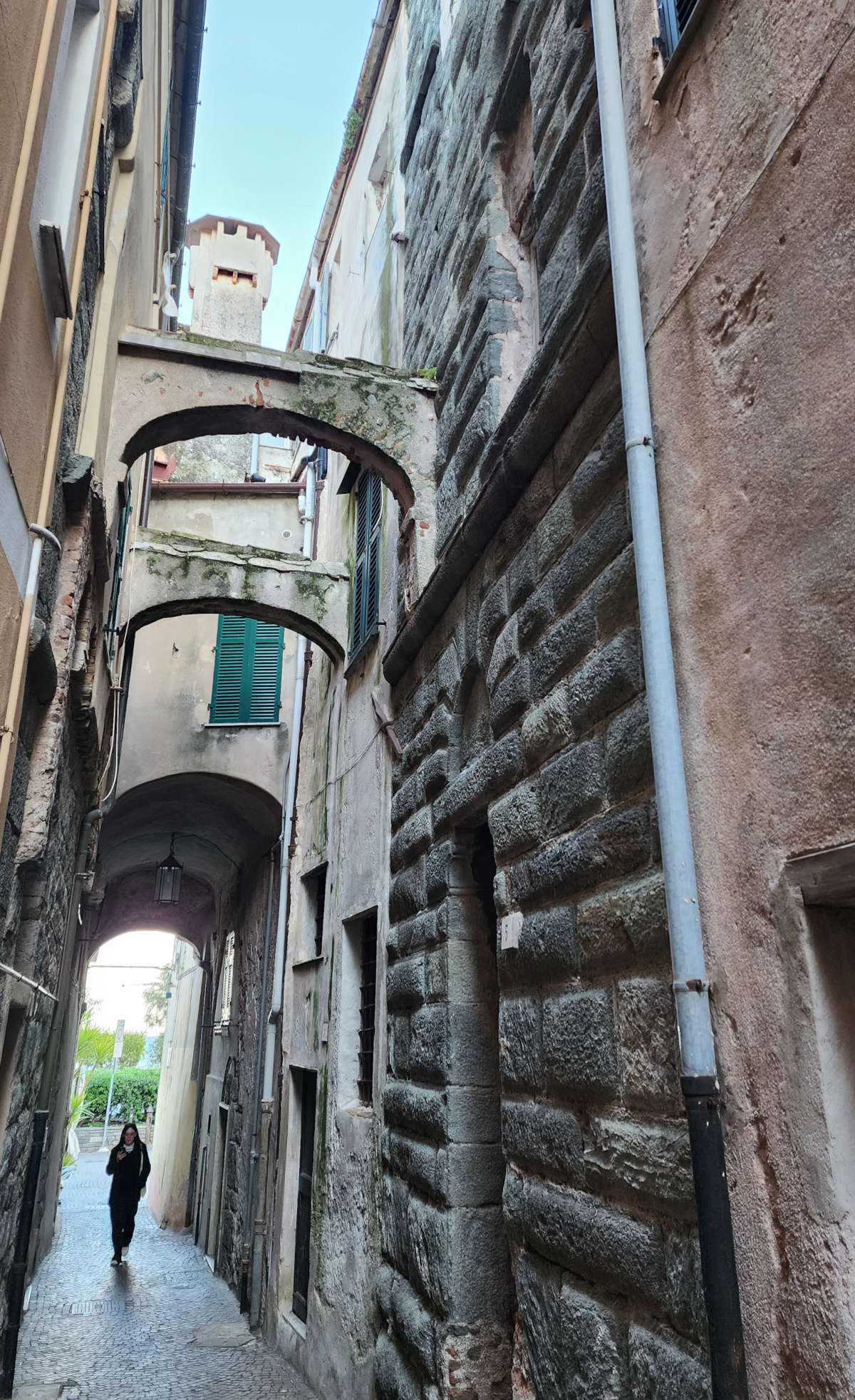
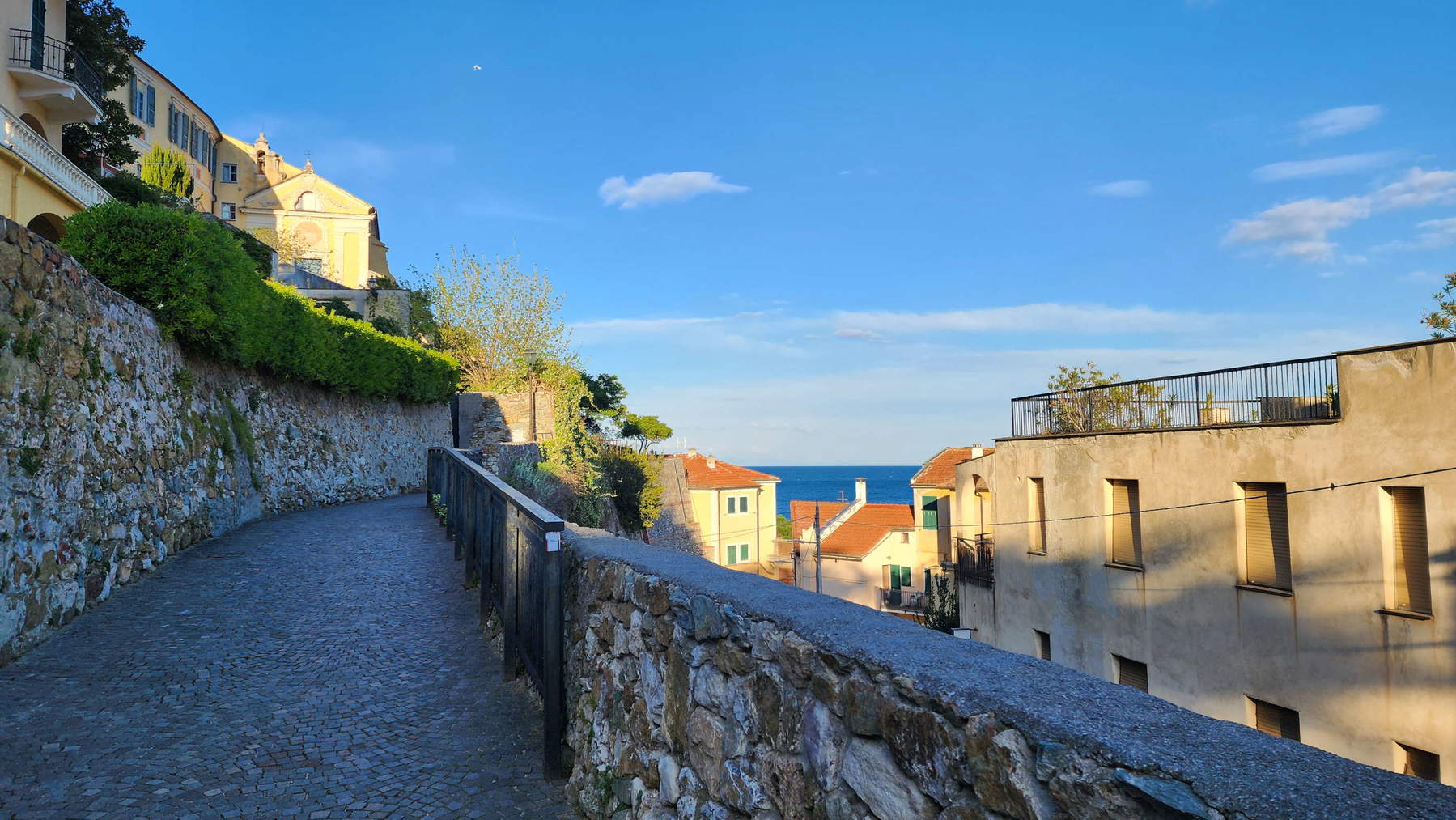
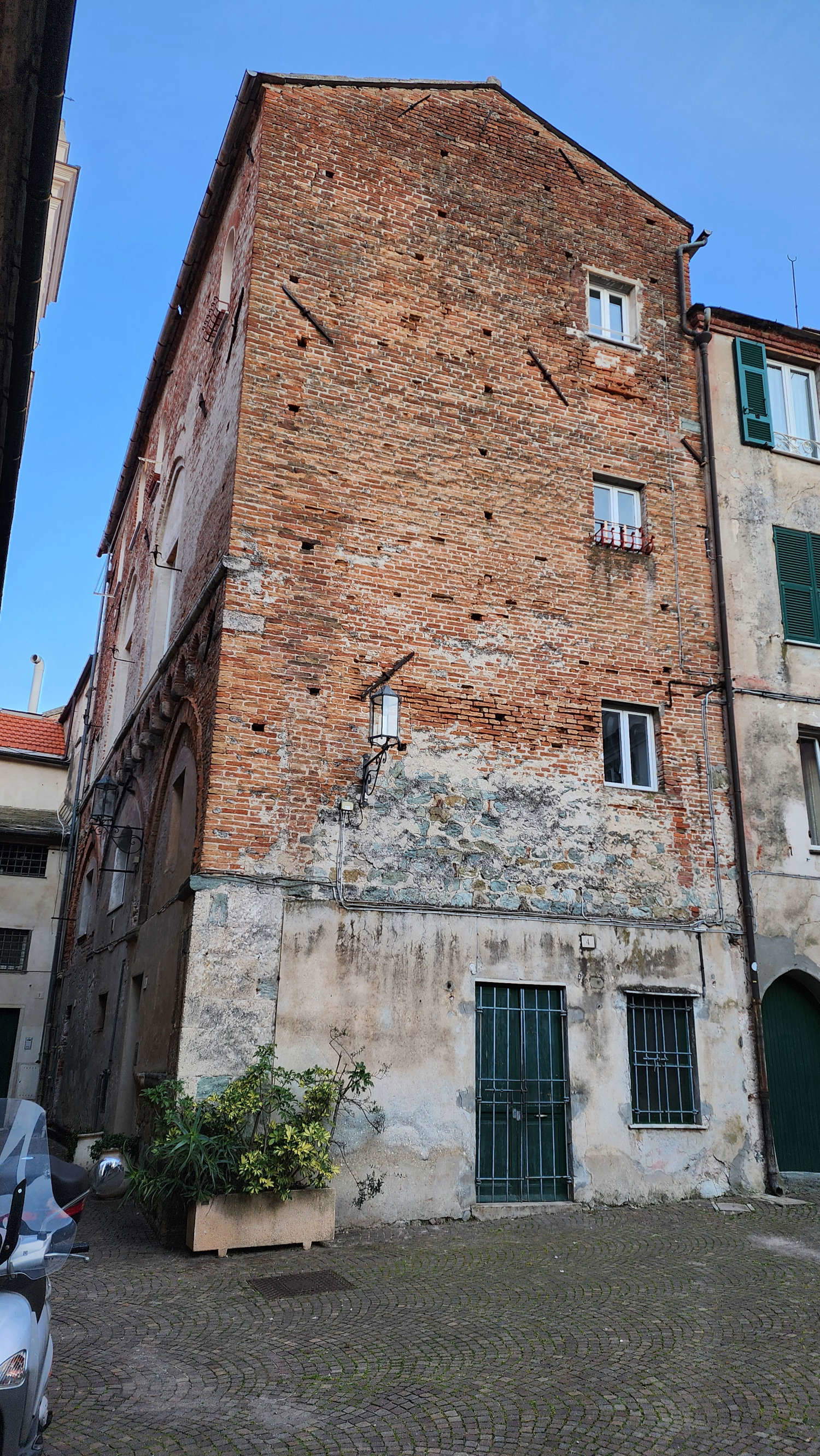
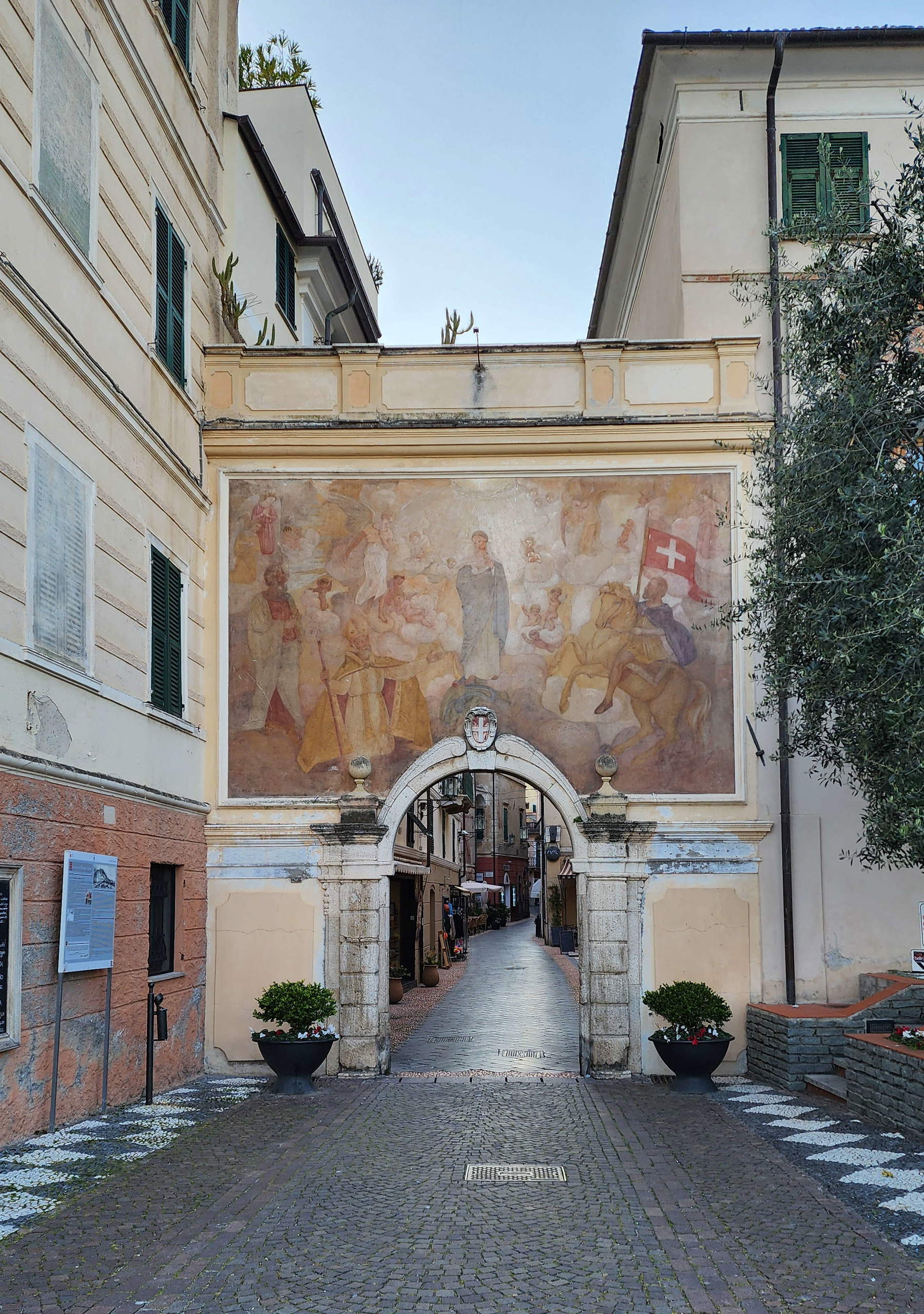
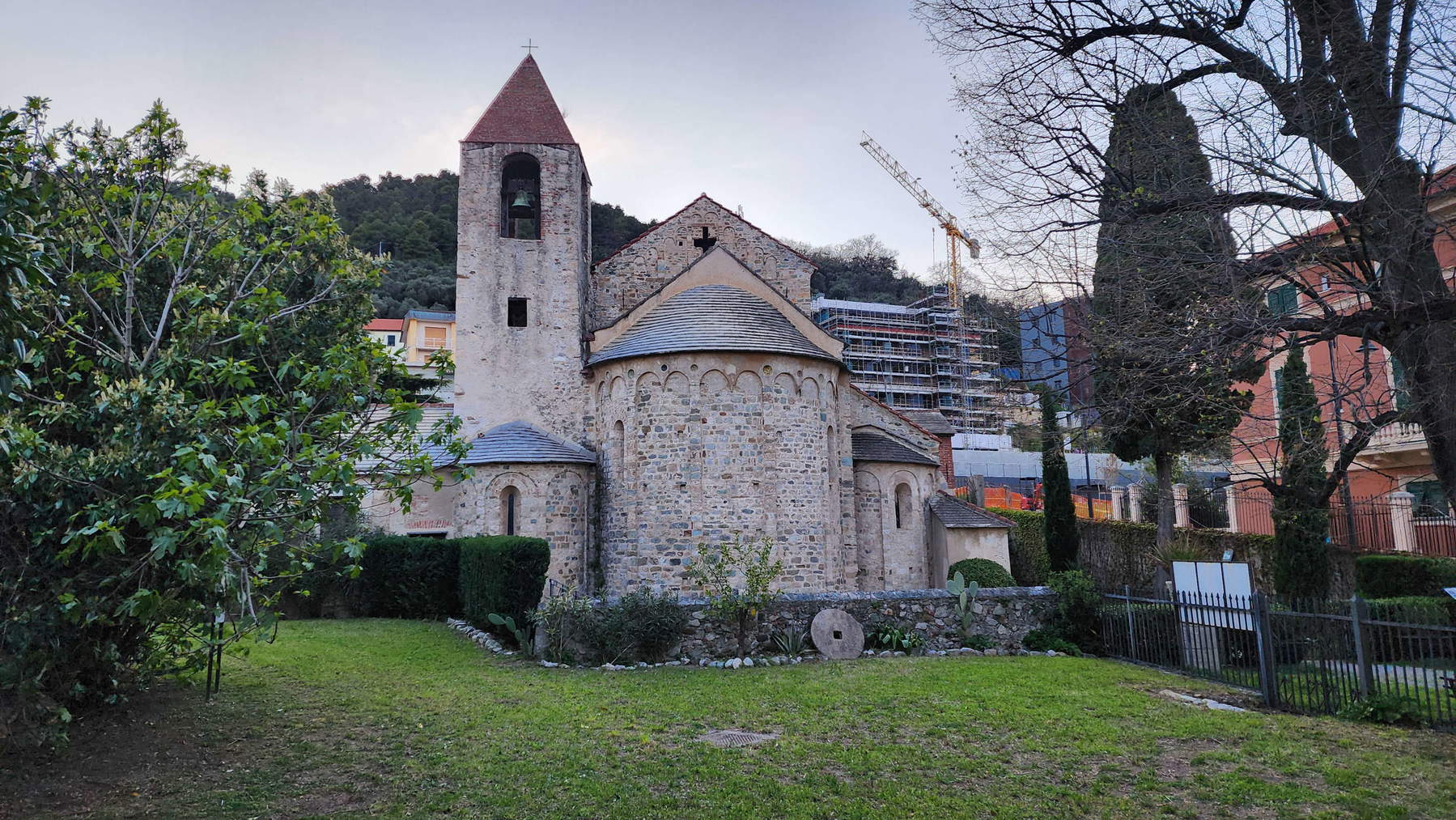
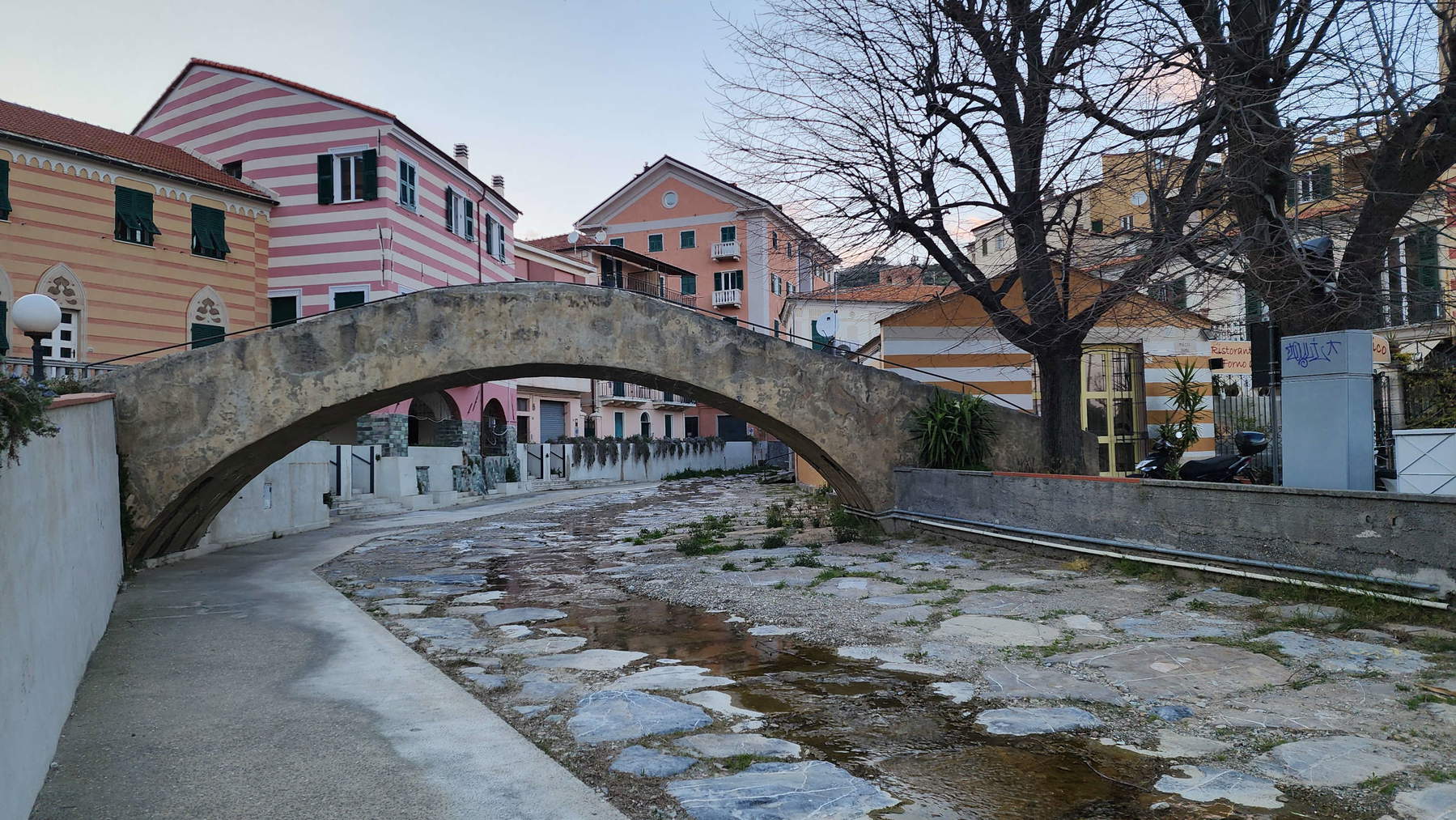
Anyone hoping to find more remnants of Dante’s time would have a hard time: there is the Castle of Monte Ursino, of course, but what you see today is no longer the medieval fortress, but the ruins of a compact, heavy, imposing 16th-century structure. The Bishops’ Palace below the castle, however, is a different story—it dates from the late 16th century and was rebuilt two or three centuries later. The same goes for the little Church of the Grazie you come across along the climb: you go there to take photos of Noli from above and because, in what used to be the bishops’ garden, there’s an excellent cocktail bar (trying not to get run over on the way there, because beneath what remains of the walls—once you leave Porta Papona to climb up to the Bishop’s Palace—they’ve built a very busy state highway, and it just so happens to be the only route to the hamlets further up the mountain). There’s the Town Hall, which served as the seat of government for the Republic of Noli, though it’s said to have been extensively remodeled over the centuries. Just off the main street, nestled among the middle-class villas, stands the Church of San Paragorio, the original cathedral, which is one of the most important Romanesque buildings in Liguria; inside, there is also a 13th-century crucifix similar to the Volto Santo of Lucca, but we see it as it was restored by Alfredo d’Andrade in the late 19th century; moreover, it’s more likely to be closed than open, so you end up wading through the little stream that runs along the edge of the town center (spanned by a small stone bridge pompously called “Old Bridge”: the people of Nola must have thought there were already too many “old” bridges, so they had to find another adjective) and head back to hide among the alleys in search of something else. There are a few tower houses, at most, but you have to go to the trouble of imagining them without the embellishments that often weigh them down: Pagliano House is the most striking, but it dates back to the 14th century, and then in the early 20th century an assistant to Alfredo d’Andrade worked on it, so it’s no longer clear what’s Gothic and what’s Neo-Gothic. Repetto House would be a good choice—in fact, it’s even more interesting than its counterparts—because it was built on the green-stone stump of a 12th-century tower, but it’s the least striking of the lot. Casa Maglio and Casa Garzoglio appear to date from the 13th century; little remains, but at least one can see what the homes of the people of Nola who lived at the beginning of the Republic must have looked like: buildings with a solid stone foundation and a more open-plan first floor, clad in terracotta and graced with double- and triple-lancet windows. There is the Piazza Gate, but at the end of the 18th century it was frescoed by a Spanish painter, a certain Vicente Suárez—a “meteor,” as one art historian put it, Massimo Bartoletti, “who, before disappearing—in the space of a couple of years or so—produced a rather substantial number of religious paintings distributed between Noli and the Balagna,” that is, the area of Corsica, rugged, sparsely populated, and densely forested, surrounding Calvi and Mount Cinto: evidently, Suárez was drawn to inaccessible places.
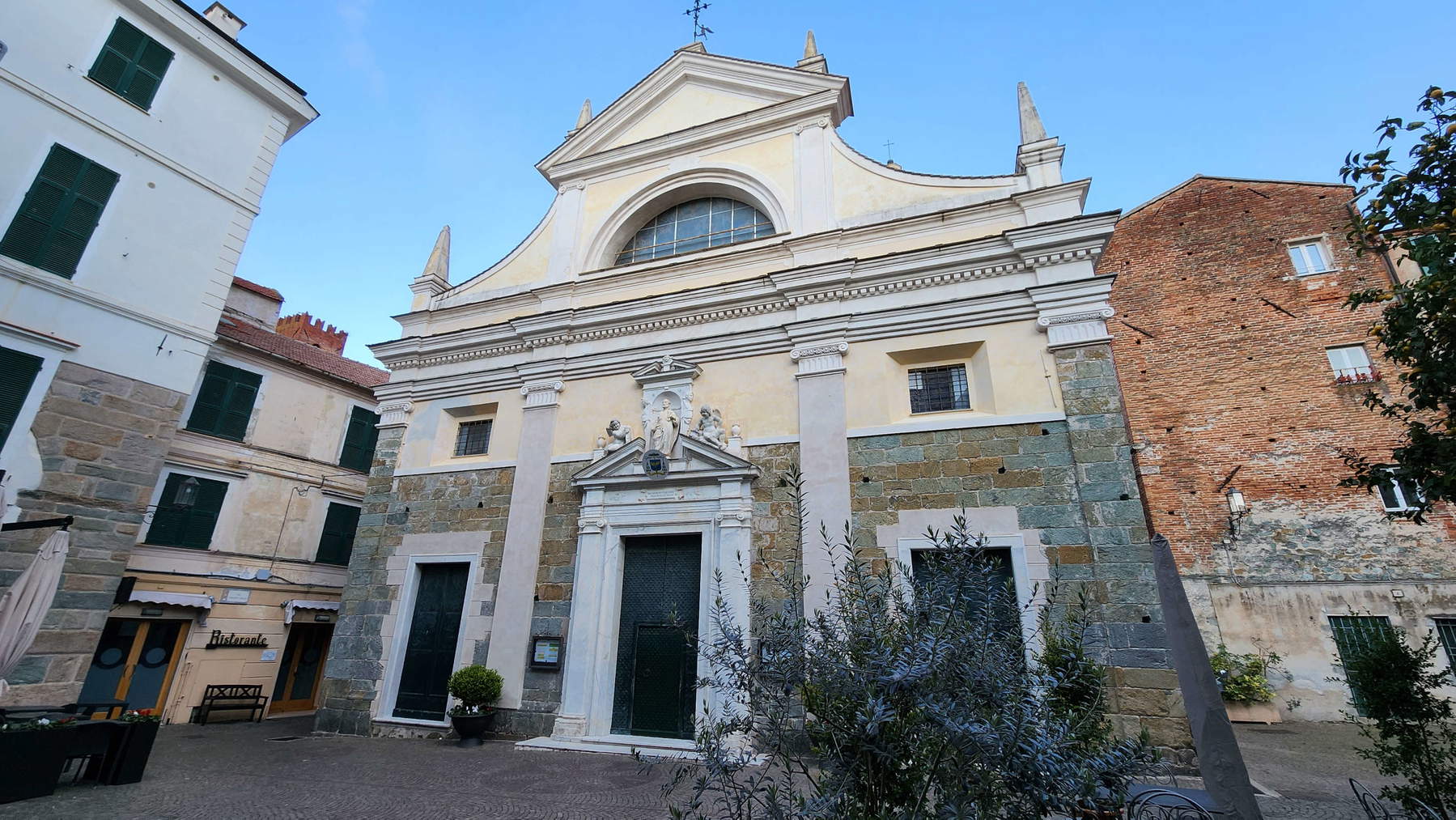
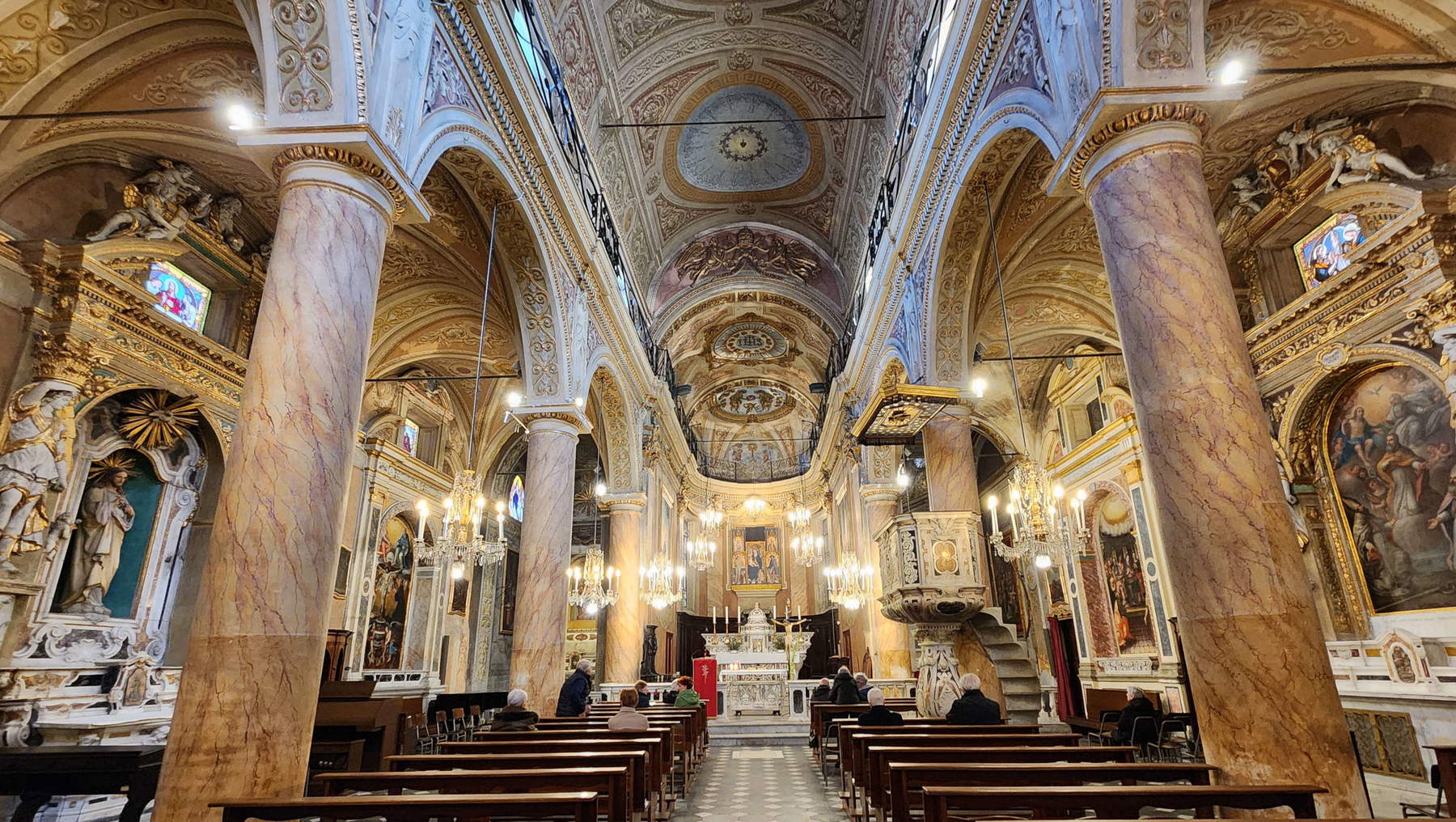
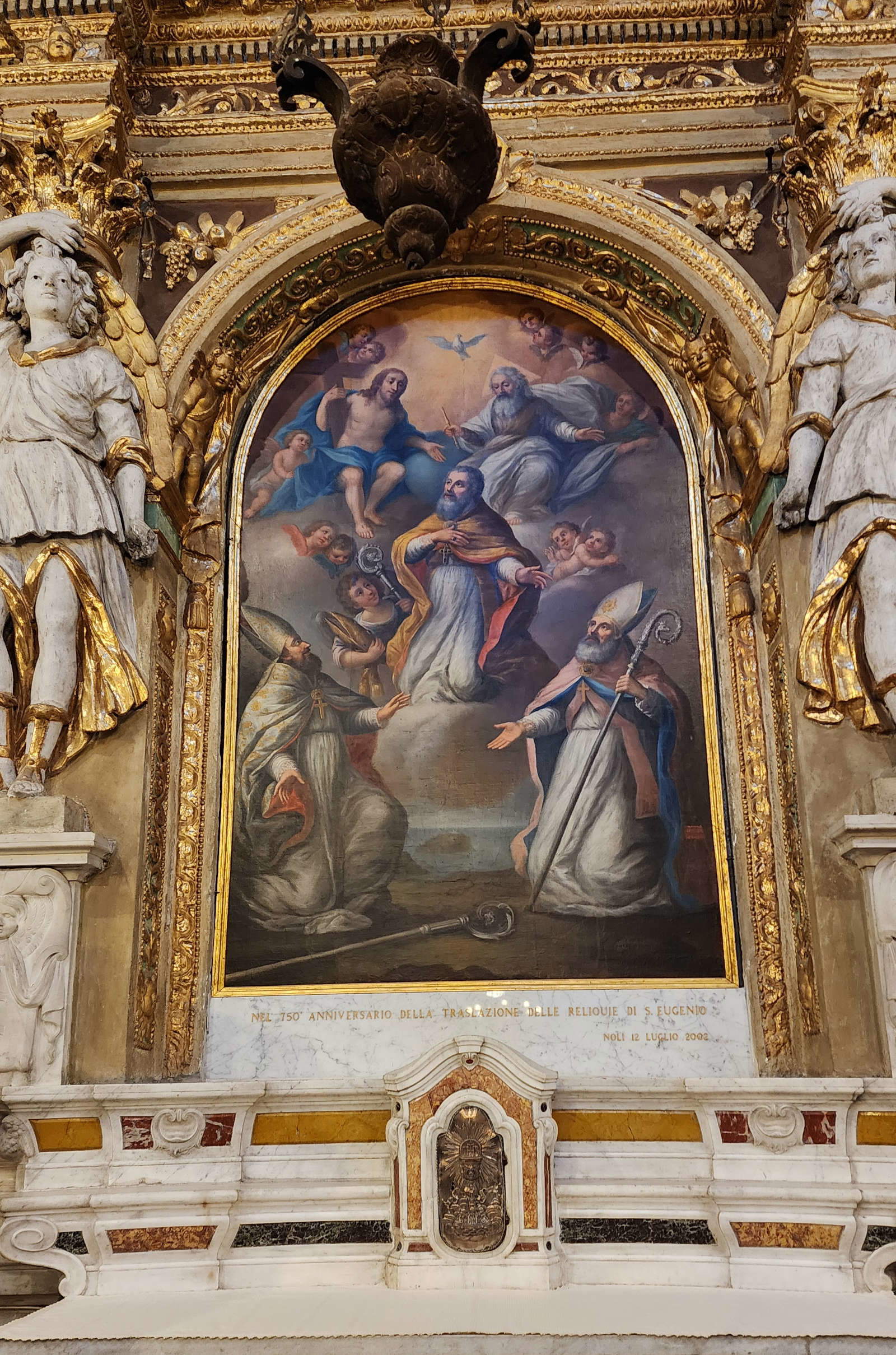
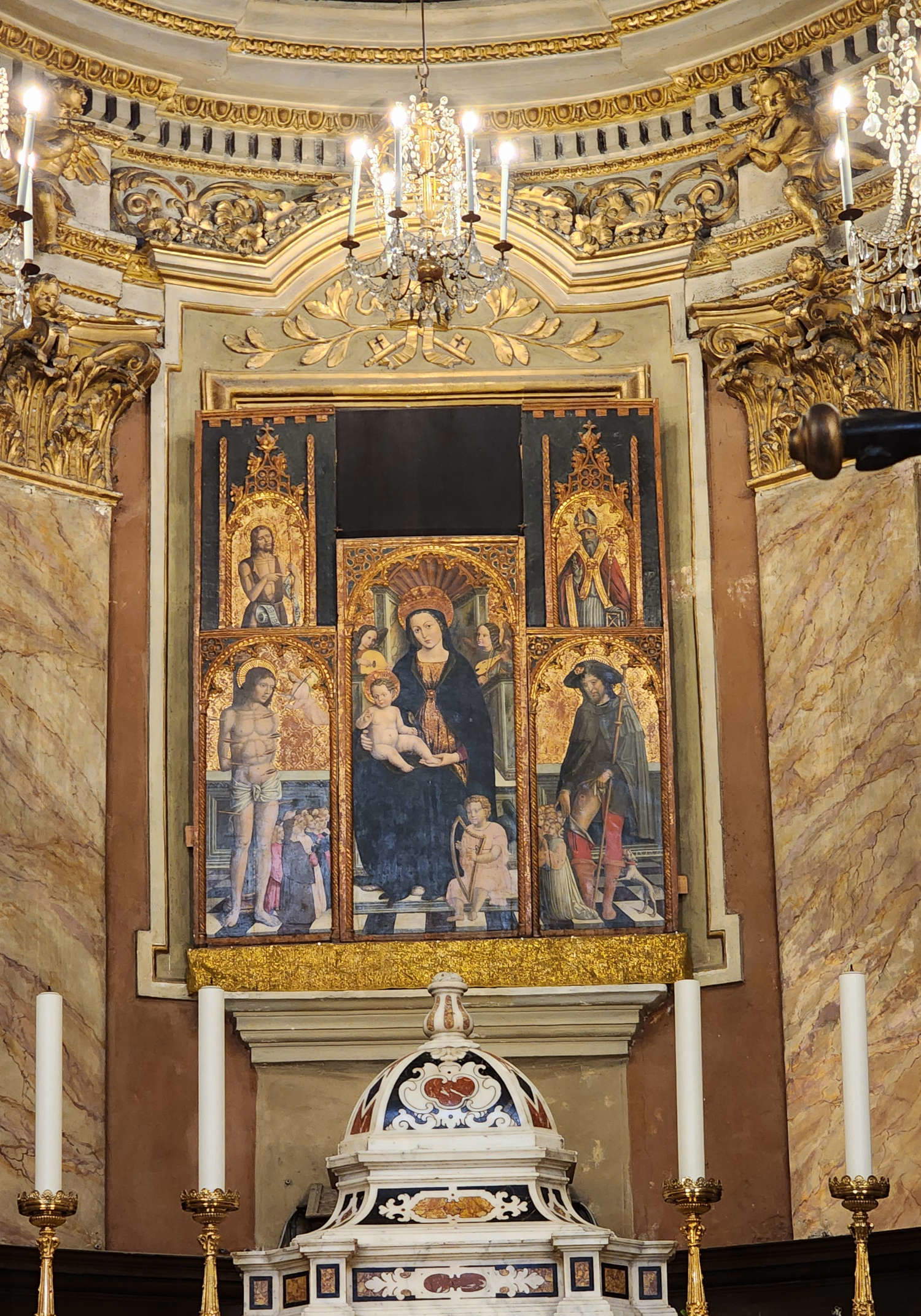
In Noli, Suárez painted the image on the Piazza Gate and a few works inside the beautiful Cathedral of St. Peter, which began to become Noli’s most important church after 1572—the year in which the bishop’s see was transferred here by papal bull of Pope Gregory XIII: modest altarpieces, to which the people of Noli were evidently very attached (there is also a painting depicting the glory of the patron saint, Saint Eugene), so much so that they granted the Spaniard citizenship on August 6, 1788; little else is known about the life of this fleeting figure. Inside the late-16th-century cathedral—which prefers to keep a low profile and would gladly remain tucked away among the narrow alleys were it not for the bell tower that signals its presence—one does not find oneself there out of interest: one enters the Cathedral almost by chance, or at most out of that sense of obligation that compels every visitor to a historic center to slip into the church perceived as the most important. There are works by Suárez; there is a late-17th-century Baroque pulpit, the work of a certain Anselmo Quadro; there isan Annunciation by Giovanni Battista Maragliano, who attempts to emulate the better-known Anton Maria—who was his relative—and then, on the high altar, there is a polyptych that comes from the Bishop’s Church and which tradition attributes to Vincenzo Foppa, likely due to a vague resemblance between the features of the Virgin—seated on a marble throne holding the Child while angels around her play lutes, viols, and harps—and those of the Madonnas by the Lombard master. The problem is that this, though delightful, polyptych is too rigid, too antiquated, too inflexible to be the work of the master who frescoed the Portinari Chapel, who painted the Saint Sebastian in Brera, and who created the Madonna of the Carpet: it is, therefore, an attribution to be rejected without much hesitation—an attribution that cannot be taken seriously. If a name must be found, the most plausible would be Lorenzo Fasolo, whose style is similar to that of the polyptych now housed at the Pinacoteca Civica in Savona—though it originates from the Santissima Annunziata in Spotorno, the town just beyond Noli, and which has a structure identical to that of the Noli polyptych, with the same layout, the same proportions between the panels—even the frame seems almost interchangeable. The one from Spotorno has survived in far better condition than what we can, without much doubt, consider a sort of counterpart from Noli—which, however, appears more damaged, more faded, and more worn. The evidence, in any case, all points to Fasolo: the features of the figures, especially the female ones; the perpendicular way in which the painter renders the drapery, which looks almost like heavy canvas curtains; and the sculptural musculature. The Noli polyptych was evidently created to give thanks to Saints Sebastian and Roch, depicted in the side panels—saints who protect against disease—for having spared Noli from some contagion: the worshippers are shown at the saints’ feet, praying and facing the Virgin Mary. A fascinating work, certainly, but also a rather common one for its time—a work created for the devotion of a small community, and therefore not of such high quality as to suggest that the master himself was responsible for it: it is more convincing to think of it as a fine workshop piece, or a work painted by one of Lorenzo Fasolo’s followers active along the Ponente Riviera.
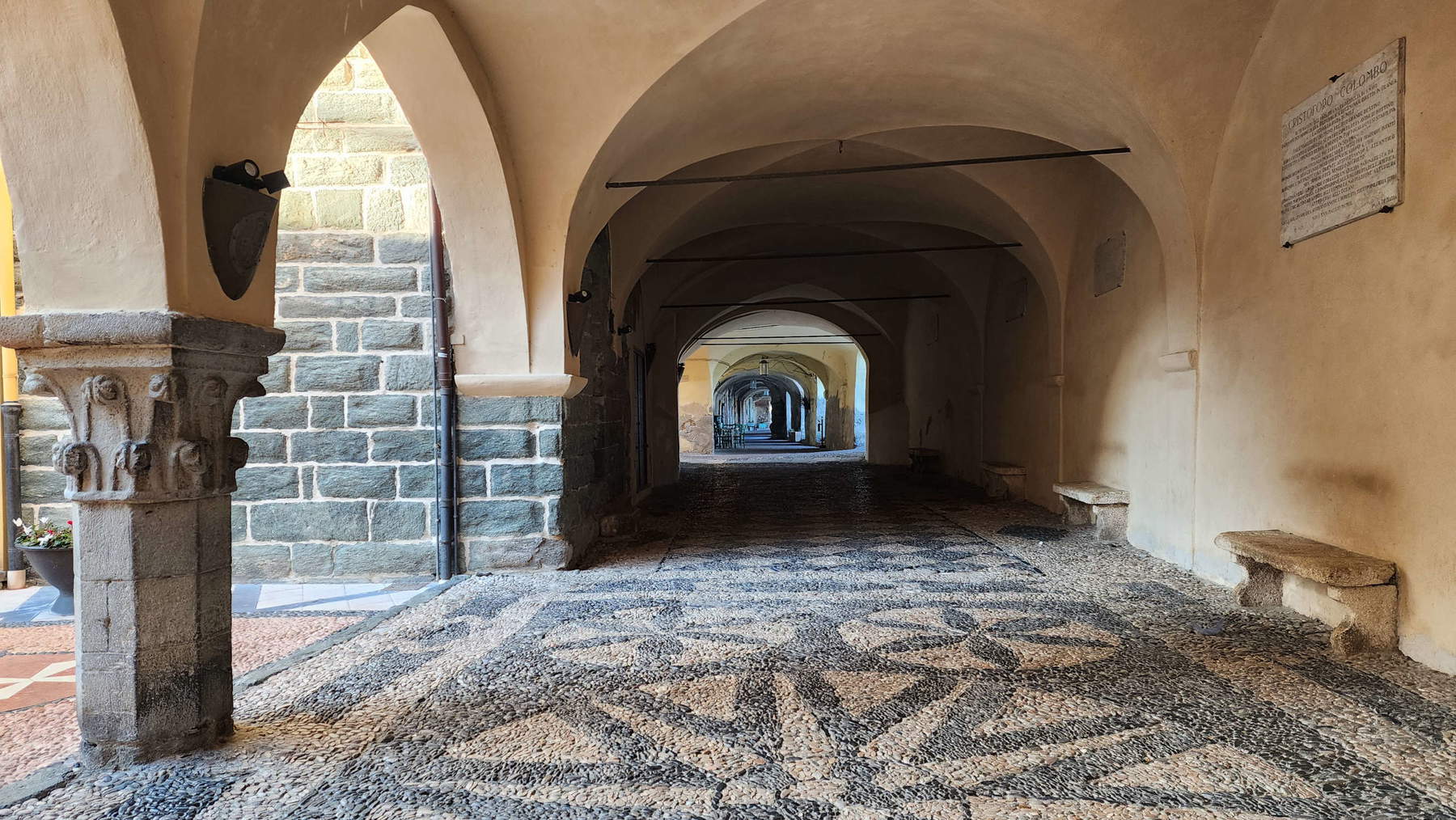
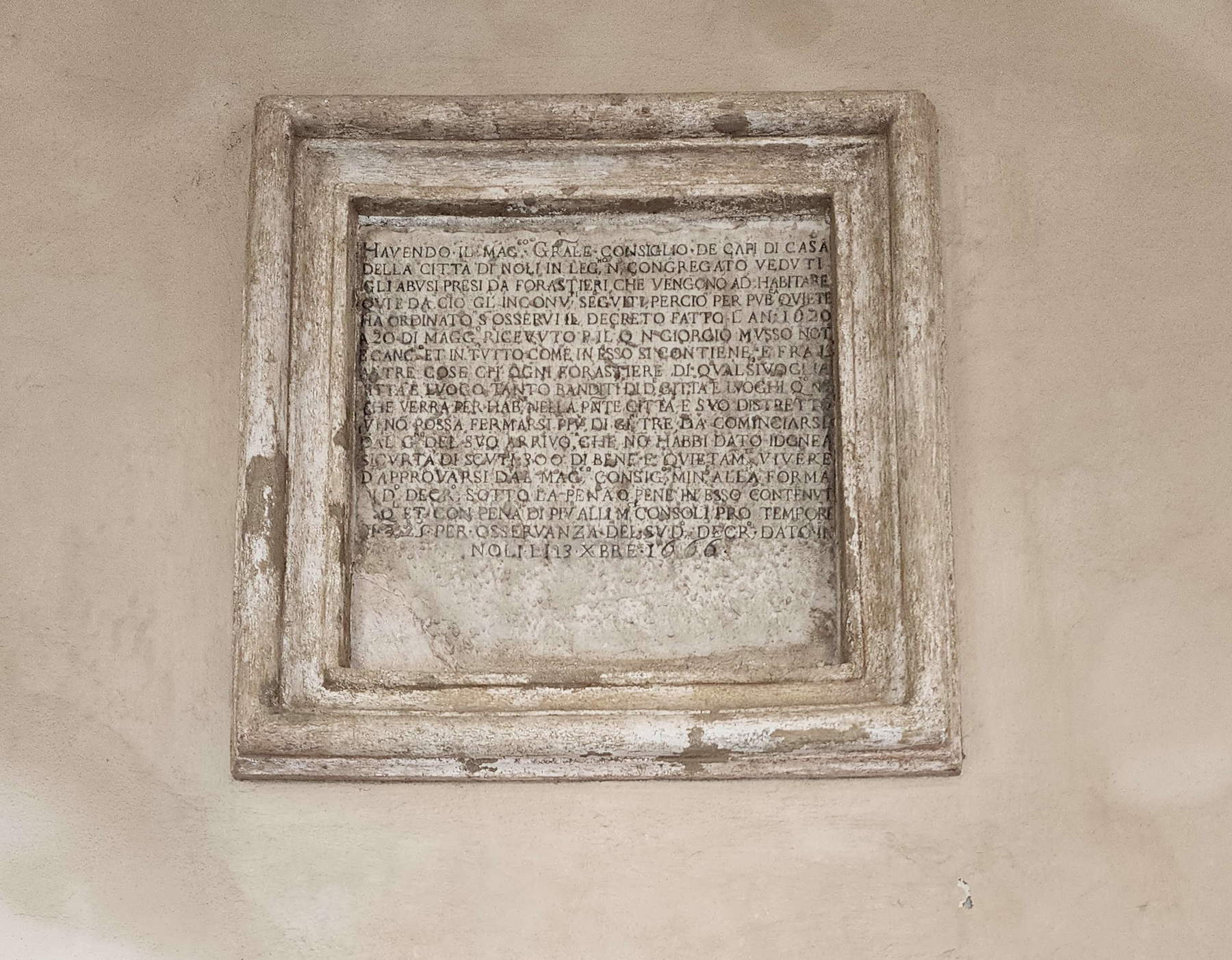
And in any case, for the faithful who pray before this polyptych—and who are perhaps the only ones, along with art historians, who might get worked up over its attribution—a Vincenzo Foppa is probably just as good as a Lorenzo Fasolo, or one of his followers, and that’s perfectly fine: outside of museums, one may still be fortunate enough to attempt to write a history of art without names. And in Noli there are no museums: its history therefore remains hidden amid its shadows, and to seek the echoes of its trade, its shipyards, its bishops, its mayors, its families, its wars, the deliberations of its Council of Consuls, of the travelers who admired it, of the sailors who set out from its shores to venture into the oceans when the sea still smelled of the unknown—well, to hear these sounds, one might need to rummage through the stones and bricks. But stones and bricks, you can bet on it, have little desire to respond. The most one can find is some cracked sign pointing out the main monuments (and, in rare cases, recipes for local dishes once you’ve finished reading about the history of the Bishop’s Palace or the Papona Tower), or at most a 17th-century plaque beneath the Loggia of the Republic of Nola, which states that no stranger could stay more than three days unless in possession of a guarantee—issued by the authorities—attesting that he was a person of good character; otherwise, he would have to pay a fine and risk additional penalties. The plaque is dated 1666, but the decree to which it refers, as stated, is from 1620, and now that more than four hundred years have passed, one might dust off that decree and tailor it to the needs of the contemporary tourist. The mayors of all the coastal towns should mark a trip to Noli on their calendars.
Some might conclude that hospitality isn’t exactly the town’s specialty. And in fact, here the tradition of driving out strangers runs deeper than that of stuffed anchovies—perhaps rivaling even the tradition of seine fishing. And yet, if you look closely, it’s not entirely true that Noli is a city of shadows. Perhaps Camillo Sbarbaro was right: it’s simply disdainful of the land, and it likely became so from gazing at the sea like a wounded seagull, from having its towers gnawed away by the wind. Its gloom, then, dissipates on certain winter or spring days, when you happen to be in Noli and see only the residents—those who have stayed—wondering what to do with all the empty houses left in the town center, what to do with the abandoned hotel near the sea, on the road leading to the Bishop’s Palace, what to do with a housing stock that is very often not even within the means of those who live here: in forty years, the town has lost a third of its residents, and according to data the mayor presented to the town council a few weeks ago, two-thirds of Noli’s apartments are now unoccupied. And then, the gloom lifts as soon as you reach that boardwalk that everyone agrees on—the boardwalk lined with beach clubs, bars, restaurants, hotels, perfume shops, what remains of the newsstands, what remains of the souvenir shops for vacationers, what remains of the nightlife spots—that promenade that has the power to feel like a kind of conclusion to the story. Even if it’s not entirely clear what the moral of the story is. Assuming there even is one.
Warning: the translation into English of the original Italian article was created using automatic tools. We undertake to review all articles, but we do not guarantee the total absence of inaccuracies in the translation due to the program. You can find the original by clicking on the ITA button. If you find any mistake,please contact us.