




by Ilaria Baratta 22/07/2026



Categories: Works and artists / Disclaimer
An enchanted cup, a cunning hero, and a seductive sorceress: the story of Odysseus and Circe as told in the *Odyssey* has inspired artists across different eras. In the 19th century, Baldassarre Calamai and John William Waterhouse offered two contrasting interpretations: reason on one hand, seduction on the other. This article by Ilaria Baratta is the first installment of the new column “Robe da miti!”

A cup containing a magic potion, Ulysses and Circe: one of the most enigmatic episodesof the Odyssey takes place right in the sorceress’s home, where seduction, metamorphosis, and deception intertwine, captivating and inspiring the paintings of many artists—both well-known and lesser-known—for centuries. The story is recounted in Book X of Homer’s epic, which chronicles the Greek hero’s long sea voyage back to his Ithaca after the Trojan War. The “terrible goddess, with curly / hair and a sweet song” (as in Ippolito Pindemonte’s famous 1822 translation) dwelt in a “sublime palace,” built “of gleaming stones” and locatedon the island of Eea, traditionally identified with the Circeo promontory on the Lazio coast; a place that appeared peaceful and hospitable, since the mansion “overlooked a fertile valley” and was nestled in the woods—except that guarding the palace itself were “mountain wolves and tawny lions, whom she / had tamed with her potions,” which wagged their long tails. It so happened that Odysseus, having learned that all his companions, except for one— Eurylochus—had been transformed into boars by the sorceress, who, luring them with deceit, had offered them “sweet wine mixed with curdled milk, / white flour, and fresh honey; and a juice / that was deadly to them, for with this / each would drink the oblivion of his homeland,” set out for Circe’s dwelling with the intent of freeing his companions and convincing the sorceress to restore their human form. First, however, Mercury appeared to him, warning him and giving him advice on how to act once he arrived in the woman’s presence, but above all providing him with a true antidote, a “wonderful potion” made froma healing herb the gods called Moli, to counter the concoction the sorceress would immediately try to give him. Just as the winged god had foretold, as soon as Odysseus arrived at Circe’s dwelling, the “goddess with the beautiful braids” opened her radiant doors, invited him in, and, after seating him on a stool, handed him the enchanted drink, which he drank without it having any effect on him. The woman was taken aback: she realized at that moment that she was facing none other than “that shrewd Odysseus, / whom Mercury had always told me / was bound to come from Troy on a black ship”; she swore she would no longer plot against him, and invited him into her bed. The hero accepted the arrangement, so much so that he spent an entire year in that dwelling, together with his companions, to whom the sorceress had in the meantime restored their human form.
As mentioned, this episode served as inspiration for many painters for a long time, and it is curious to note how, in the same century—the nineteenth—though several decades apart and thus in two distinct historical periods, the myth of Circe gave rise to two opposing interpretations, two distinct interpretations that reflect a shift in the sensibilities of European culture throughout the 19th century: on the one hand, the trust in reason characteristic of Neoclassicism, and on the other, the attraction to mystery, symbolism, and the psychology of fin-de-siècle art. On the one hand, rigor, control, clarity, and rationality; on the other, enigma, sensuality, desire, and instinct. The same episode, therefore, manages to adapt perfectly to two different cultural climates.


Baldassarre Calamai was an artist with a solid neoclassical background; he was born in Florence in 1787, where he studied at the Academy of Fine Arts as a student of Pietro Benvenuti. In 1824, the artist participated in the Curlandese Prize in Bologna (established in 1785 by Duke Pietro of Courland, a region in the southern part of present-day Latvia, with a donation of one thousand gold zecchini to the Accademia Clementina in Bologna to be “invested in perpetuity, so that the proceeds may provide for an annual Gold Medal to be distributed in the following manner [...] In the first year, to that painter—whether Italian or foreign—who submits an entry on a given subject and donates, at the Institute’s convenience, the painting judged the best among the good ones. In the second year, to the sculptor who, in the manner described above, submits the best statue. Finally, in the third year, to those two artists—one of whom will provide the best architectural drawing, the other the best copper engraving—the prize will be divided between them. “And so this shall be repeated and continued according to the established order,” thus dictating the rules of the prize—specifically with the painting *Ulysses in Circe’s House*, now part of the collections of the MAMbo in Bologna. The theme of that year’s competition was “Circe, having welcomed Ulysses into her home, offers him the fatal drink: the hero realizes this and draws his sword to strike her.”

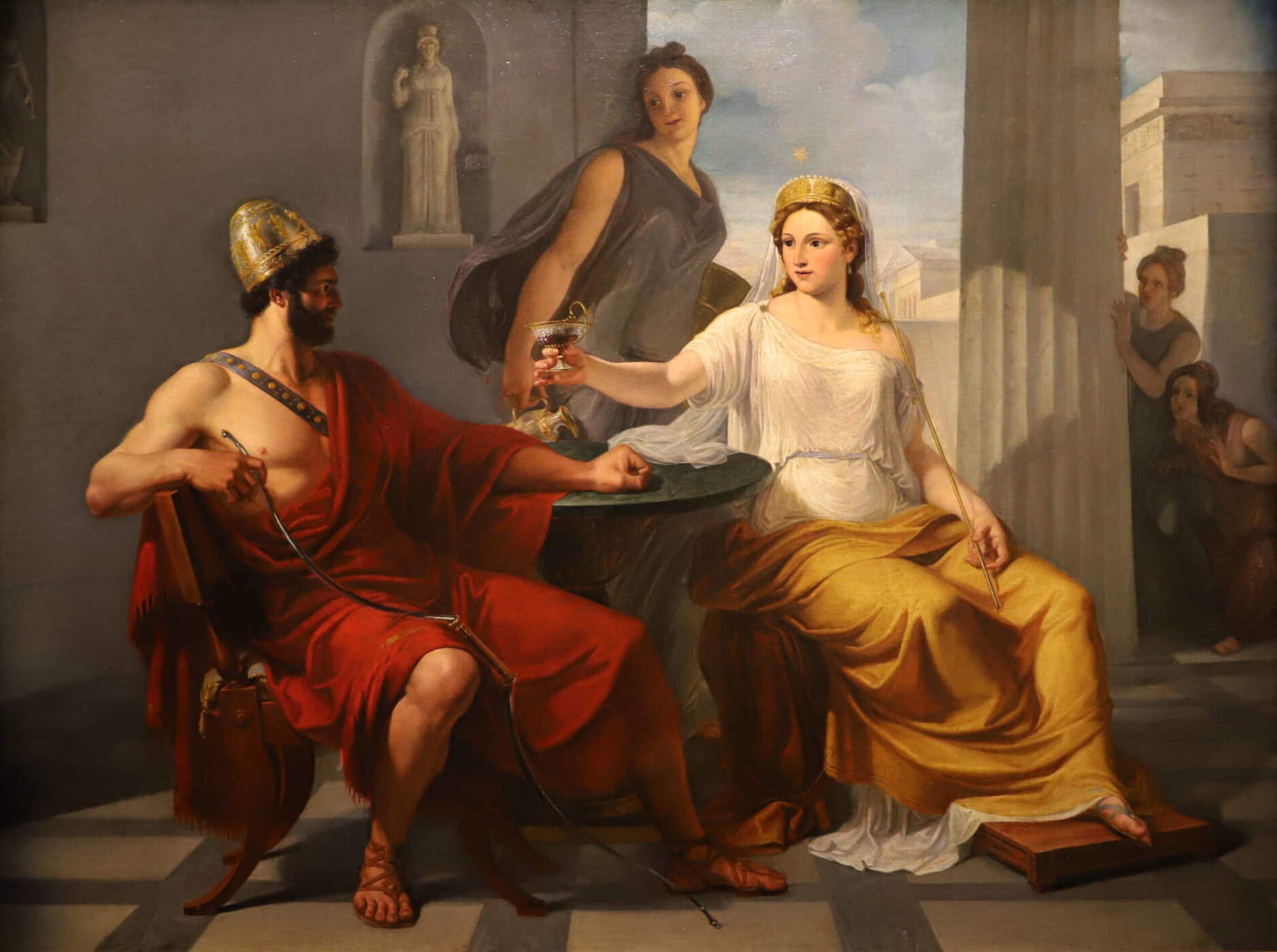
Calamai chose to focus on the first part of the theme and to depict the moment of greatest narrative tension in the famous episodefrom the *Odyssey*: seated at a small table facing each other, the sorceress Circe is offering Odysseus the cup containing the enchanting drink. His hand poised over the bow (here in place of the sword) and his wary gaze suggest that the hero is ready to react; he knows he is immune to the spell and confronts the sorceress without being deceived, while Circe’s calm demeanor hints at her attempt at seduction and persuasion. Behind them, a young maid holds the jug that likely contained the magic potion. The three, who form the main group of the scene, are arranged in a pyramid, and the stillness of Odysseus and Circe contrasts with the sense of movement conveyed by the maid. The composition is balanced, typical of Neoclassical painting: the gestures are measured, the figures assume elegant poses, and the setting evokes the ancient ideal of harmony and order, with small niches on the wall housing the statues of the gods and, beyond the portico, the silhouette of the opulent palace. The handmaiden, on the other hand, evokes the poses of the figures by Guido Reni, the great 17th-century Bolognese master. The viewer’s attention, however, is drawn to the cup, the true symbolic centerpiece of the painting, which represents the clash between Odysseus’s intelligence and prudence and Circe’s magical and seductive power. Finally, the two young women peering at the scene while hiding behind the Doric column foreshadow the action to come. The light comes mainly from the right, highlighting Circe’s figure in particular—her light-colored robe reflects the light, while Odysseus is shrouded in deeper shadows. The chromatic contrast between the intense red of the hero’s cloak and the white and gold of Circe’s garments emphasizes the contrast between the two characters.
Sixty years later, interest in Book X of the Odyssey—while remaining strong, vibrant, and fervent—would give rise to an interpretation with a different atmosphere and sensibility. Toward the end of the century, in 1891, John William Waterhouse offered an interpretation of the Homeric episode that fully responded to the sensibilities of the Pre-Raphaelites. The British painter depicts Circe in all her power: her frontal pose, the monumental throne set on a raised platform, and her gaze fixed on the viewer transform the sorceress into a powerful and evocative figure, capable of dominating anyone who stands before her. She sits on an imposing throne adorned with lion heads carved into the armrests, and wears a long, flowing gown in shades of bluish-gray, which leaves one shoulder bare, lending her a sensual yet austere elegance. Her long dark hair falls over her shoulders, while her face, turned slightly upward, evokes a strong emotional response. In her left hand she raises the cup—a central element of the story—while her raised right arm holds a long magic wand, a symbol of her power and her role as a sorceress.
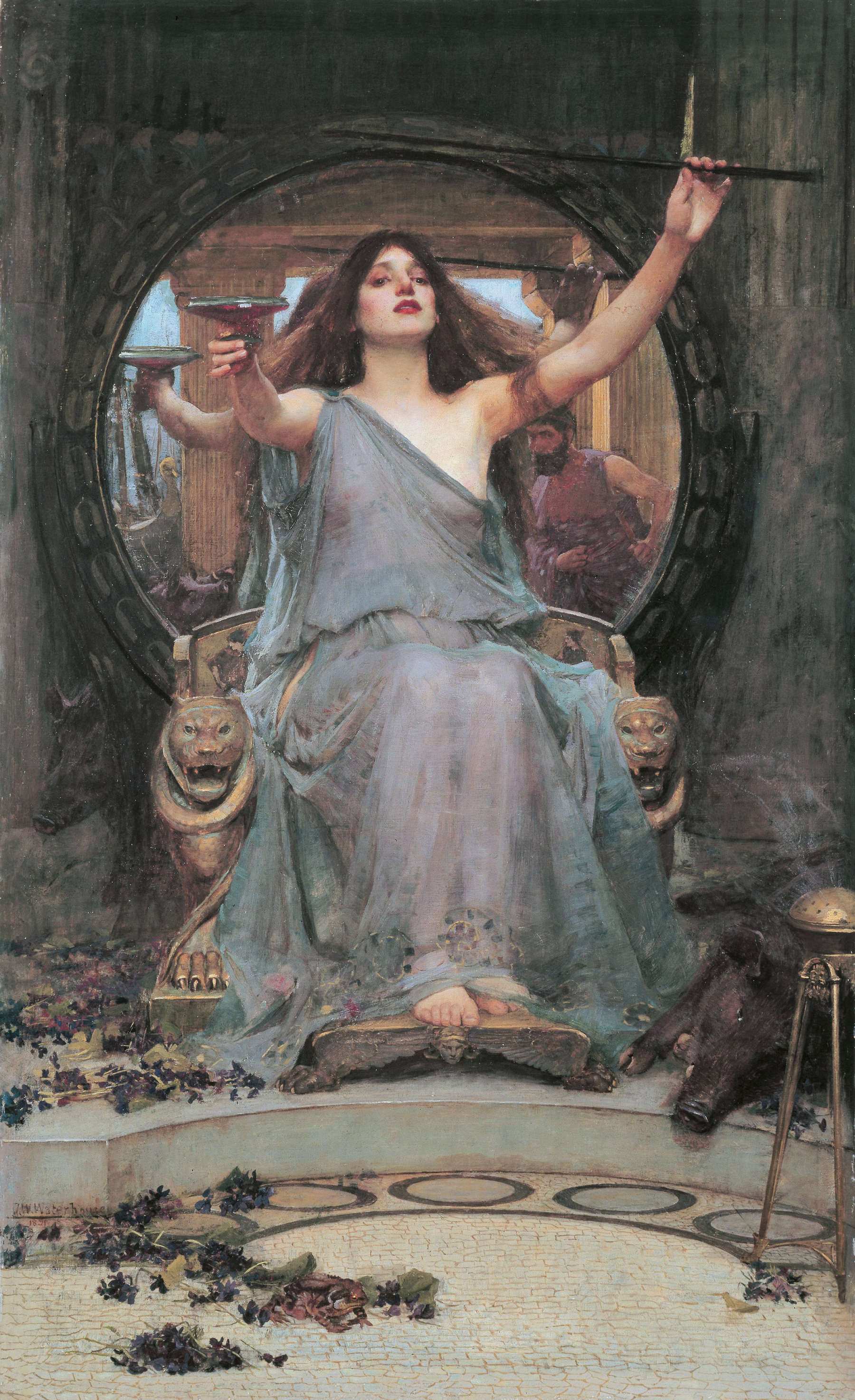
Behind the throne, in the large circular mirror, Odysseus is reflected as he watches her, along with part of the surrounding environment, while at the foot of the throne several pigs are visible, evoking the transformation brought about by the potion. Withered flowers are scattered across the floor, while on the right is a brazier likely used for magical rituals. All these elements contribute to a suspended atmosphere of great evocative power.
Unlike Calamai’s work, in which both Odysseus and Circe are central figures, here the main figure is exclusively the sorceress. Waterhouse highlights her charm, beauty, and enigmatic nature, emphasizing the link between seduction and magic. In this painting, now housed at the Oldham Gallery, Circe appears not only as a sorceress, aware of the spell she casts on anyone who looks at her, but also as the sovereign of her own island.
From Calamai’s neoclassical composure to Waterhouse’s Pre-Raphaelite sensuality: while the former depicts the decisive moment of the clash between reason and enchantment, the latter transforms the sorceress into a figure of charm and power, causing the hero to almost fade into the background. Yet, in both works, the encounter between Odysseus and Circe preserves the allure of the Homeric narrative intact: it is the moment when cunning and deceit, the hero and the sorceress, come face to face—one of the most emblematic and evocative episodes of classical mythology.
Warning: the translation into English of the original Italian article was created using automatic tools. We undertake to review all articles, but we do not guarantee the total absence of inaccuracies in the translation due to the program. You can find the original by clicking on the ITA button. If you find any mistake,please contact us.