





For nearly five hundred years, anyone who enters the Hall of Olympus at Villa Barbaro in Maser, in the province of Treviso, has had the impression of being watched—and, in a certain sense, protected—by the principal deities of the Greek pantheon. Around 1560, in fact, the brothers Daniele and Marcantonio Barbaro commissioned Paolo Caliari, known as “il Veronese”—one of the most important artists of the Venetian Renaissance, who was just over thirty at the time— to create a magnificent cycle of frescoes to decorate six rooms of their Palladian villa; for the central hall—which served as the heart of the entire building—they chose the gods of Olympus as their preferred subject. Why did they choose Mount Olympus and its deities in particular?
Mount Olympus, designated a UNESCO World Heritage Site in July 2026, is the highest mountain in Greece and is traditionally considered the home of the gods; an eternal symbol of Hellenic culture, it embodies all the charm of Greek mythology, so much so that its stories and myths have enchanted and inspired every generation over the centuries—including artists—passing down through time that aura of the divine that permeates its image. In the collective imagination, Mount Olympus is, in fact, a place where light always reigns, towering high and shrouded in clouds—a blissful realm inaccessible to mere mortals. This vision was likely influenced by Homer’s description in Book Six of his *Odyssey*: “He returned to Olympus, returned to the steadfast / Tranquil abode of the eternal gods, / Which neither the winds disturb, nor rain / Ever wets, nor snow ever covers; / But a pure, serene light spreads over it / Unhindered by any cloud, and a vivid / Pure white light surrounds it, in which / The blessed gods rejoice forever” (as in Ippolito Pindemonte’s 1822 translation).
This was the home of the so-called Olympian generation, comprising the principal deities of the Greek pantheon. After dethroning his father Cronus, Zeus became the lord of Olympus, the king of the gods, establishing on the mountain the dwelling place of the new divine generation, which included Hera, Poseidon, Athena, Apollo, Artemis, Aphrodite, Ares, Demeter, Hephaestus, Hermes, Dionysus, and Hestia. It was a sort of divine court that spent its time deciding important matters concerning the world and the affairs of mortals and heroes, listening to music and poetry, participating in banquets where nectar and ambrosia were consumed, and often displaying passions and behaviors very similar to those of human beings, such as quarrels and betrayals (Zeus was the most skilled at this), while still retaining their immortal nature. There were also the Muses, the Graces, the Hours, and other minor deities who frequented and participated in the life of the divine court of Olympus, at the gods’ festivals and ceremonies, but their role was distinctly different.
Girls of my generation, in particular, will remember that little troublemaker Pollon from the anime series that first aired in Italy in 1984: the only daughter of the god Apollo lived in the magical city atop Mount Olympus, surrounded by the gods and always in the company of her inseparable friend Eros; Pollon’s greatest desire was to become a true goddess, since she was the daughter of the Sun God and a mortal, and therefore a demigoddess. For this reason, she was always on the lookout for good deeds to perform, encountering the protagonists of Greek myths along the way, so that her grandfather Zeus would reward her with a coin to fill her magical piggy bank. A cartoon that helped many children, including myself, fall in love with Greek mythology.
Depictions of Mount Olympus in art are very rare: in the Hall of Deeds at the Ducal Palace in Mantua, associated with the Gonzaga family and in particular with Federico II Gonzaga, Mount Olympus is depicted, for example, in a tondo accompanied by the Latin inscription FIDES. The image alludes to the virtues of faith and loyalty, qualities that a knight is called upon to demonstrate constantly toward his lord. Through this emblem, Federico II intends to emphasize the value of steadfast faith: just as Mount Olympus, considered immune to any atmospheric disturbance, preserves unchanged the ashes of the sacrifices offered to the gods, so too must the knight keep his faith and loyalty toward his lord steadfast and unchanging.
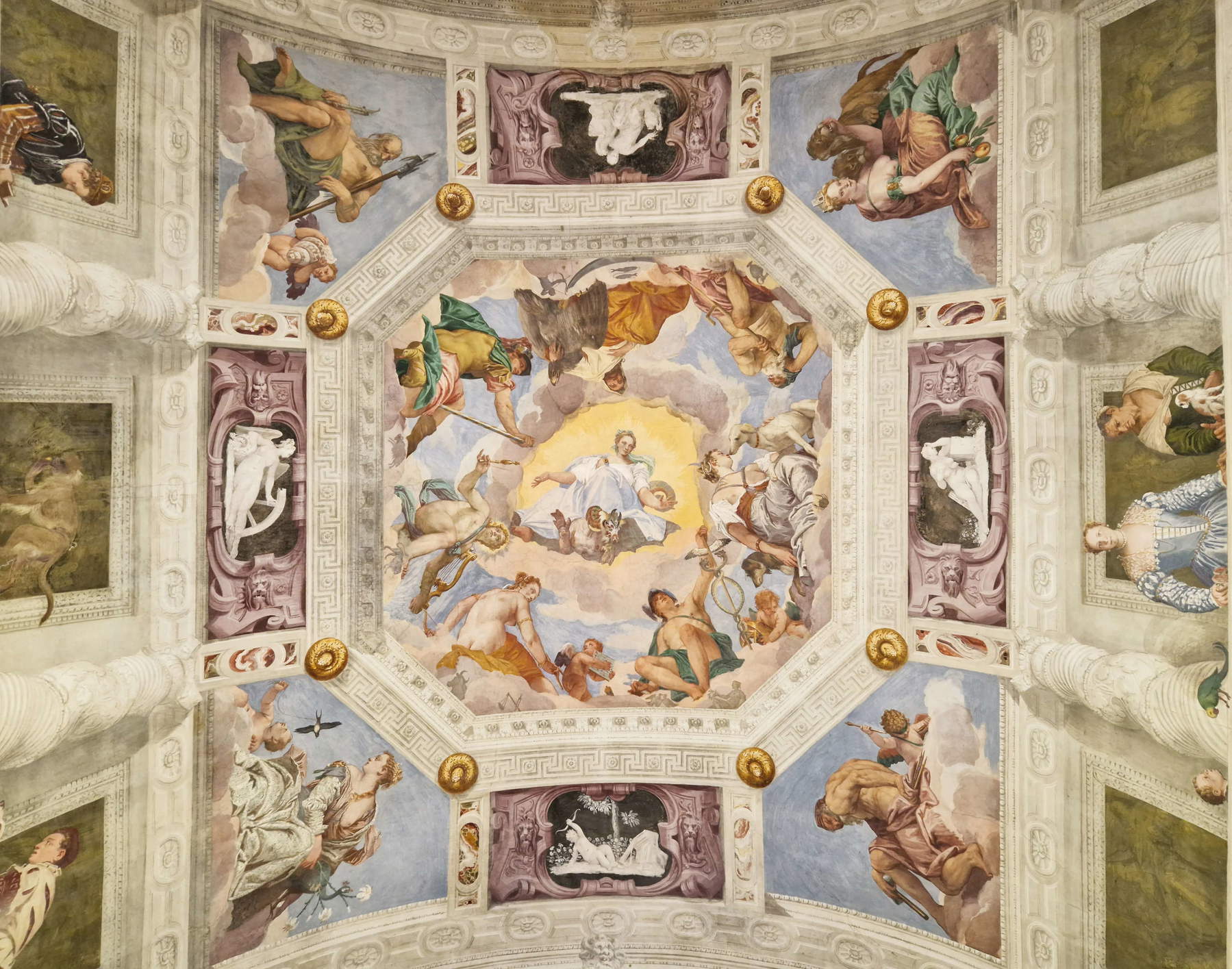
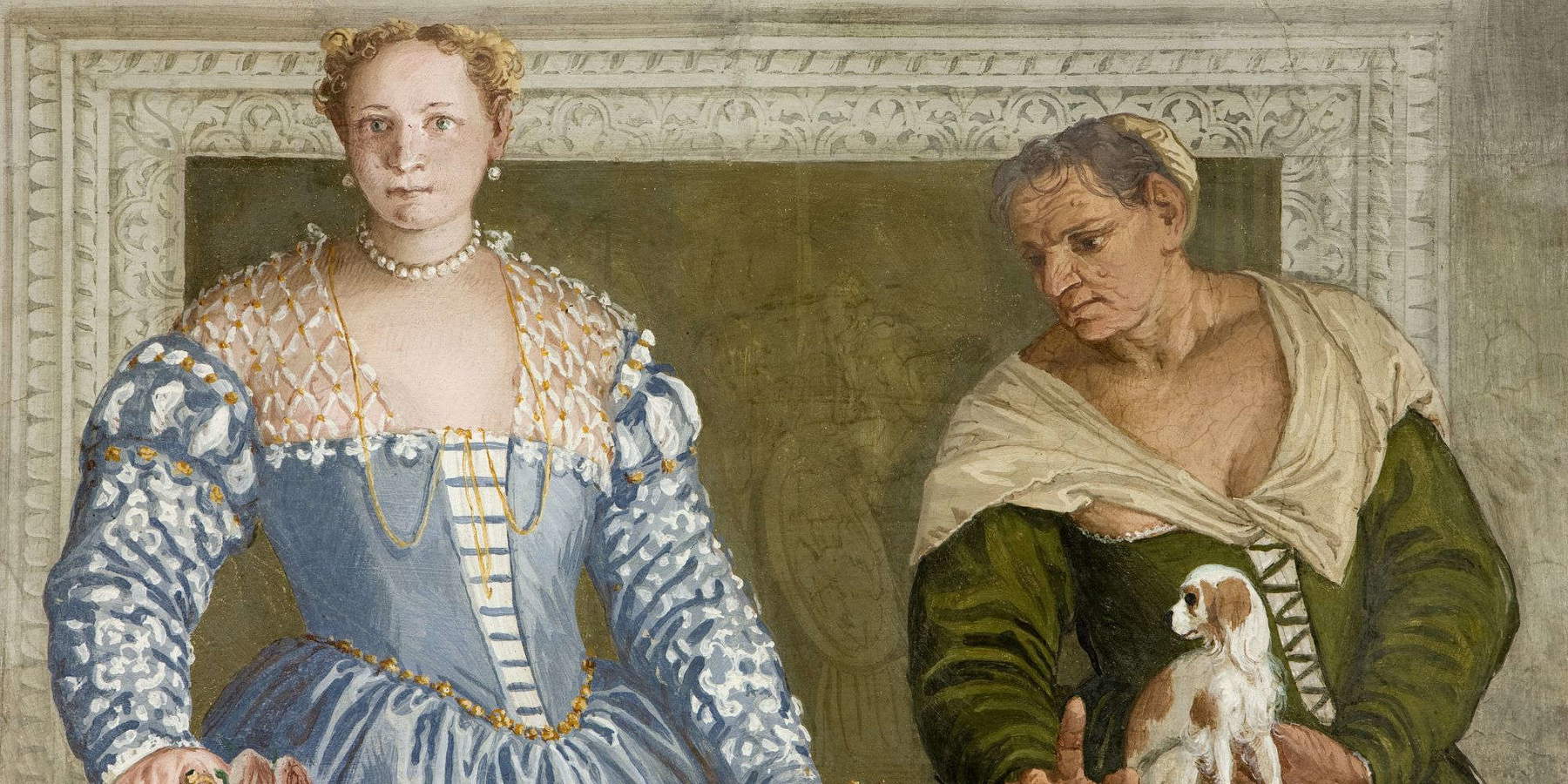
In most cases, however, Mount Olympus is artistically depicted as the place where the principal Greek deities gather, thus offering a view from the inside rather than the outside. And in the aforementioned Hall of Olympus at Villa Barbaro in Maser, this is precisely the perspective. It is as if all the gods had gathered here to protect the hosts, who have been welcoming their guests and visitors in this very central hall for nearly five hundred years: on one side, on the faux balustrade, stand Marcantonio Barbaro’s wife, Giustiniana Giustinian, with her wet nurse, along with their pets—a small parrot and a little dog—while on the opposite side, also on the balustrade, are Giustiniana’s other two children along with a little monkey. Veronese created for Villa Barbaro one of the most important and illusionistic fresco cycles of the Venetian Renaissance, characterized by numerous trompe l’oeil effects that seem to emerge from the walls to become real columns, architectural elements, and actual people who have been welcoming anyone entering the villa for nearly five centuries.
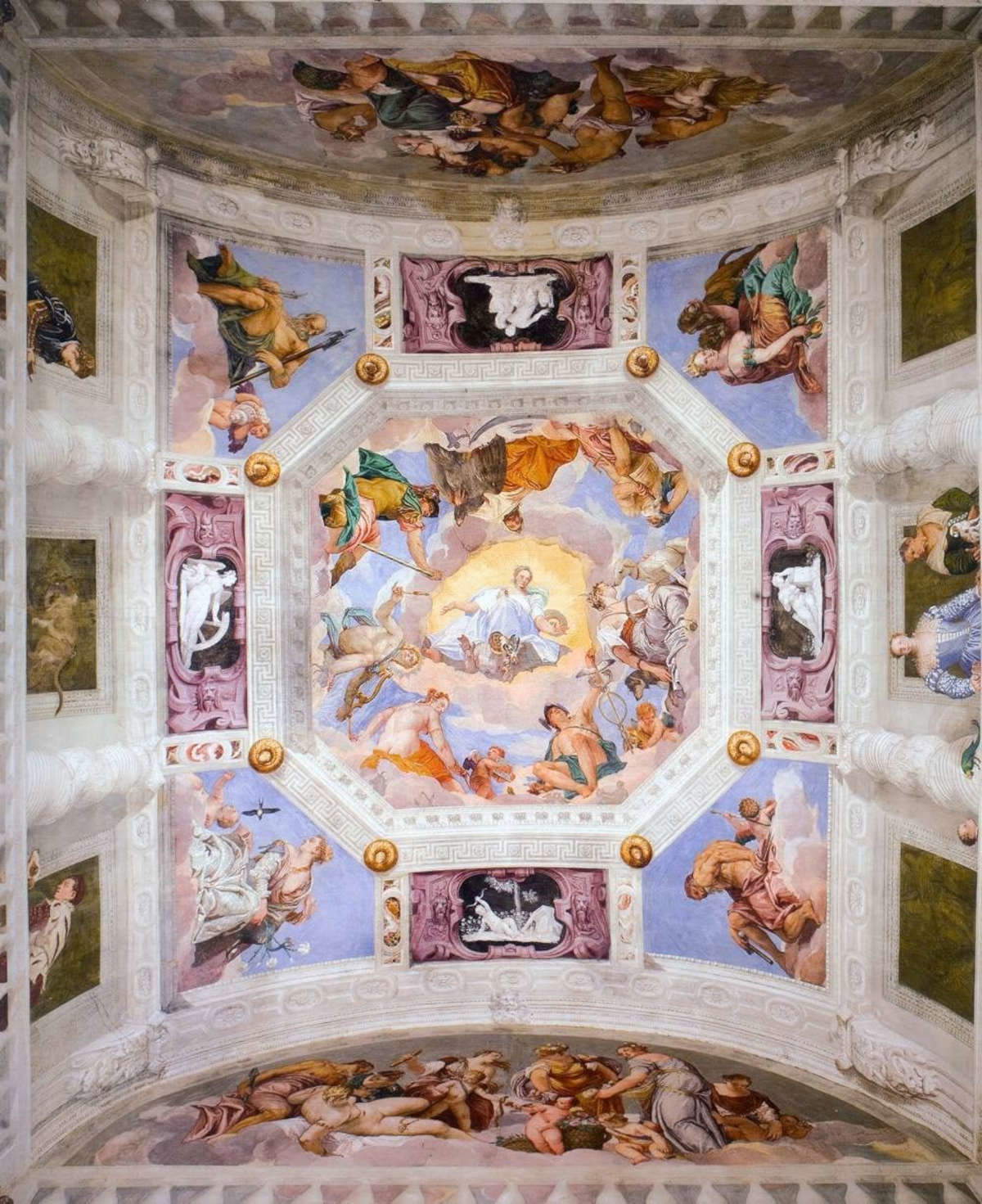
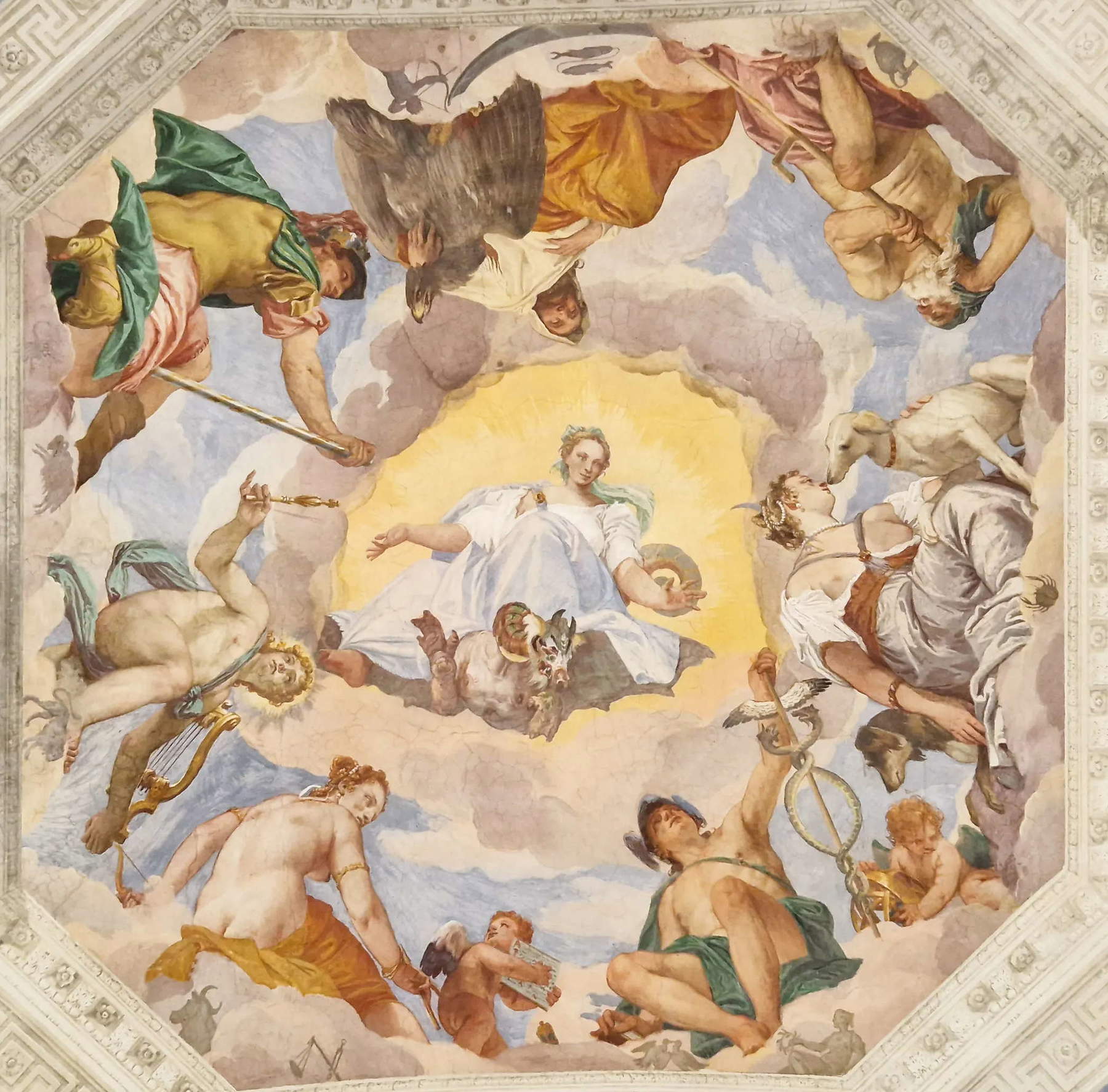
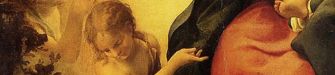
On the vault, within an octagon, the painter has gathered the most important deities of Greek mythology seated on the clouds, each with their own attributes. Recognizable among them are Zeus, the lord of the gods, with his eagle; Ares, the god of war; Apollo, god of music and the arts, holding a lyre and paintbrushes; Aphrodite, goddess of beauty and love, together with her young son, Eros; Hermes, the messenger of the gods, recognizable by his winged headdress; Artemis, goddess of the hunt, accompanied by her two hounds; Cronus, the father of Zeus. In the center, with her arms outstretched toward a winged monster, a female figure emerges from an intense light. r her identity remains uncertain: Richard Cocke interprets her as Universal Harmony, the entity capable of resolving the discordant tensions that arise between Nature and the Celestial Spheres; Rodolfo Pallucchini as “Eternity around which the constellation of Olympus is composed”; Eva Tea as “Immortality, symbol of the Barbaro family’s lofty destiny, by virtue of the heavenly graces that will be bestowed over the long course of time”; and Stefano Pierguidi as Wisdom, who is reflected in and stands above a serpent.
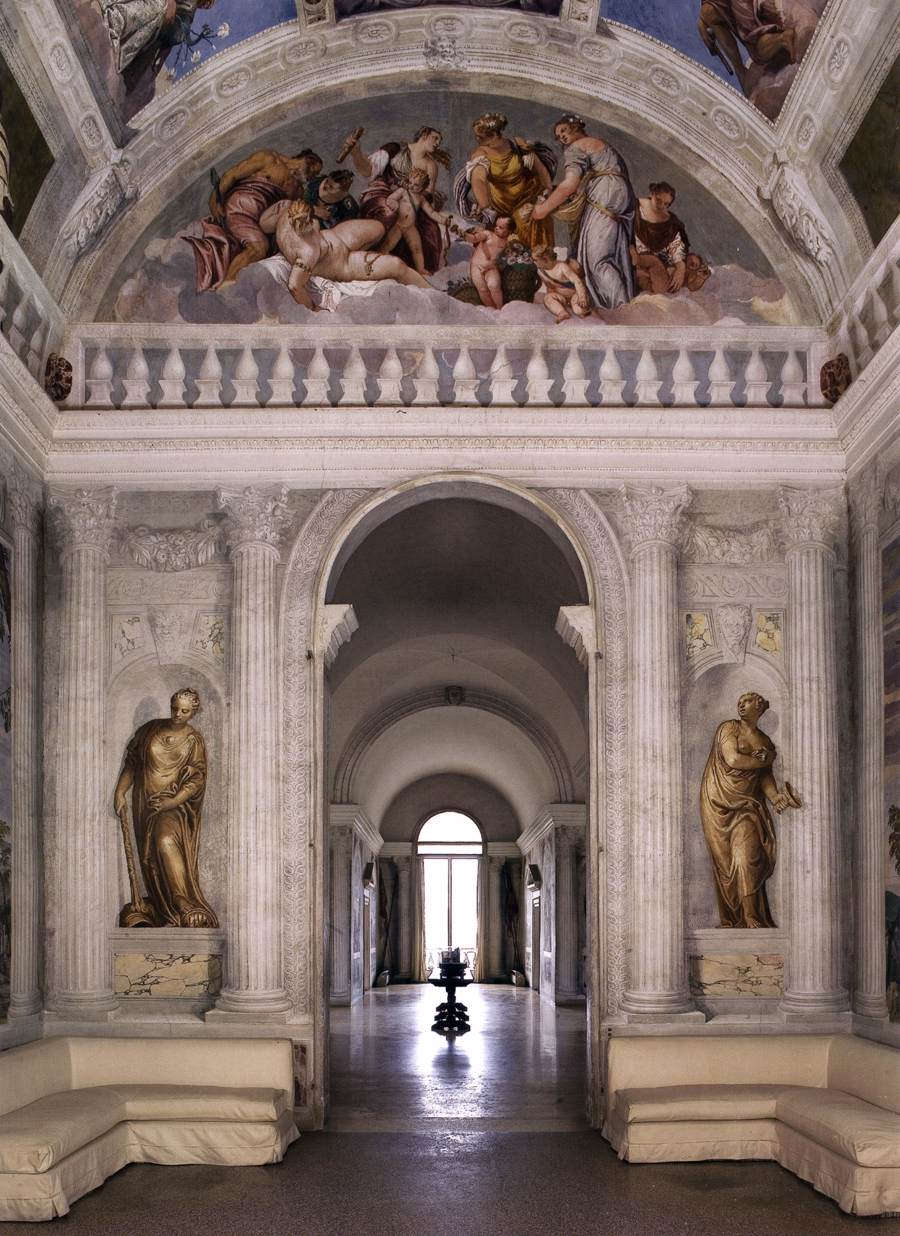
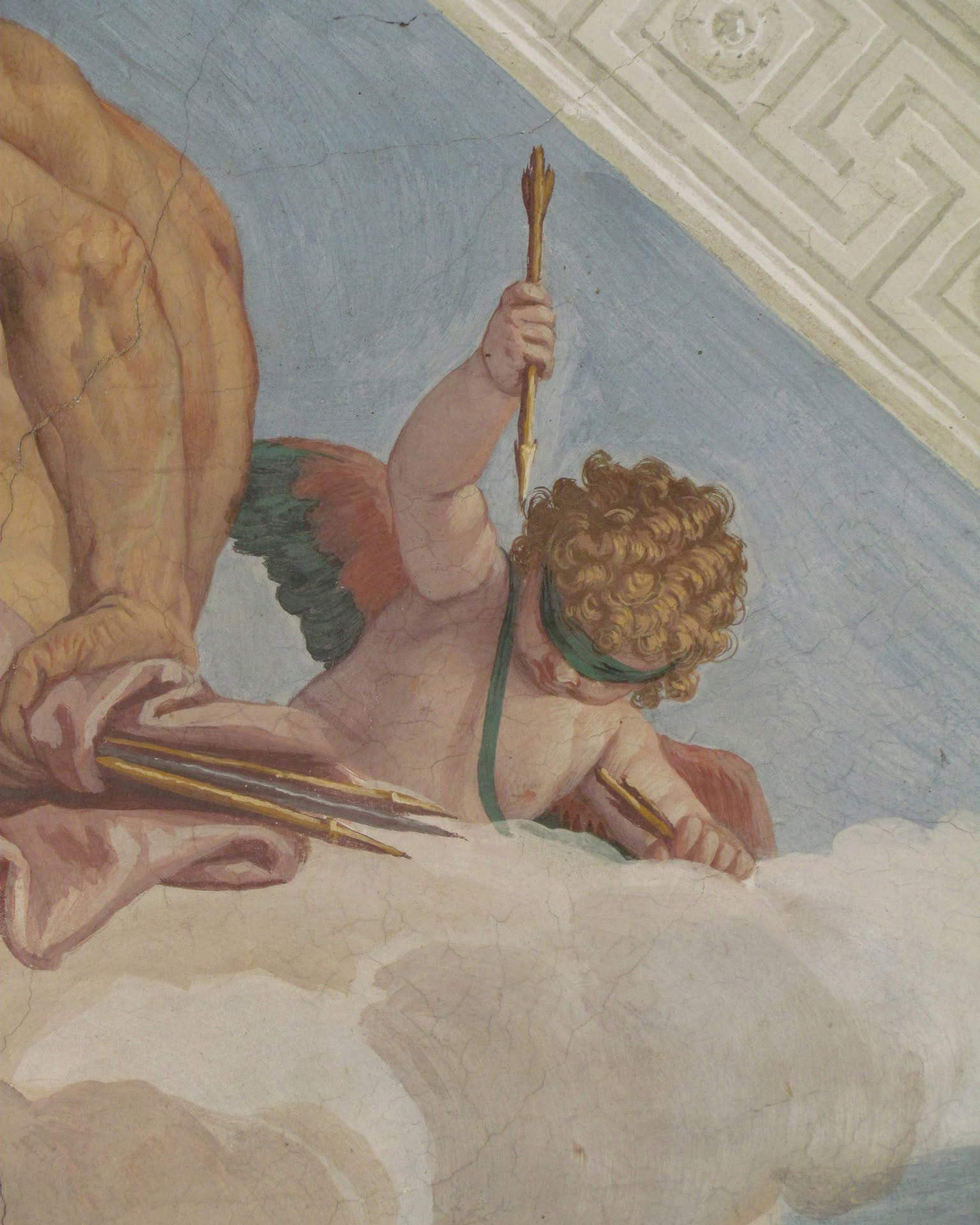
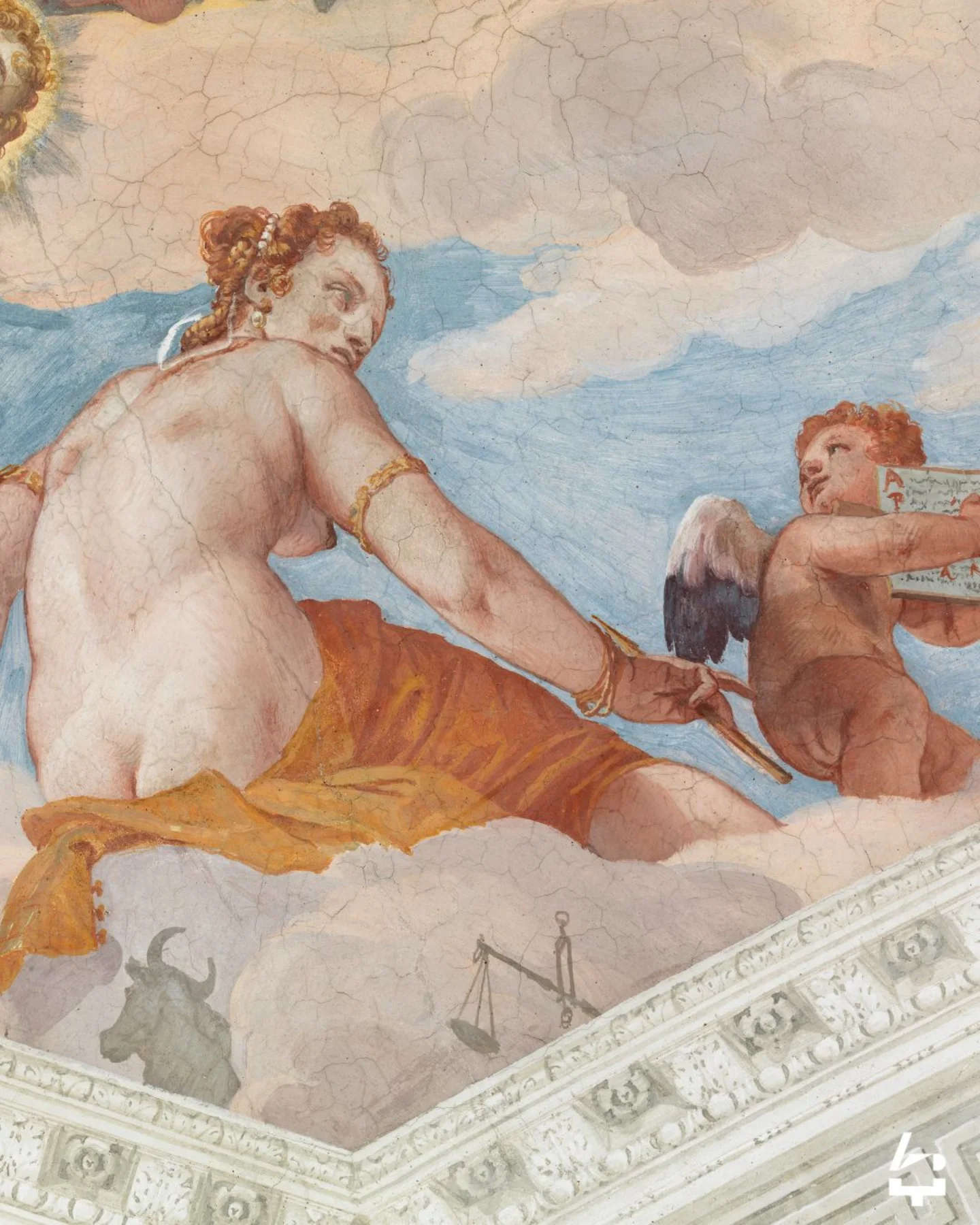
The four monochrome panels, on the other hand, depict the forces that govern human life—such as Love, Fidelity, Abundance, and Fortune—while the corners feature the deities associated with the four elements: Hera, symbol of air; Hephaestus, symbol of fire; Cybele, symbol of earth, and Poseidon, symbol of water . The iconographic scheme does not end on the vault but continues onto the lunettes, where two groups of deities are painted , representing the four seasons: Summer and Fall, with Demeter—shown from behind and recognizable by the ears of wheat on her head—and Dionysus, with grape clusters and vine leaves on his head, seated and intent on crushing grapes with his hands; Winter and Spring, featuring Aphrodite and her son Eros, Hephaestus, and Flora, who holds a bouquet of flowers in a drapery.
Everything is rendered in Veronese’s extraordinary palette, with his Venetian colorism unfolding across shades of sky blue, pink, cinnabar green, golden yellow, and luminous white, blended with delicate color transitions so that the figures of the gods, the clouds, and the landscapes ultimately take on a texture of their own, inhabiting forms and volumes without the confines of a defined outline; painting and architecture, with their faux balustrades and columns, blend and merge under a diffused light, giving life to an illusionistic and harmonious space. Refined trompe l’oeil effects, open skies, and lush landscapes open up a space that seems to defy its own dimensions, as if the walls were striving to expand and open outward.
One gets the sensation that the boundary between the world of men and that of the gods suddenly grows thinner. Veronese does not paint Mount Olympus; he paints a world: that of the Olympian gods, eternally suspended between myth and imagination. After all, Olympus has never been merely the highest peak in Greece: it is a place where the gods continue to weave those stories and passions that continue to speak to people of every age. This, perhaps, is its most authentic form of immortality.


The author of this article: Ilaria Baratta
Giornalista, è co-fondatrice di Finestre sull'Arte con Federico Giannini. È nata a Carrara nel 1987 e si è laureata a Pisa. È responsabile della redazione di Finestre sull'Arte.
Warning: the translation into English of the original Italian article was created using automatic tools. We undertake to review all articles, but we do not guarantee the total absence of inaccuracies in the translation due to the program. You can find the original by clicking on the ITA button. If you find any mistake,please contact us.



















 IT
IT FR
FR DE
DE ES
ES CN
CN


