




by Federico Giannini, Ilaria Baratta 25/07/2026



Categories: Works and artists / Disclaimer
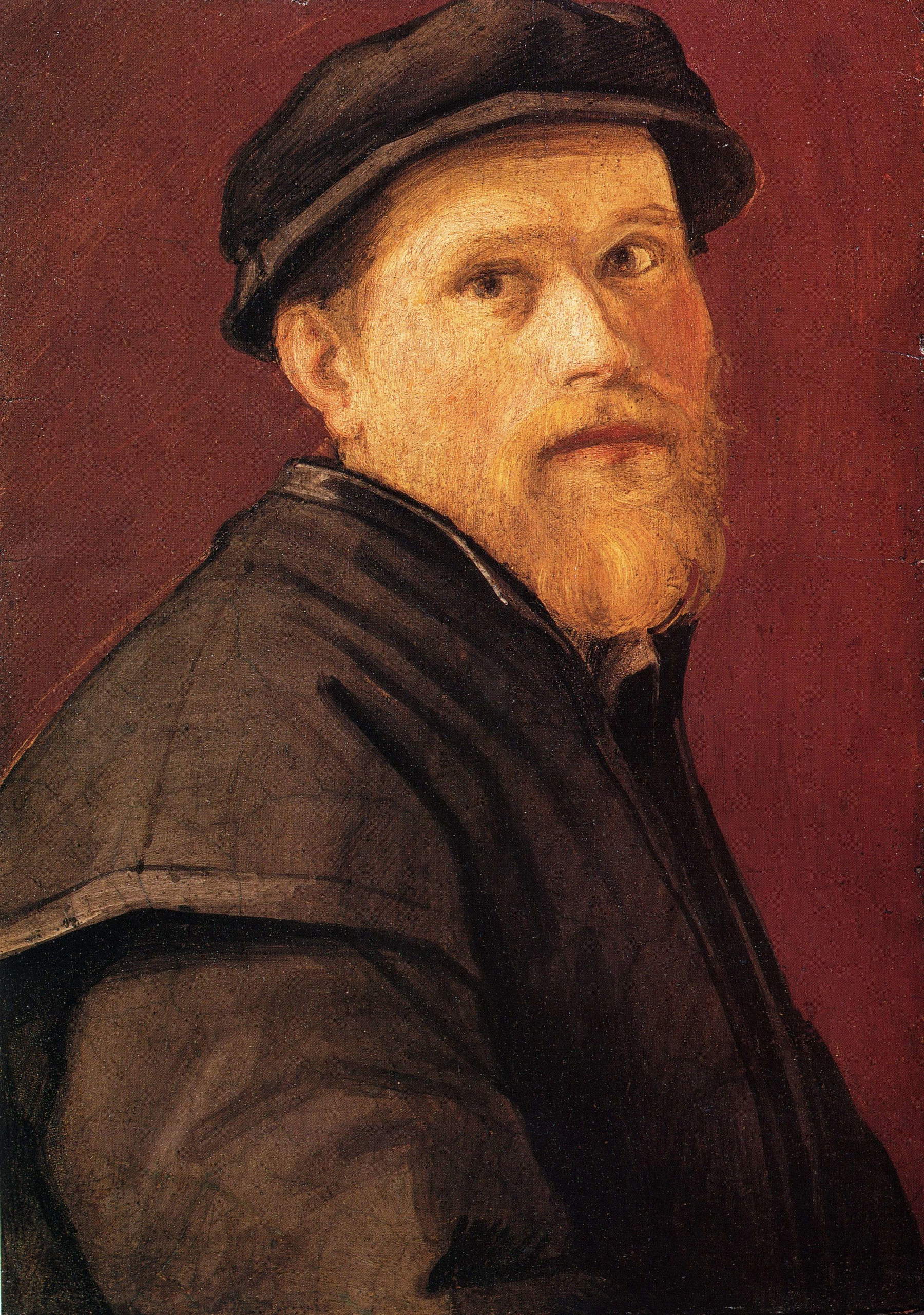
Pontormo’s Diary reveals a daily life filled with bread, omelets, vegetables, taverns, friends, and health concerns; it offers a valuable insight into Renaissance Florence and, above all, portrays a man very different from the myth of the solitary genius: shared meals, relentless work, and daily routines paint a picture of a life more eventful than one might imagine.
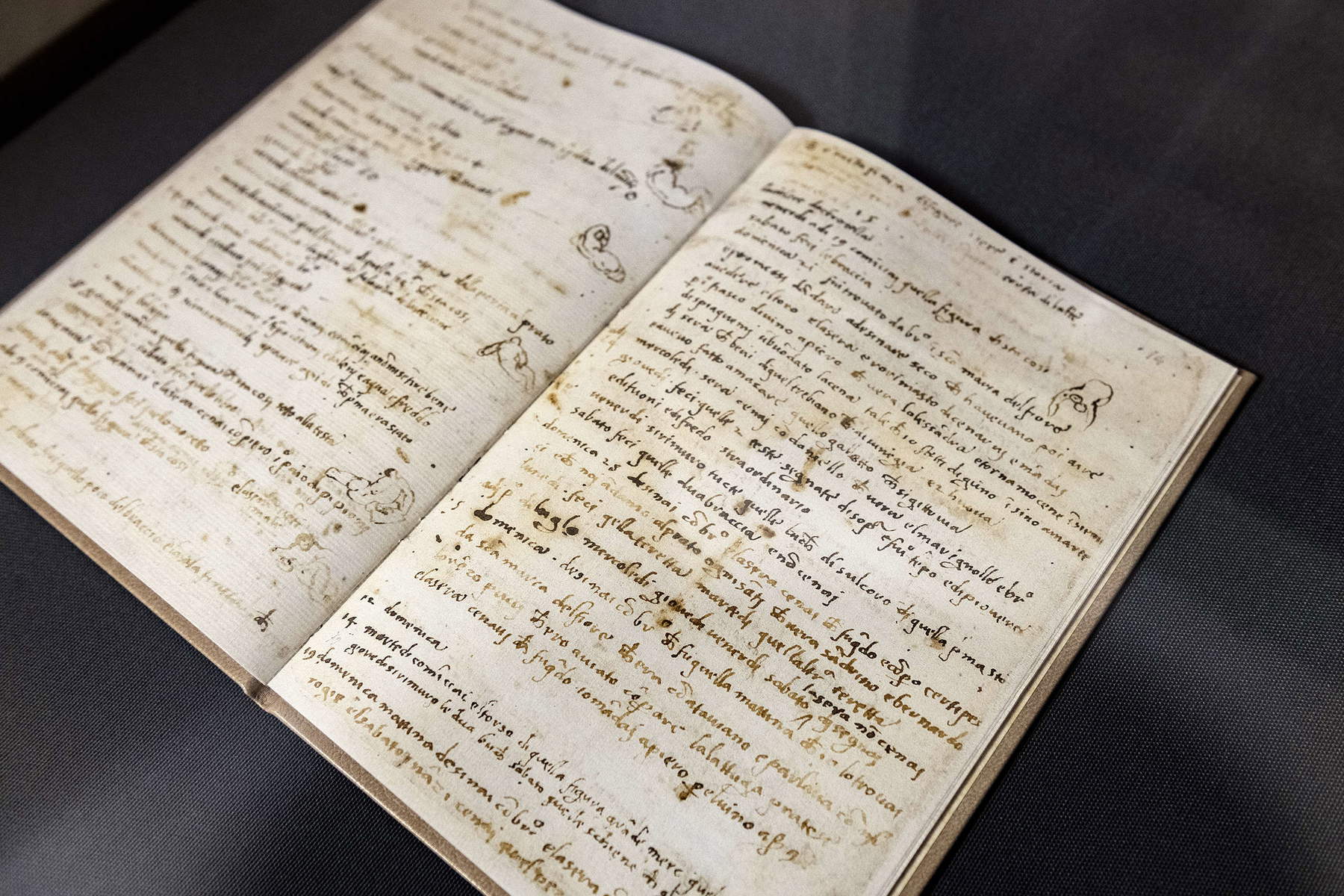
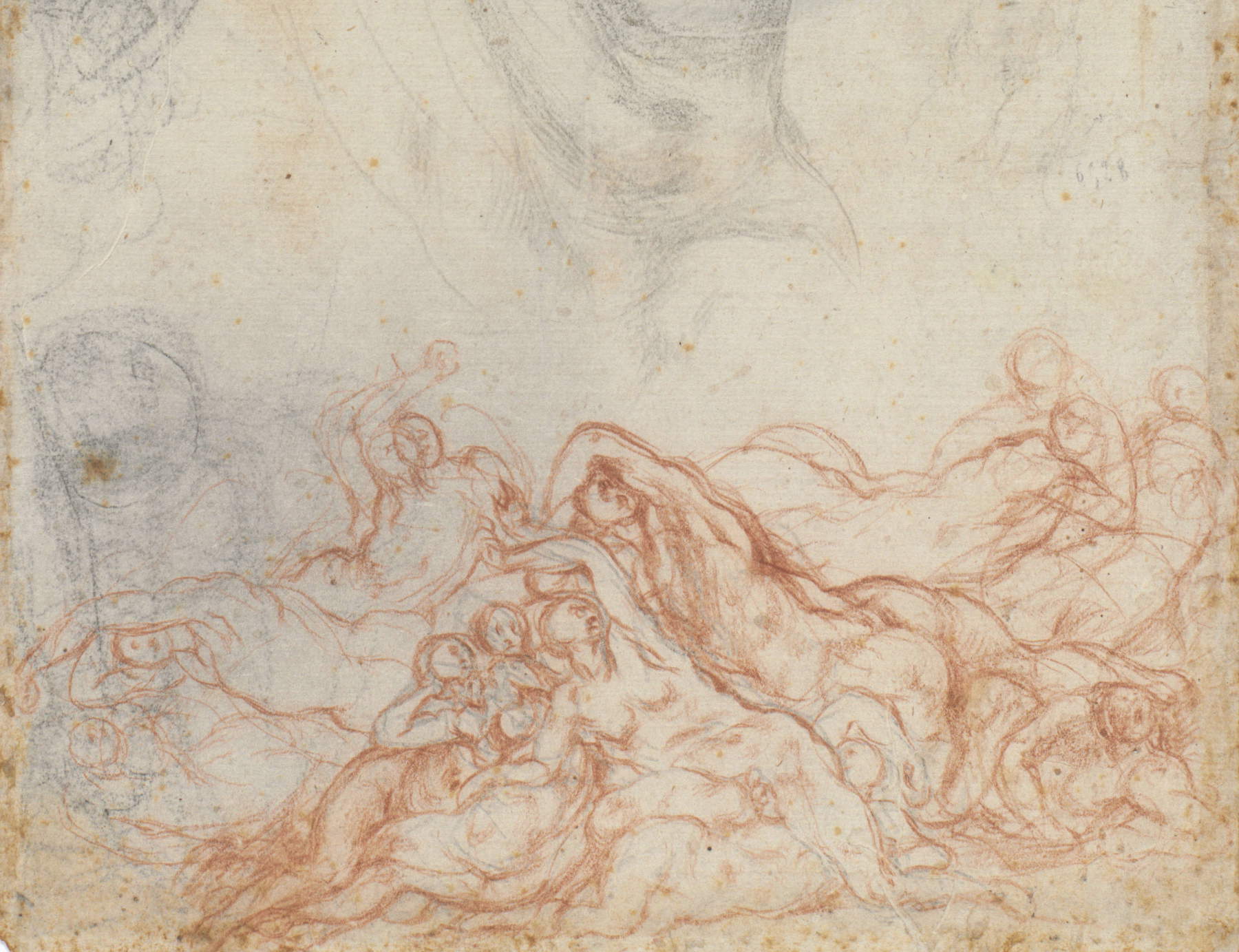
Anyone who opens the pages of the diary that Pontormo (Jacopo Carucci; Pontorme di Empoli, 1494 – Florence, 1557) kept during the final years of his life, from January 7, 1554, to October 23, 1556, is confronted with a unique text: not a narrative intended for others to read, but a daily journal written for himself, in which the work—begun in 1546—on the frescoes in the choir of San Lorenzo in Florence, which the artist was still working on at that time (and which have since been lost: they were painted over in 1742, probably because they were in very poor condition), is continually interwoven with notes on his daily meals, his health, the weather, and his relationships with friends—in particular Bronzino, first a student and later a colleague with whom Pontormo had always worked and with whom he often shared his daily life. It is precisely this seemingly disordered mix of entries that makes the manuscript a valuable source for understanding not only this eccentric artist but also the dietary habits of a Florentine in the mid-sixteenth century. We are not entirely sure why he kept this diary: Pontormo likely felt the importance of the workshop where he was working and therefore wanted to record every day of his life. “Everything in the diary, during the slightly less than three-year period covered by the entries,” notes Roberto Fedi in the introduction to the 1996 edition of the Diary , “revolves incessantly and obsessively around that work. San Lorenzo, and nothing else, is the center of the world for Pontormo.”
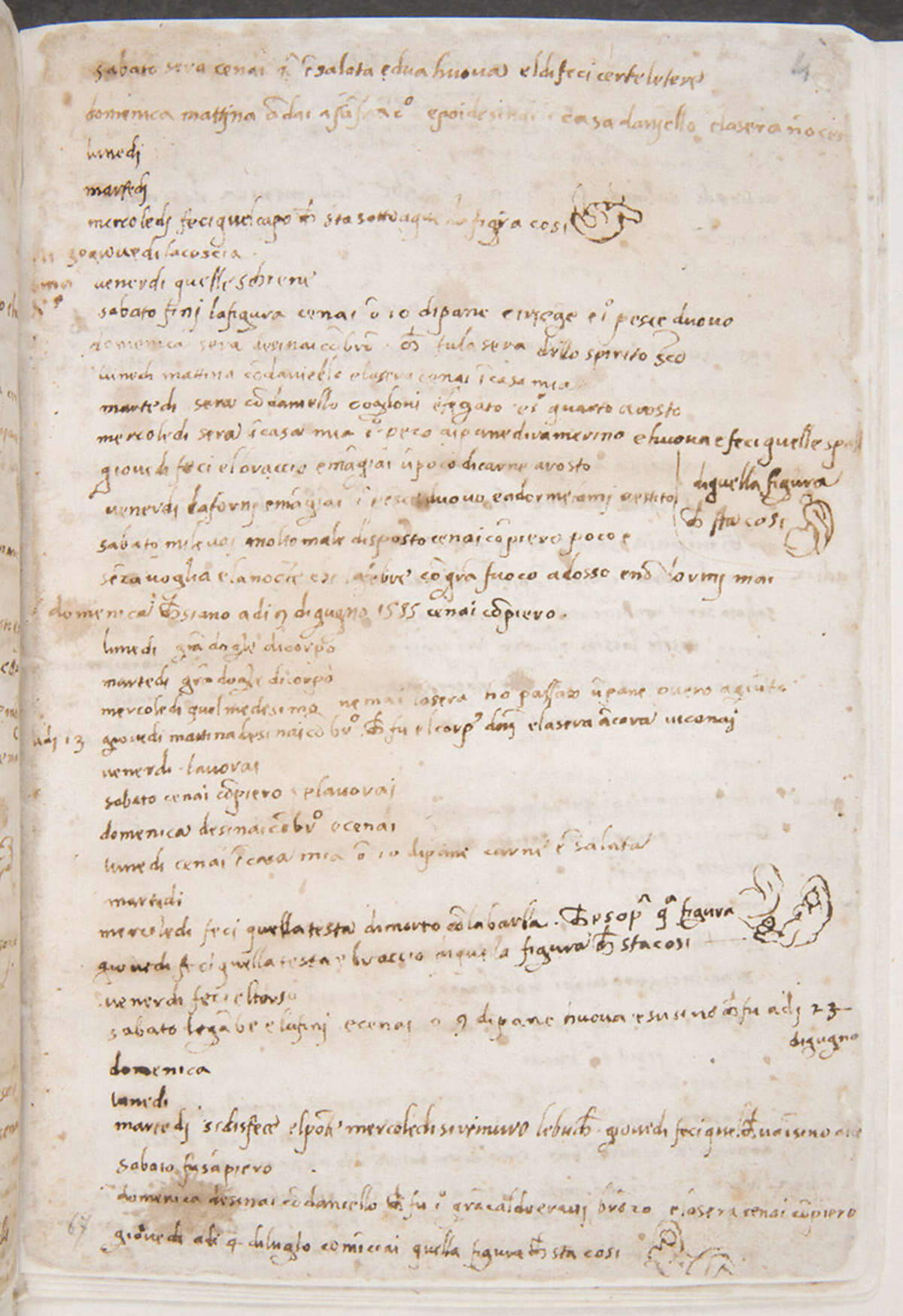
The small booklet, now preserved at the National Library of Florence, was rediscovered only in 1902 among the Strozzi papers in the Magliabechiano collection, although its existence had been known for some time, and since then it has been published several times—including in a facsimile edition—and studied. It consists of two booklets of sixteen sheets in which the painter “makes daily entries, interspersed with traditional health-related notes,” summarizes scholar Anna Forlani Tempesti, “recording raw accounts of his daily life: his health, food and its effects, encounters or clashes with friends and collaborators, and the execution of the figures in San Lorenzo, for which he sketches brief reminders in the margins.” Precisely because of its private nature, the diary offers an image of Pontormo free of rhetorical filters, different from the one handed down by Giorgio Vasari in his *Lives*, even though Vasari had personally known the artist and gathered firsthand accounts, particularly from Bronzino himself. Vasari describes a reserved man who disliked parties and crowded places, capable of living almost in isolation even within his own home: the bedroom, the Arezzo-born historian recounts, was accessible only via a wooden staircase that the artist could pull up using a pulley, so that no one could reach him without his consent (“since the room where he slept and sometimes worked was accessed via a wooden staircase, which, once he had entered, he would pull up using a pulley, so that no one could go up to him without his consent or knowledge”). The house, located on what was then called Via Laura and is now Via della Colonna, near Piazza della Santissima Annunziata, did not have a prominent street-facing entrance but opened onto an inner courtyard where Pontormo cultivated a small vegetable garden and fruit trees. However, as will be seen later, the image of Pontormo as a gruff, eccentric, and unsociable genius—an image that has become entrenched in part due to Vasari’s account—clashes with what emerges from Pontormo’s own writings in his diary.


The pages of this unique journal of his—which he began keeping regularly starting on March 11, 1554—actually open with an entry about a mishap that occurred a couple of months earlier: an accident—a fall that took place on January 7 of that year (a date that can therefore be taken as the start of the entries), in which the painter injured his shoulder and arm so severely that he stayed as a guest in Bronzino’s home for several days before returning to his own home, where his discomfort persisted until Carnival. After a couple of months’ break, starting on March 11, the entries follow one another almost every evening, listing precisely what was consumed at dinner, often indicating even the weight of the bread.
From these pages, written with great regularity, a fairly consistent diet emerges, based primarily on eggs and bread—staples of the diet of the time for most of the population—accompanied by vegetables, salads, and a little meat or fish. A few lines from the diary: “On Sunday morning, March 11, 1554, I had chicken and veal for breakfast with Bronzino and felt well.” “Friday evening: a salad of seaweed and two eggs in ‘fish-egg’” (the “fish-egg” was an omelet: it was called this because its shape resembled that of a fish, since it was traditionally folded closed like a modern-day omelet). “Saturday: butter, salad, sugar, and ‘fish egg.’” “Monday evening: I had boiled bread with butter and ‘fish egg’ for dinner.” “Saturday: I went to the tavern: salad, ‘fish egg,’ and cheese, and I felt fine.”
Pontormo notes salads made with lettuce, endive, borage, cooked cabbage, turnips, peas, asparagus, artichokes, ricotta, and cheese, often accompanied by dried figs or a few almonds. Eggs appear very frequently, cooked in various ways: hard-boiled, fried, or transformed, as we’ve seen, into the precursorof the omelet. Meat appears less regularly but is never entirely absent: boiled mutton or in soup, roasted or fried kid, veal, chicken, hare, rabbit, pork boiled in wine, and sausage. There is no shortage of birds either, which were highly prized on Florentine tables of the time: duck, guinea fowl, thrushes, woodcocks, and other waterfowl that the painter calls “farciglioni,” likely a wild duck. As for fish, in addition to the humble fare of simpler dinners, there are also more convivial meals, such as the one in which Pontormo recounts having bought a large fish and some fried small fish for a dinner with his friend Attaviano, for which he spent the sum of 12 soldi (which corresponded, roughly, to one-fortieth of a bricklayer’s monthly wage).
Alongside these almost bookkeeping-like entries, the diary records with equal care the artist’s state of health; he often appears concerned about his physical well-being: dizziness, stomachaches, digestive problems, fevers, and a persistent sore throat. Pontormo explicitly links these sensations to what he ate the previous day or days, going so far in some cases as to impose a stricter regimen on himself—with meals reduced to a few ounces of bread—when he fears he has overindulged. In a lengthy reflection at the end of the year—a rare moment when the Diary aspires to be more than a series of almost notarial records—the painter even goes so far as to put down in writing a sort of short treatise on personal hygiene, in which he explains how to regulate his diet, drinking, and physical exercise according to the seasons, to avoid the ailments he believed were linked to temperature fluctuations and the influence of the moon, particularly in the month of March.
This almost obsessive attention to his own body has, over time, fueled an interpretation of him as a melancholic and hypochondriac man—if not outright a sort of neurotic old man shut away in his workshop. Several scholars who have studied the diary in recent decades, however, have urged us not to stop at this image, however evocative it may be. While it is true that the pages reveal a man who was attentive—perhaps overly so—to the signals of his own body, it is equally true that the same text recounts festive dinners, convivial lunches, and outings to eat at taverns with friends (in particular with Bronzino and the aforementioned Attaviano, including a note of how much they spent per person: evidently... they split the bill), all of which are regularly noted—in short, small daily pleasures that are hard to reconcile with the idea of a recluse completely withdrawn into himself. “I’d say that by now he’s been over-analyzed, creating an overall ‘image’ in popular culture that’s somewhat one-sided and contrived,” wrote Luciano Berti, for example: “too much solitude, too much dieting with dinners consisting only of bread and omelet (‘egg fish’), too much hypochondria […]. In fact, I would say that he comes across (and I believe this could be demonstrated statistically by categorizing the negative and positive entries in the diary day by day) as an elderly but rather healthy man, and an extraordinarily hard worker.”
Moreover, the occasions on which Pontormo had lunch or dinner with Bronzino were very numerous and likely represent the most consistent thread throughout the entire diary. The two saw each other almost every week—sometimes several times in the same week—sharing meals at one or the other’s home. On some of these occasions, the painter even notes his enthusiasm for what is served to him, such as when he recounts having eaten crepes at his student’s home that had astounded him (“certain marvelous crepes”), or when he recalls a rosemary bread that had been promised to him by the mother of a young woman named Maria.
In addition to Bronzino, other names associated with the painter’s circle of friends frequently appear in the pages of the diary: a certain Daniello, at whose home Pontormo dined regularly; an Attaviano with whom he spent several evenings; and figures from Florentine cultural circles of the time, such as the men of letters Benedetto Varchi (who on one occasion even gave him a sonnet), Luca Martini and Giovanni Battista Gelli, Vincenzo Borghini, the director of the Ospedale degli Innocenti, and even the young student Battista Naldini, to whom Pontormo appears to have been very fondly attached.
The diary also recounts small episodes of daily life that broaden our perspective beyond the canvas alone: an early-morning stroll through the garden to examine some drawings shown to him by an acquaintance, a visit to admire a painting depicting Hercules, another to see a portrait painted by a young artist from the Allori circle, and an evening spent watching a play. Domestic chores also feature, such as the day when laundry is done at home.
Nor is there any lack of observations on the weather, noted almost every day with the same care reserved for food: days of persistent rain, sudden frosts, thunderstorms with thunder and lightning, but also clear days that the painter describes with evident relief. This attention to the weather does not appear to be a mere quirk, but is linked to the practical demands of fresco painting, a technique that requires precise environmental conditions and does not tolerate excessive cold or humidity: on more than one occasion, Pontormo notes that he had to interrupt his work precisely because of bad weather. Moreover, precisely during periods of greatest concentration on his work, his notes on health and food thin out almost entirely, replaced by a sparse, almost military-style account of the progress of the paintings, day by day, with no room for complaints. This is a different Pontormo from the one of the gloomiest winters—an artist so absorbed in his task that he forgets, for weeks on end, the concerns that elsewhere seem to occupy much of his thoughts.
Precisely because of this complexity, the diary continues to be the subject of new interpretations. In 2014, on the occasion of the exhibition at Palazzo Strozzi dedicated to Pontormo and Rosso Fiorentino, a book compiled the interpretations of several contemporary Tuscan chefs, who were invited to propose a recipe based on the very same ingredients mentioned in the painter’s pages, demonstrating how regional cuisine has maintained, centuries later, a substantially unchanged foundation of ingredients. “Precisely because the ingredients of Tuscan cuisine have not changed in five centuries,” noted scholar Ludovica Sebregondi at the time, “nineteen renowned chefs from the region were asked to create a recipe based on the ingredients mentioned by Pontormo in his Diary.” Nineteen professional chefs and one special guest, Father Sisto Giacomini—a bibliophile and book restorer—who contributed a recipe, in the tradition of the Certosa del Galluzzo on the outskirts of Florence: Trout with Egg White, Marjoram Leaves, and Borage Flowers. Gut a trout, wash it, and stuff it with a clove of garlic and a sprig of rosemary; cook it over charcoal and fillet it. Place a little Tuscan IGP extra virgin olive oil in a small skillet and add the egg white; season with salt, then add a few marjoram leaves and borage flowers. Add the trout fillets and cook until the egg white sets.”
Pontormo’s relationship with food changes significantly depending on the liturgical calendar, another element that the diary records regularly. On the eve of holidays and during periods of fasting prescribed by the Church, dinners are drastically reduced or disappear entirely, replaced by a brief note, while on feast days, starting with Easter, richer dishes return, such as eggs, roasted lamb or goat seasoned with seasonal vegetables. In this regard as well, Pontormo’s diary proves to be a valuable source not only for the artist’s biography but also for reconstructing the dietary habits of an entire city, shaped by the rhythm of the seasons, religious holidays, and friendships cultivated around the table.
The diary ends abruptly in October 1556, just over two months before the painter’s death on January 1, 1557. The final entries still mention a sore throat, a minor ailment that, in hindsight, appears to be one of the first signs of a physical decline that Vasari would later attribute to an excessive dedication to work. Almost five centuries later, these pages—filled with entries about bread, eggs, vegetables, and meat, along with dinners with friends and rainy days—remain as a subtle yet vivid testimony to how people lived, what they ate, and how they socialized in mid-sixteenth-century Florence.
Warning: the translation into English of the original Italian article was created using automatic tools. We undertake to review all articles, but we do not guarantee the total absence of inaccuracies in the translation due to the program. You can find the original by clicking on the ITA button. If you find any mistake,please contact us.