





When I began collecting my first RAUs (Urban Archaeological Finds) in 1995, I was searching for traces of a daily life that was slipping away: the remnants of a civilization devoted to consumption and, ultimately, to a slow self-destruction. I walked the streets of Rome looking down, treating the sidewalks as a contemporary archaeological site. I collected lost items, scraps, wrappers, used bus tickets, and crushed cigarette packs. To me, they weren’t trash, but biological and social evidence of human passage.
Thirty years later, in the fall of 2026, I realize that that urban trash has dematerialized. Today we no longer find it just on the sidewalks; it floats invisibly within the screens of our phones. They call it digital addiction; they compare it to “social media cigarettes,” but the principle is the same: consuming people to generate profit.
That is why I have decided to present my new series titled “Smoking Kills, Geometry Doesn’t!” at ArtParma Fair (taking place right now, on October 3 and 4, and then from October 9 to 11, 2026), in collaboration with Pinzimonio Space. A conceptual and aesthetic challenge that I feel is dramatically urgent.
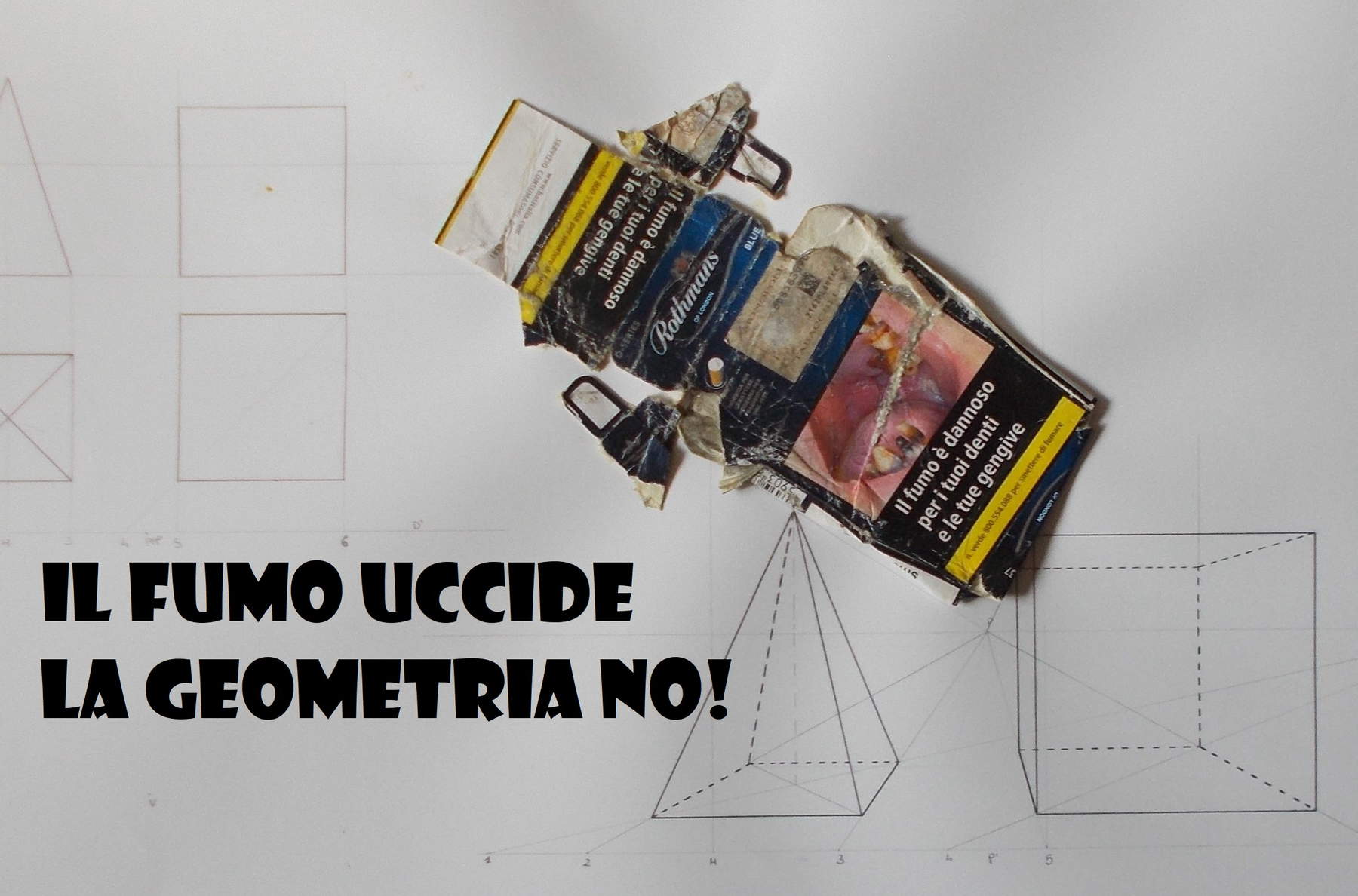
In conceiving this project for Pavilion 7 of the Parma exhibition center, I sought to radically contrast two conditions: on the one hand, the ephemeral, formless smoke of a cigarette; on the other, the absolute stability of geometry, which for me signifies structure, order, resilience, and the principle of organization. Smoke is, by definition, a substance destined to dissipate—an immediate and fleeting pleasure that leaves behind only ash and damage.
And it is exactly the same gaseous high that I see millions of young people chasing today as they’re hooked on the endless scrolling of TikTok or Instagram: a continuous flow, devoid of a beginning or an end (infinite scroll), designed to eliminate any temporal barrier; a dopamine-driven trap based on the principle of intermittent variable reinforcement (the same as slot machines), which stimulates the striatum in adolescents even before their prefrontal cortex can activate self-control; a psychological dissolution into anxiety, hypersensitivity to the judgment of others (the hunt for “Likes”), and chronic isolation.
The smoke I explore in my paintings no longer comes only from cigarettes, but from pixels. In both cases, we are faced with a manipulative industry that exploits our biological vulnerabilities. The theme of tobacco, after all, has always been part of my research: from the performance *Rifiutindagine* at Big Torino 2000, to the 2011 group exhibition *FUMO* at the Luigi di Sarro Gallery in Rome. Today, that smoke has become virtual.
The art project “Smoking Kills, Geometry Doesn’t!” thus addresses the theme of deep addiction induced by smoking, social media, and artificial intelligence, contrasting the ephemeral nature of digital dissolution with geometric stability. The works incorporate analog elements such as cigarette packs and hand-drawn technical sketches, destined to transform over time into Archaeological Artifacts (RAU) of historical and economic value.
Where smoke disperses and destroys, my Geometry seeks to offer permanence, order, and structure. It is my way of putting a dam in the face of chaos and psychological subjugation.
I find it extraordinary that at this very moment in history, as I exhibit my geometric structures at ArtParma, civil society and the political sphere are struggling to find their own “legal geometry” to defend themselves against Big Tech. I’m thinking of the landmark rulings in U.S. courts—such as the KGM v. Meta and Google case, which found the tech giants liable for the “dangerous” original design of their algorithms—or the billion-dollar fines for violating children’s privacy.
Think of the newly enacted EU KIDS Act: what is it doing if not imposing geometric rules on the chaos of the web? It introduces strict time limits (one hour per day for accounts held by children under 15), prohibits the creation of profiles for children under 13, and mandates the forced deactivation of autoplay and manipulative push notifications (so-called “Safety by Design”). Even the cryptographic age-verification application (Zero-Knowledge Proof), currently being tested in Italy as well, uses mathematics to tell social media platforms, “Yes, this user is authorized,” without revealing personal or biometric data.
What politics and technology are trying to achieve through regulations and cryptographic systems to defuse dopamine, I try to achieve through works of art: I use geometric rigor as a shield against the toxic fog of the eternal digital present.
Tobacco multinationals want you addicted to smoking. Tech giants want you passive, trapped in consuming videos for hours on end. My response to this total anesthesia has always been relational action.
Those who come to my booth in Parma won’t just find historical paintings or new works to contemplate from a distance. I’ll force you to move, to interact, to reawaken your reflective prefrontal cortex through two open-ended devices: CUS – Search and Use the Grimace ( I’ll hand out my signature stickers: not commercial logos, but human grimaces; my aim is urban sticker bombing: you must leave the fair and stick them on walls, poles, and train cars. While the red social media notification badges keep you glued to the screen, my sticker forces you to physically reclaim public space); LCA – Books in Search of an Author ( I’ll be circulating these altered volumes, created in 2003: a modified book isn’t a sacred object to be merely contemplated; it is a device that comes to life only if you pick it up, flip through its pages, follow—or disregard—my instructions, thereby becoming co-authors of the work. In an era when we touch a smooth glass surface that forgets everything in five seconds, the LCA restores to you the friction of paper and the effort of thought).
There is one final, immense urgency behind my presence at ArtParma. The proceeds from the sale of this new series (offered at affordable prices, ranging from 600 to 1,500 euros) will serve to fund a collective project: the creation of my Official Archive.
Those who decide to acquire one of my works are not merely engaging in private collecting, but are participating in a true cultural subscription, thereby automatically becoming “Friends of the future Archive Association.” Alongside the new canvases, I will—and not by chance—exhibit some of my historic “Testaments,” works that address the theme of memory and the fragility of cultural production.
In an era when algorithms burn and devour billions of thoughts, images, and lives in the meat grinder of the daily news feed—condemning everything to oblivion with a single click—establishing an Archive is a political stance. It is a conscious choice to preserve historical memory, organizing it geometrically against the digital fog that erases and dissolves everything.
“Smoke Kills, Geometry Doesn’t!” is not just the title of my exhibition. It is my personal Warning Label, a relational guerrilla manifesto to remind you that the only way to keep from dissipating like smoke is to turn off the screen, get your hands dirty, and return to drawing—together—the boundaries of our freedom.

Warning: the translation into English of the original Italian article was created using automatic tools. We undertake to review all articles, but we do not guarantee the total absence of inaccuracies in the translation due to the program. You can find the original by clicking on the ITA button. If you find any mistake,please contact us.





















 IT
IT FR
FR DE
DE ES
ES CN
CN


