



by Redazione 16/11/2026


Categories: Works and artists / Disclaimer
Lines that loop back on themselves, broken strokes, marks that overlap until they resemble a tangle. Then, from that tangle, bodies in motion take shape, brimming with energy. This is how Giorgio Gandini del Grano, the unrecognized heir to Correggio, drew. About 40 of his drawings are known to exist, half of which have been brought together in Parma for the first exhibition dedicated to him.


Lines that loop back on themselves, broken strokes, marks that overlap until they resemble a tangle. Then, from that tangle, bodies in motion take shape, brimming with energy: this was the style of Giorgio Gandini del Grano (Parma, 1498–1538), an early 16th-century painter from Parma who is virtually unknown to the general public. Correggio and Parmigianino, the great masters of Parma in his time, drew with softness and elegance. Gandini, according to art historian Roberta Serra, who has studied his drawings in detail (about forty are known in total), had a completely different style, marked by the “fury of the lines,” as she herself puts it. His drawings, like his paintings, possess an internal tension—an almost nervous and tormented quality—that produces results of the highest caliber but is ill-suited to large-scale projects. This is another reason why his fate was unique: in 1535, he was chosen to complete the decoration of Parma Cathedral, which Correggio had left unfinished, but he died before he could do so, leaving behind only a few preparatory drawings.

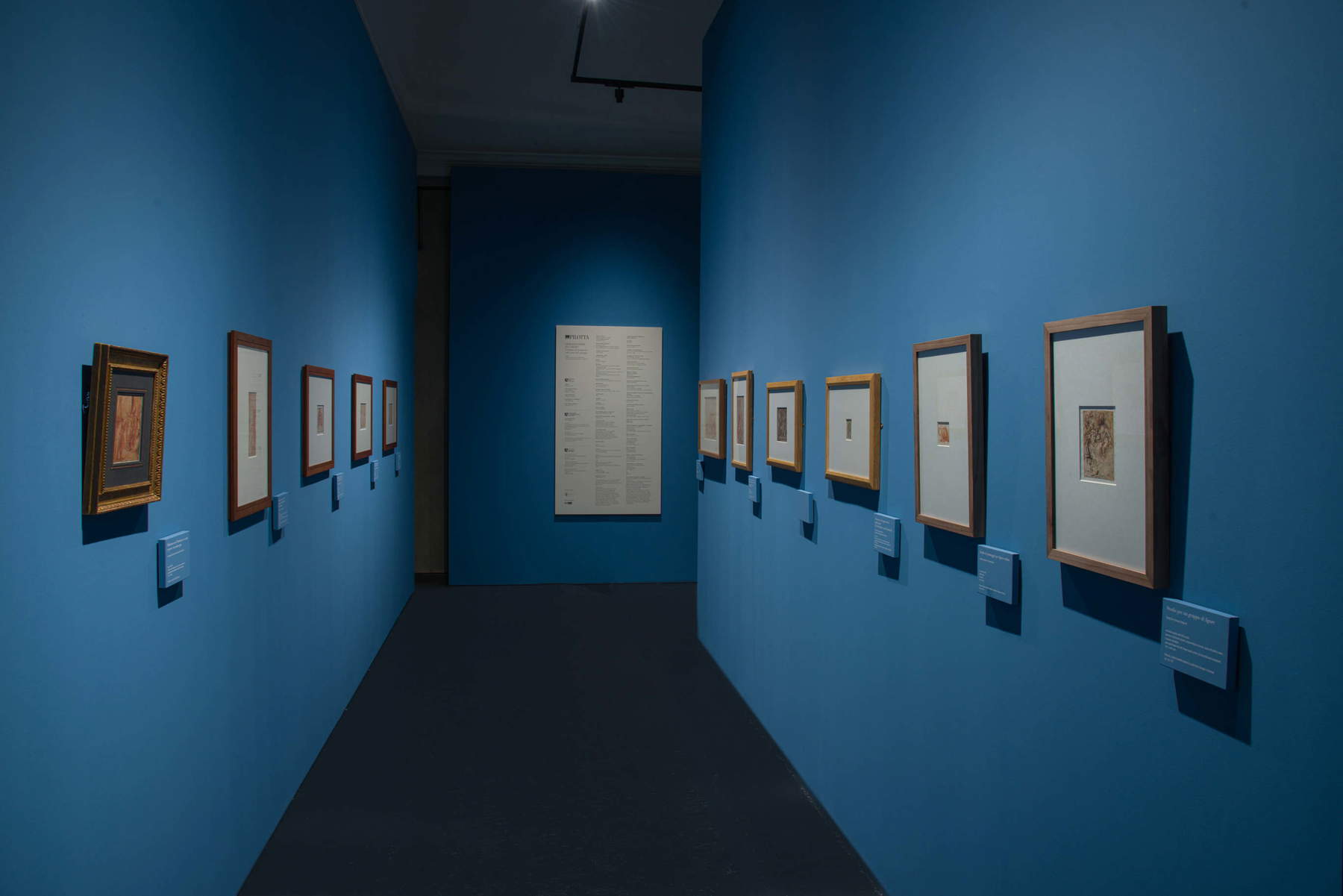
From October 17, 2026, through January 17, 2027, the Pilotta Monumental Complex has dedicated its first monographic exhibition to this artist: Giorgio Gandini del Grano. The Enigma of a Master in the Footsteps of Correggio, curated by Stefano L’Occaso, director of the Ducal Palace in Mantua, and Denis Ton, director of the Pilotta, in collaboration with Stefania Girometti (read our review here). For the first time, nearly the master’s entire known body of paintings ( that is, all known paintings except one) has been brought together, alongside a selection of drawings on loan from institutions such as the Albertina in Vienna, the Louvre, the Gallerie dell’Accademia in Venice, the Pinacoteca dell’Accademia Albertina in Turin, and the Uffizi, as well as from several private collections. Displayed alongside the paintings, the drawings allow visitors to trace the creative process of an artist long forgotten and to appreciate the extent of his mastery of drawing techniques.


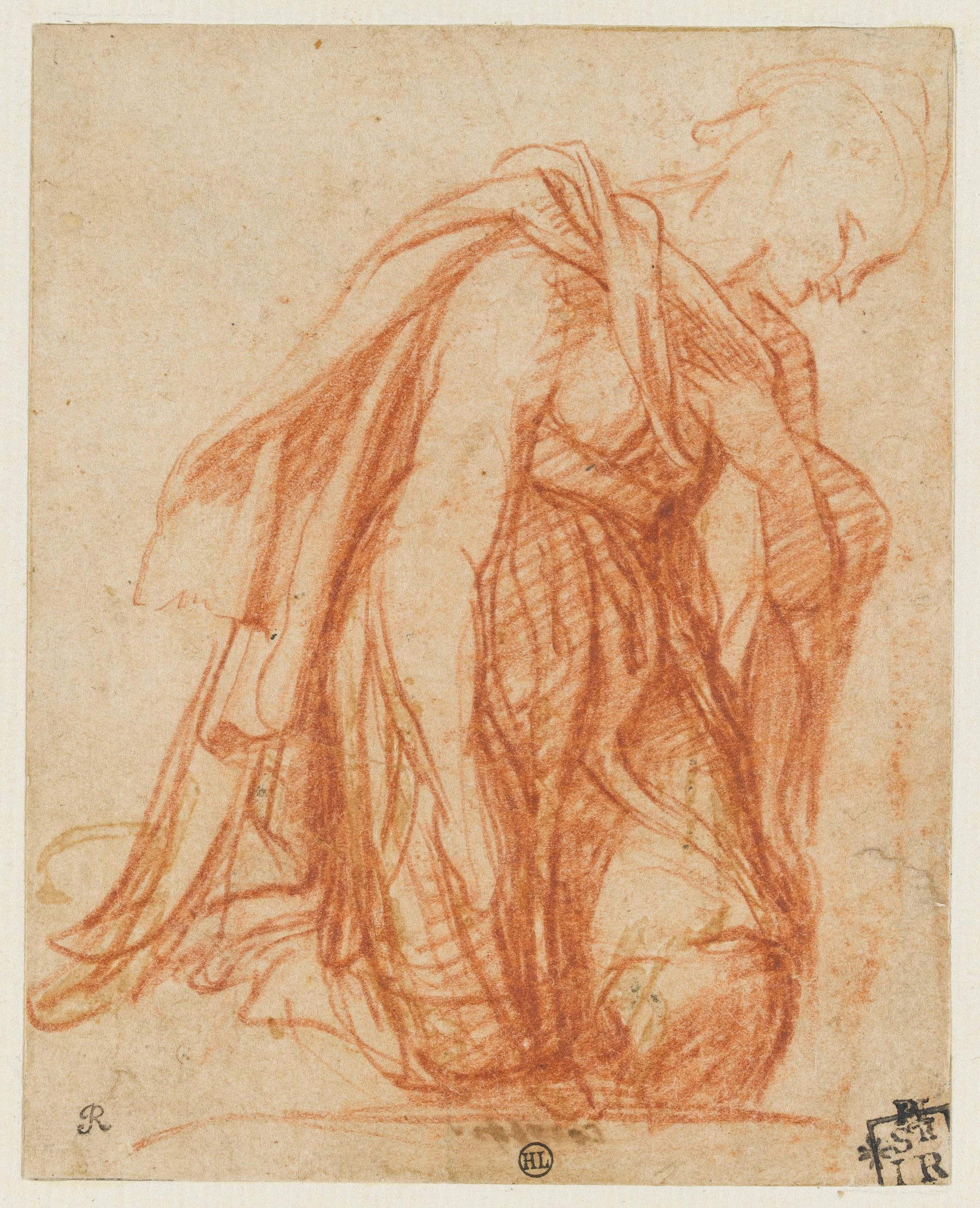
Reconstructing Gandini as a draftsman has been a long process. The sheets now attributed to him, explains Serra, are drawn on loose sheets of paper of various sizes, yellowed by time, and have come down to us with one common element: an early attribution to Correggio, often later corrected in favor of Bernardino Gatti (Pavia, c. 1495 – Cremona, 1576), who was less well-known than Correggio but very active and prolific. The only drawing that bore an early attribution to Gandini—a pen-and-brown-ink study from the Uffizi depicting Joseph interpreting his brothers’ dreams, published as an original in 1935—was excluded from his catalog by the English scholar Arthur E. Popham in 1957. Popham also excluded a Madonna and Child with an Angel from the Courtauld Institute and a Martyrdom of a Saint from Chatsworth. Today, as mentioned, there are about forty drawings by the artist, ten of which are in the Département des Arts graphiques at the Louvre: this is likely an incomplete collection, but sufficient to reveal a feverish draftsman who paid close attention to the observation of the human figure, studying poses from life to then adapt them to complex compositions.


Attributing these drawings to Giorgio Gandini was a lengthy process, grounded in philological analysis. The starting point for recognizing the hand of an artist about whose graphic work nothing is known is to study the relationship between the drawings and the paintings, and in particular to verify whether there are drawings that can be unequivocally linked to the paintings: a study close to the final version, for example, in which the painting is recognizable. It was on this basis that Konrad Oberhuber worked in 1970 and then, in 1978, Giuseppe Cirillo and Giovanni Godi. One example is a drawing from the British Museum linked to the panel depicting Saint Catherine of Alexandria blessed by the Infant Jesus and crowned by the Virgin Mary with two angels, now in a private collection and on display at the exhibition; this work is also connected to the drawing from the Louvre showing the saint kneeling, which is also on view at the Pilotta. The clearest example, however, is a sheet from the Royal Collections at Windsor depicting the Rest on the Flight into Egypt, undoubtedly a preparatory study for the painting now at the Sinebrychoff Museum in Helsinki, which is also on display. Although the sheet is missing its upper right corner, the complete composition is visible, later transferred to canvas with minimal variations in the head of Saint Joseph and the fingers of the Virgin’s left hand. The drawing is grid-marked in red pencil, likely to triple its dimensions on the painting. This sheet also has another story: the reverse side was in fact rubbed with a black pencil, and the outlines were traced with the tip of a stylus, as if to transfer the composition by contact onto another surface. According to Serra, this intervention may date back to 1781, when the English painter Ozias Humphry made a copy on paper of the same dimensions, now in Oxford.
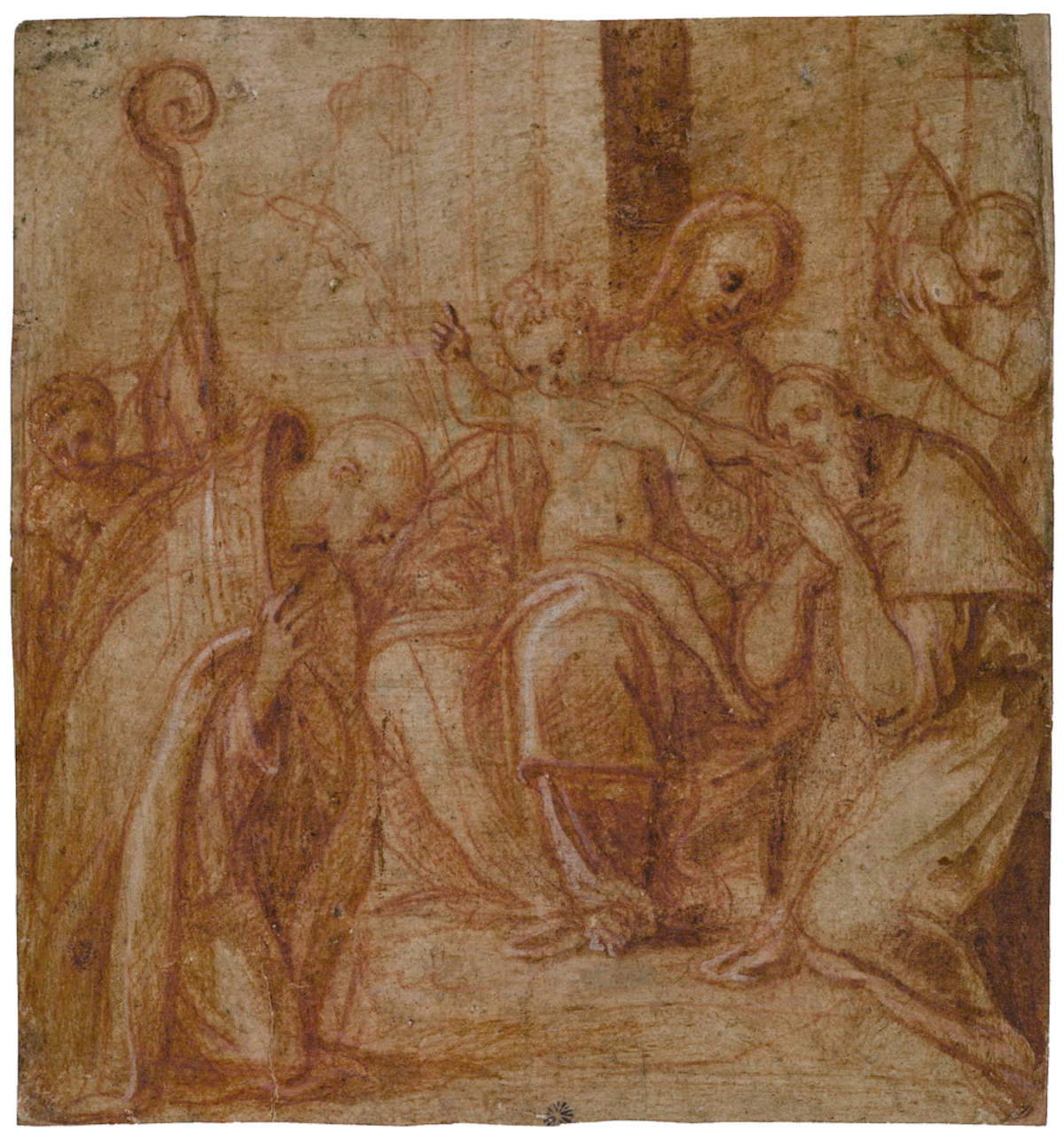
Gandini used mainly red pencil, the technique favored by the artists of Parma: Correggio, Parmigianino, and their followers Michelangelo Anselmi and Girolamo Mazzola Bedoli all employed this medium, which is particularly well-suited for rendering skin tones and evoking the soft light of the Po Valley, which blurs the contours of the figures. Gandini used the red pencil both for its softness—well-suited to the curves of the body—and for the intensity of its tone, as in the quick study at the Louvre for a very complex composition: a Madonna and Child with two saints. Among Gandini’s known drawings are also two studies from the Louvre, likely created for figures in the apse and choir vault of Parma Cathedral—a commission the artist was unable to complete due to his untimely death; they are among the few remaining traces of this great, unfulfilled undertaking. The shadows are rendered with quick, fairly regular parallel hatching, sometimes covered with red pencil dust blended with a stump.
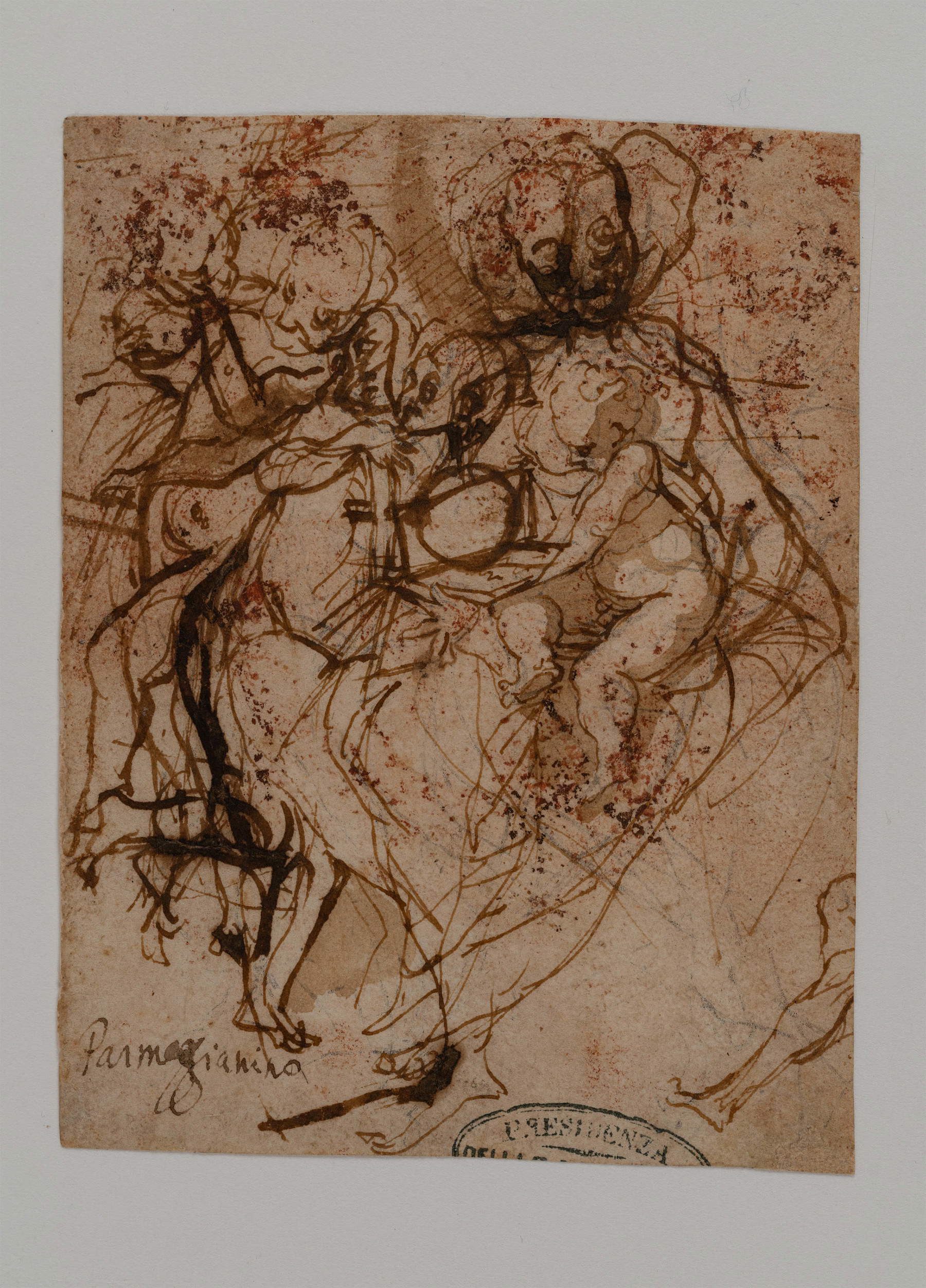
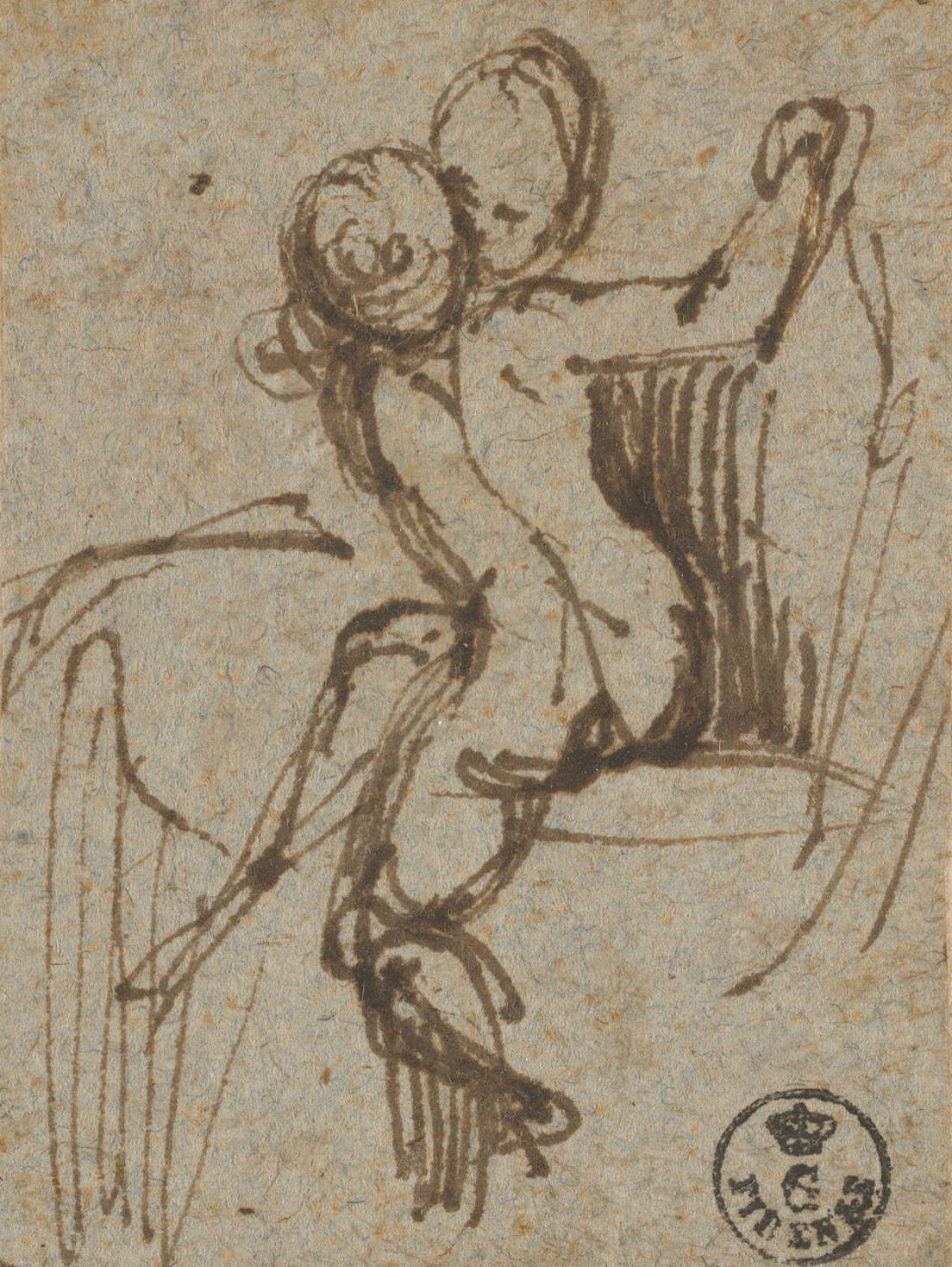
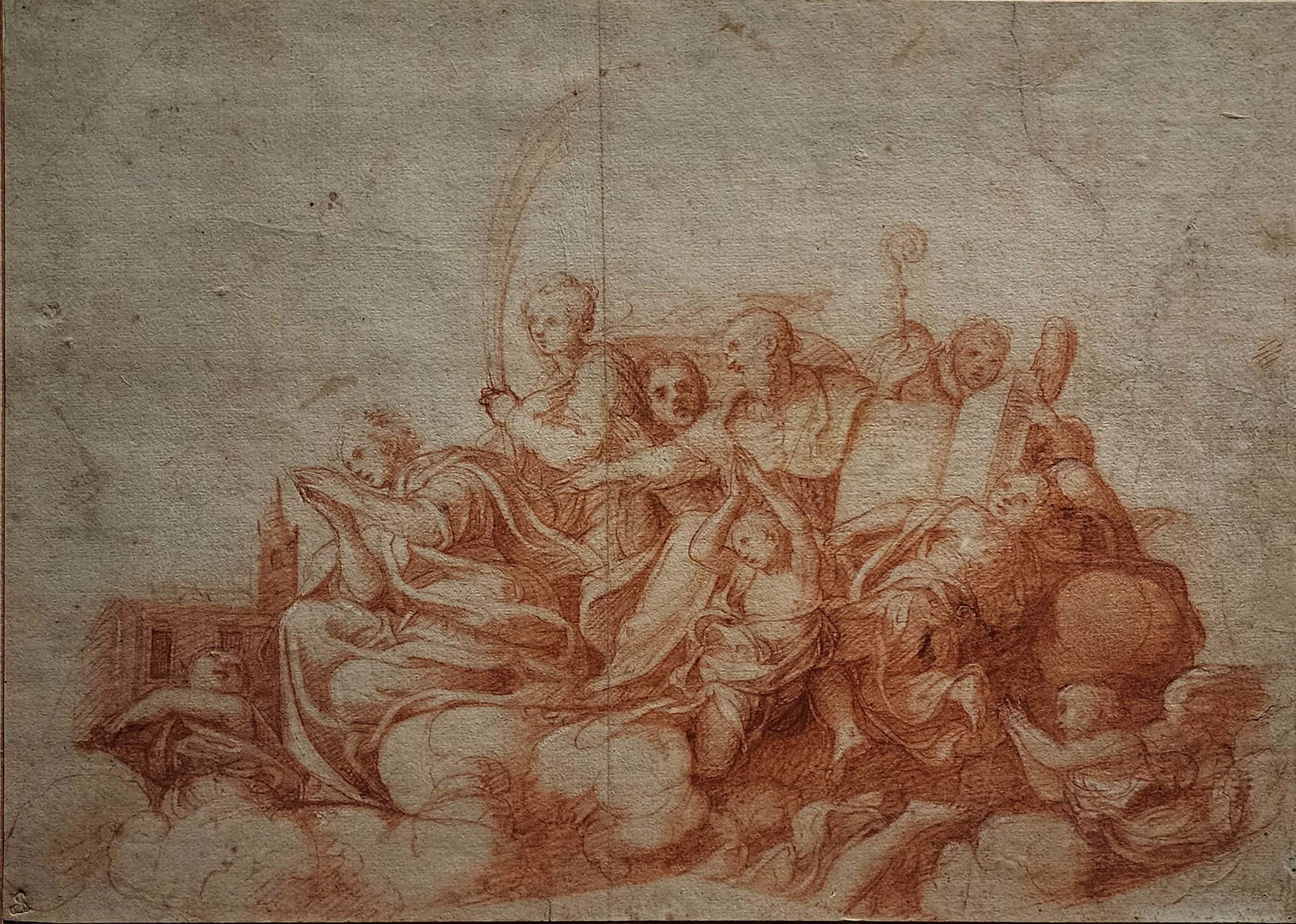
Like Correggio, Gandini sometimes combined red chalk with pen and brown ink, and he did so in a distinctive manner. In a study preserved in Budapest for a Madonna and Child with the Infant Saint John, the painter in fact added the small figure of Saint John the Baptist only at a later stage, using a pen, vigorously superimposing a tangle of marks over the red-pencil sketch. Something similar can be seen in the drawing at the Louvre depicting Saint Catherine kneeling: here, the drapery is reinforced with extremely fine and rapid pen strokes, which time has faded; according to Serra, these elements are not visible at first glance and can only be discovered with a magnifying glass. The same technique appears in the Windsor sheet depicting the Rest on the Flight into Egypt.
Another sheet from the Louvre shows the painter at work: it is a sheet containing several independent sketches, varying in subject and technique. On the front are a study of drapery for the legs of a seated figure and two men who appear to be engaged in a heated discussion, while on the back are two studies from life: a figure on the ground—perhaps asleep, fainted, or even dead—and the bust of a man with his right arm raised. The varying proportions and overlapping parts, Serra observes, suggest a quick execution, as if the artistwanted to capture a pose that would change shortly thereafter. On the front, red pencil alternates with pen, and the painter then intervened with a brush loaded with white. The left side of the sheet is darkened with a brown watercolor wash, which makes the draped figure stand out; she is leaning backward in an unstable pose, and it is precisely this that makes her appear so lifelike. There is a very similar sheet in Chicago, still cataloged as an anonymous Florentine or Lombard work from the late sixteenth century, which the scholar Mary Vaccaro recently attributed to Gandini: According to Serra, the two sheets may have come from the same dismembered sketchbook, but for now there is insufficient evidence to confirm this, since the Louvre sheet bears a watermark absent from the Chicago sheet, and their dimensions differ by a few centimeters.
The drapery study from the Louvre corresponds to the Virgin’s legs inan *Adoration of the Shepherds* housed in Windsor: in this sheet, Serra explains, “the layering of graphic techniques reappears in a sort of ‘crescendo’ of the scene.” First, a quick red-pencil sketch of the entire composition emerges, featuring numerous variations; then, certain details are redrawn in pen; shadows are added with a brush, which smudge and accentuate the volumes; and finally, there is the rich, textured highlighting that softens the contours.” Here, too, the outlines have been traced with a stylus, and the sheet is slightly larger than the others. For this reason, the scholar Francesca Frucco, echoing an observation by Popham, has considered it a small preparatory sketch for an unidentified painting. Serra disagrees: the revisions and variations are still too evident, and she believes it is a work-in-progress, preceding the finished study intended to be transferred to the painting, which is now lost.
Some drawings are done solely in pen: on a sheet in the Uffizi, the body of the small, writhing Saint John is traced with harsh, scratchy lines that seek the power of expression rather than the beauty of the line, and the same is seen in a drawing at the Gallerie dell’Accademia in Venice, where a more complex composition emerges from the interweaving of the lines. Serra links this method to a famous drawing by Correggio preserved in Oxford, likely a preparatory study for the Madonna of Saint Jerome, known as *Il Giorno*, now in the National Gallery of Parma. Popham described those red pencil lines as an “incomprehensible scribble”: the two artists’ styles differ, but their method is similar, aiming to determine the figures’ positions by superimposing lines that writhe across the page.
Giorgio Gandini del Grano’s body of drawings, however, remains incomplete, and even his known drawings raise questions. For example, a study at the Louvre depicting a man holding a plate and raising his left arm is constructed differently from the other sheets: first, extremely fine black pencil lines, visible only under a magnifying glass; then, a red pencil to define the shapes; and finally, the drapery rendered with a broader, softer pencil. The sheet bore an early attribution to Carlo Urbino da Crema, corrected to Gandini by Konrad Oberhuber and Mario Di Giampaolo, and subsequently accepted by Diane DeGrazia in 1984: it is grid-marked for transfer, and according to Serra, it is a far cry from the freedom of the *Madonna and Child with Two Saints* in the Louvre, whose brushstrokes lend the composition an overwhelming energy. A recent restoration has revealed some pen annotations with numbers on the reverse side, perhaps workshop accounts or records of a commission related to that figure. The question of how Gandini would have organized the construction site at the Duomo also remains open. From an analysis of the frescoes in the Church of St. John the Evangelist, we know that Parmigianino used cartoons, while Correggio marked only a few reference points on the wall. As Serra notes, the only known evidence regarding Gandini refers to the preparation of drawings and cartoons, but no trace of these remains.
Little is known about Giorgio Gandini del Grano’s life, and for this very reason he has long remained in the shadows, along with the very small number of works that have survived to the present day. Recently discovered archival documents, presented as part of the exhibition, confirm his baptism in Parma in 1498 and clarify uncertainties regarding his date of birth. His career spanned a brief period, from 1528 to 1538, during which he undertook public and religious commissions. His most significant recognition came in 1535, a year after Correggio’s death, with the contract to continue the decoration of the cathedral—a sign of the high regard in which he was held. Gandini died before 1538 without having carried out this work. For scholars, this outcome confirms that the painter was at his best in small-scale works, where he could freely express his inventiveness and extraordinary finesse—the same impetuous finesse seen in his drawings.
Warning: the translation into English of the original Italian article was created using automatic tools. We undertake to review all articles, but we do not guarantee the total absence of inaccuracies in the translation due to the program. You can find the original by clicking on the ITA button. If you find any mistake,please contact us.