




by Jacopo Suggi 28/08/2026



Categories: Works and artists / Disclaimer
The Tuscan countryside, particularly that of the Maremma, has been the subject of numerous works by 19th-century artists, most notably the Macchiaioli, who explored its wildest and most rugged aspects. An article by Jacopo Suggi.
The history of the depiction of labor in art is long and complex, but in Italy it took on particular significance throughoutthe 19th century—not only in the most explicit forms of social critique, but also in the more subdued and less overt expressions of everyday realism. Numerous studies have now focused on the relationship between art and society, showing how, between the Risorgimento and the early post-unification period, the depiction of ordinary people, trades, and manual labor became one of the ways in which painting measured the reality of the country. No longer just heroes, saints, illustrious figures, or allegorical characters, but men in the fields, women at work, artisans, peasants, cowboys, washerwomen, fishermen, and factory workers: a teeming mass of humble life that characterized the new Italian state. These are subjects that gradually entered the realm of art with a newfound dignity. The theme did not always have explicit protest intentions; in Italian Realism, moral commitment did not necessarily imply an explicit declaration of social goals or a direct condemnation of the living conditions of the working classes. Yet even the simple act of observing daily life—of translating into images the gestures of labor, the bodies, the tools, the animals, the places, and the rhythms of toil—without succumbing to a farcical, grotesque, or mocking interpretation—constitutes a form of engagement with the social reality of the time. It is here that the painting of the Macchiaioli and Tuscan Realism takes on particular significance, as it nevertheless succeeded in bringing a new clarity to the rural world. In this context, agricultural labor is not merely a narrative detail but one of the areas in which nineteenth-century painting tests its relationship with reality. The fields, oxen, carts, herds, peasants, and cowboys are generally not picturesque figures, nor elements of local color, but the very center of the vision—the way through which the countryside reveals itself not as abstract nature, but as a productive and social space. The modernity of realism also lies in this choice: to observe ordinary life without necessarily transforming it into an allegory, and to recognize in trades and manual labor an autonomous pictorial subject capable of sustaining the composition on its own. The Maremma of the Macchiaioli must also be understood within this perspective. Not merely a picturesque view, then, but a worked landscape. In the paintings of Giovanni Fattori, but also in the works of other artists associated with the Macchiaioli movement and Tuscan realism, the Maremma does not appear as a reassuring idyll, but rather as a rugged, vast, and often forbidding countryside, where human presence seems to be constantly grappling with extremely harsh living conditions. But even before the Macchiaioli movement reached its peak, the Maremma had already taken on a special evocative power in the Tuscan figurative imagination.
A land of borders and marshes, it was at once a real place and a literary space, a historic territory and the setting for tragic memories. Malaria loomed over it all—an endemic presence in areas of stagnant water—which long marked the lives of local populations and was eradicated only through 20th-century land reclamation projects and subsequent public health campaigns.


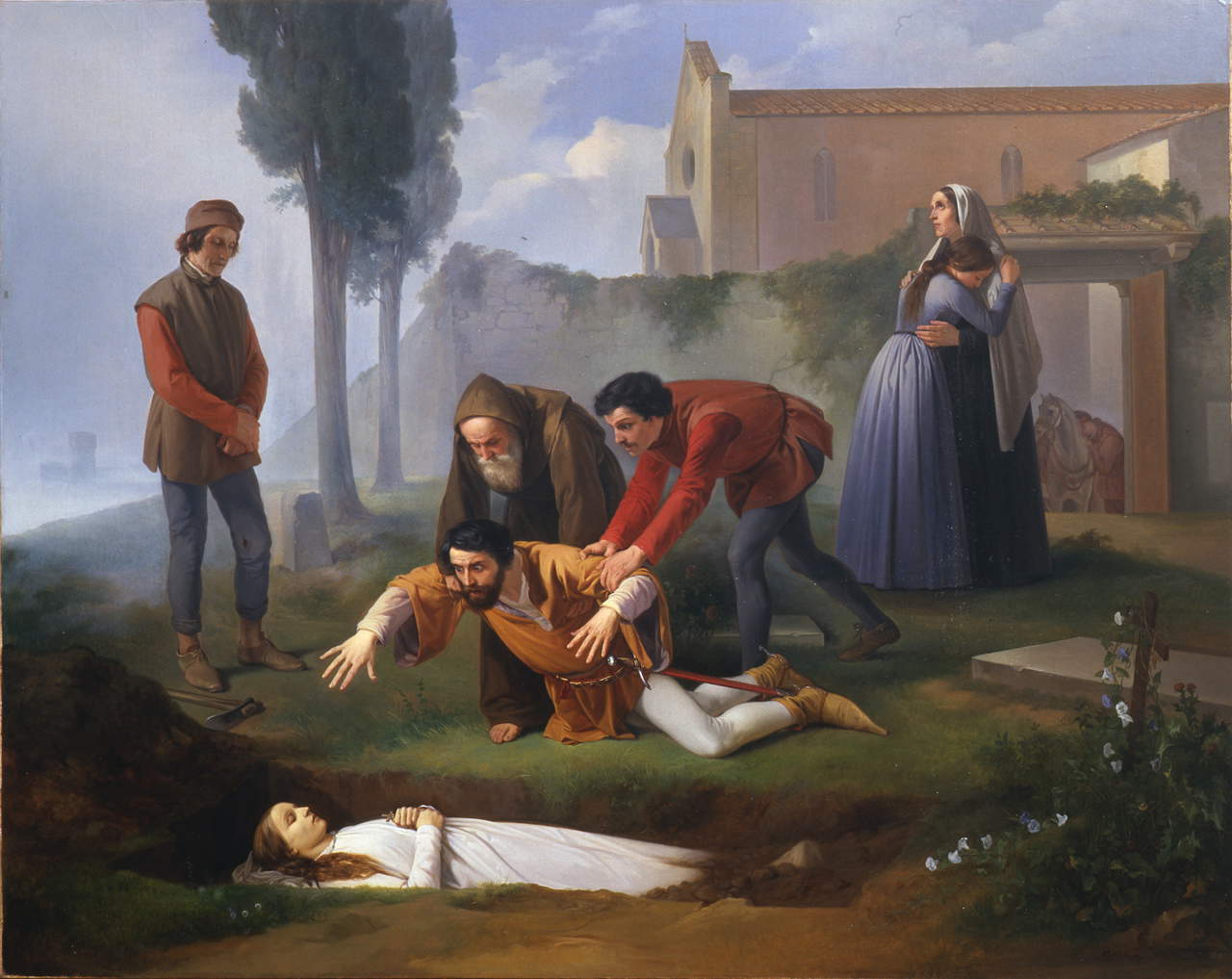
The nineteenth-century Maremma was a land to be inhabited and perhaps conquered, a reality in which the relationship between humans, animals, and the environment took on a clear centrality. A starting point—still distinct from Macchiaioli painting in the strict sense but useful for understanding the figurative significance of this region—can be found in Enrico Pollastrini’s painting, *Nello at Pia’s Tomb*, completed in 1851 and now housed at the Gallery of Modern Art in Palazzo Pitti. The work by Fattori’s master still belongs to a historical-literary and purist tradition; the subject refers to the story of Pia de’ Tolomei—a figure made famous by Canto V of *Purgatorio*—and to her death at the Pietra castle in the Maremma. The work was commissioned by Grand Duke Leopold II, who wished to celebrate the land reclamation projects in the Maremma that had been promoted under his rule. Here, the Maremma is presented as a tragic, remote setting, steeped in poetic and moral symbolism. With the Macchiaioli, and in particular with Giovanni Fattori, the perspective changes radically; the Maremma is no longer merely a literary backdrop or a setting for romantic tragedy, but becomes an environment observed, traversed, and studied from life. Its power lies in the concreteness of its landscapes—the fields, the animals, the herds, the cowboys, the roads, the marshes, the rest stops, and the journeys. Labor is not glorified but made visible within a rural landscape that is not a place of leisure or retreat, but of toil and pain. The Maremma revealed in the paintings of this Tuscan group, therefore, is not merely nature, but a space wrested from it for agricultural and pastoral uses, where humans and animals share not only in the landscape’s economy but also in the same difficult fate. This shift in approach also stemmed from firsthand experience of the region. The Maremma estates—and in particular the Marsiliana farm of the Corsini princes—offered the Tuscan artists a privileged vantage point onto a rural world that was still deeply rooted in tradition. It is from this proximity to reality, rather than from an illustrative or sentimental impulse, that an essential part of the Macchiaioli iconography arises. Beginning in the 1880s, Fattori was a frequent guest at La Marsiliana, where he was able to discover this primordial world; but it was especially in the following decade that his body of work increasingly featured scenes set in the Maremma region, with subjects drawn from the simple, spartan life led there. As the scholar Vincenzo Farinella points out, for Fattori, the Maremma “represents the dream of a primitive world, a refuge unspoiled by the contradictions of modernity, much like Polynesia for Gauguin or Provence for Van Gogh.”
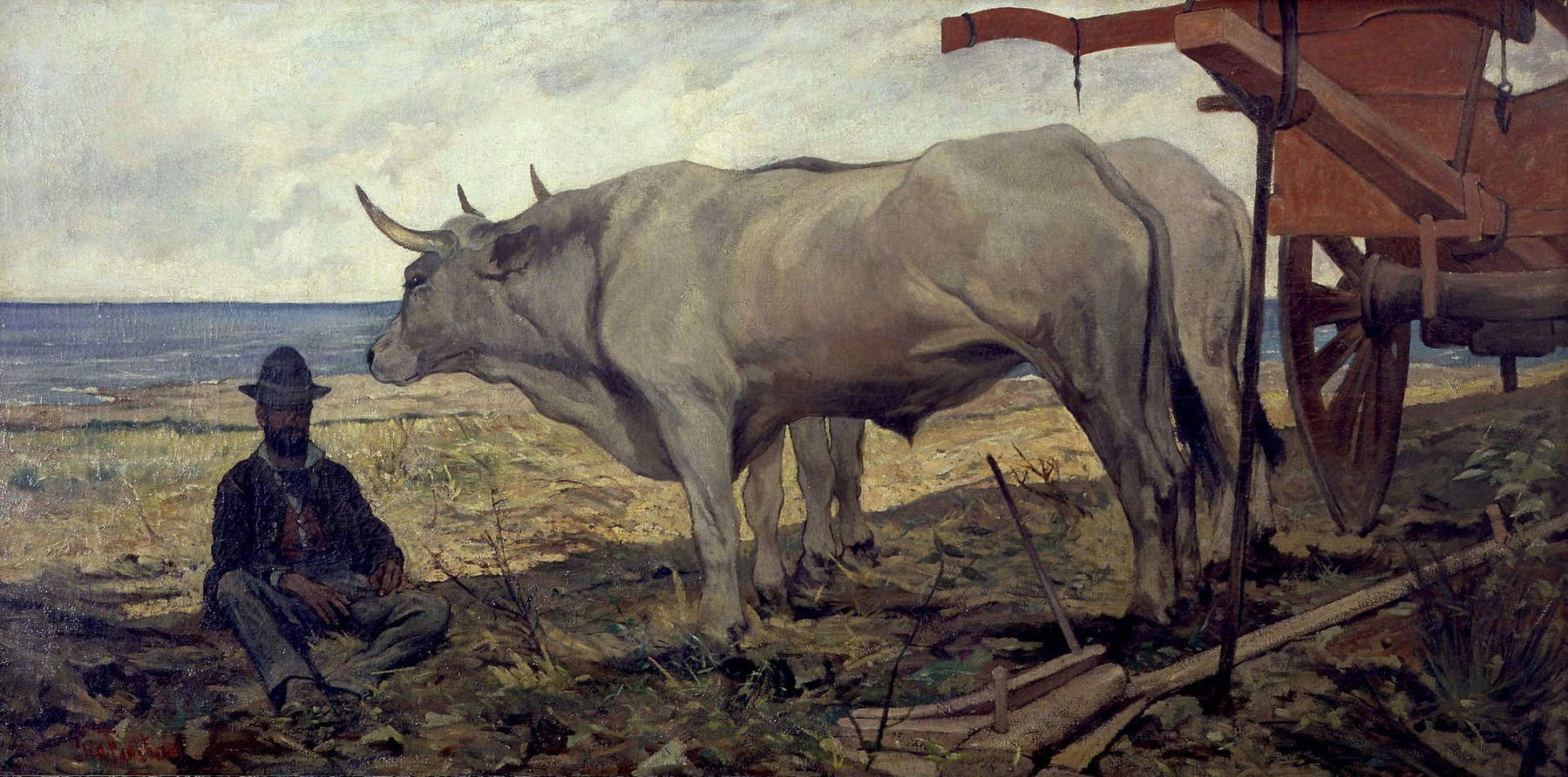
There is no doubt that, inspired by the Maremma landscape, Fattori created some of his most iconic works. In 1882, in a letter to his lover Amalia Nollenberger, he described one of his stays as a guest of Prince Corsini, highlighting the characteristics of the environment that so fascinated him—marked by “rather bleak views, more sad than pleasant, arid countryside,” beyond which the view stretches all the way to the sea. These were places inhabited by “primitive” people, as evidenced by their “garments made of goatskin, with dark, elongated faces and beards as if they had never known a razor.”
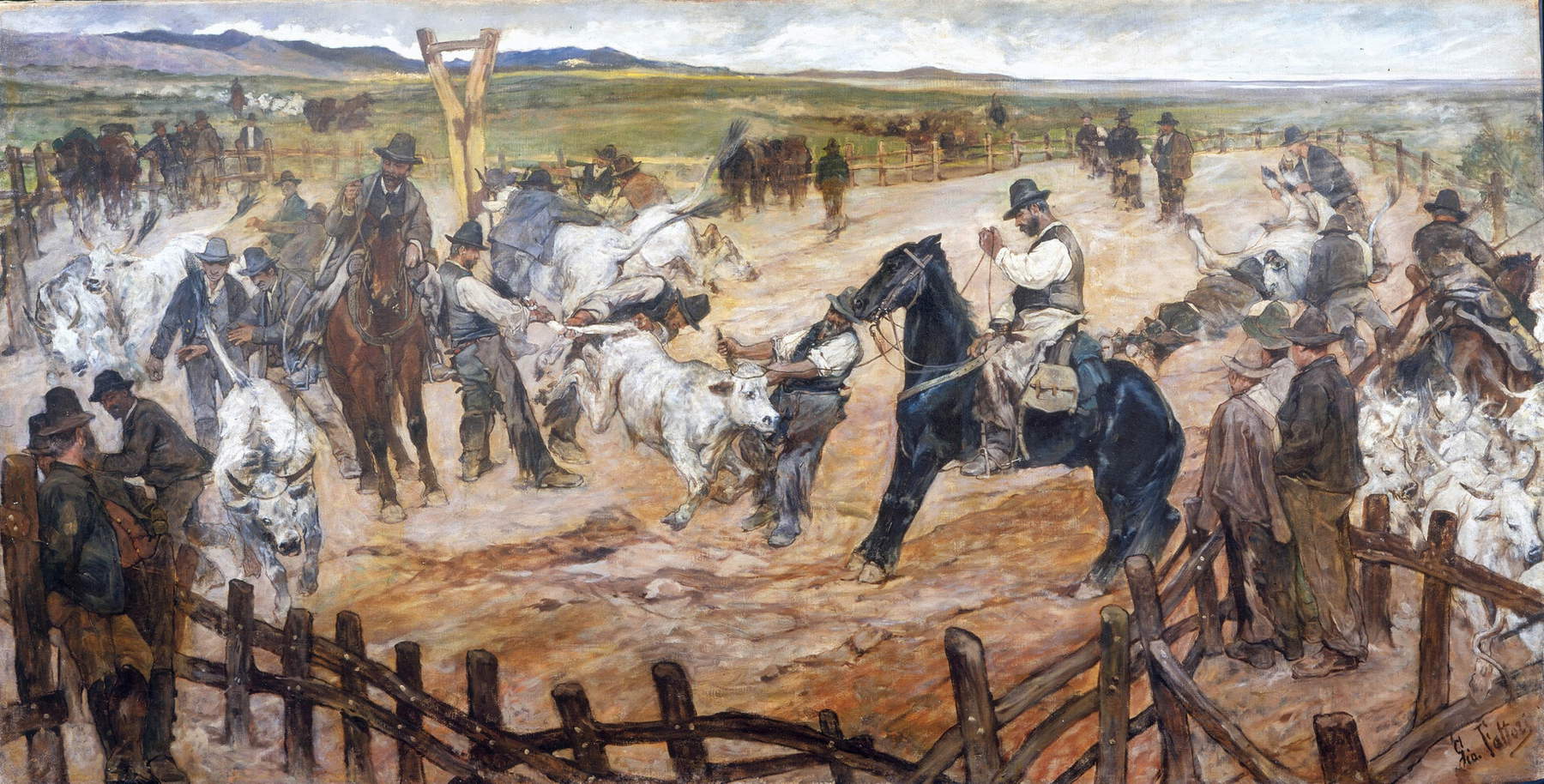
Alongside Corsini, Fattori immerses himself in the life of the Maremma, riding for four hours as he accompanies a herd of horses into the scrubland, and then participates in the castration and branding of the horses. Here he witnesses this brutal operation, which pits man against animal. He recalled how the herders would lasso the horses and then leap onto their backs, trying to subdue those uncontrollable forces: “All of this is worth a painting—and a very beautiful one at that. The struggle between men and horses is terrible.” That painting was indeed created between 1882 and 1887; it is the large canvas titled *The Brandmarking of Foals in the Maremma*, where the episode observed from life becomes a scene of restrained yet violent energy. At the center is not the tranquility of the countryside, but the hand-to-hand struggle between men and animals: herders bent over in exertion, kicking horses, figures tense in an almost frenzied movement, set within a landscape that seems to absorb and amplify that exertion. The same theme recurs in *The Branding of the Young Bulls*, a contemporary work in which the struggle shifts from horses to cattle, yet the principle remains the same: rural labor is depicted as the tension of bodies, grip, resistance, and collective effort.
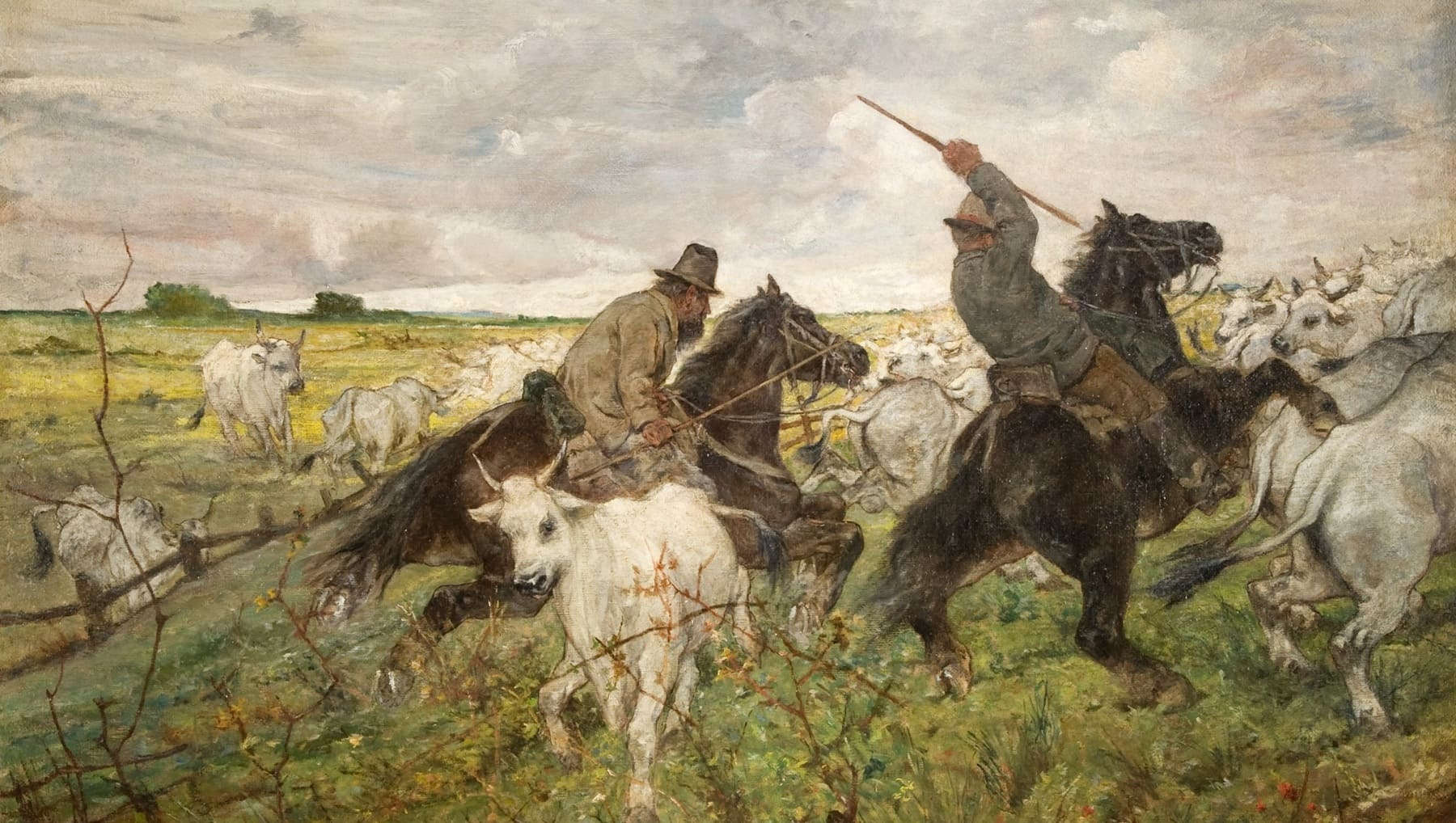
But the figure destined to become the most iconic in his depiction of the Maremma is that of the buttero. Thanks in part to Fattori, this ancient profession was not confined to local memory or rural chronicles but became a permanent fixture in the Italian visual imagination. The buttero, in fact, became the very face of the Maremma—the horseman-laborer capable of embodying the harsh, everyday relationship between man, animal, and landscape. Forged by a harsh landscape, where bandits roam alongside the threat of malaria, the butteri wear humble clothes, their skin sunburned in a culture that had not yet embraced the narcissism of tanning—a tan that, in fact, continued to be a sign of low social status. Yet Fattori’s brushstrokes convey solidarity; he paints them with a dignity and composure that cloaks these figures in heroism—an aura previously reserved for nobles, soldiers, and military leaders. The gigantic canvas *Mandrie Maremmane* (Herds of the Maremma), housed at the Civic Museum of Livorno and awarded a silver medal in 1904 at the World’s Fair in St. Louis, United States, depicts two cowboys tending a herd. They wear dark hats, velvet vests and jackets, and fur-lined leggings, and wield the “pungolo,” the stick used to prod oxen and horses. They reappear in numerous scenes, such as the dynamic painting *Butteri e mandrie in Maremma* from the Monte dei Paschi di Siena collection.
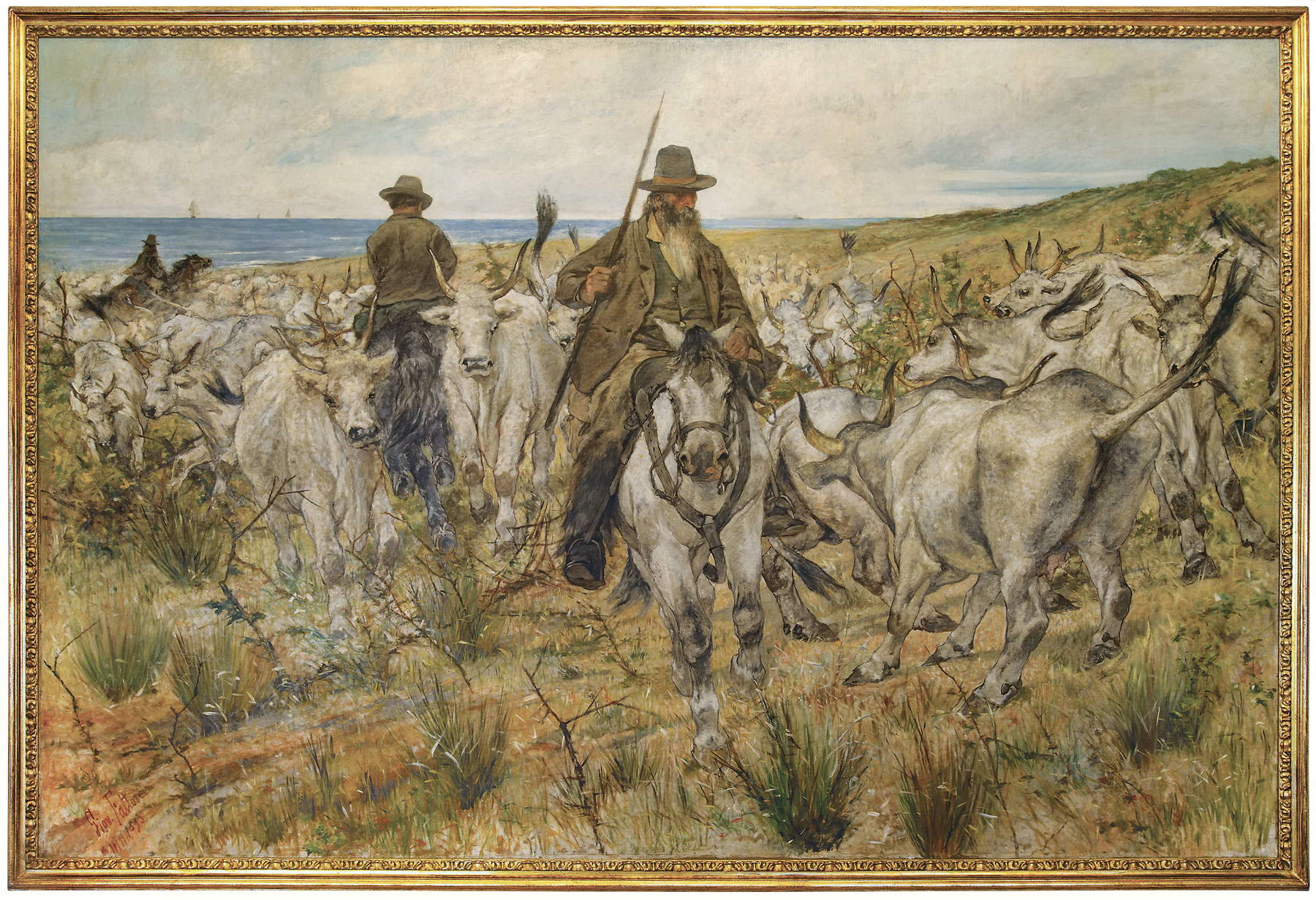
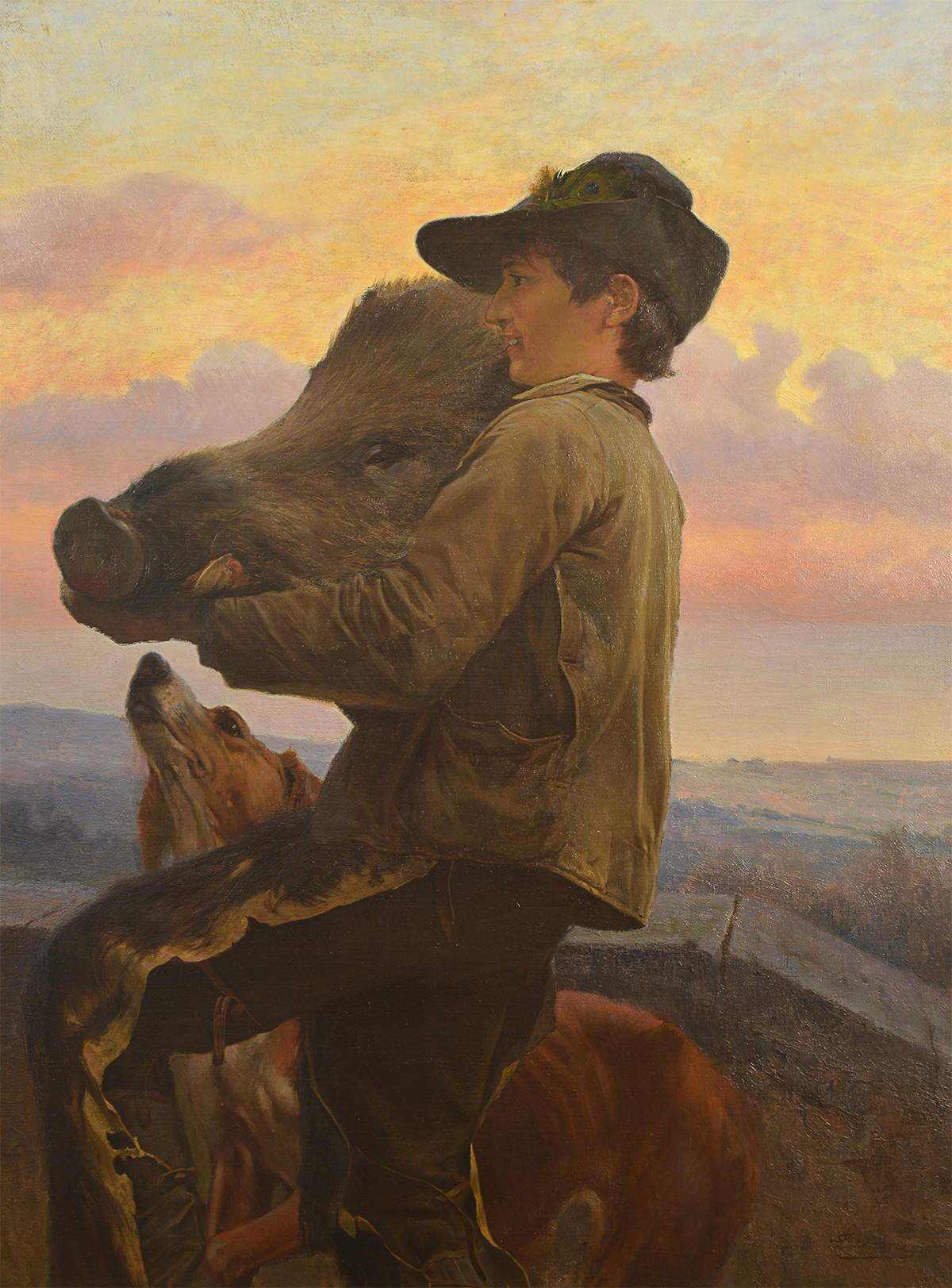
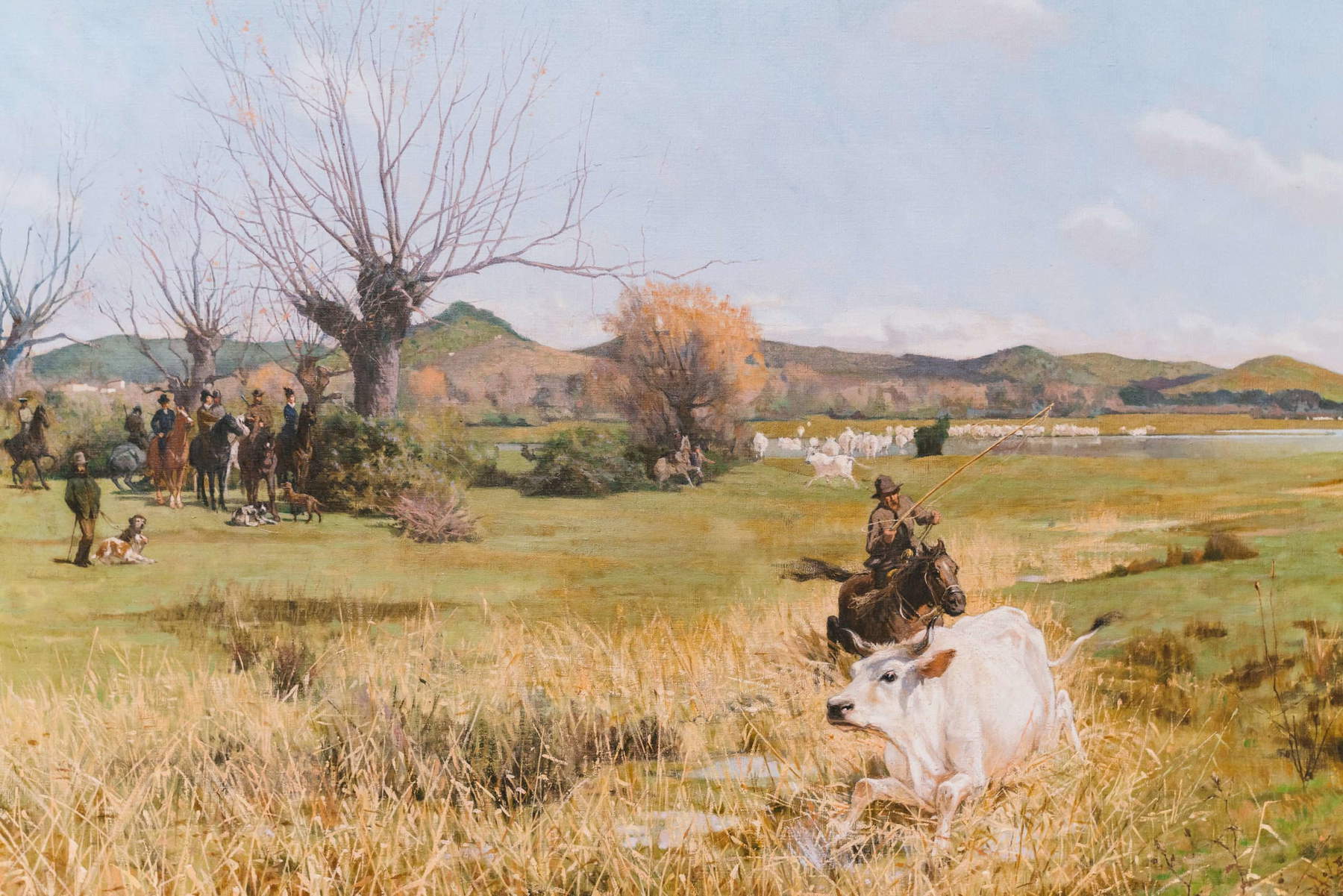
The “Macchiaioli” vision of the Maremma extends beyond the scope of Giovanni Fattori’s work. Around him—or slightly beyond his own experience—other Tuscan artists contributed to capturing an image of the region characterized by its primitive aspects and dominated by archaic social relationships. This is the case with his fellow citizen Eugenio Cecconi, a painter and hunter deeply attached to the Maremma and its rugged landscapes, who was also a frequent guest of the Corsini family. While in *Il Bracchiere maremmano* the figure of the young servant wearing fur leg warmers introduces the theme of hunting and the wild boar hunt, in *La lacciaia* the reference to pastoral work is even more direct: on the banks of the Ombrone River, a cowherd throws his lasso to retrieve a calf that has strayed from the herd. The scene retains a narrative and almost spectacular quality, but at its core lies the technical skill of the work, the knowledge of the animal, the control of movement, and the physical alertness of the cowboy within a landscape rendered in all its colors, sounds, and ruggedness.
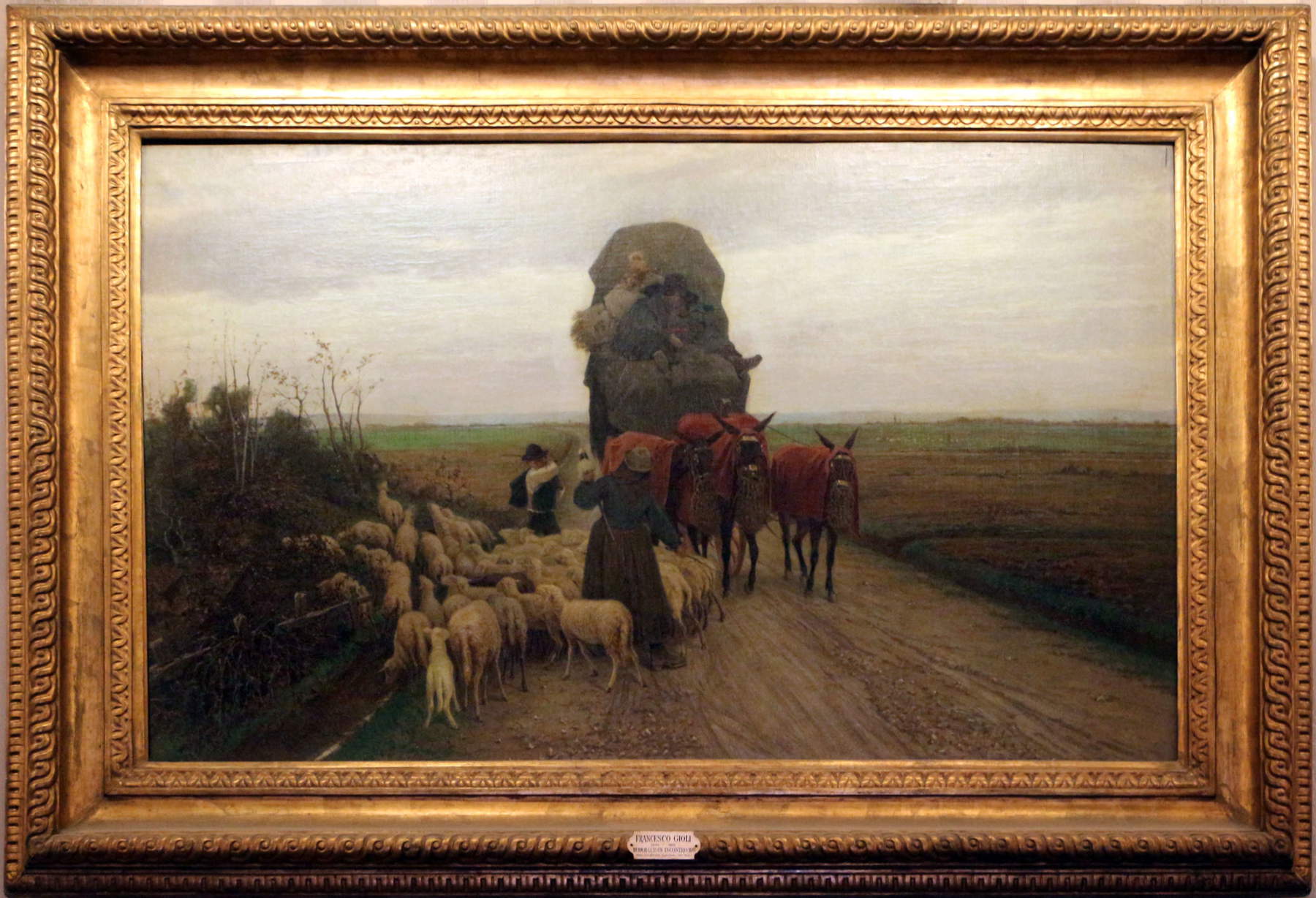
Alongside Cecconi, Francesco Gioli also offers a useful insight into how the Maremma enters Tuscan painting not merely as a remote backdrop, but as a lived-in place, traversed by human presences and everyday interactions. In *An Encounter in the Maremma*, painted in 1874 and exhibited at the Paris Salon the following year, the artist has now moved away from historical painting toward a rural scene with a naturalistic sensibility. The subject is simple: an encounter along a rural road, figures standing still and passing by, immersed in a vast and silent landscape. It is a world in which daily life is measured by the slowness of movement, by the isolation of places, and by a nature that does not welcome but constrains.
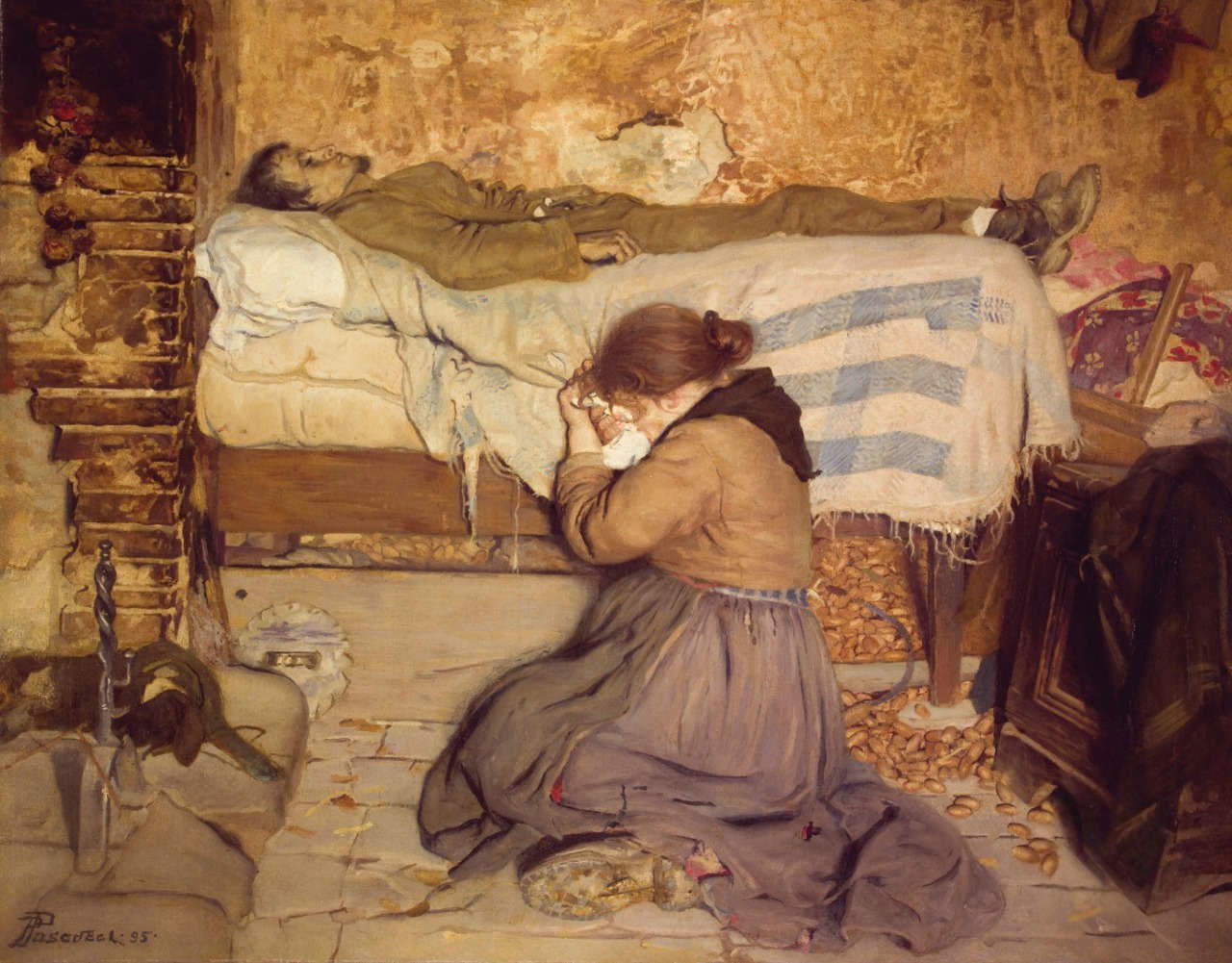
Through Fattori, Cecconi, and Gioli, the Maremma of the Macchiaioli and Tuscan Realism thus takes on a complex character. It is not only the land of cowboys and herds, but also that of malarial marshes, golden fields, pack animals and livestock, hunts, isolated roads, rest stops, and chance encounters. It is a territory explored in its many facets, its resources, and its harshness. It is a countryside that yields its fruits only at the price of sacrifice, forcing people to live far from civilization, endure the harshness of the elements, face poverty, and endure physical toil; a place that demands obedient submission to nature even in the century when civilization was beginning to write its most important chapters. To recall just how fraught with danger this challenge still was at the end of the century, we can turn to a work that, while no longer strictly part of the Macchiaioli movement, is fully rooted in the rural reality of the Maremma: Paride Pascucci’s *Heroes of the Maremma*, painted in 1895. Here, life in the fields is reflected in the extremely humble interior of a house, where a man lies dead from malaria while his pregnant wife weeps silently for him. The Maremma is no longer a landscape or a scene of labor, but a social destiny; it is the domestic and tragic flip side of that land which the Macchiaioli had observed in the open spaces: a world of toil and resilience, where the beauty of the landscape never erases the harshness of life.
Warning: the translation into English of the original Italian article was created using automatic tools. We undertake to review all articles, but we do not guarantee the total absence of inaccuracies in the translation due to the program. You can find the original by clicking on the ITA button. If you find any mistake,please contact us.