




by Andrea Fusani 04/09/2026



Categories: Works and artists / Disclaimer
In Carrara—specifically in the Torano Valley, at the foot of the Apuan Alps—the Marcognano Monumental Cemetery houses marble masterpieces, the stories of artists, entrepreneurs, and workers, civic memories, and traces of the Carrara that transformed between the 19th and 20th centuries. A journey to discover a heritage that remains largely unknown. An article by Andrea Fusani.

Nestled among the marble-rich mountains of Carrara, in a narrow and secluded valley, the monumental cemetery of Marcognano is a place of great charm, both for the richness of its artistic heritage and for its historical, civic, and scenic value. Although still relatively unknown compared to other similar sites, it preserves a wealth of historical evidence that places it among Italy’s most significant historic cemeteries. But how is it that a relatively small city like Carrara has a monumental complex of this importance? We may disappoint those who love puzzles and mysteries, but the reasons, in this case, are clear and tied to the unique history of the city of marble. First of all, in the decades spanning the late 19th and early 20th centuries (when Marcognano was designed, built, and decorated), Carrara experienced unprecedented economic and demographic growth. In the first forty years following national unification, the population had more than doubled (+128% to be precise), a figure well above the national average (+51.4%), driven by a steady increase in exports of marble, both processed and unprocessed. The presence of a rapidly expanding industrial sector attracted a steady flow of migrants, and the constantly changing social context provided fertile ground for the spread of modern ideas and revolutionary ideals.
Finally, it should be noted that, amid an international climate particularly favorable to sculpture, artistic studios and workshops were flourishing in the city—ranging from the most humble workshops to large-scale industrial facilities dedicated to the creation of luxurious marble ornaments and architectural elements.


Marcognano offers perhaps the most vivid picture of that unique interplay between the Industrial Revolution, social upheaval, and artistic practice that characterized Carrara at the turn of the century: walking among its monuments and in the shade of its cypress trees, one has the sensation of strolling along the boundary between art and memory, where the stories of individuals become collective history.
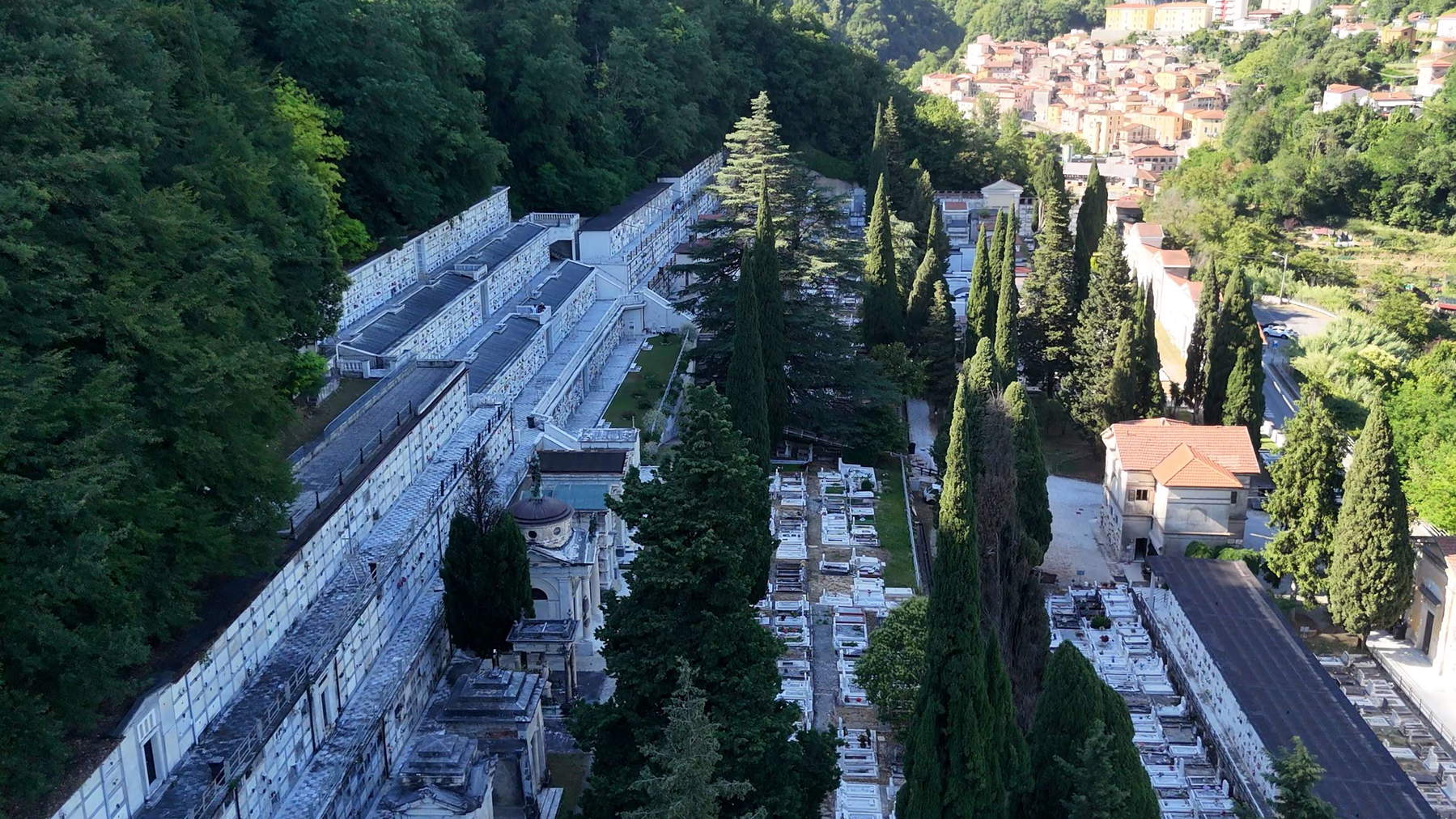
The site has remained untouched by the urban development of the modern city and is pleasantly nestled in the greenery of the Torano Valley, offering picturesque views of the Apuan Alps and the marble quarries. You reach it by walking up a pleasant tree-lined avenue, designed in the late 19th century specifically to provide access to the new cemetery. The idea was to provide citizens with “a pleasant walk, which is almost entirely lacking in Carrara,” thereby promoting “the hygiene and decorum of the city”; intentions that have been disregarded and which it might be worth reconsidering, given the general state of neglect in which the area seems to find itself.
The exterior is austere and bare: a long gray wall, broken up only by the rhythm of the chapels, runs alongside the road, concealing the interior of the complex from traffic. The topography of the site dictated the cemetery’s overall shape—a compact amphitheater that takes advantage of the mountain’s natural slope—and its secluded character, which was intended to inspire an intimate sense of contemplation.
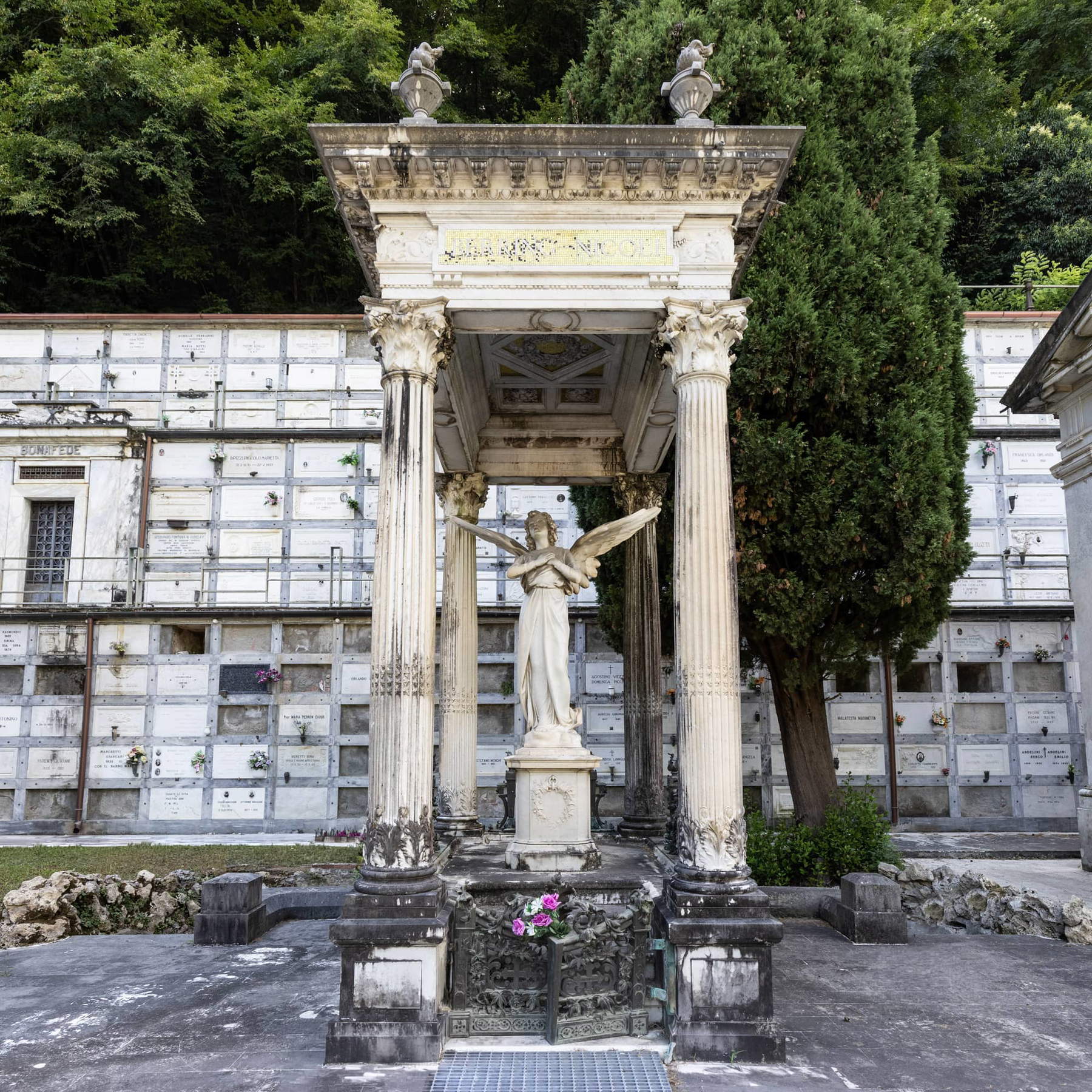
At the center of the structure is a small exedra, framed by four elegant Tuscan-order marble columns topped with classical-style ornamental vases, through which one enters the cemetery at the funeral chapel. The more observant eye will not fail to notice a strange sense of asymmetry: the sacred building is, in fact, not aligned with the center of the entrance but slightly offset toward the south. Was this a deliberate choice? Far from it. This slight imbalance, within an otherwise perfectly harmonious complex, reflects the history of its construction, which is worth briefly reviewing.
Carrara had a suburban cemetery, built in the early 19th century, whose inadequacy had been evident since the middle of the century. It was not merely a matter of size—certainly insufficient to accommodate the city’s aforementioned growth rates—but also of a location that was no longer secluded: the site, located where Piazza Matteotti stands today, was too close to the historic center and destined to become an integral part of the urban fabric (as indeed happened).
The first post-unification administrations had no doubts about the urgency of the matter: in 1862, an initial commission was formed that identified the area known as “Foce”—along the picturesque Napoleonic road that still connects Massa to Carrara—as the suitable site for the construction of a new cemetery. An initial design was submitted for review to the “Commission for Architecture and Ornamentation” of the Academy of Fine Arts in Carrara, which noted the need to carefully attend to the structure’s ornamental details, but also to avoid constructing a planned “peristyle” for reasons that had little to do with the architecture itself (“so as not to create a haven for inappropriate encounters”!).
After four years of discussions and the evaluation of at least five other sites, the current location was chosen: “on the southern slope of Mount d’Arma, in a narrow valley, almost secluded from the clustered and scattered settlements of Carrara, nestled within a natural hollow of the mountain.”
The original structure was much smaller than the current one; it took the form of an elongated parallelepiped, organized along a central axis that gently followed the contours of the terrain. The first design for the funeral chapel dates back to 1866 and was drawn up by the city’s chief engineer, Francesco Bourelly; it was later supplemented the following year by another municipal engineer, Vincenzo Lucchini: the building’s basic structure is the same as today’s, although the decorative elements—the rustication on the lower level, the pilasters, and the frieze—are missing.
Not even a decade had passed when the need arose to significantly expand the complex, which was still under construction: Telesforo Simonelli, to whom the very recent and pioneering master plan for Carrara (1874–1875) was attributed, envisioned a cemetery with “Romanesque forms”—a neo-Gothic structure that would have created a Marcognano profoundly different from the one we see today.
The decisive intervention was the work of the dynamic Leandro Caselli (Fubine, 1854 – Messina, 1906), a student in Turin of Alessandro Antonelli (Ghemme, 1798 – Turin, 1888) in Turin and the younger brother of the better-known Crescentino Caselli (Fubine, 1849 – Bagni San Giuliano, 1932), an architect and essayist active in both his native Piedmont and Sardinia (he designed the city hall in Cagliari). Upon arriving in Carrara in 1883, after winning the public competition for chief engineer of the municipality, Leandro Caselli devoted himself with tireless dedication to the city’s architectural renewal, constructing (or at least designing) iconic buildings such as the Politeama Giuseppe Verdi and the Dogali Barracks, public schools, headquarters for commercial and financial institutions, and private residences. In 1885, on behalf of the city council, he published a small volume dedicated to “Public Works Projects for the City and the Villages,” a veritable master plan destined to forever change the face of the city. Significantly, this comprehensive report opened with the plan for the new Marcognano cemetery, the most ambitious of all the architectural projects envisioned by Caselli. It was not merely a matter of fulfilling practical or devotional functions, but of endowing the city with a structure that would reflect its status as a city of marble, art, and sculpture: “All the people of Carrara deeply feel the need to express, through the veneration of tombs, that sentiment so universal in the history of peoples—indeed, of the human race—which inspired the poet’s sublime thoughts on the urns of the departed; the very plastic and sculptural arts so widely practiced in Carrara demand a setting worthy of housing funerary monuments exquisite for the quality of their marble and the precision of their forms.”
Caselli’s grand vision took shape in a design with a distinctly monumental character: the site’s natural slope was viewed as a scenic asset capable of creating “a variety of scenic effects.” Long porticoes would guide the eye toward the imposing central chapel, the visual focal point of the composition. The complex echoed the architecture of the Staglieno Monumental Cemetery in Genoa, designed by Carlo Barabino (Genoa, 1768–1835) and Giovanni Battista Resasco (Genoa, 1798 –1872), not least because of the solemn and austere classicist style adopted by Caselli, despite his initial temptation to “follow local traditions, attempting a composition inspired by the forms of the Carrara cathedral.”
The young engineer enjoyed the full support of Mayor Agostino Marchetti, who was responsible for officially approving a plan that was considered “a sign of advanced civilization in our country”: “A cemetery that may serve as a worthy resting place for the deceased and an artistic adornment for our town […] a work worthy of the city of marble, the city that gave birth to so many artists […] a design that could meet the current needs of the city and those of its future,”
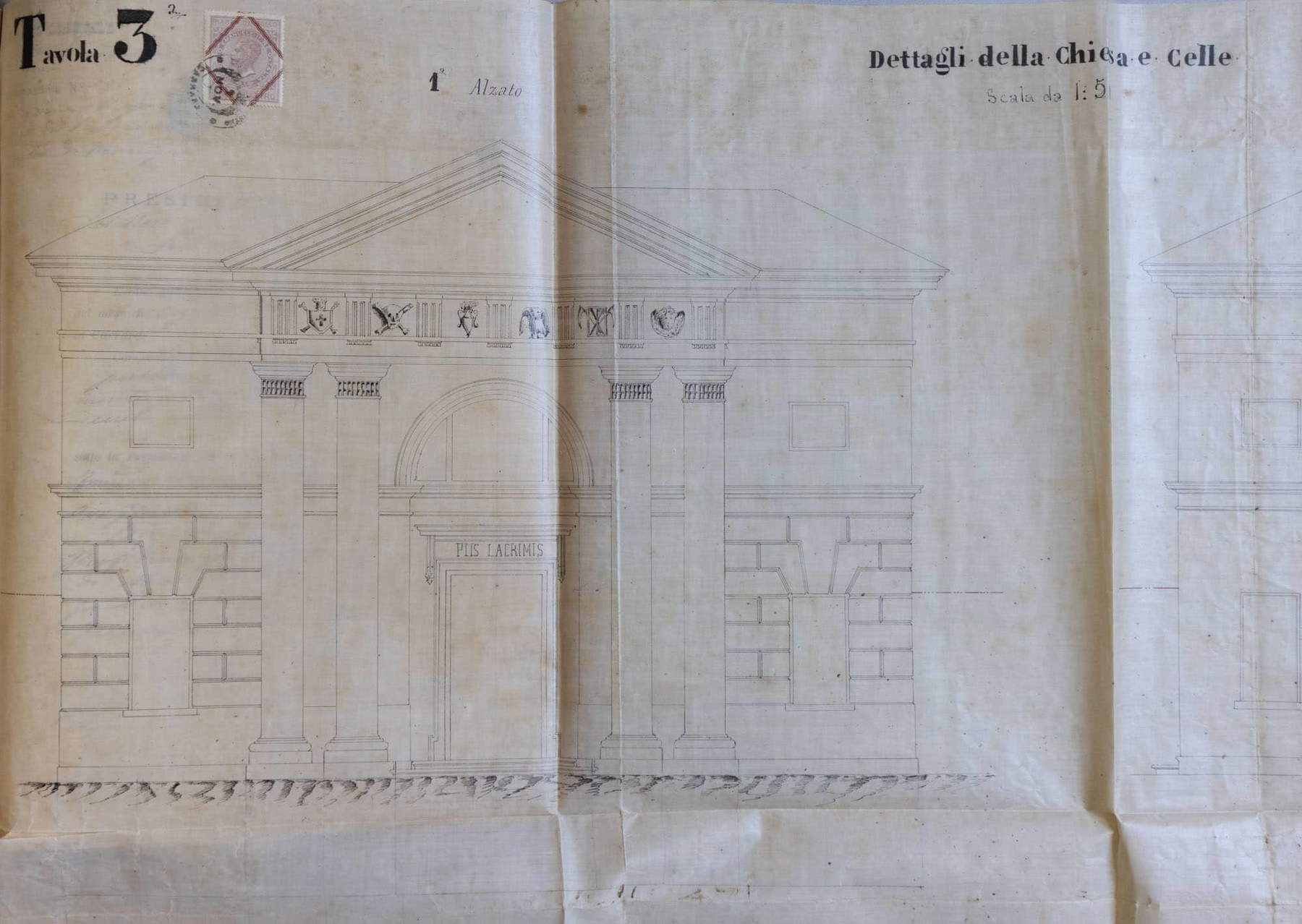
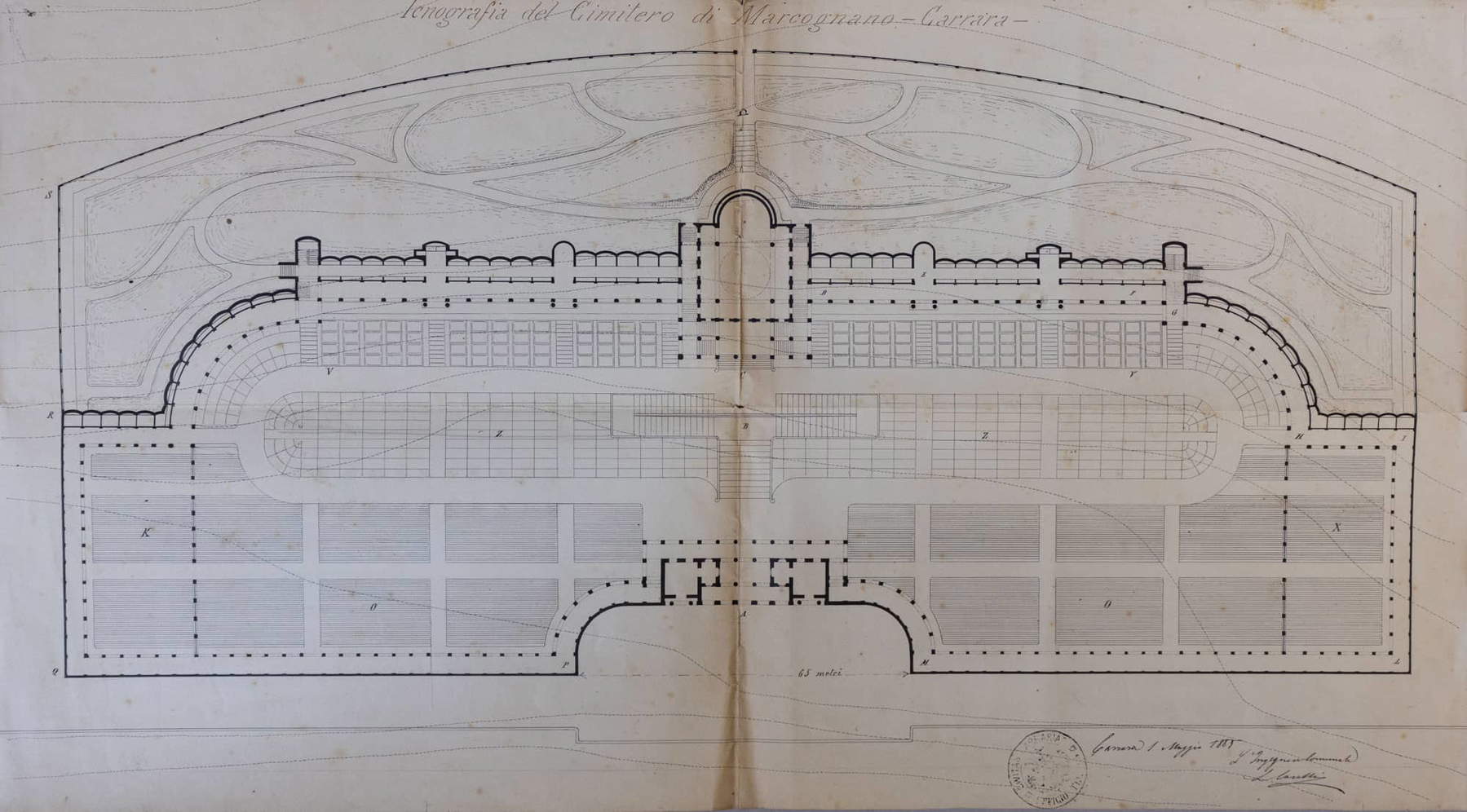
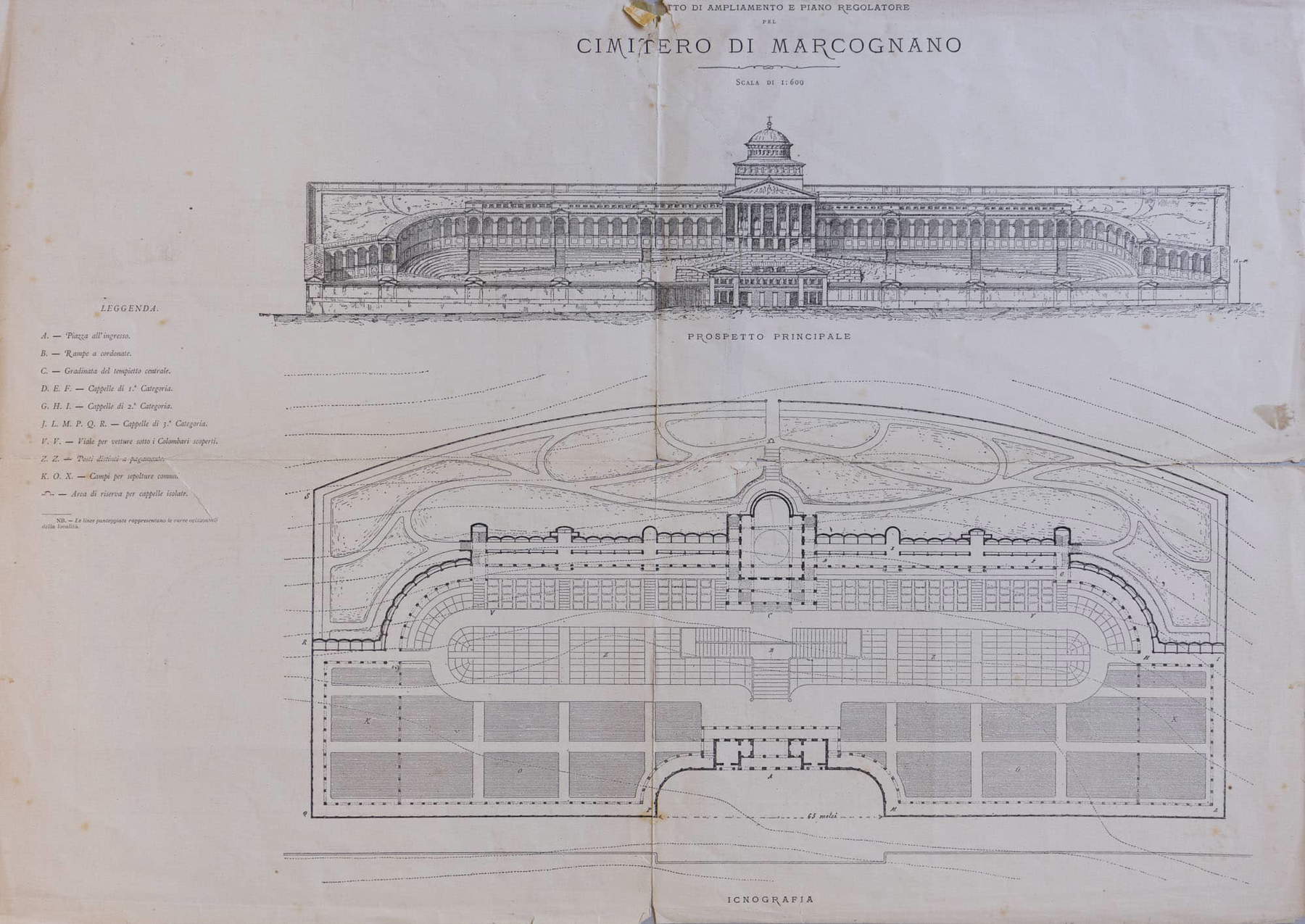
Yet, looking at the current structure, there is no trace of the propylaea, the porticoes, or the central temple with its dome and octastyle pronaos: Caselli’s design remained, for the most part, a dream—but a dream that casts its benevolent shadow over today’s Marcognano. The overall layout, the idea of making dramatic use of the hill’s contours, and the exedra at the entrance are all traces that point back to the visionary nineteenth-century project, which called for, among other things, the demolition of the 1868–69 chapel—a fact that explains its off-center position relative to the entrance envisioned by Caselli. Caselli, however, had already partially foreseen the future fate of the cemetery with far-sighted vision: we will have the opportunity to return to this topic.
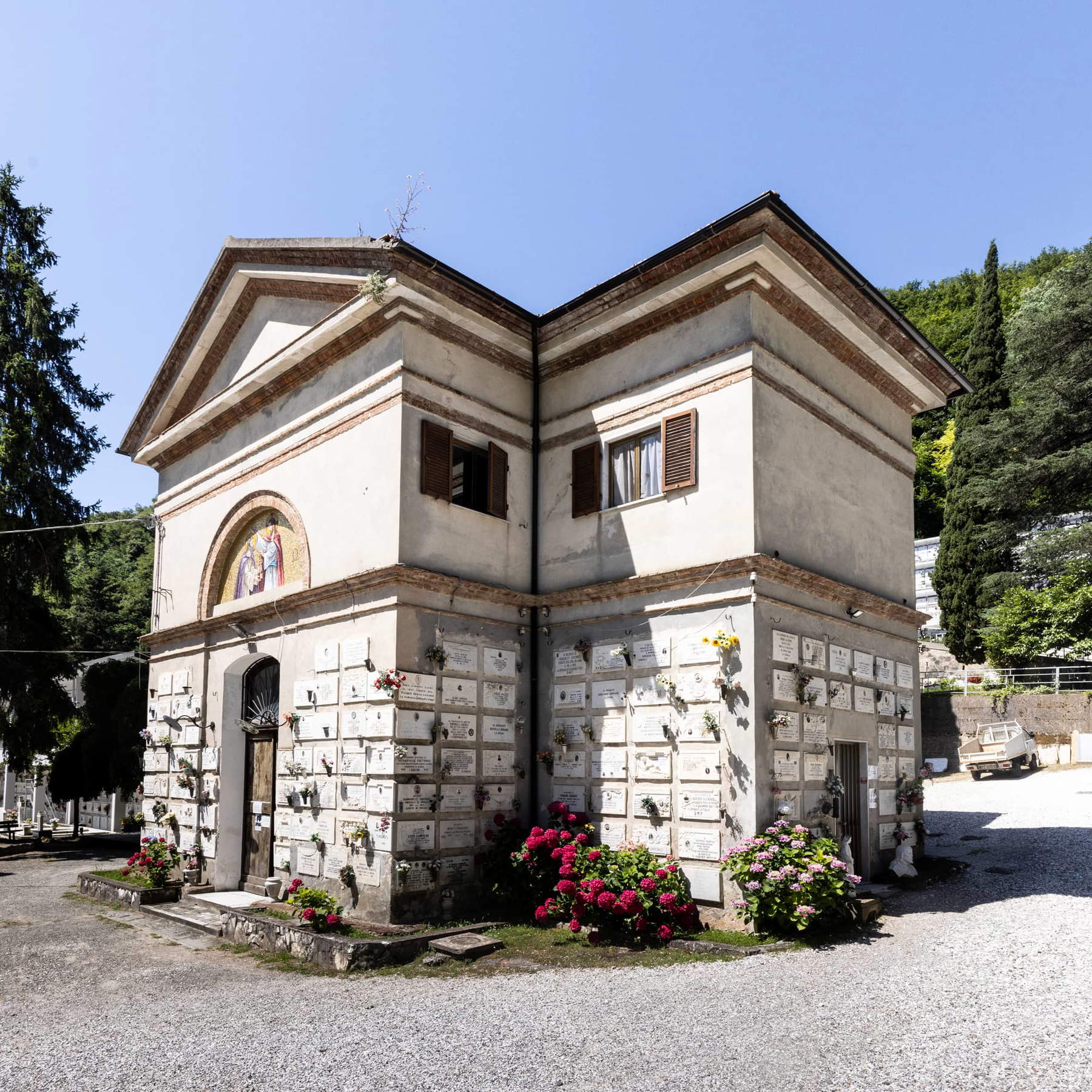
Upon crossing the threshold of the complex—aware that we have entered a suspended realm where silence and stillness intertwine art with memory—we are greeted by the oft-mentioned cemetery chapel, which today also serves as a service center and historical archive. Its exterior walls are literally encrusted with tombstones: they commemorate the fallen of the two world wars, whose remains were lost on the front lines. Over time, the place has thus taken on the character of a memorial, celebrating a grief that is both personal and shared: there are many stories, many faces, and the voices seem to join in a single mournful chorus.
Marcognano, by its very nature, lends itself to being explored at one’s leisure, allowing visitors to be captivated by the exquisite marble carvings, the grandeur of the architecture, or the stories entrusted to the tombstones and monuments. What we propose today is an itinerary that touches on the town’s main points of interest—at least from a historical, artistic, and civic memory perspective—without claiming to be exhaustive. A series of landmarks to help you find your way through a complex and multifaceted landscape that undoubtedly lends itself to multiple interpretations.
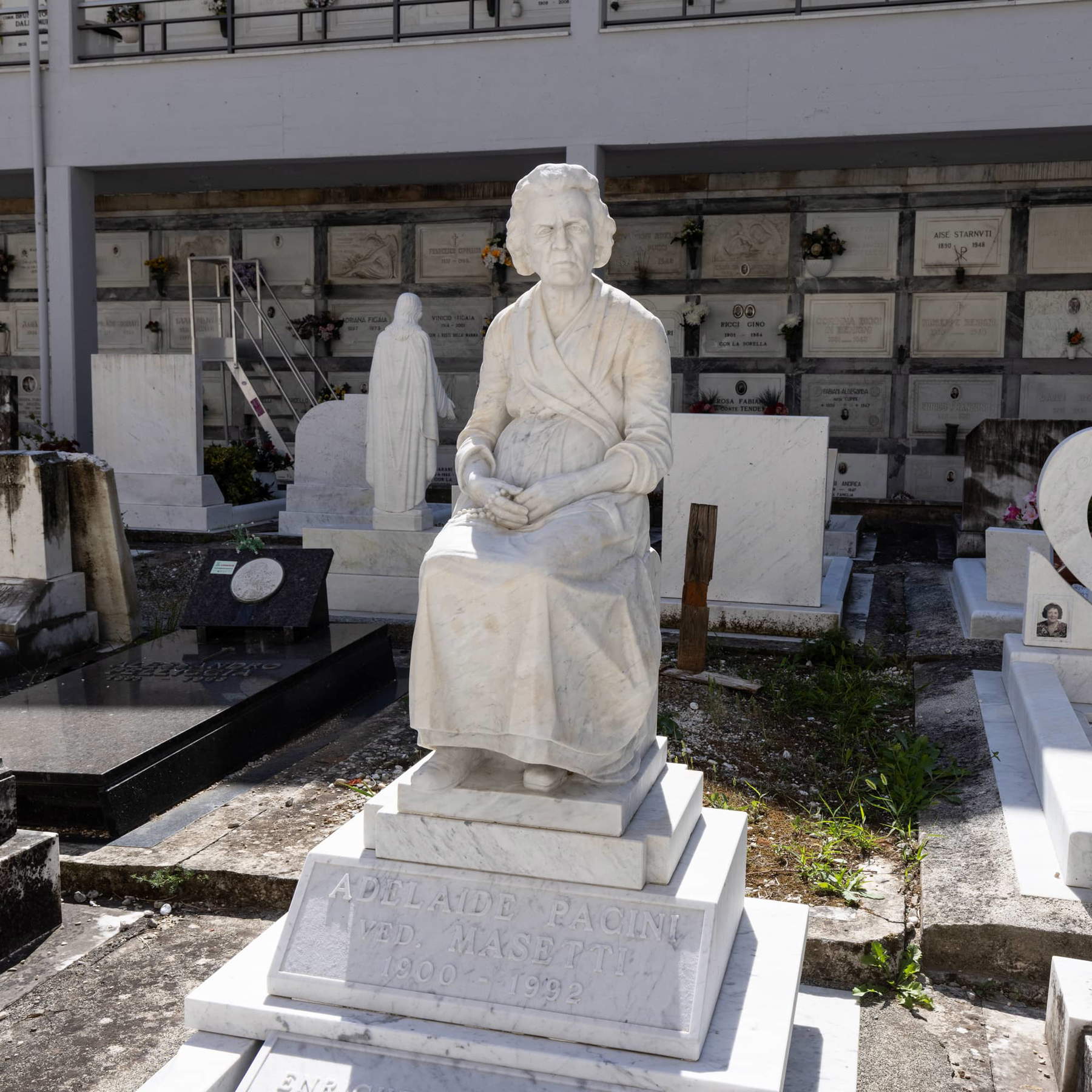
The tour can therefore begin, to the left of the main entrance, with the evocative statue of an elderly woman holding a rosary, her arms resting in her lap, and an expression of profound humanity. It is one of the most beloved monuments in the entire complex, a vivid portrait created by Renato Beretta (Carrara, 1891–1963): It commemorates not a famous figure but a woman of the people, Enrichetta Raggi (Carrara, 1837–1929), a housewife and mother of five children, who spent her life, like so many others, between the Caffaggio neighborhood and Via Carriona. Pursuing her dream of a “gentleman’s” tomb, Enrichetta saved for years, lira by lira, to afford a statue created by one of the city’s most important studios, that of the Berettas. This story echoes the well-known tale of the Hazelnut Seller (Caterina Campodonico) in Staglieno, created in 1881 by Lorenzo Orengo (Genoa, 1838–1909). Over the years, the work—which remains the cemetery’s only full-length portrait—has taken on universal significance as a monument to all grandmothers (B. Gemignani).
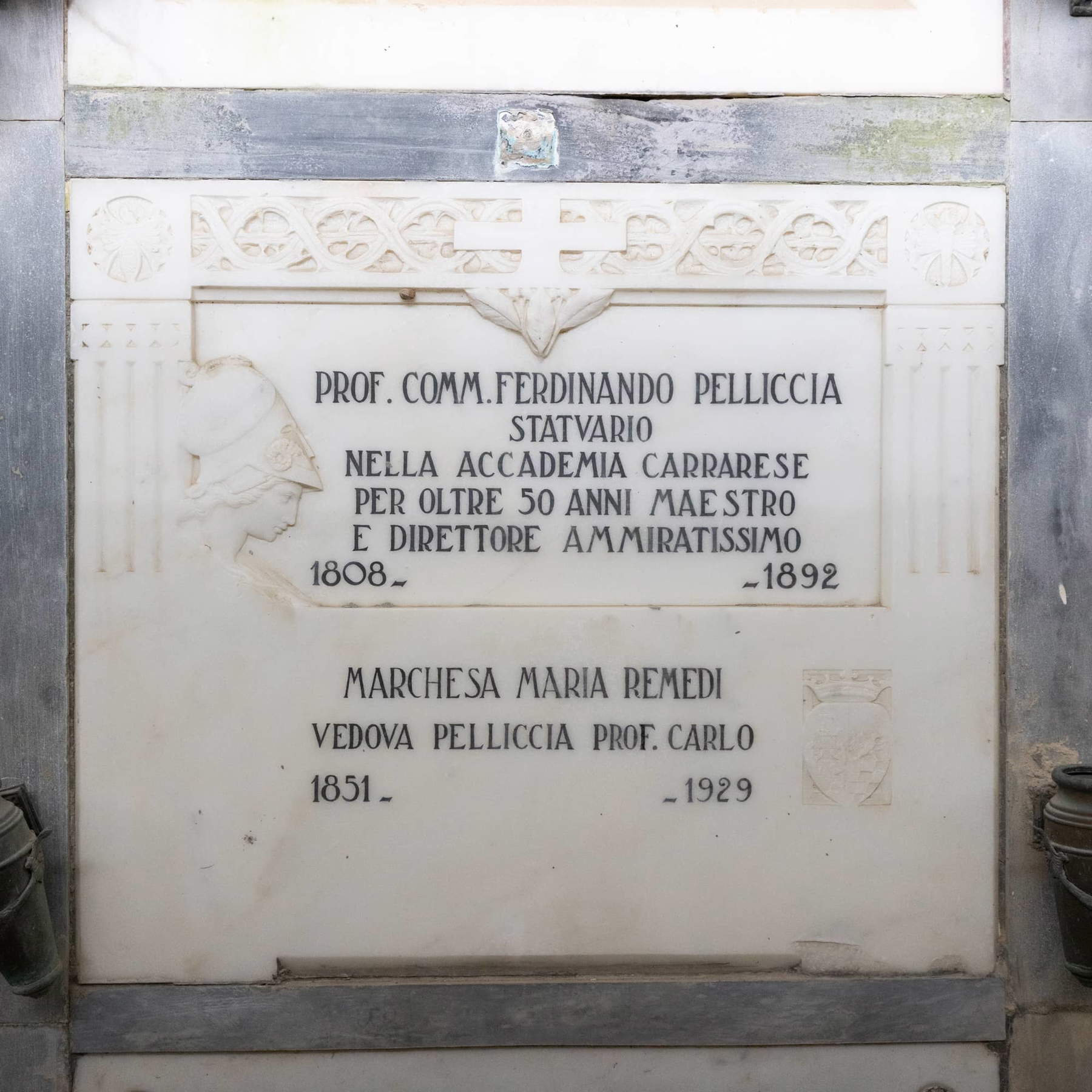
Descending the staircase leading to Marcognano’s evocative underground chamber—a long funerary gallery housing some of the site’s oldest burials—one reaches the tombstone of the dean among Marcognano’s sculptors, Ferdinando Pelliccia (Carrara, 1808 – 1892). His family’s history is emblematic of the deep, ancestral bond between these Carrara masters and the art of sculpture: one of his ancestors, Francesco, was a trusted confidant of Michelangelo, managing his affairs and renting him a house during his stays in the city. His great-grandfather, Jacopo Antonio (Carrara, 1713–1774), had worked in Naples with Francesco Queirolo (Genoa, 1704 – Naples, 1762), contributing to the incredible carvings of the “Disinganno” group (1753) in the Sansevero Chapel. His grandfather, Domenico Andrea (Carrara, 1736–1821), is credited with the monument to Pietro Leopoldo I, Grand Duke of Tuscany, in Livorno, as well as several refined portrait busts of the same figure, while his father, Carlo Antonio (Carrara, 1774 – 1851) was active in the mass production of imperial busts for the Napoleonic government.
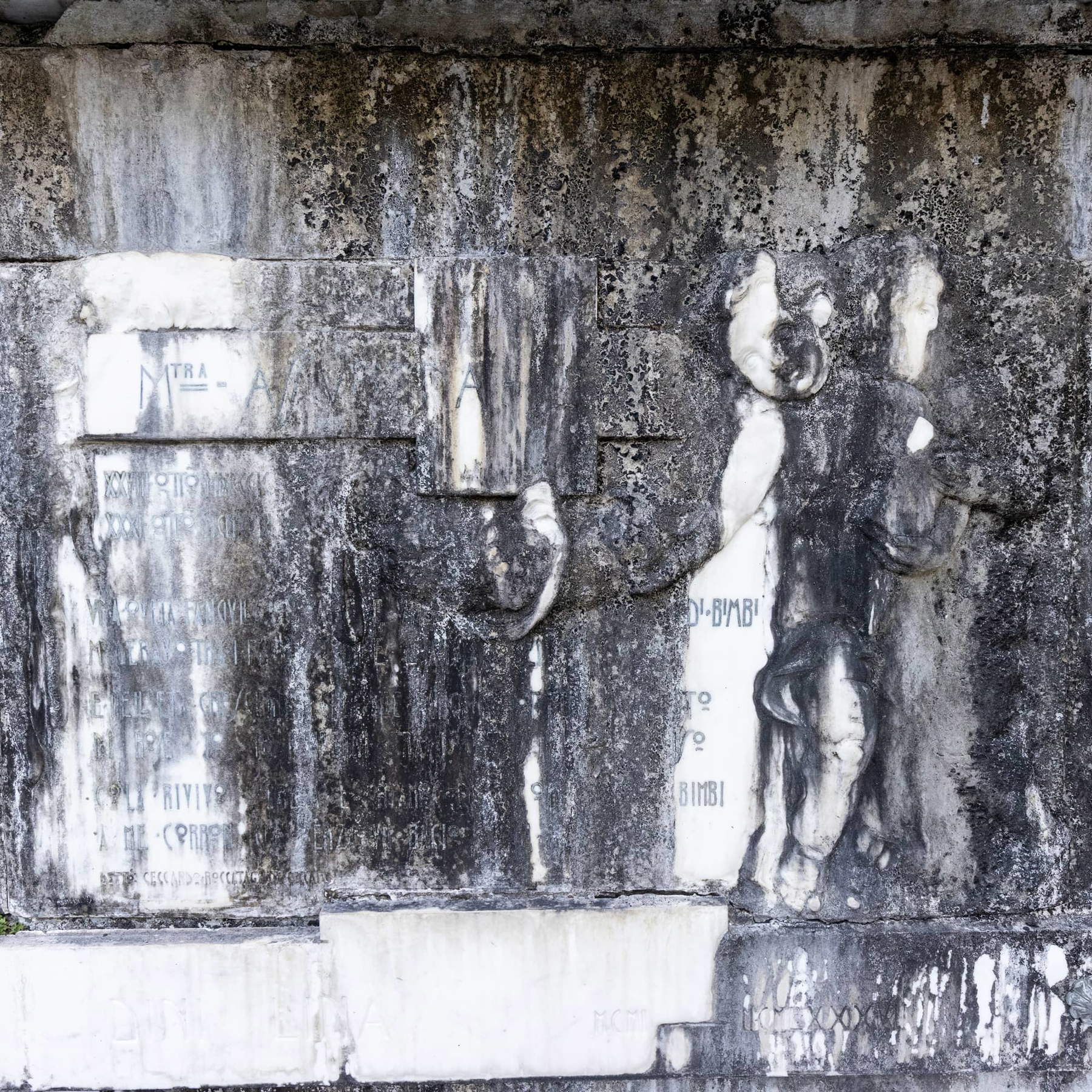
Ferdinando, after his early training with his grandfather—who had long taught at the Academy—studied in Rome under Pietro Tenerani (Carrara, 1789 – Rome, 1869), who considered him his most gifted pupil, and later established himself at the court of Modena. Upon becoming director of the local Academy of Fine Arts, he led the institution throughout the second half of the nineteenth century (1846–1892). The memorial plaque commemorates him as “Professor,” “Commander,” and “Sculptor,” highlighting his academic role (“for over 50 years, a highly admired teacher and director”) and pairing an Art Nouveau-inspired ornamental motif with an extremely elegant head of Minerva, a tribute to the neoclassical tradition that dominated the local school of sculpture throughout the 19th century.
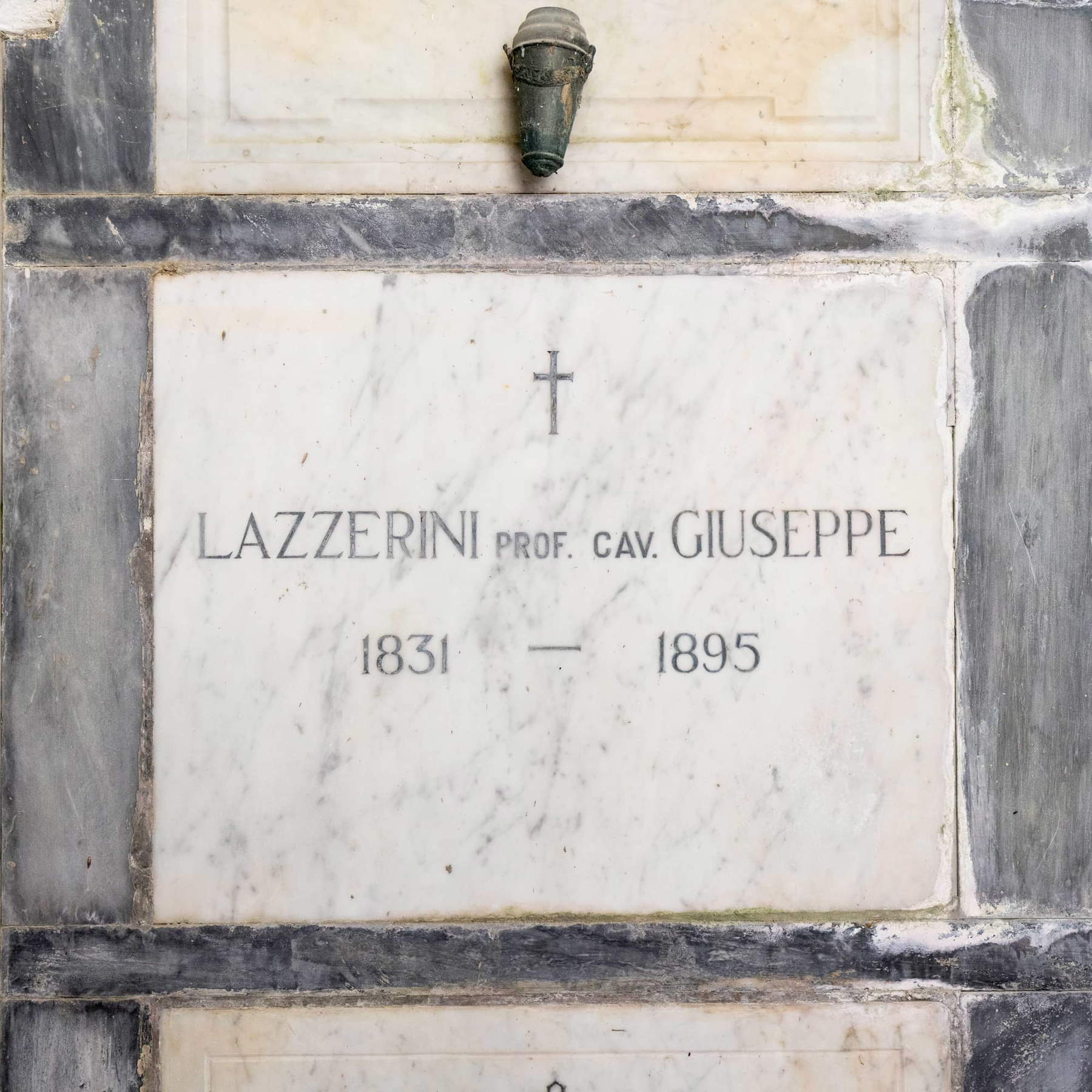
Just before returning to the surface, one encounters the tombstones of two other renowned sculptors, Giuseppe Lazzerini (Carrara, 1831–1895) and his son Alessandro (Carrara, 1860–1942): the Lazzerini tombs tell a story of rise and fall, one shared by many artists active in the interwar period. They, too, could boast an artistic pedigree rooted in a very long tradition, with ancestors involved in various capacities in the sculpture market since at least the late 17th century: Francesco (Carrara, 1748–1808), a figure of almost legendary stature, had been a successful sculptor, active in Paris, Rome, and St. Petersburg. Giuseppe, his grandson, had studied at the Academy under Pelliccia and in Rome under Tenerani. Upon returning to his homeland, he ran the family studio on Corso Rosselli for many years, from which he sent works to Ireland, Denmark, France, Great Britain, and elsewhere. Success soon came to his son Alessandro, thanks to the successful completion of the Funerary Monument to the Princes of Bourbon (1888) for the Villa Reale in Marlia (LU): at just twenty-nine years old, he was able to open his own studio in Florence, dividing his time between this prestigious atelier and his father’s workshop, and achieved full recognition with a long series of public monuments, ranging from the one for Guido Mazzoni in Prato (1897), to the one in Jesi dedicated to Giovanni Battista Pergolesi (1910), and on to the monuments to Giorgio Vasari (1911) and Petrarch (1928) in Arezzo. Among his best-known works is also the funerary monument to the entrepreneur Carlo Fabbricotti, located at the family estate in Marinella di Sarzana (1912). Like many of his generation, he also worked in the Americas (he created the monument to Benito Juárez in Mexico City—1910—and the one to Marshal Sucre in Havana—1930), and, like many others, he suffered the bitter consequences of the crisis of the 1930s. Severely damaged by Mussolini’s monetary policies (1926), exports of marble and sculptures suffered a devastating blow following the international financial crisis of 1929. Alessandro Lazzerini was forced to abandon his Florentine studio and sell his homes and workshops in Carrara. The tombstone, modest by all accounts, reflects the difficulties of this final phase of his life: created from one of his own models, it features a sorrowful female figure, hunched over as if covering her face, while her right hand brushes against sculpting tools. It is almost as if a genius of sculpture were weeping, reflecting on the end of an irreplaceable era for the art of the chisel.
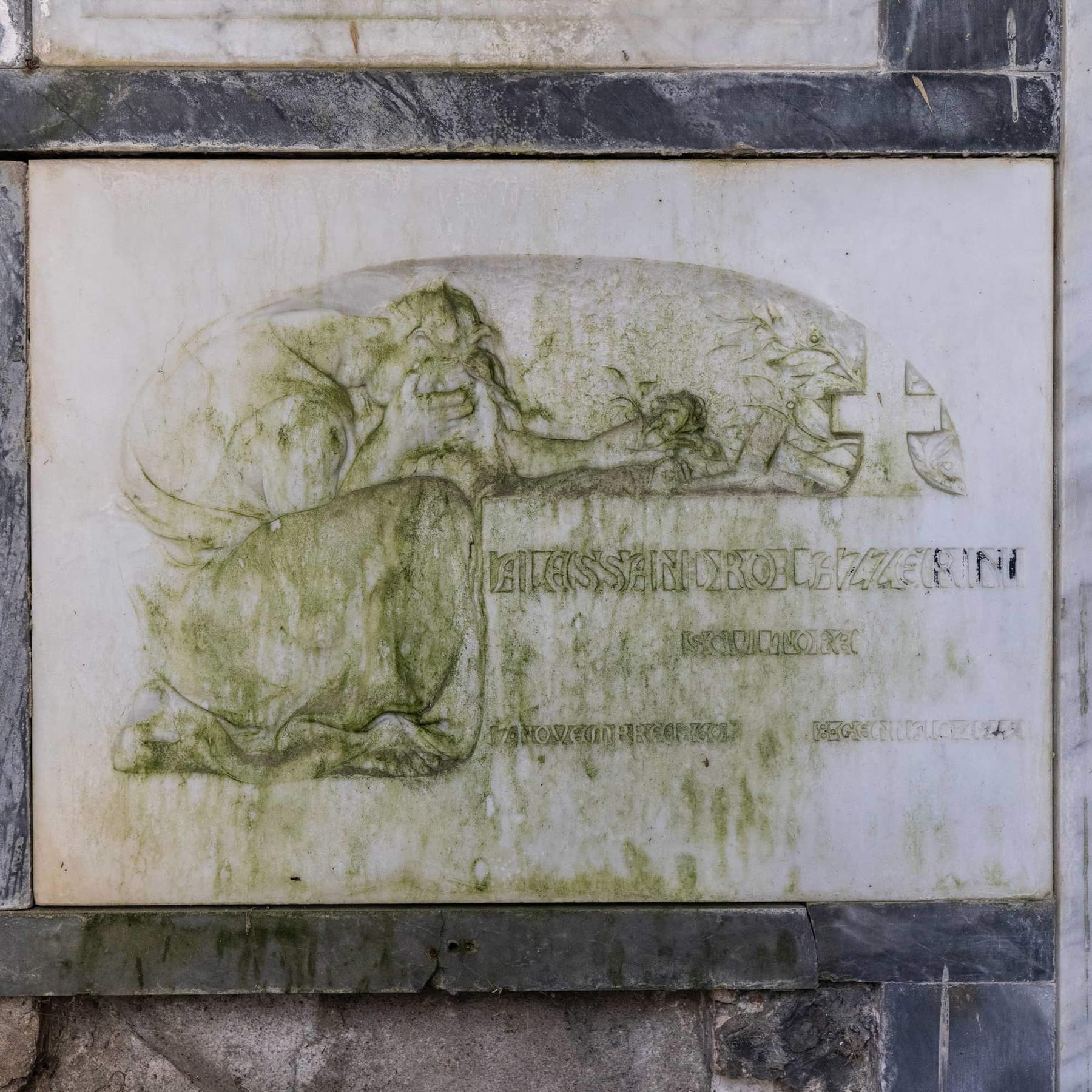
Back outside, among the many wall-mounted tombstones, one soon comes across a most unusual scene: next to the portrait of Corinto Bellotti (Carrara, 1911 – Syracuse, 1940), a bas-relief depicts a burning airplane with two angel wings that seem to spring from the cockpit. The artist’s vision alludes to the tragic death of Bellotti, a highly experienced pilot who died during an air ambulance mission for which he had volunteered. It was December 1940, and the flight—from Africa to Sicily—was intended to bring sixteen wounded soldiers home: during the flight, a fire broke out in the cockpit, but Bellotti, enduring the pain, remained at the controls until landing; he died shortly afterward but saved the lives of all the passengers. The incident received widespread attention at the time, so much so that it was celebrated in an “aeropoem” by Filippo Tommaso Marinetti: “Cruelly swirling, the flames in the cockpit gnaw at a heel of Corinto Bellotti’s shoe // Boiling // Smoldering, they gnaw at a human heel—leather, skin, woody tendons, bone, silky threads of slumbering nerves // Deeply preoccupied with his own particular distraction, Corinto Bellotti watches over every detail of the evacuation—one by one, the sixteen seriously injured—with sixteen precautions // And then make up his mind // Charred down to the groin // Make up his mind to die.” The relief is a signed work by Alterige Giorgi (Carrara, 1885–1970), a student of Leonardo Bistolfi in Carrara (Casale Monferrato, 1859 – La Loggia, 1933) and of Giuseppe Guastalla (Florence, 1867 – Rome, 1952) in Rome: Marcognano preserves many of his creations, animated by profound sensitivity and inexhaustible imagination, as well as his own tomb.
A little further on, one notices a tombstone with a very different style, deeply engraved: it was created by a young Nardo Dunchi (Carrara, 1914–2010) for his brother Carlo (1916–1945) and is known as *The New Beatitudes*. The relief combines echoes of 14th-century Tuscan art—from Giovanni Pisano to Giotto—with the influence of the master Arturo Martini (1889–1947), whom the sculptor had met at the Nicoli studio in 1936–37. The title refers to the Beatitudes of the Gospels and seems to express a hope for a new beginning—both moral and civil—for humanity emerging from World War II. Nardo Dunchi, also remembered for his *Memorie Partigiane* (Partisan Memoirs) published in 1957, later abandoned the figurative style: after a period spent in Paris, he returned to Italy and continued to produce monumental works for public spaces until late in life.
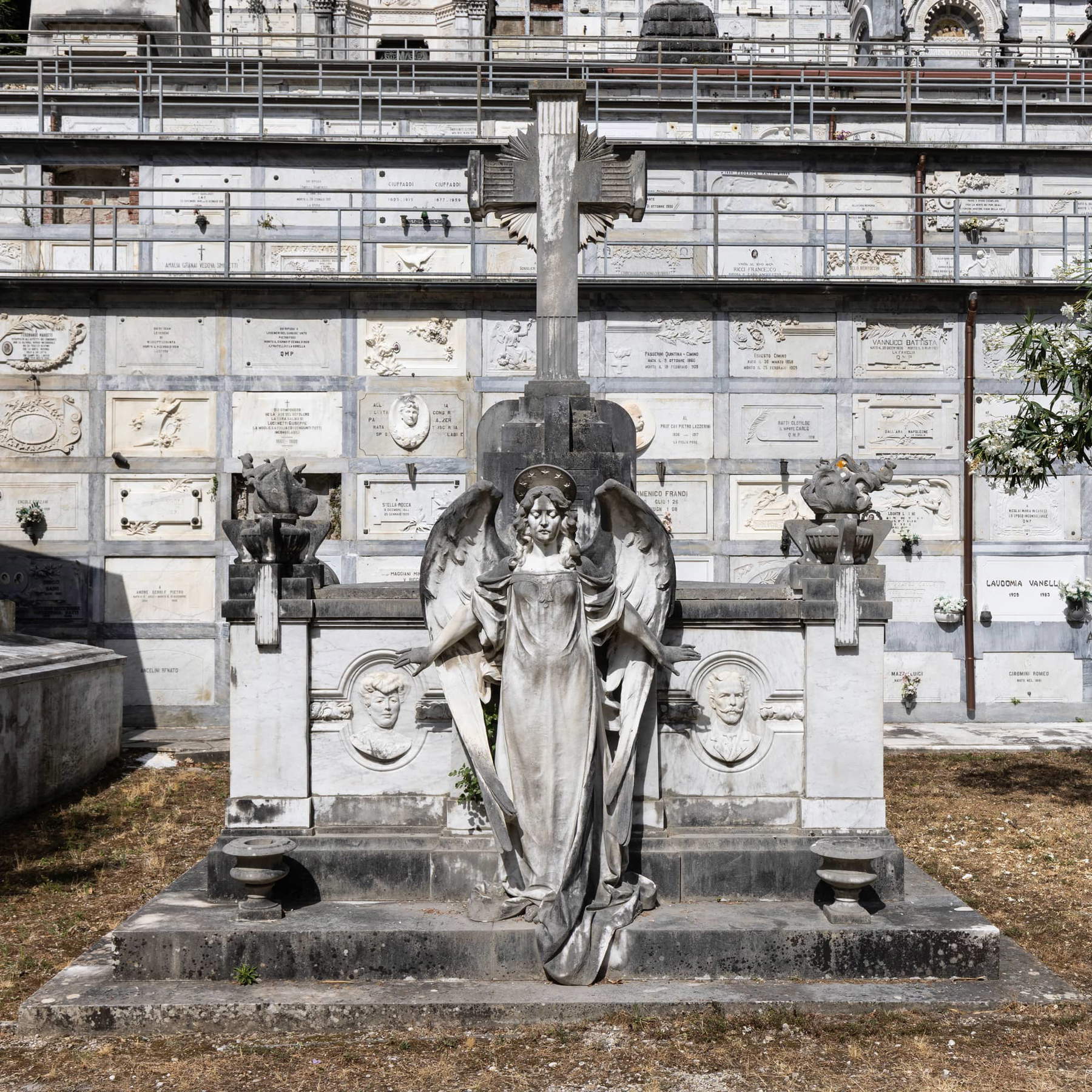
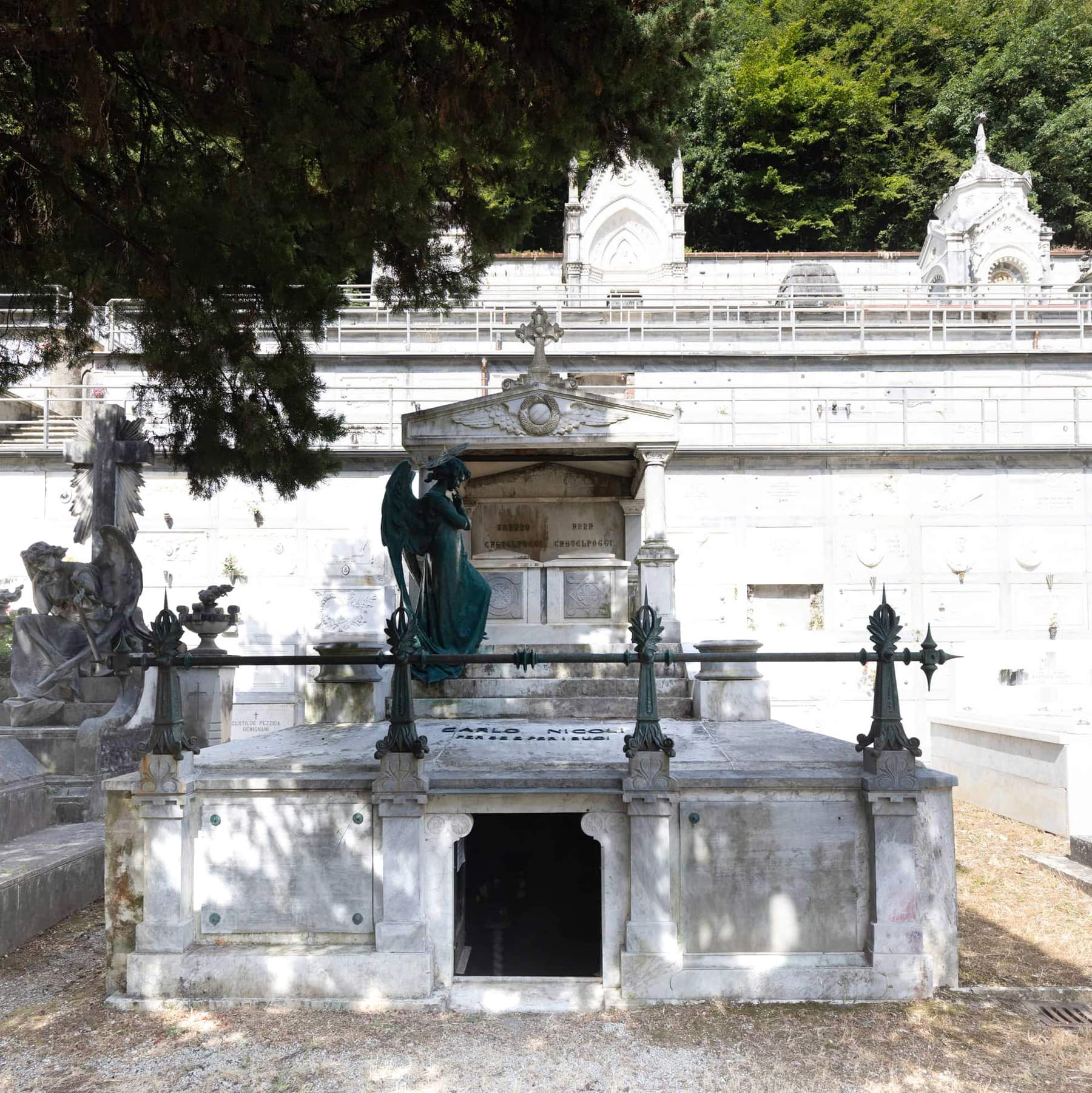
Returning to the area near the central chapel, turn left again and head toward the slope of the hill, where you’ll see the first majestic series of early 20th-century funerary monuments: situated a short distance from one another are the tombs of Cesare Faggioni (Carrara, 1843–1912), Carlo Nicoli (Carrara, 1843–1915), Emilio Bernabò (Carrara, 1848–1912), and Erminia Maggesi (Carrara, 1833–1903) stand in close proximity to one another, creating a collection of great charm and rare stylistic coherence. It is no coincidence that the four tombs, created over a relatively short period of time, are all animated by angelic figures in marble and can be traced, to varying degrees, to the work of the renowned Nicoli sculpture studio.
The Nicoli Chapel, completed in 1899, is not only the oldest of the group but also the very first to have been erected in Marcognano: it is a fully architectural structure, featuring an underground burial chamber and a Byzantine-style aedicule that completes the composition and houses the remains of the ornamental architect Urbano Castelpoggi and his wife Anna. On the spacious terrace, which serves as a link between the two spaces, stands a bronze angel, his step eternally suspended and his face turned toward the simple funerary inscription: CARLO NICOLI // FOR HIMSELF AND HIS FAMILY. The angel’s expression is intense, with a finger lightly touching its mouth, inviting reflection on the transience of human fortunes and the fate of artists who dare to defy the centuries with their creations.
Nicoli was the founder (1876) of the city’s most important artistic workshop, the only one still active to this day. A student of Ferdinando Pelliccia at the Academy, he honed his skills in the Florentine studio of Giovanni Duprè (Siena 1817 – Florence, 1882) before embarking on a successful independent career: among his many monumental works, we mention, for the sake of brevity, the marble sculptures and groups for the Galleria Umberto I in Naples, the statue of Miguel de Cervantes for Alcalá de Henares (1876), that of Francisco Jiménez de Cisneros for Madrid (1881), and a successful model of Queen Victoria replicated several times in marble (Brighton, Durban, Melbourne, etc.). In Carrara, he left behind a powerful monument to Giuseppe Garibaldi (1889), considered one of the most significant of its kind. The tradition of his studio—which over the years has hosted artists of the caliber of Ettore Ximenes, Leonardo Bistolfi, Arturo Martini, Francesco Messina, Henry Moore, Lorenzo Viani, Carlo Sergio Signori, Anish Kapoor, Louise Bourgeois, and many others—has been successfully carried on by his heirs and grandchildren.
Cesare Faggioni was also a master of the chisel, but little is known about him: he participatedin the Italian General Exposition in Turin in 1884, sent several funerary monuments to Uruguay, and was active for many years in the Nicoli studio. The tomb has a distinctly sculptural character: every architectural element is designed to serve the large central winged figure—an angel of the Resurrection or a guardian angel of the tomb—who stands absorbed in thought and silent. The trumpet rests on the ground; the face is solemn. Once again, we are invited to reflect on the artist’s fleeting earthly glory, destined to survive only in the echo of his works.
The tomb of Bernabò—a professor, architect, and entrepreneur—is, in contrast, built around a large rectangular sarcophagus: the central figure, in this case, belongs to the typeof the “Severe Angel,” who bars the gates of the afterlife. Its authorship is attributed to Carlo Nicoli, who was able to create a personal synthesis between the prototype of the Pigni tomb (Milan, Monumental Cemetery, 1877) by Odoardo Tabacchi (1831–1905) and the sensual tones of the famous Angelo Oneto (1882) by Giulio Monteverde (1837–1917) in Staglieno. Also noteworthy are the portraits of Emilio Bernabò and his wife Clotilde (1865–1912), depicted in medallions wearing the clothing and hairstyles characteristic of the early-20th-century upper middle class.
The series concludes with the imposing tomb of Erminia Maggesi, commemorated by the inscription as “CONSTANT AND GENEROUS // HELPER OF THE POOR”: the sculpture, once again taking center stage, is an “Angel Scattering Flowers ” (as defined by Nicoli himself). The robe, flowing down toward the sarcophagus, forms an extremely elegant Art Nouveau motif, while the gesture lends the whole a lively, almost narrative quality, making it less solemn.
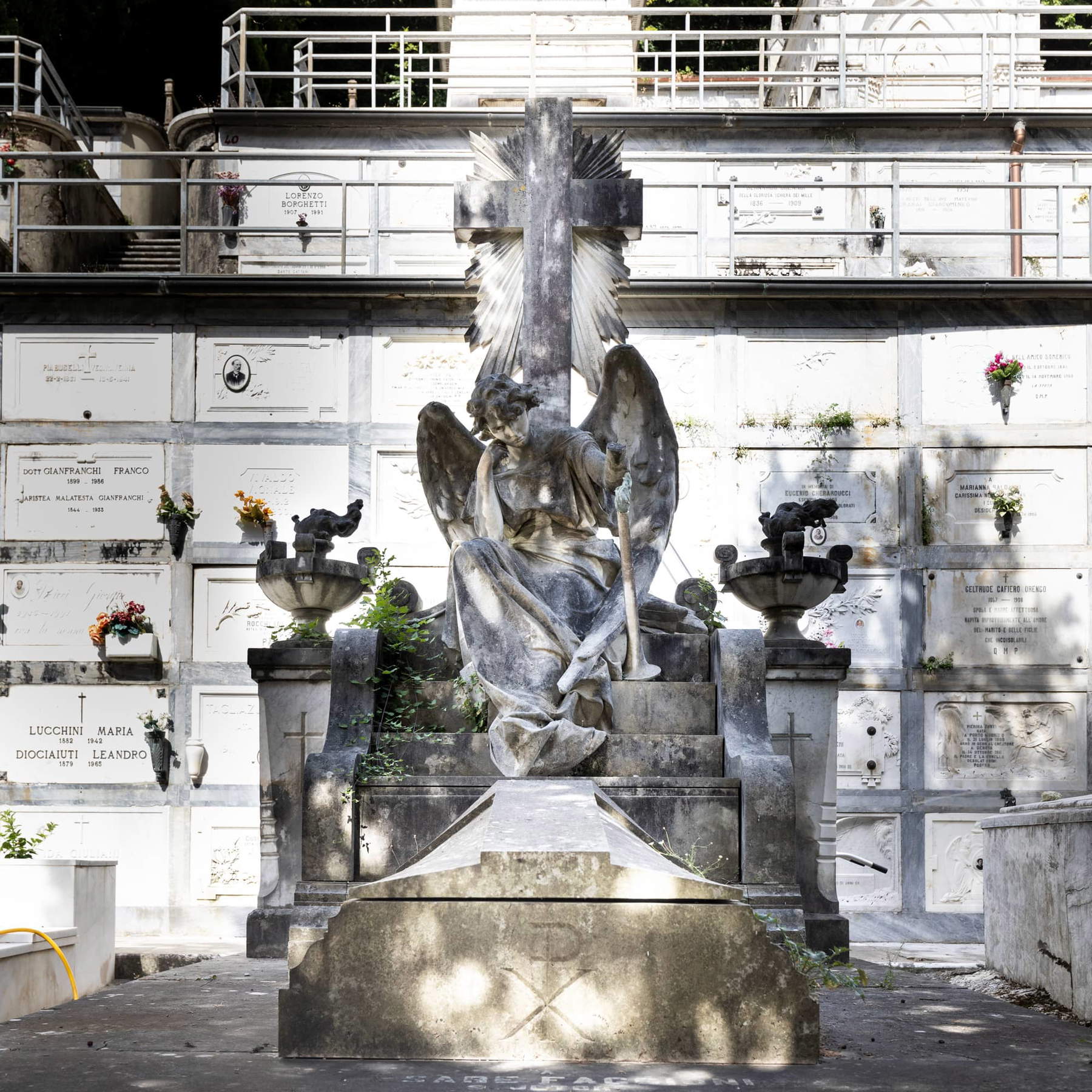
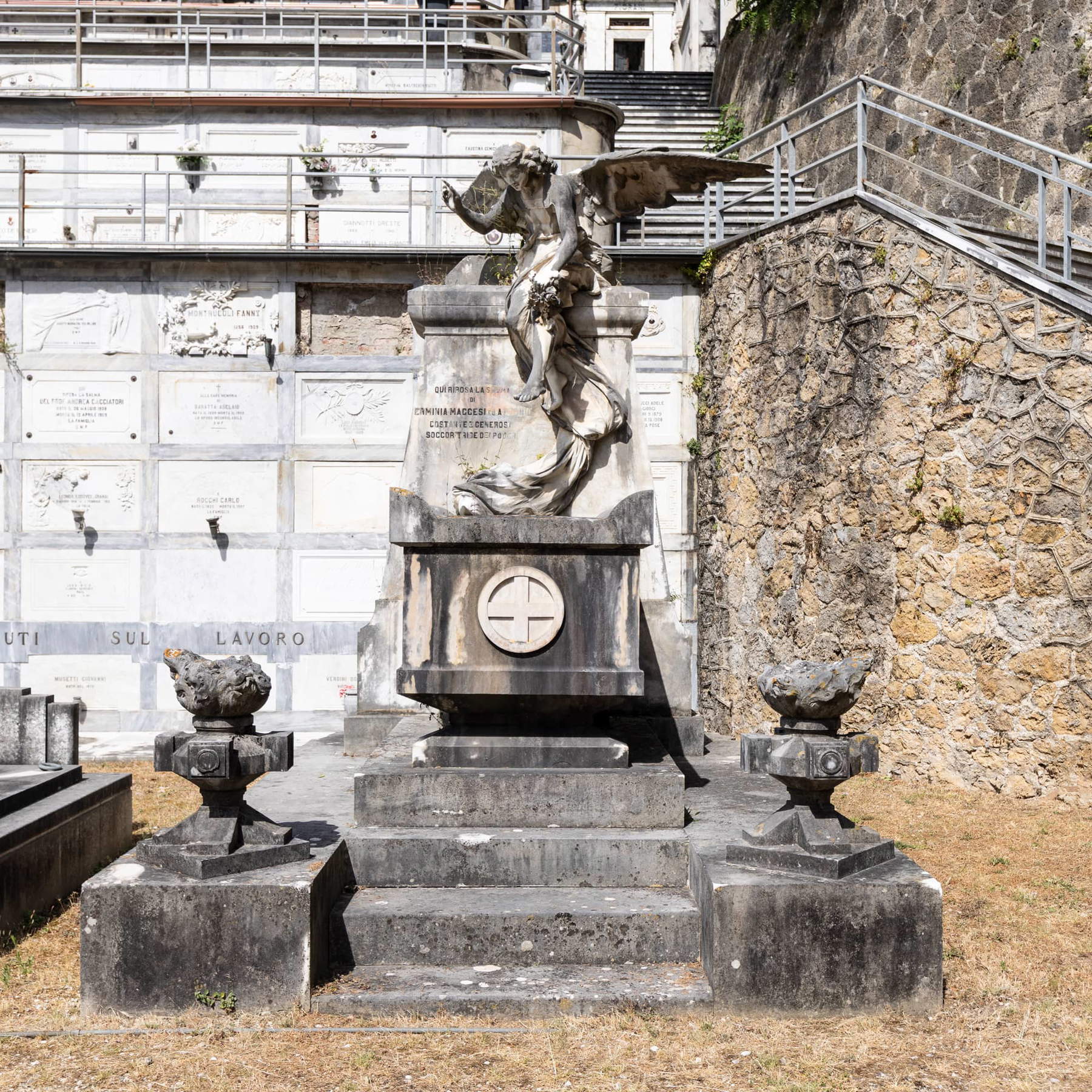
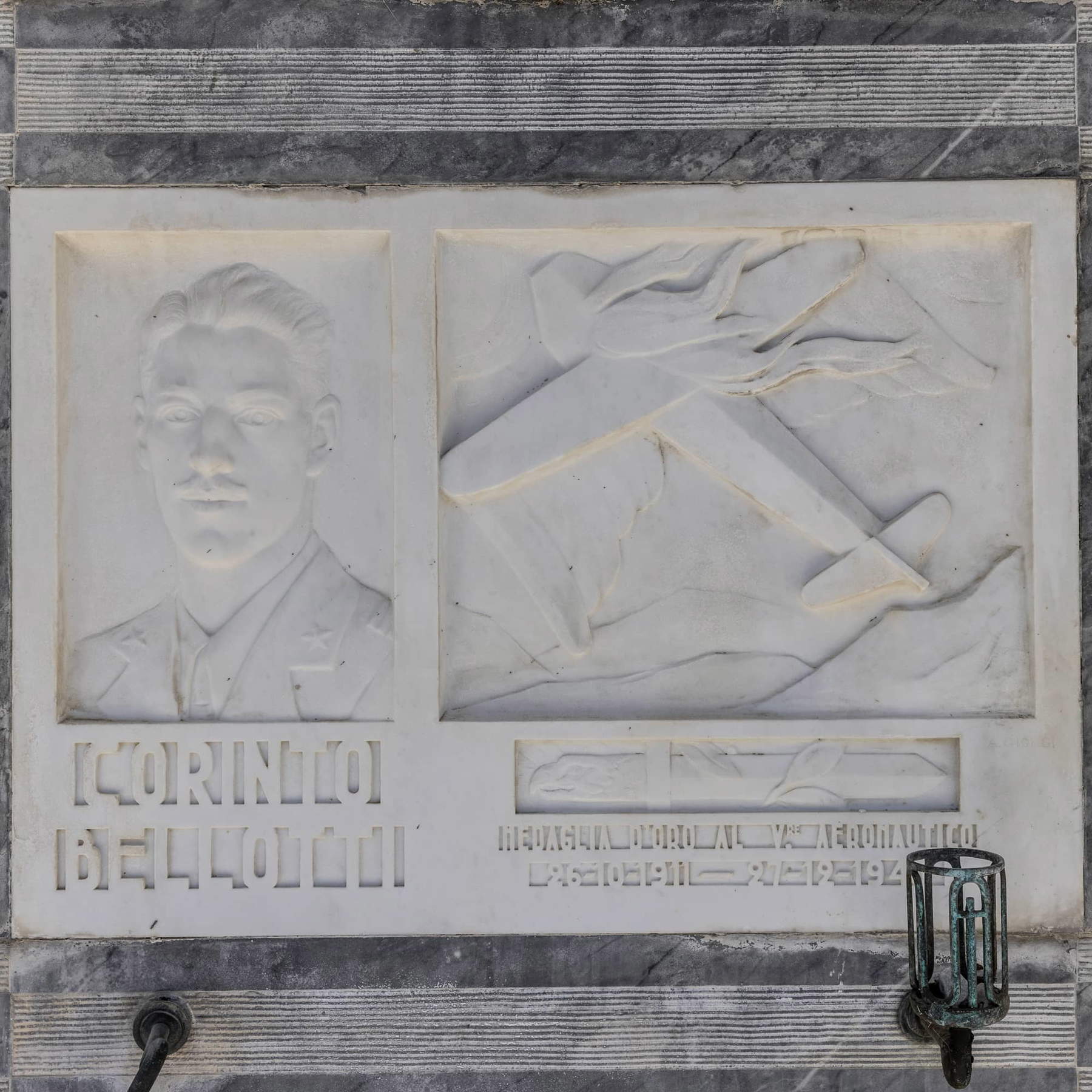
On the back wall, among the “columbarium” burials ( to use an expression dear to Leandro Caselli), three vivid portraits in medallions stand out: these are of Pietro Lazzerini (Carrara, 1837–1917), his daughter Olga, and his wife Paolina. We have already encountered his cousin (Giuseppe) and his nephew (Alessandro): a successful sculptor in his own right, he sent works to Rome, London, Paris, Dublin, and Vienna. Carrara Cathedral houses his high relief depicting the Four Crowned Saints (1861), the patron saints of stonecutters and sculptors.
Further down, in the same section, lies one of the most solemn and moving corners of Marcognano: ten simple headstones united by a single date of death: July 19, 1911. Fourteen quarrymen, busy eating their frugal meal—brought from home—were buried when the mountain collapsed beneath which they had sought relief from the summer heat. The tragedy, which occurred in the Bettogli area, claimed the lives of ten of them: the oldest was 71, the youngest just thirteen.
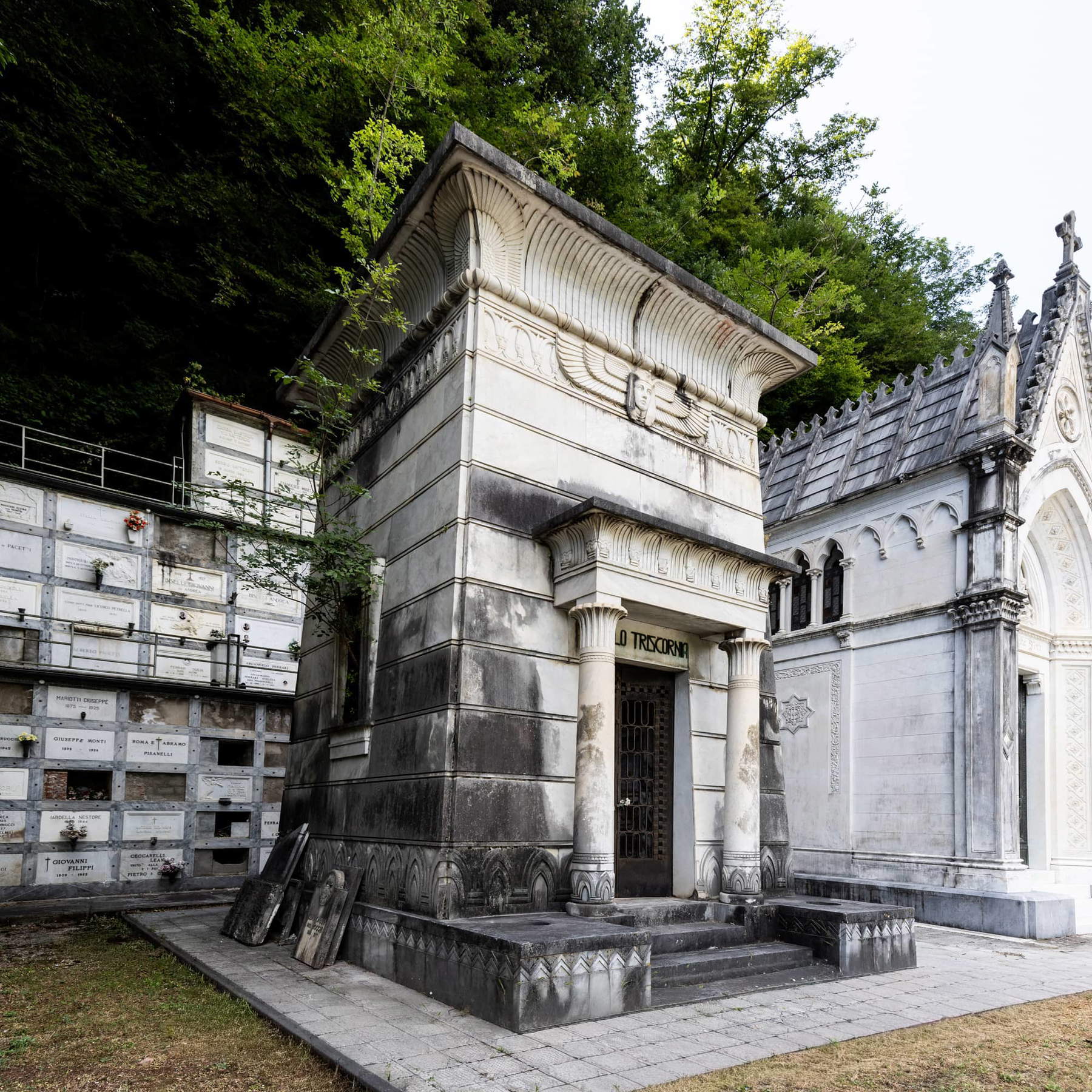
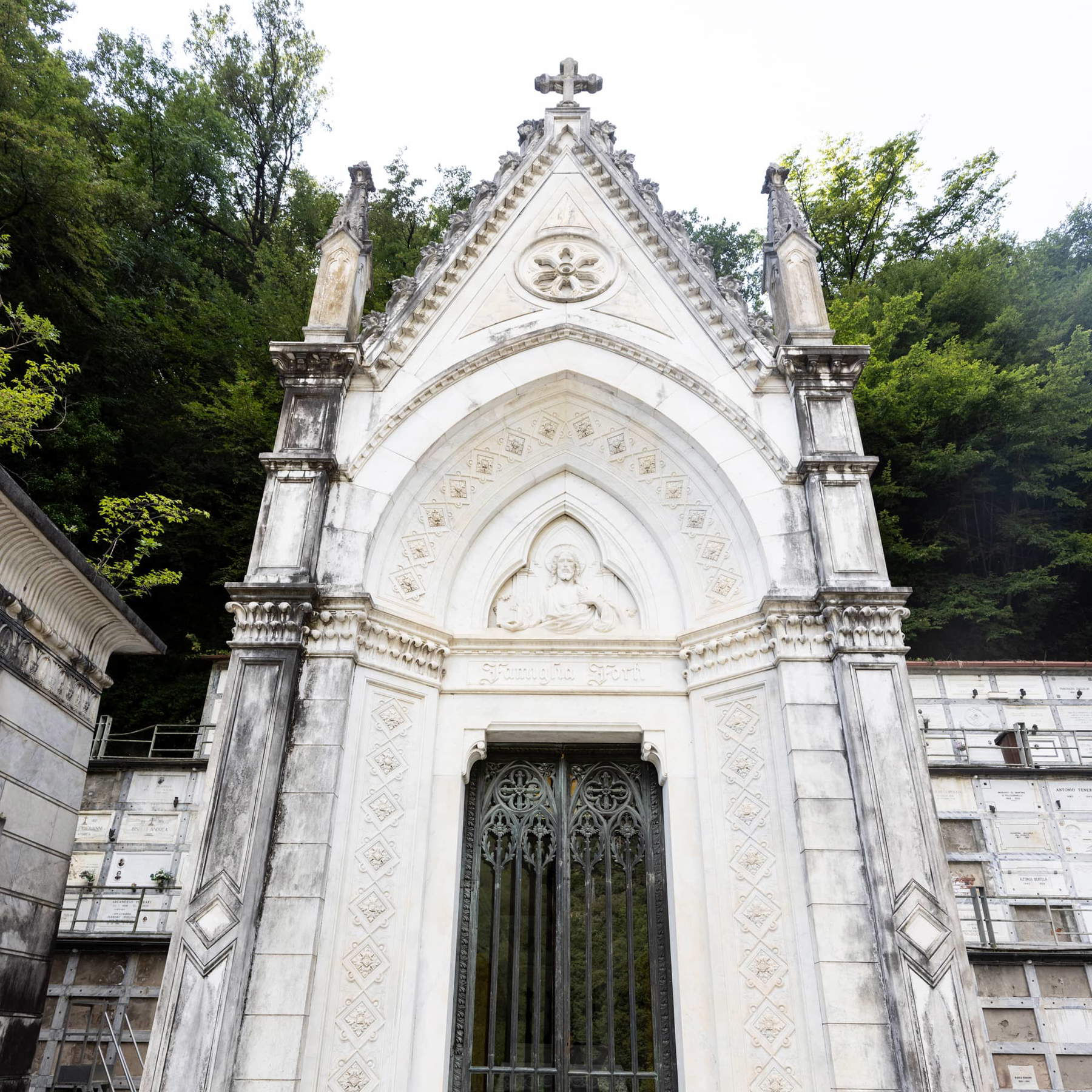
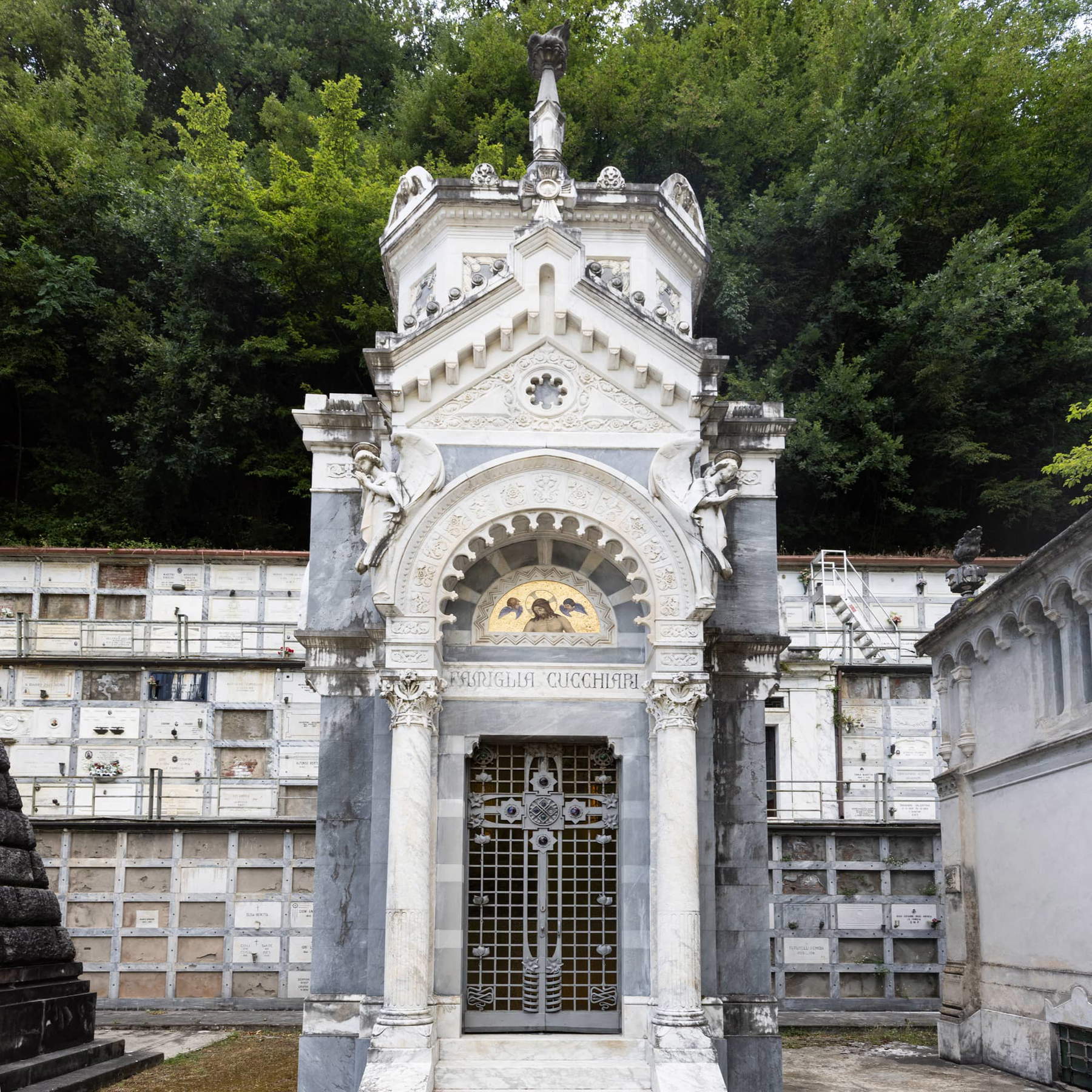
You climb a few steep flights of stairs, surrounded by exquisitely crafted early-20th-century tombstones, until you reach the first long terrace, where you are greeted by the spectacular sight of Marcognano’s oldest burial chapels. The overall effect is striking and varied; the style is generally eclectic, but the inspiration is expressed in very different ways, ranging from Neo-Gothic to a taste for ancient Egypt, all the way to Art Nouveau and Art Deco.
Proceeding from left to right, the first chapel you encounter is that of Paolo di Ferdinando Triscornia (Carrara, 1853–1936), built by him in 1914 to house the remains of his parents. He was the last heir of a dynasty of sculptors active since the late 18th century (the Triscornia family maintained a gallery/workshop in St. Petersburg until 1875!). Paolo is remembered both for his production of extremely valuable small- and medium-sized sculptures, intended for a refined European clientele, and for the industrial-scale production of marble ornaments and architectural elements in his large workshop in San Martino. While the exterior’s architectural and decorative vocabulary reflectsa symbolist-tingedEgyptomania, evoking an imagery suspended between exoticism, mystery, and esoteric allusions, the interior is dominated by an original depiction of Christ carrying the cross, reminiscent of the linear and geometric language of Art Deco.
In contrast, the adjacent Forti Chapel (named after wealthy entrepreneurs in the marble and grain industries) has the character of a true miniature Gothic church, characterized by motifs clearly inspired by the Neo-Medieval style and by exquisite ornamentation featuring geometric and botanical patterns.
The tomb of marble industrialist Antonio Mattioli is of an entirely different nature: a massive truncated pyramid clad in enormous rusticated blocks. It is an enigmatic structure, well-rooted in the symbolism of the early 20th century, yet with clear Masonic echoes.
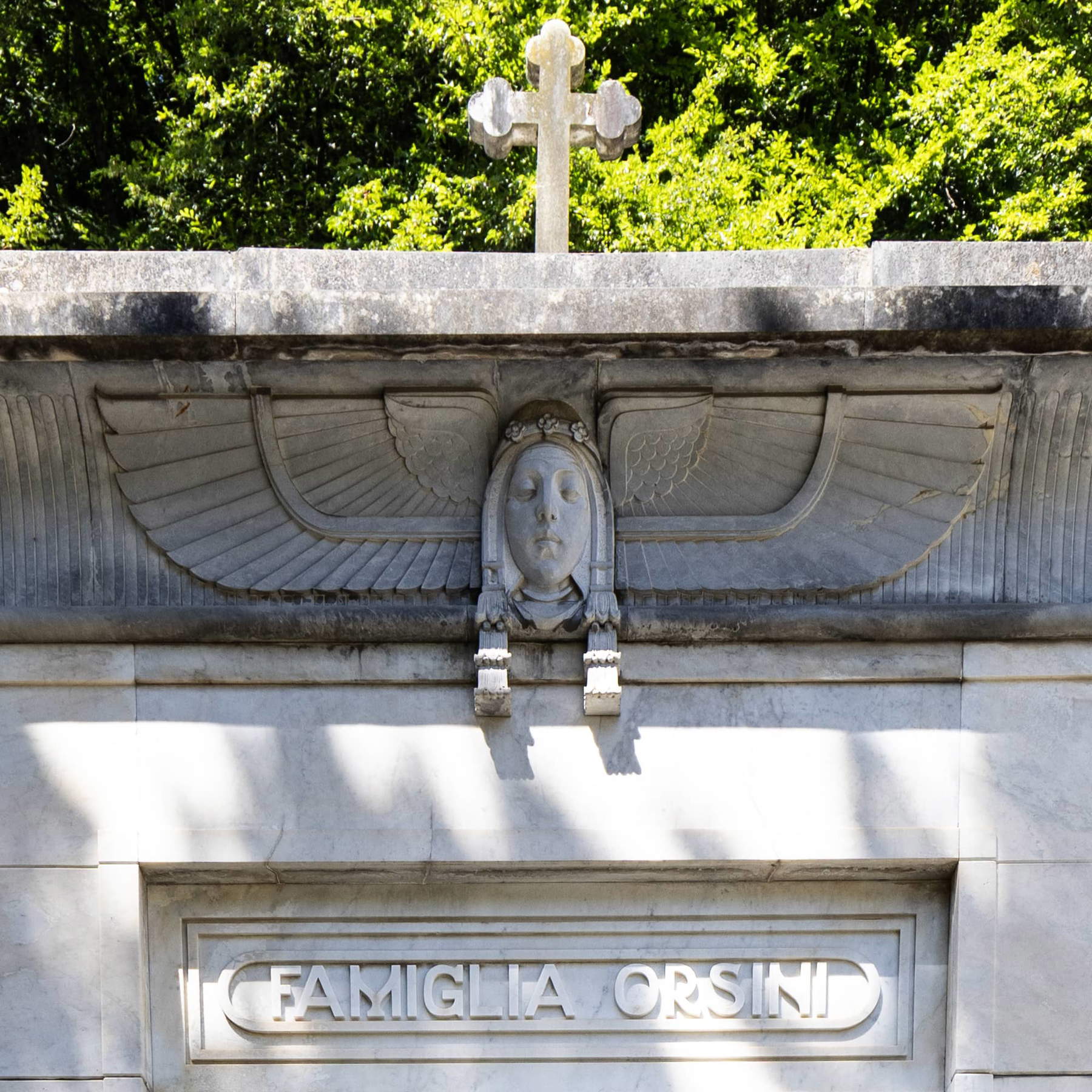
Next is the majestic Cucchiari Chapel, created in 1906 by the sculptor Giuseppe Garibaldi (Carrara, 1857–1910). Romanesque and Gothic motifs, along with Byzantine influences, coexist with creativity and freedom in a monument dedicated to General Domenico Cucchiari (Carrara, 1806 – Livorno, 1900), a leading figure in the Wars of Independence, and a deputy and senator of the Kingdom (1861–1900). It was erected by his nephew Giovanni Battista (Carrara, 1861–1919), who commissioned Leandro Caselli to design the family palace, now home to the Giorgio Conti Foundation and a prestigious exhibition venue.
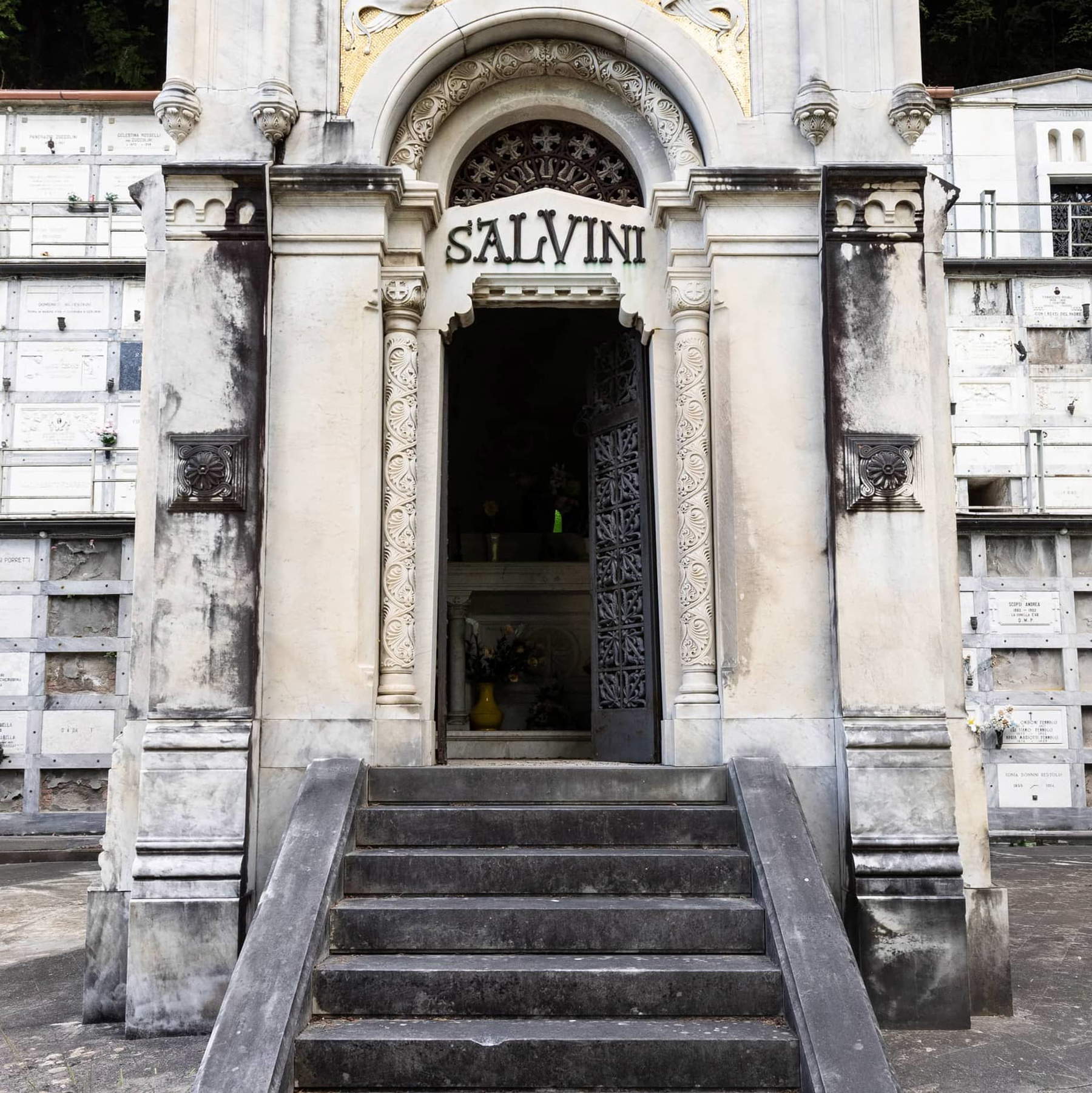
The adjacent Salvini Chapel, commissioned in 1904 to commemorate Francesco Salvini (Livorno, 1835 – Carrara, 1899), who enjoyed a meteoric rise in nineteenth-century Carrara, is built in a similar style. Having arrived in the city to work for the British industrialist William Walton (1786–1873), he first became branch manager and later a partner; his sons would go on to take over the Carrara operations of the firm Walton Goody & Crips in 1922. The façade is dominated by an imposing angel holding a scroll, a work signed by Carlo Nicoli, one of the cemetery’s most famous symbols. In the crypt is a beautiful bas-relief portrait of Francesco Salvini, created by Pietro Lazzerini, whom we have already mentioned.
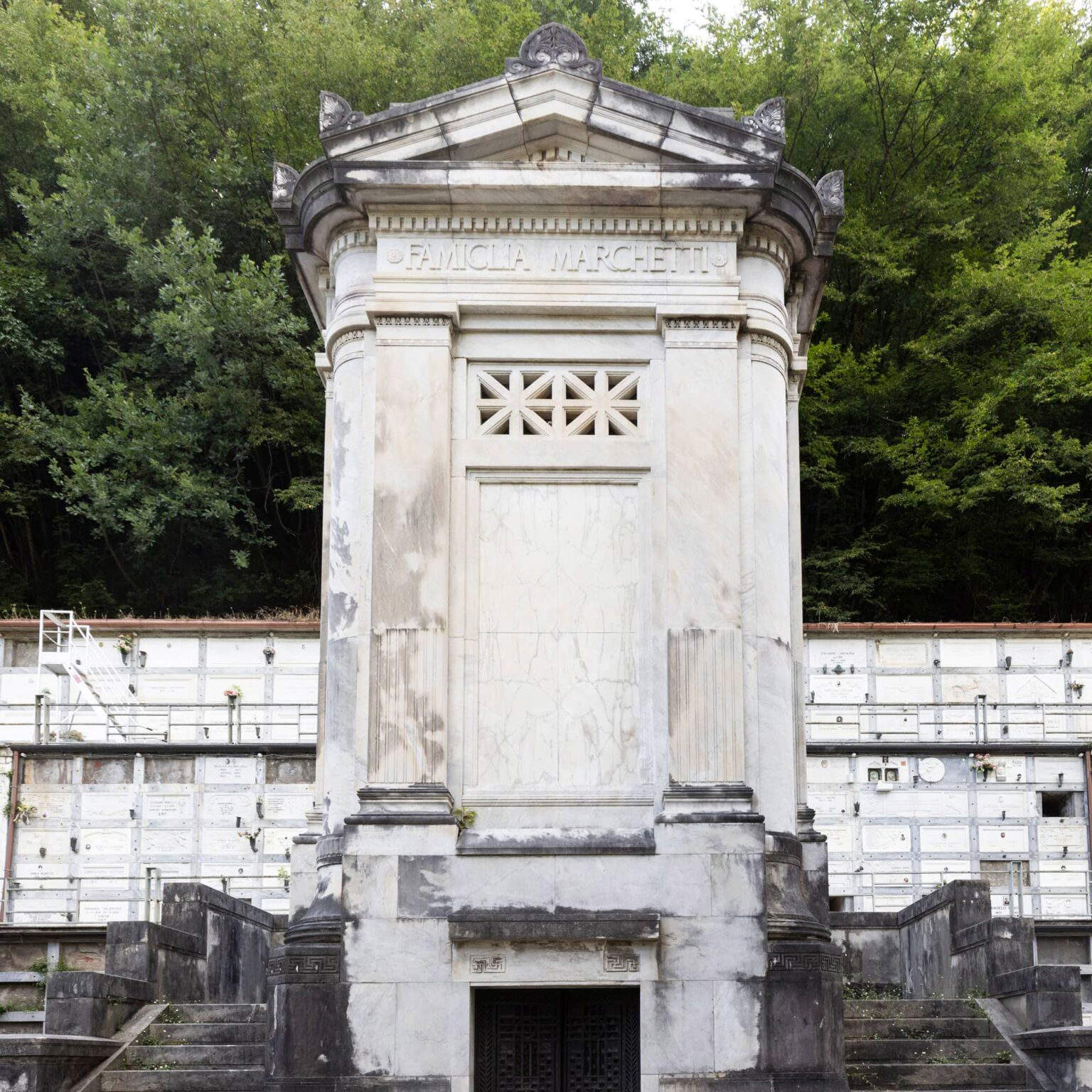
The architecture of the funerary monument to notary Augusto Marchetti (Carrara, 1847–1929), who served for many years as director of the Cassa di Risparmio di Carrara, is imposing. While the narrow front portal leads into the burial chamber, the chapel itself is located on the upper level and is reached by climbing two wide flights of stairs. The complex, in the classical style, is austere and solemn.
Past the Orsini Chapel—which echoes the Triscornia Chapel in its use of an architectural and decorative vocabulary inspired by ancient Egypt—one finds oneself facing one of Marcognano’s most celebrated monuments. The Berring Nicoli family tomb is set atop a tall aedicule made entirely of marble, which overlooks the actual funeral chapel, accessed via a double flight of stairs at the rear. At the center stands an ethereal angelic figure that serves as the true focal point of the composition. The ensemble is dominated by a hyper-decorative style, typical of the era, blending Art Nouveau ornamentation with classical forms—a reflection of the family workshop’s modern and international outlook.
Erected between 1907 and 1909, the monument honors Alex Berring Nicoli (1857–1906), a sculptor and skilled entrepreneur in the marble trade and artistic marble craftsmanship: he supplied marble to many French artists (including Auguste Rodin) and, in his Carrara studio, carried out major commissions for Lucien Pallez (1853–1933), Jacques Froment-Meurice (1864–1947), Henri-Édouard Lombard (1855–1929), and others. He died under tragic circumstances in 1906, at the age of 39: it cannot be ruled out that the model for the Praying Angel was provided by one of the French artists with whom he regularly collaborated.
The grand series of historic chapels is rounded out by those of the Gattini family, in the Neo-Renaissance style, and the Bufalini family’s chapel, with its imposing Art Deco forms.
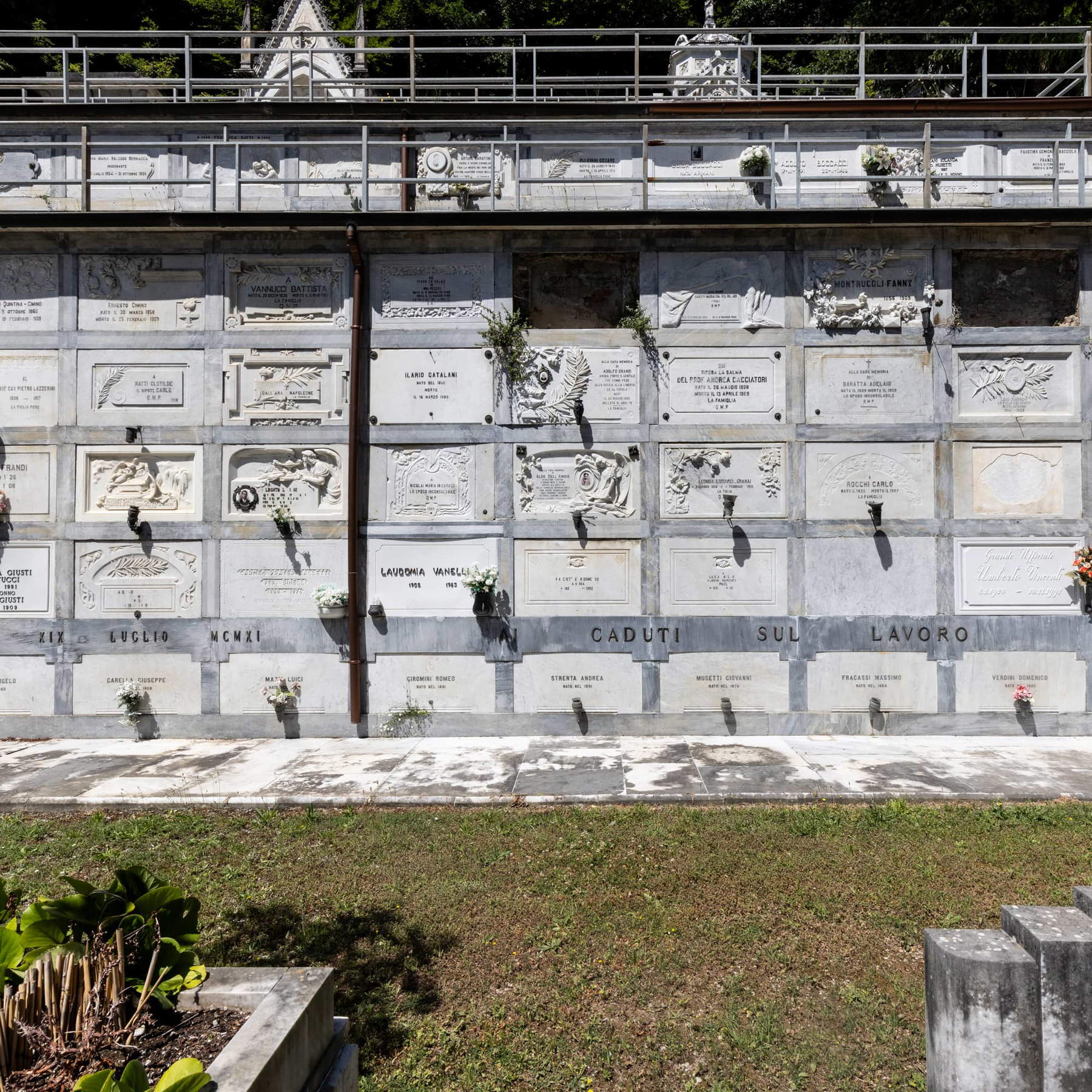
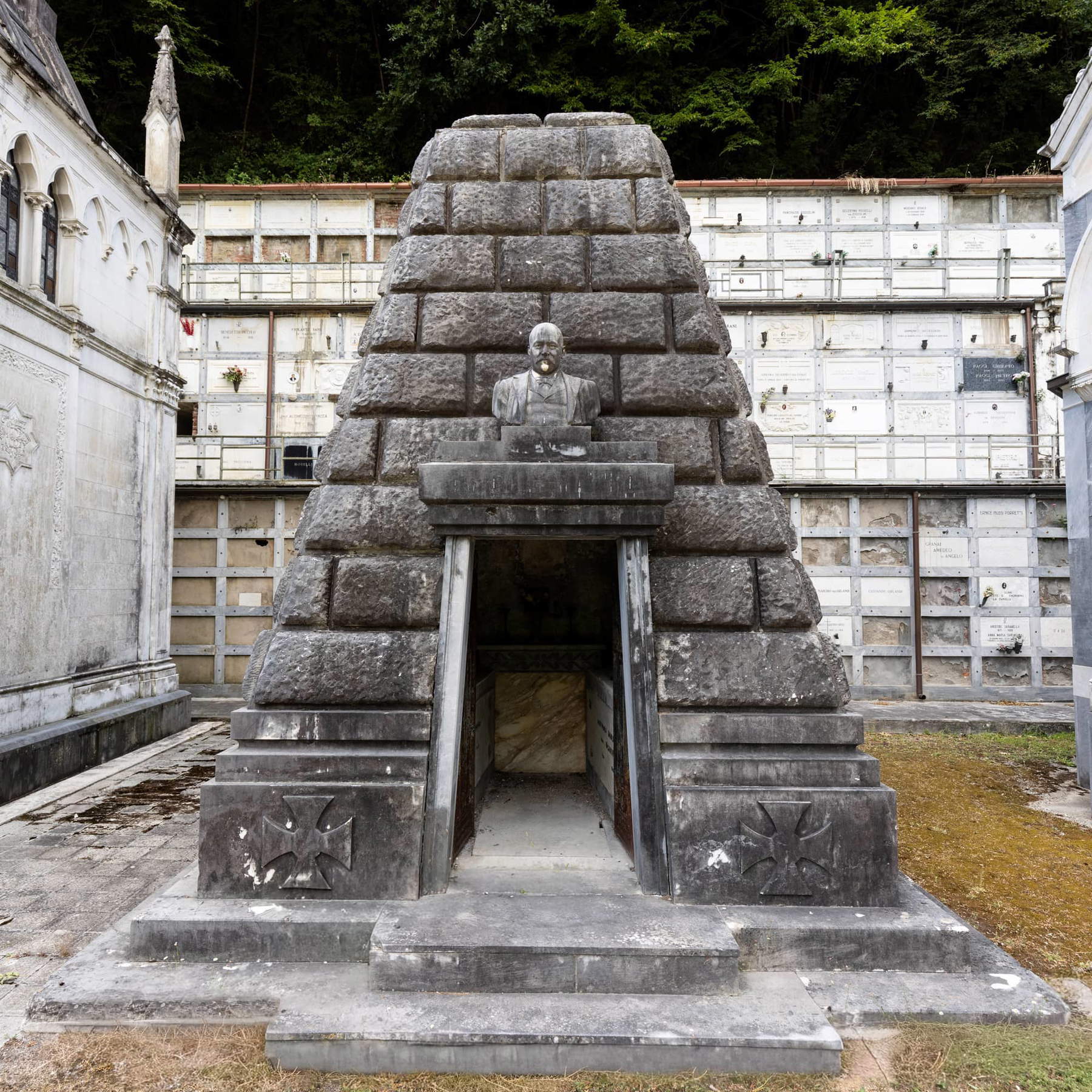
Climbing the hill to the highest terrace (though you can also use the elevators located in the central, more modern section of the structure), and passing the graves of the many who fell for freedom, the partisans who died in the struggle for liberation between 1944 and 1945 (the province of Massa Carrara was the first in Italy to be awarded the Gold Medal for Military Valor, in 1947, and the municipality of Carrara was awarded the Gold Medal for Civil Valor in 2007), you reach the evocative burial chapel designed by the sculptor Giovanni Beretta (Carrara, 1867–1931).
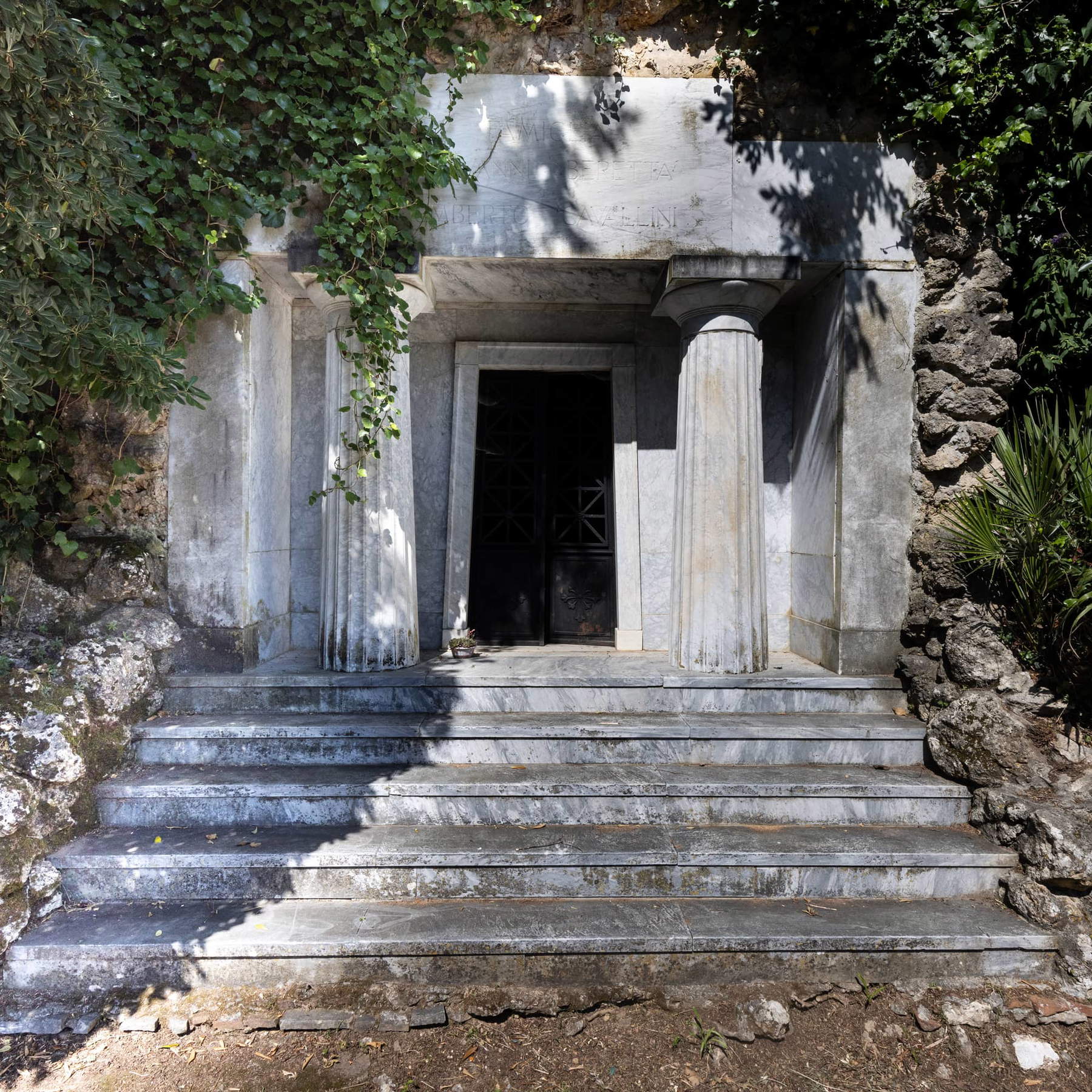
One gets the impression that the tomb is carved directly into the bare rock, and the encroaching vegetation—we are at the edge of the woods—accentuates the scenic effect. The charming neoclassical atmosphere, however, conceals a deeper meaning, echoing the similar architecture of Giuseppe Mazzini’s mausoleum in Staglieno (1874). This is not merely a declaration of Mazzinian faith but a specific reference to the construction of the monument, designed by architect Gaetano Vittorio Grasso (1849–1899) and in whose construction Beretta himself had participated.
Next to it stands one of Marcognano’s darkest and most controversial features: an altar—almost a pagan altar—marked by bronze fasces, commemorating the fascists who fell during the 1921 Sarzana uprisings. The monument, titled “Memorial to the Martyrs of the Fascist Revolution,” was to have been completed with a colossal bust of Mussolini, which appears never to have been created. Information on the matter is, however, very scarce; the shadows of history still shroud the men and monuments linked to those tragic events.
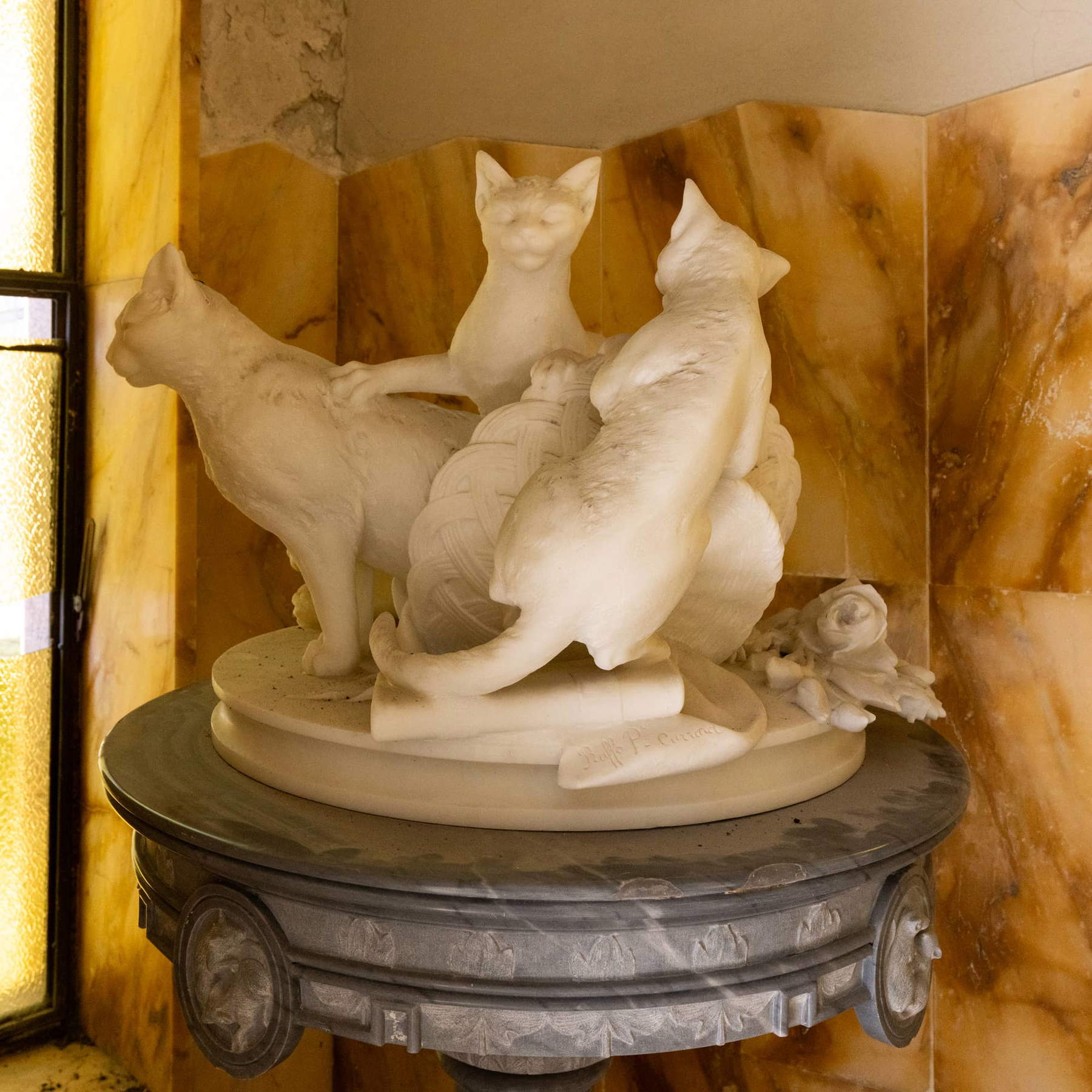
The descent takes place through the northern section of the cemetery. Here, among more modern-looking tombs, lies a unique work of art: a sculptural group titled *Masters of the Field* (*Masters of the Field*), winner of the Fabbricotti Prize (a coveted award in Carrara between the 19th and 20th centuries) in 1906.
The work, created by Pietro Raffo (Carrara, 1866–1912), is located in the family chapel and depicts a group of four cats playing and stretching, overturning a wicker basket and breaking a small vase. A Bardiglio marble base with original Art Nouveau decorations (there are pairs of mice that seem to be dancing!) completes the ensemble and allows the sculpture to rotate on its own axis.
Further down the valley, one is once again surrounded by early-20th-century graves: among the many tombstones, we highlight that of schoolteacher Assuntina Dini (Carrara, 1890–1918), featuring a bas-relief by her brother Ezio (Carrara, 1887–1966) and a fine epitaph composed by the poet Ceccardo Roccatagliata Ceccardi (Genoa, 1871–1919). We provide the full transcription here, pending a restoration that will restore the original’s dignity: “I was a quiet young girl: and a flock of children / I guided between their early studies and their eagerness to play / and as I grew into the age that offers young girls a wreath / of roses, I found myself among the cypresses of Elysium. / There I live again in serenity; and I call out: and still chattering children / run to me, who wander without a kiss among the shadows / dictated by Ceccardo Roccatagliata Ceccardi.”
Not far away stands the Pocherra Chapel, whose design straddles the line between Rationalism and Art Deco, dominated by a monumental Christ the Redeemer by Carlo Fontana (Carrara, 1865 – Sarzana, 1856): Here rests Bernardo Pocherra (Carrara, 1885–1968), a lawyer, politician, mayor of Carrara (1922–23), and member of parliament (1934–39), as well as director of the publishing company Messaggerie Italiane. Noteworthy are the artistic stained-glass windows and the tombstone featuring two large cherubs supporting an elaborate garland.
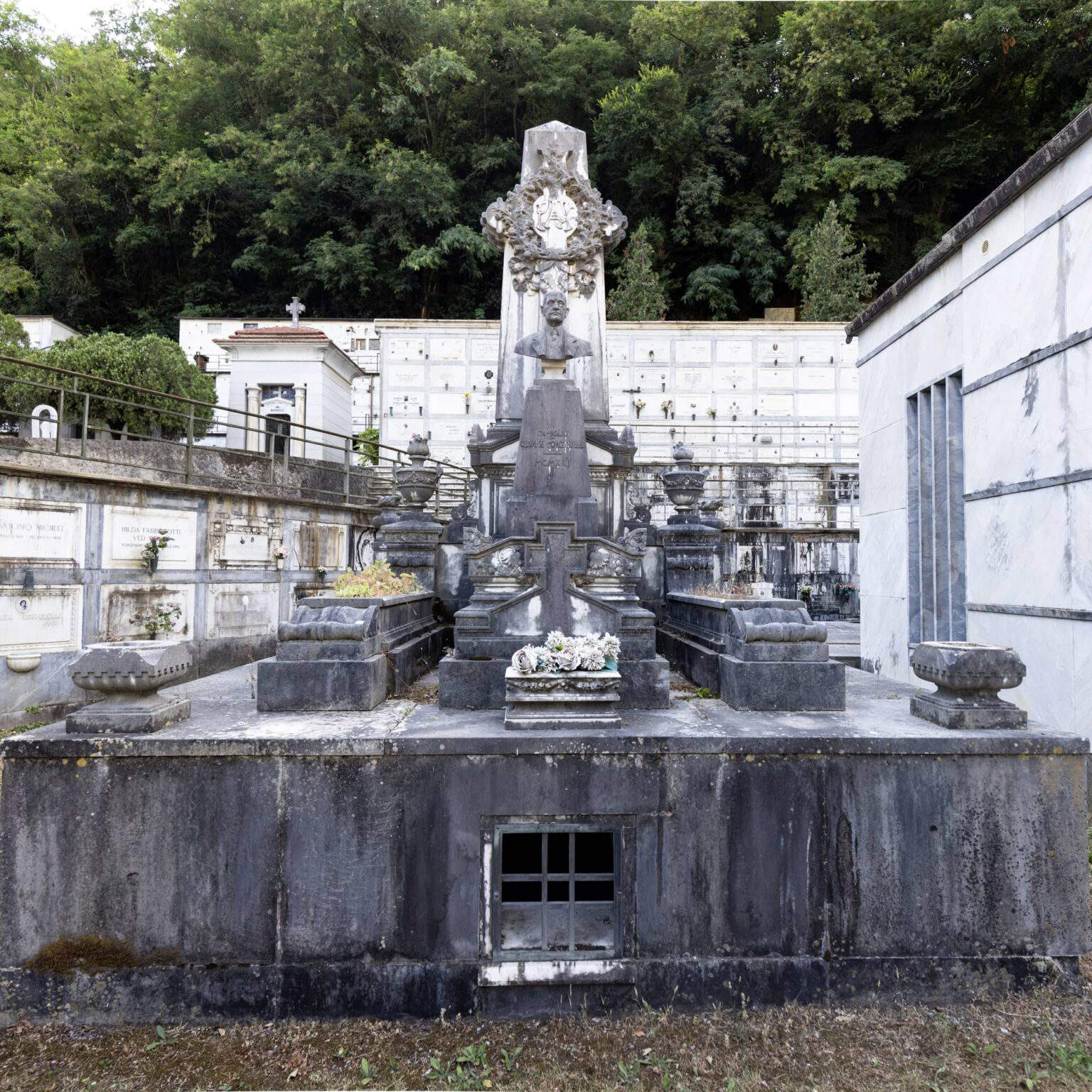
Unique and shrouded in mystery is the monument erected by the sculptor Adolfo Ottavio Ponzanelli (Carrara, 1879–1952) in memory of his father, Cesare. A student of Auguste Rodin in Paris, Ponzanelli settled in Mexico in 1906, where he opened a successful sculpture studio that remains in operation today. The work is characterized by an eclectic use of classical motifs and a consistent emphasis on refined marble carvings, culminating in the heartfelt bust portraying the artist’s father. The most intriguing—and elusive—element, however, is found on the back of the monument, where the figure of a nun in prayer appears. The accompanying inscription reads: “THE REV. MOTHER ANTONIA MAYLEN / SUPERIOR GENERAL OF THE DAUGHTERS OF MARY / IMMACULATE OF GUADALUPE / CAME TO PRAY AT THIS TOMB, WHICH SHE DESIRED AS HER OWN / THE SCULPTED IMAGE AS A VENERABLE MEMORIAL / A.P. 1931”.
The story remains shrouded in mystery, and we do not know—at least for the moment—what a Mexican mother superior was doing in Carrara, or why she wished to be buried in the Ponzanelli family tomb.
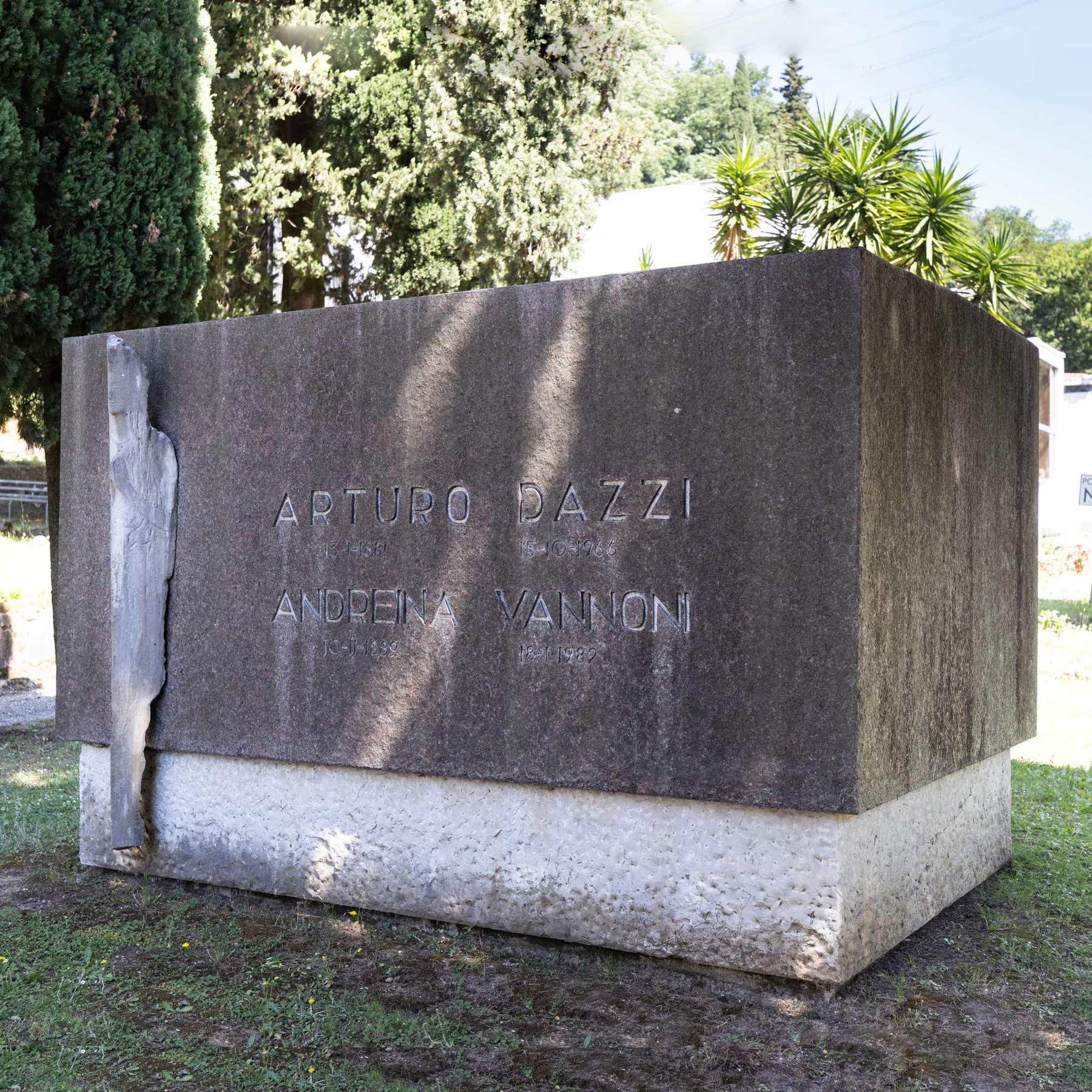
The route reaches its natural conclusion, circling back to the central temple, in front of the granite funerary monument to Arturo Dazzi (Carrara, 1881 – Pisa, 1966) and his wife Andreina Vannoni, known as Gri (1889–1982). A leading figure of the Italian 20th century, Dazzi created monumental works, often in collaboration with the architect Marcello Piacentini (Rome, 1881 –1960), as well as highly regarded sculptures of a more intimate nature, including the famous *Cavallino* (1928), which has been replicated many times and of which an unfinished version is preserved near the cemetery entrance. He also created the monument (also known as the obelisk or antenna) to Guglielmo Marconi in the EUR district, a work of impressive dimensions (45 meters high) whose construction was a long and troubled process (1939–1959). The austere tomb, initially completely bare, was later embellished, at the request of his widow, with a marble version of Dazzi’s model for a Saint Agnes (1951, installed in 1971).
 Memorial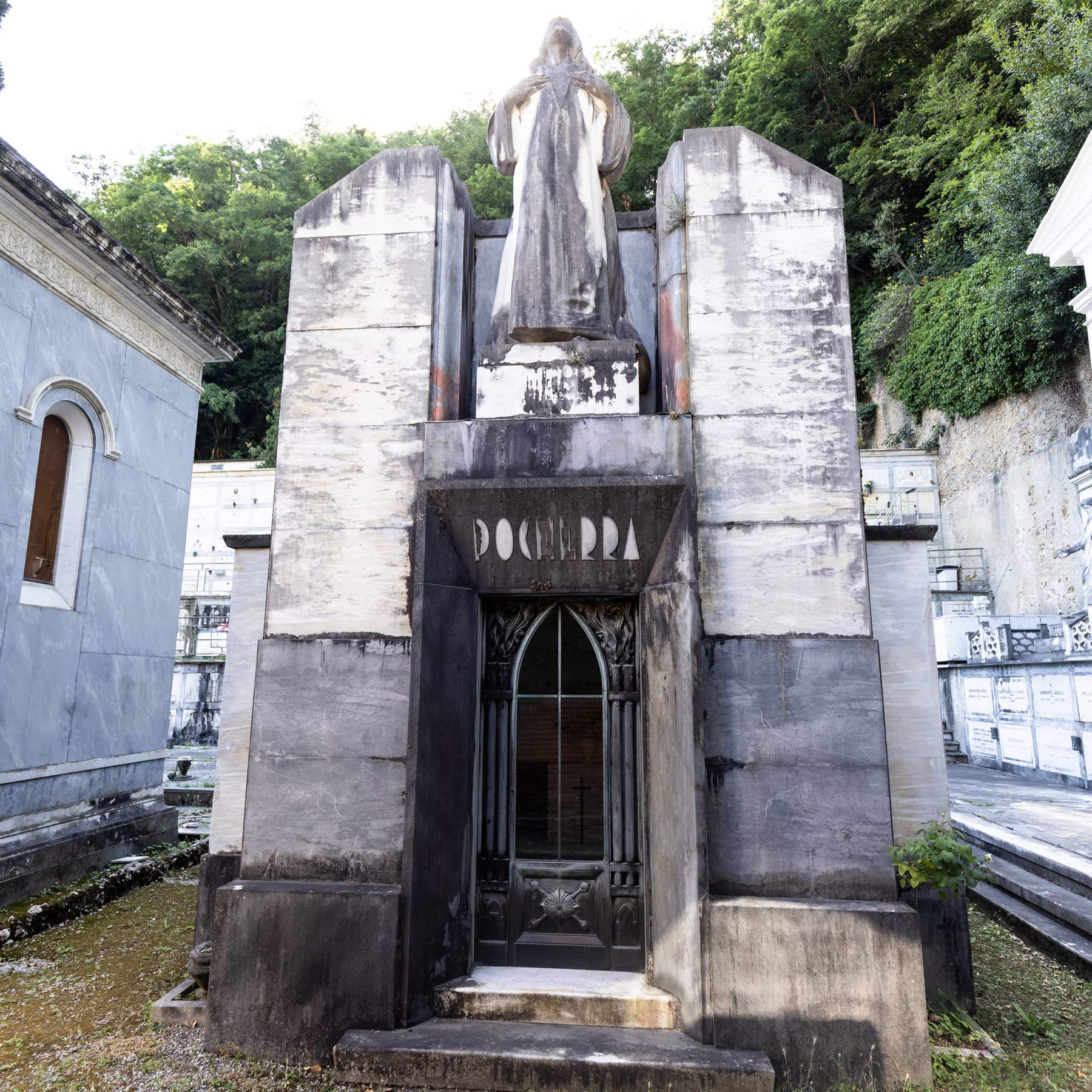
Preserving and promoting the cultural heritage of monumental cemeteries is a current and complex challenge that raises questions with no easy answers, touching on prejudices and taboos deeply rooted in our society. Alongside the primary functions of farewell and remembrance, there are now historical and conservation needs, while interest is growing in new ways to experience these unique places culturally, socially, and environmentally.
Very recent studies show that, despite an overall decline in cemetery visits, Italians are now more open to expanding the role of cemeteries through guided tours on historical or educational themes, while they remain more skeptical—if not openly opposed—to the organization of other types of initiatives, such as group activities (yoga, meditation), theater, presentations, or concerts (official data from the report *Italians and Death: Practices, Opinions, Beliefs*, Cattaneo Institute, Bologna, May 2026).
A monumental cemetery certainly cannot be treated like a public park, but neither does the overused phrase “open-air museum ” do justice to its complexity or guide how it should be experienced. The success of initiatives organized throughout Europe during the Week of DiscoveringEuropean Cemeteries (an annual event organized by the ASCE —Association of Significant Cemeteries in Europe) or, closer to home, the Staglieno Days in Genoa, nevertheless demonstrate how places of remembrance can become vibrant spaces for the city: a delicate balance.
While, at the EU level, the European Cemeteries Route has been part ofthe Council ofEurope ’s Cultural Routes since 2010, Italy has had an Atlas of Significant Italian Cemeteries since 2018. Created through a memorandum of understanding between Utilitalia SEFIT and the Ministry of Culture, the document is updated annually and currently includes thirty-nine sites.
The addition of Marcognano to the prestigious Atlas (May 2026 edition) marked the first step in a broader initiative to promote the site, spearheaded by Nausicaa Carrara, a multi-service company of the City of Carrara that manages, among other things, the area’s cemetery services. The aim is to increase awareness of and access to the monumental complex, recognizing its historical, artistic, and cultural significance.
The website www.cimiterodimarcognano.it (September 2026) marks another milestone in this journey and serves as a versatile tool: an interactive map guides visitors through more than 80 points of interest, while historical sections—featuring previously unpublished archival documents and a comprehensive bibliography—help explore the complex’s history in greater depth. Six thematic themes complete the picture, ranging from the 14 featured monuments—accompanied by in-depth historical and artistic descriptions—to the five thematic itineraries for exploring Marcognano. “Carrara and the Sculptors” celebrates the artists who shaped the history of Carrara sculpture; The Marble Trades recounts an important connection: that of those who worked marble with their own hands—quarrymen, stonemasons, polishers, and others. “Ideals, Politics, and Identities” traces the political and civic beliefs embodied in funerary monuments, while “Collective Memory and Tragedies” explores the events and losses that have shaped the local community’s collective memory. Finally, “The Faces of the City” takes us into more intimate atmospheres and everyday stories—those of ordinary people, some well-known, others less so, including artisans and professionals, but also those who made culture or social commitment the cornerstone of their existence. An invitation to view Marcognano as a vast marble book, recounting the stories of the figures who left the deepest mark on 20th-century Carrara.
Warning: the translation into English of the original Italian article was created using automatic tools. We undertake to review all articles, but we do not guarantee the total absence of inaccuracies in the translation due to the program. You can find the original by clicking on the ITA button. If you find any mistake,please contact us.