





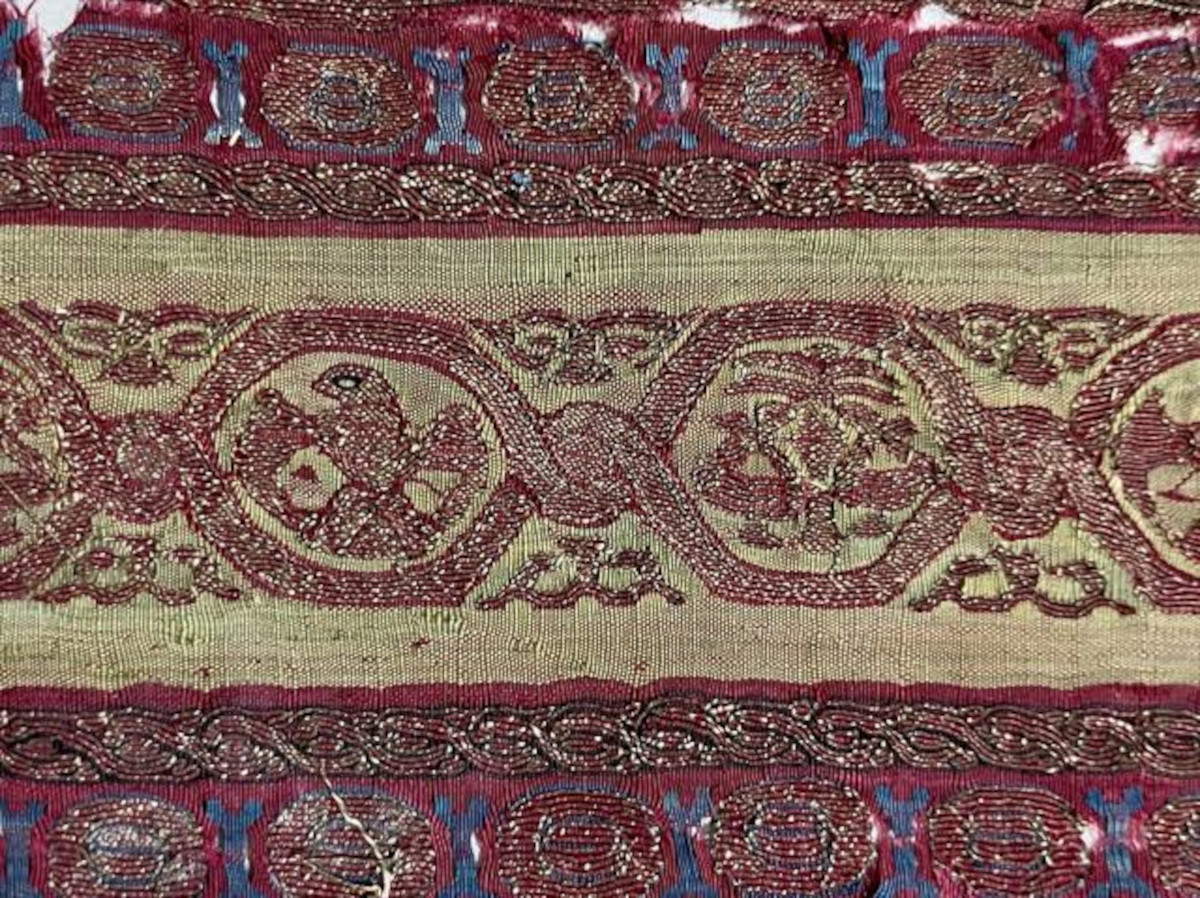
A textile artifact of extraordinary refinement, which has been preserved for generations by the nuns of the Vallegloria Monastery in Spello, is now the focus of a major research and conservation project. Initial assessments by experts have revealed features consistent with textile production in Egypt during the Fatimid period, raising the possibility that the fabric may date back to the 12th century.
The discovery was publicly unveiled during a ceremony held at the Vallegloria Monastery, attended by the monastic community, representatives of the Diocese of Foligno, the Municipality of Spello, and institutions of the Ministry of Culture. The event marked the start of a collaborative effort aimed at further investigating the artifact’s history, ensuring its protection, and determining the necessary conservation measures.
A particularly evocative story has also been passed down regarding the cloth. According to a centuries-old tradition, the artifact was donated by St. Francis of Assisi to Blessed Balbina—traditionally believed to be a relative of St. Clare—during the saint’s visit to Vallegloria. This tradition has also been linked to Francis’s journey to Egypt in 1219, when, during the Fifth Crusade, he met Sultan al-Malik al-Kamil, from whom he is said to have received numerous gifts. However, based on current knowledge, this account finds no corroboration in the oldest Franciscan sources. For this reason, the tradition must be kept distinct from the information that will be verified through historical research and scientific analysis. It is precisely the relationship between handed-down memory, documentary sources, and material evidence that constitutes one of the most interesting aspects of the study undertaken on the fabric.
The artifact’s technical and aesthetic characteristics also make it particularly valuable. Although it is in a fragile condition, the fabric has retained surprisingly vivid colors and displays a particularly high level of craftsmanship. The quality of the materials and workmanship thus helps underscore its rarity and historical-artistic value.
The importance of this research was also highlighted by Monsignor Felice Accrocca, bishop of the Dioceses of Assisi-Nocera Umbra-Gualdo Tadino and Foligno and a scholar of Franciscanism. The bishop emphasized the need to compare traditions preserved over time with available historical sources, while at the same time highlighting the role of Franciscan sites, which are often custodians of testimonies and memories that still await further study. Father Giovanni Zampa, interdiocesan vicar general of the Dioceses of Assisi-Nocera Umbra-Gualdo Tadino and Foligno, also highlighted the value of initiatives of this kind. In fact, study and research can bring to light aspects of the ecclesiastical heritage that are still little known and demonstrate how the region continues to offer evidence of great interest.
The Municipality of Spello participated in this journey of rediscovery alongside the Diocese. Mayor Moreno Landrini and Councilor for Culture David Pieroni highlighted the importance of collaboration between institutions and local communities to deepen understanding of the heritage and promote its appreciation. Another point of interest was the presentation by Monsignor Yoannis Lahzi Gaid, former personal secretary to Pope Francis, who is now engaged in activities dedicated to fraternity and interreligious dialogue and is a specialist in Arabic epigraphy. The hypothesis of a possible Egyptian origin for the fabric opens up new avenues of research that also concern the cultural, artistic, and religious exchanges that have developed over the centuries among the various regions of the Mediterranean.
Regarding conservation, the Superintendence of Archaeology, Fine Arts, and Landscape for Umbria—represented by Superintendent Francesca Valentini and art historian Giovanni Luca Delogu—has confirmed its willingness to oversee the next phases of the project, supporting the research and conservation efforts. The scientific investigations and subsequent restoration work, however, will be entrusted—at the request of the Vallegloria community—to the Opificio delle Pietre Dure in Florence. The institute will be represented by Superintendent Emanuela Daffra, Riccardo Gennaioli, director of the Textile Artifacts Division, and Licia Triolo, a restoration and conservation specialist.
A new and decisive phase of research is thus beginning for the Vallegloria textile. Before the date and place of production can be established with certainty, the artifact will need to undergo a comprehensive series of diagnostic and historical-artistic examinations. Among the aspects to be investigated are the composition and origin of the materials, the fibers used, the dyes, the weaving techniques, and the possible region of origin.
Comparisons with similar artifacts preserved in Italian and international museums and collections will also play an important role. To this end, a scientific committee will be formed shortly to support the research process. At the same time, a documentary investigation will be conducted to reconstruct the history of the fabric and understand when and under what circumstances it arrived at and was preserved within the Vallegloria monastery. Only at the conclusion of this comprehensive process will it be possible to verify whether the ancient fabric can indeed be traced back to 12th-century Fatimid Egypt and what its true history was prior to its arrival at Vallegloria. The research will thus make it possible to distinguish documented facts from handed-down traditions, restoring the artifact’s most accurate historical and cultural significance.
“Our mission,” stated Superintendent Valentini, “is to protect two aspects of cultural heritage: the first is the material aspect—in this case, the textile and its state of preservation; the second, however, is its intangible value, derived from the care with which the nuns have preserved, passed down, and safeguarded it over the centuries. It is a textile that must be studied and investigated, but it is certainly of Eastern origin and bears witness to a journey—its arrival from a distant place. It has been preserved and safeguarded as an object associated with St. Francis, bearing witness to his openness toward others, and thus it has come down to us remarkably intact. We are sincerely pleased with this value and will be its custodians.”
“We do not yet know if this is truly the fabric that tradition links to Saint Francis, nor can we today state with certainty its date or origin as a gift from the Sultan. Further investigations will determine that. But we already know that we are looking at an artifact of extraordinary interest, one that deserves to be studied and preserved,” said Monsignor Accrocca.
|
| An ancient textile, preserved for centuries at the Vallegloria Monastery in Spello, may date from Fatimid Egypt |

Warning: the translation into English of the original Italian article was created using automatic tools. We undertake to review all articles, but we do not guarantee the total absence of inaccuracies in the translation due to the program. You can find the original by clicking on the ITA button. If you find any mistake,please contact us.



























 IT
IT FR
FR DE
DE ES
ES CN
CN


