



by Redazione 20/10/2026


Categories: Ancient art / Disclaimer
Housed in the storerooms of the Bargello National Museum, the large 17th-century tapestry depicts Psyche at a table surrounded by maids and musicians. The restoration project by the Opificio delle Pietre Dure will last approximately 30 months and is supported by a grant of 100,000 euros from the Il Bargello Foundation.


A sumptuous banquet, a young woman seated before a lavishly set table, maids and musicians gathered around her, and, in the background, colonnades opening onto the landscape; all around, a rich border featuring cherubs, friezes, and floral garlands. This is the scene depicted in *The Banquet of Psyche*, a large 17th-century wool-and-silk tapestry owned by the Bargello National Museum in Florence, which has not been on public display for about a century. Stored in the Florentine museum’s vaults, the tapestry is now preparing for a new chapter in its history: on October 19, 2026, it was transferred to the workshopsof the Opificio delle Pietre Dure, where it will undergo a study and restoration project expected to last approximately 30 months. The work measures 4.20 by 3.25 meters, with a surface area of over 12 square meters; it is attributed to the workshop of the Grande Galerie du Louvre, active in Paris during the first half of the 17th century, and its composition draws on iconographic models from the repertoire of the Flemish painter Michiel Coxcie (1497–1592). The work is attributed to two prominent tapestry makers, Girard Laurent and Maurice Dubourg, who were active in the service of the royal workshop during the reigns of Henry IV and Louis XIII.

The restoration will address the conservation condition of a work that, although part of the Bargello’s collections since the late 19th century, has long been hidden from public view and represents a still little-known example of the museum’s textile heritage. The restoration will be carried out by the Opificio delle Pietre Dure in collaboration with the Galleria dell’Accademia in Florence and the Bargello Museums, an institution of the Ministry of Culture, with financial support from the Fondazione Il Bargello ETS Ente Filantropico.




A Transfer from the Palazzo del Bargello to the Palazzo Vecchio
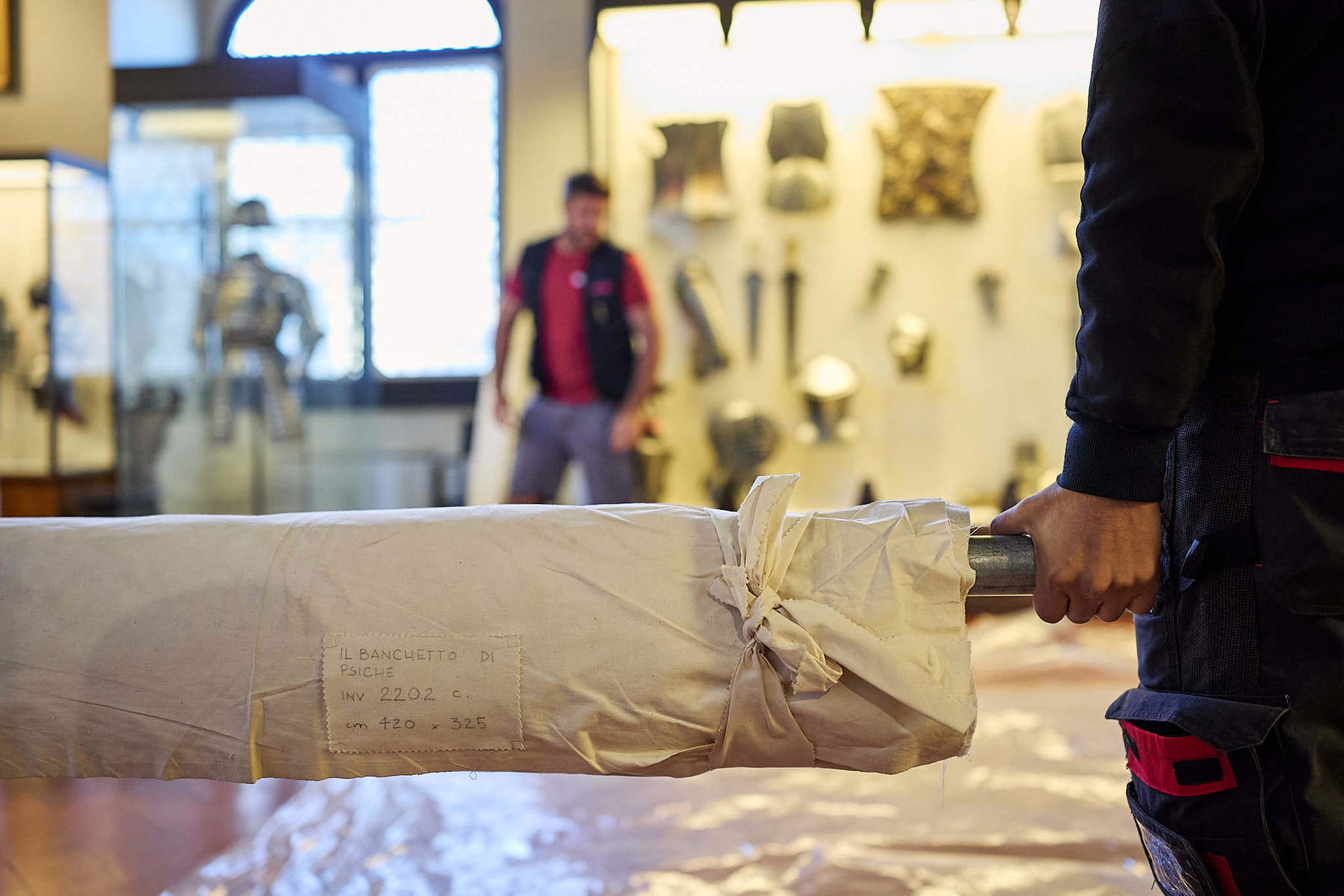
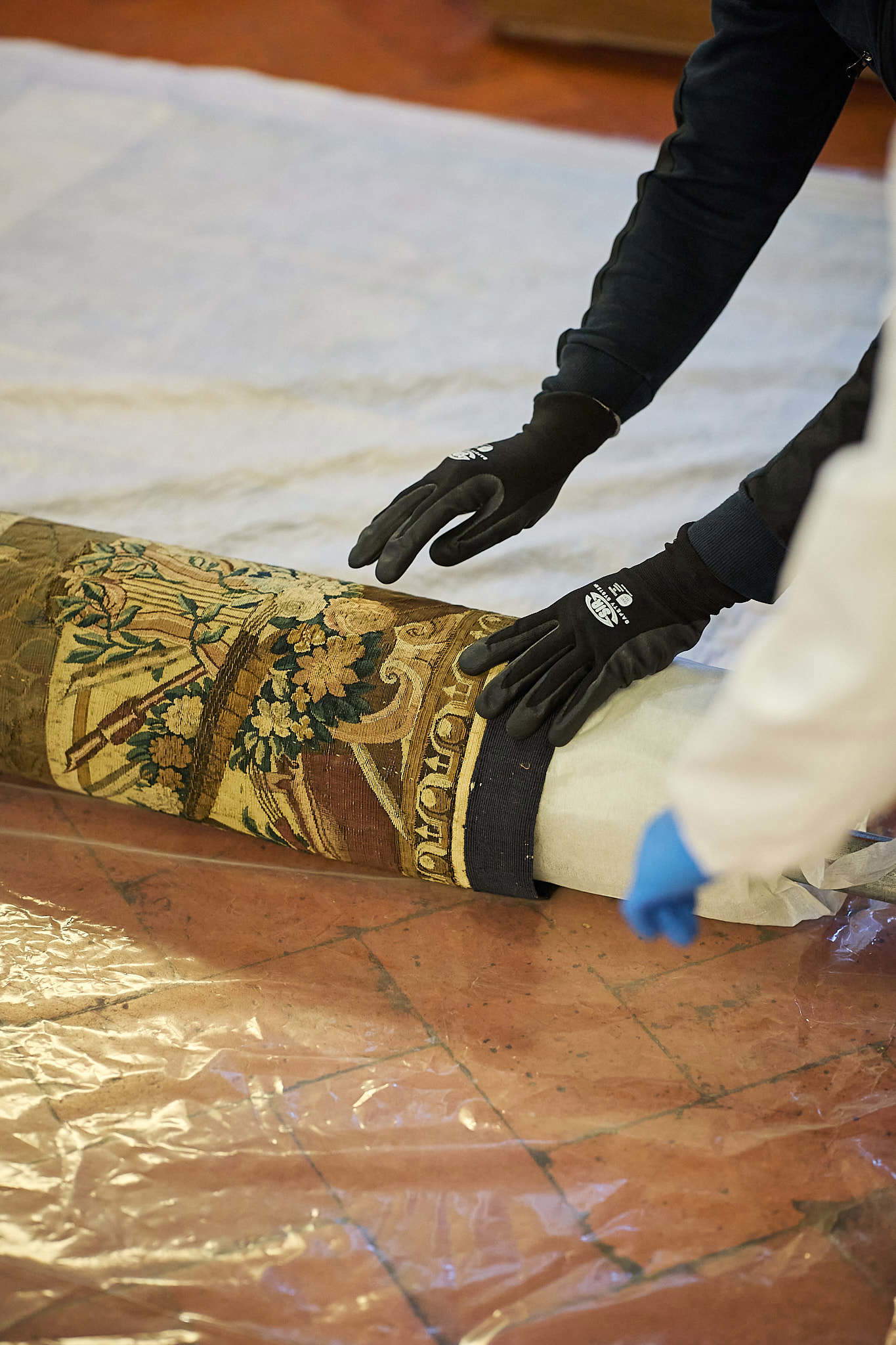
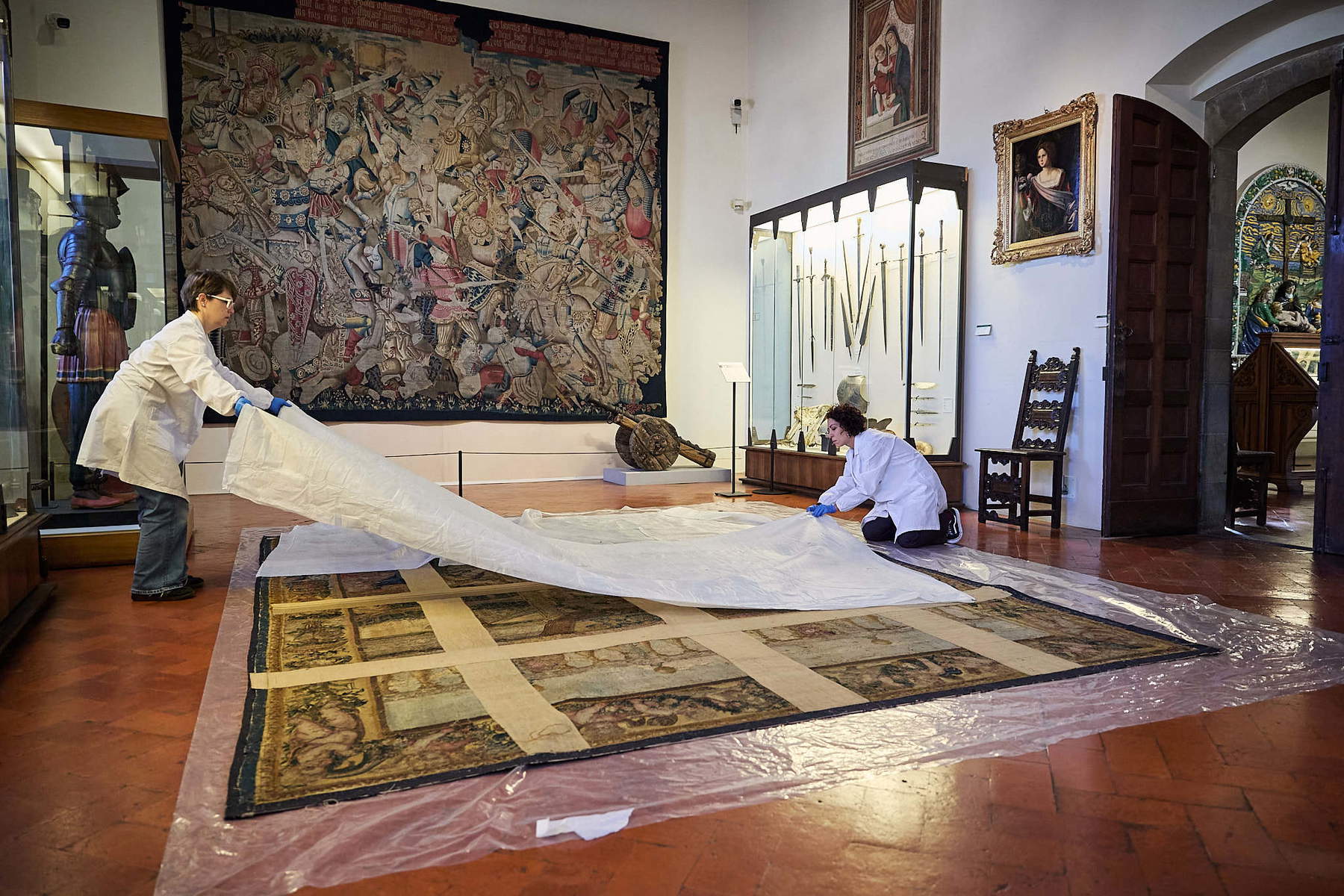
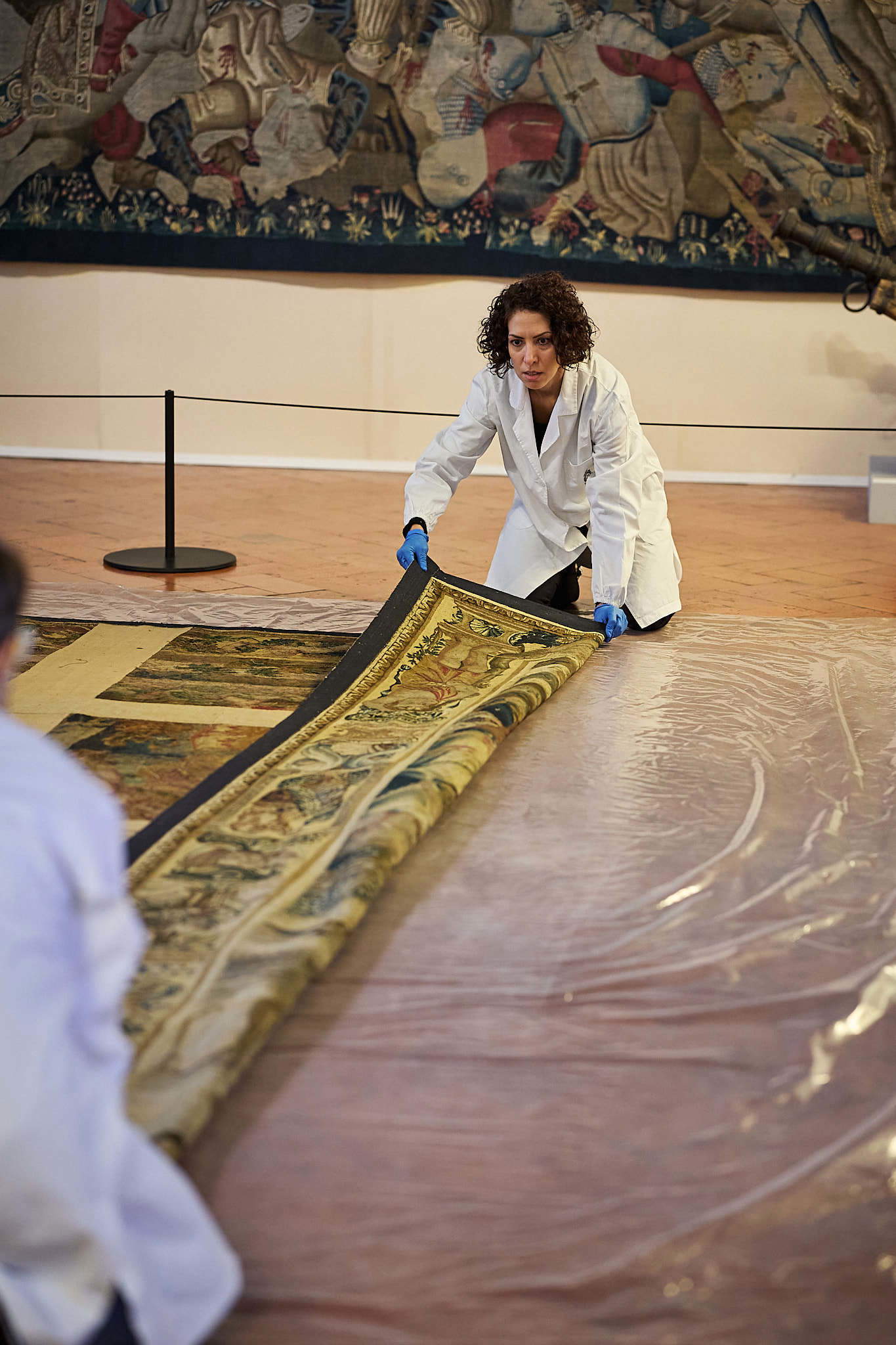
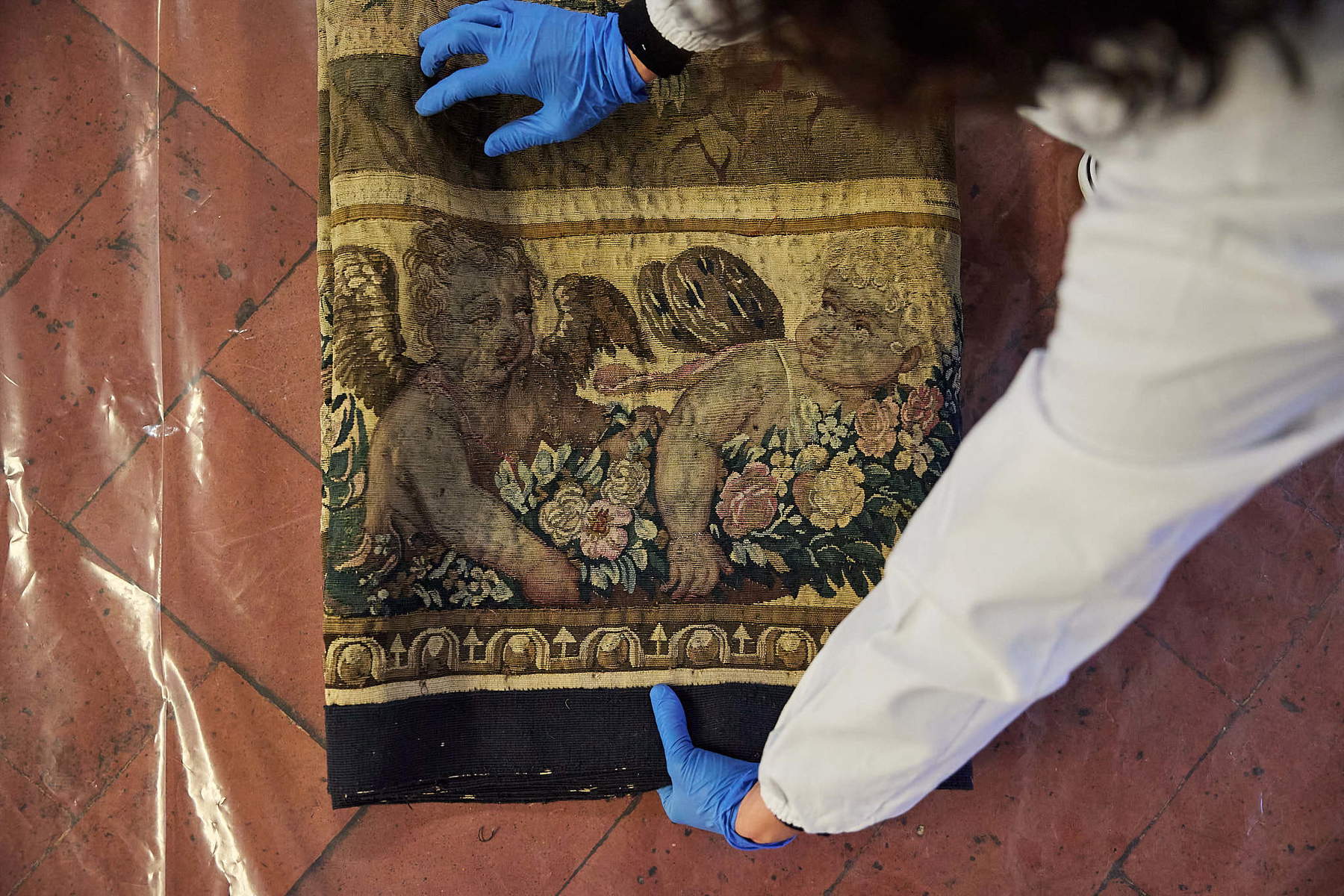
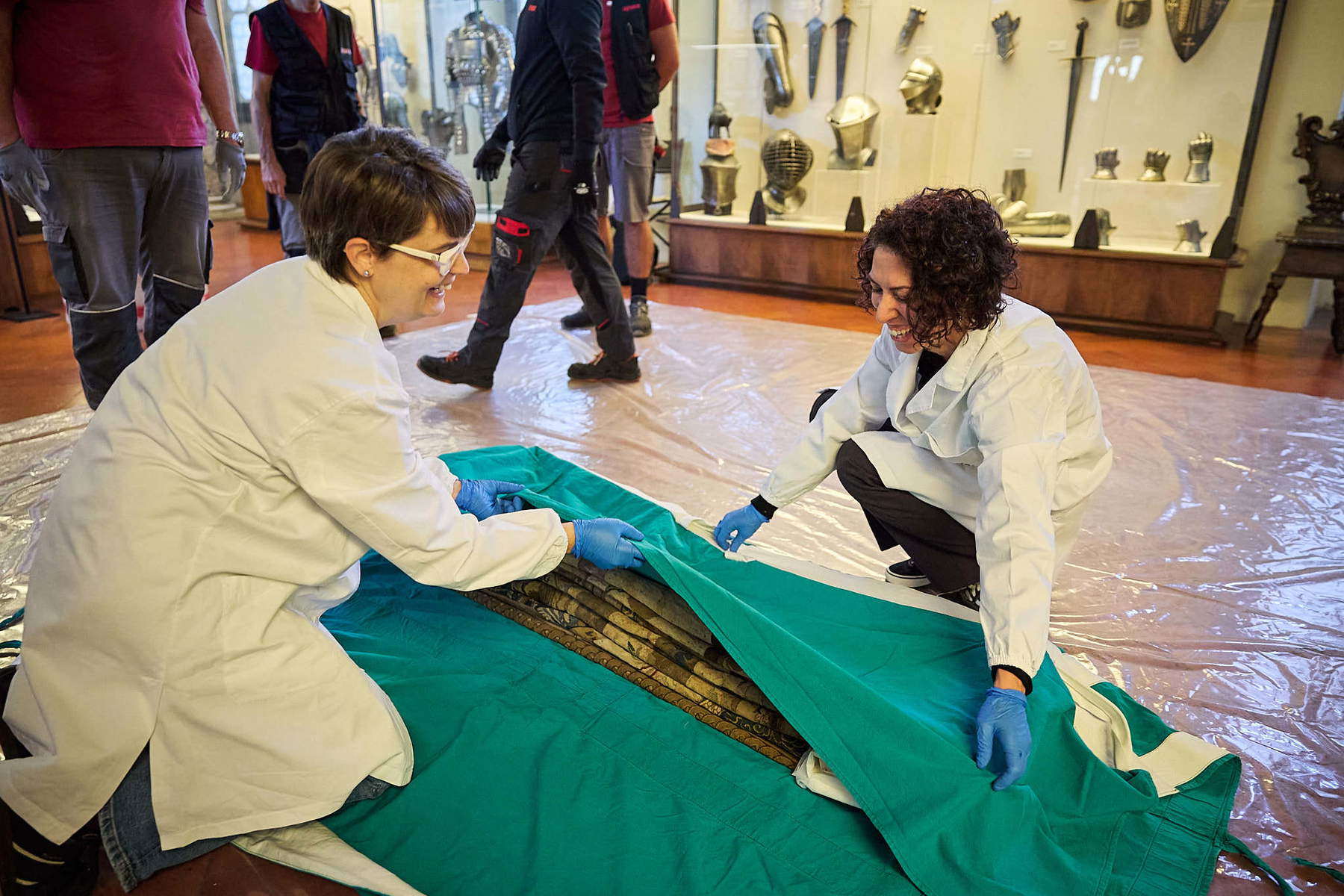
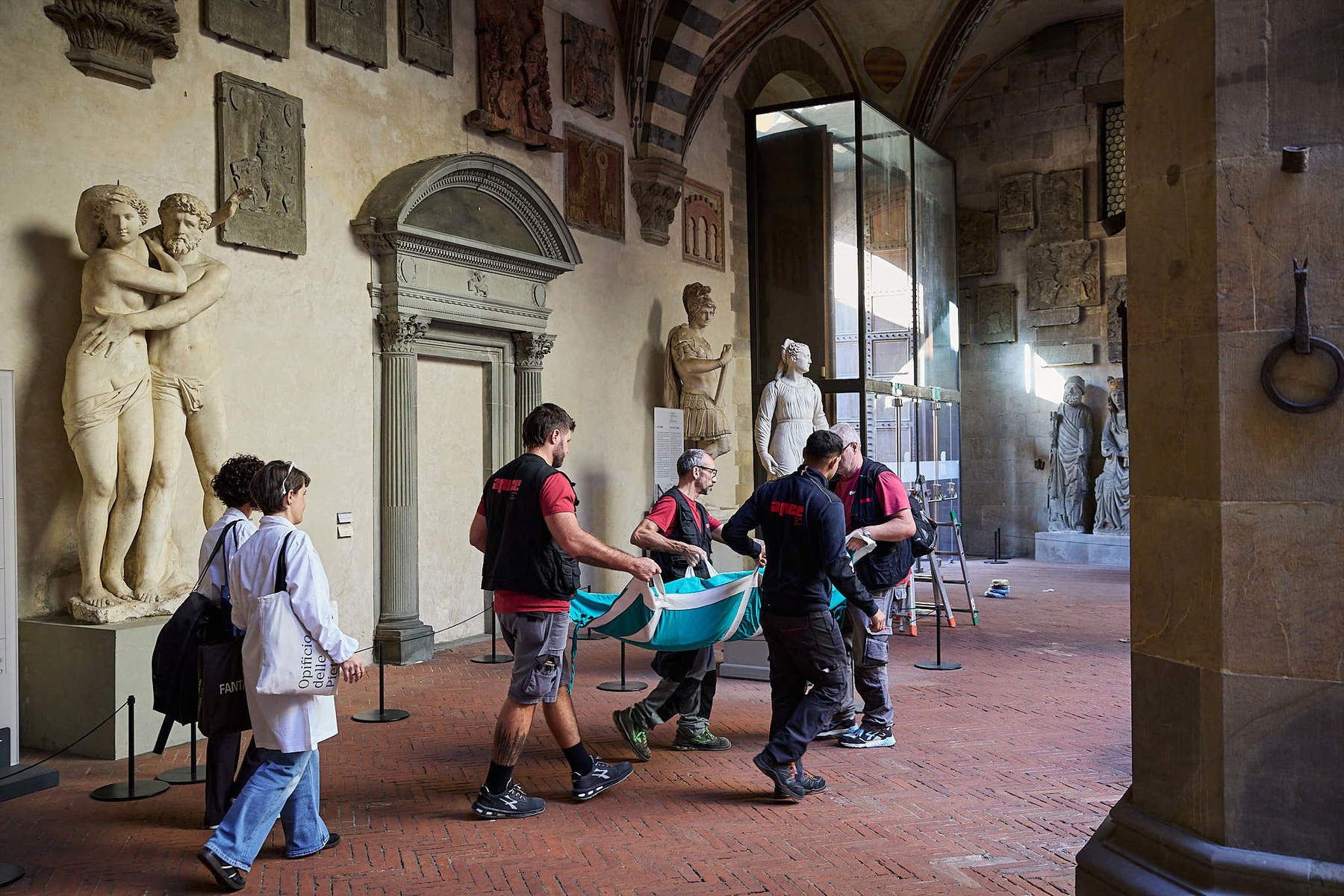
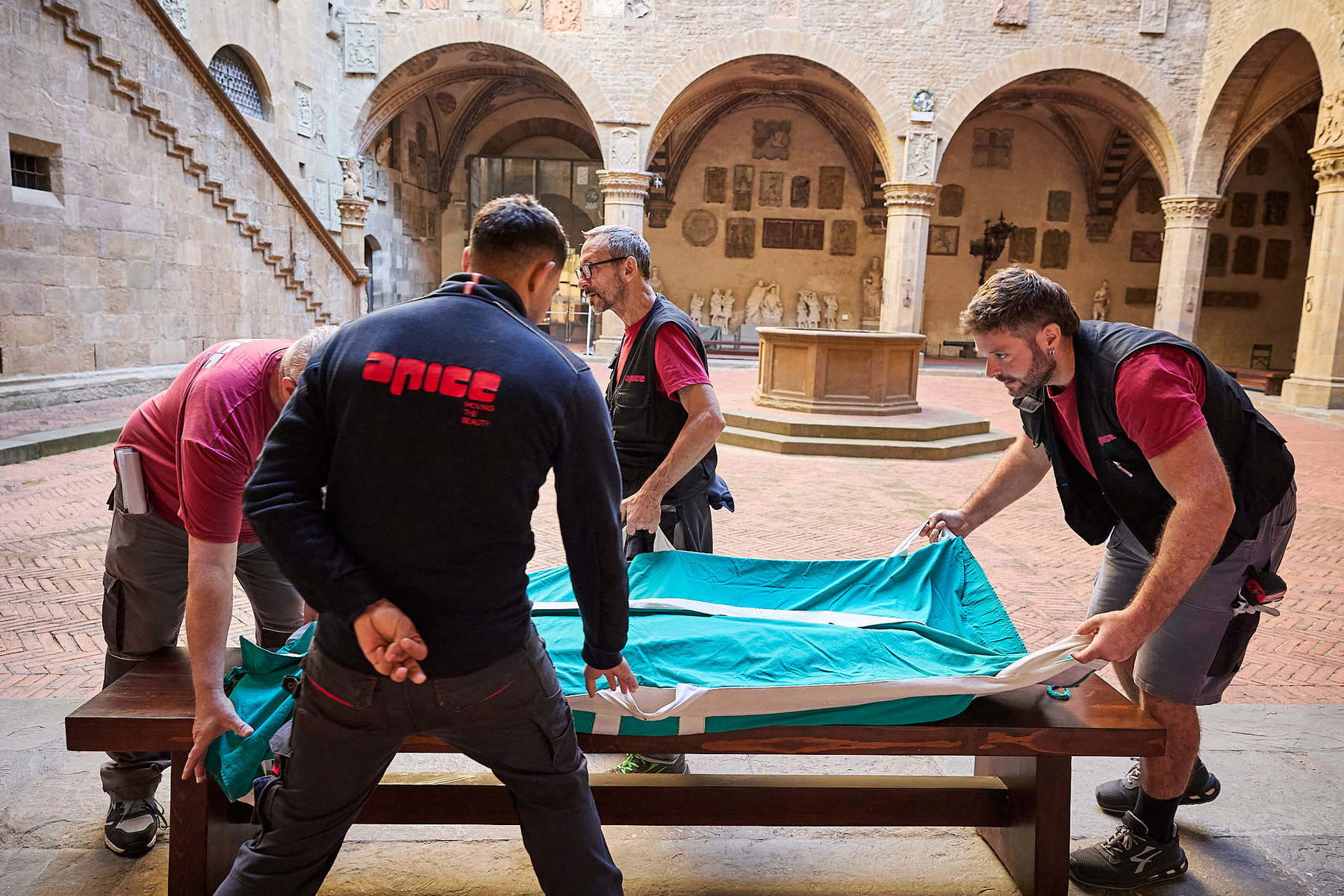
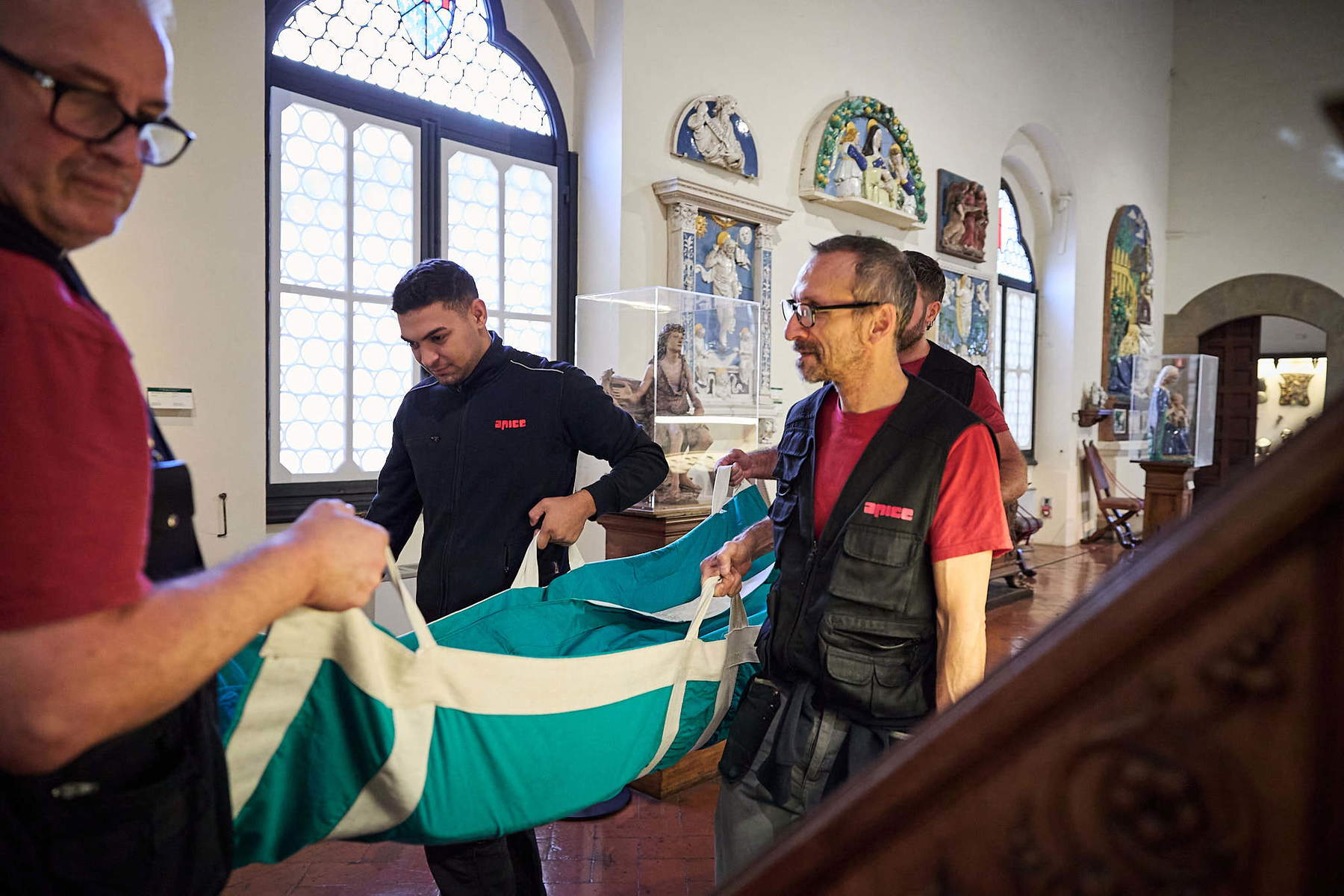
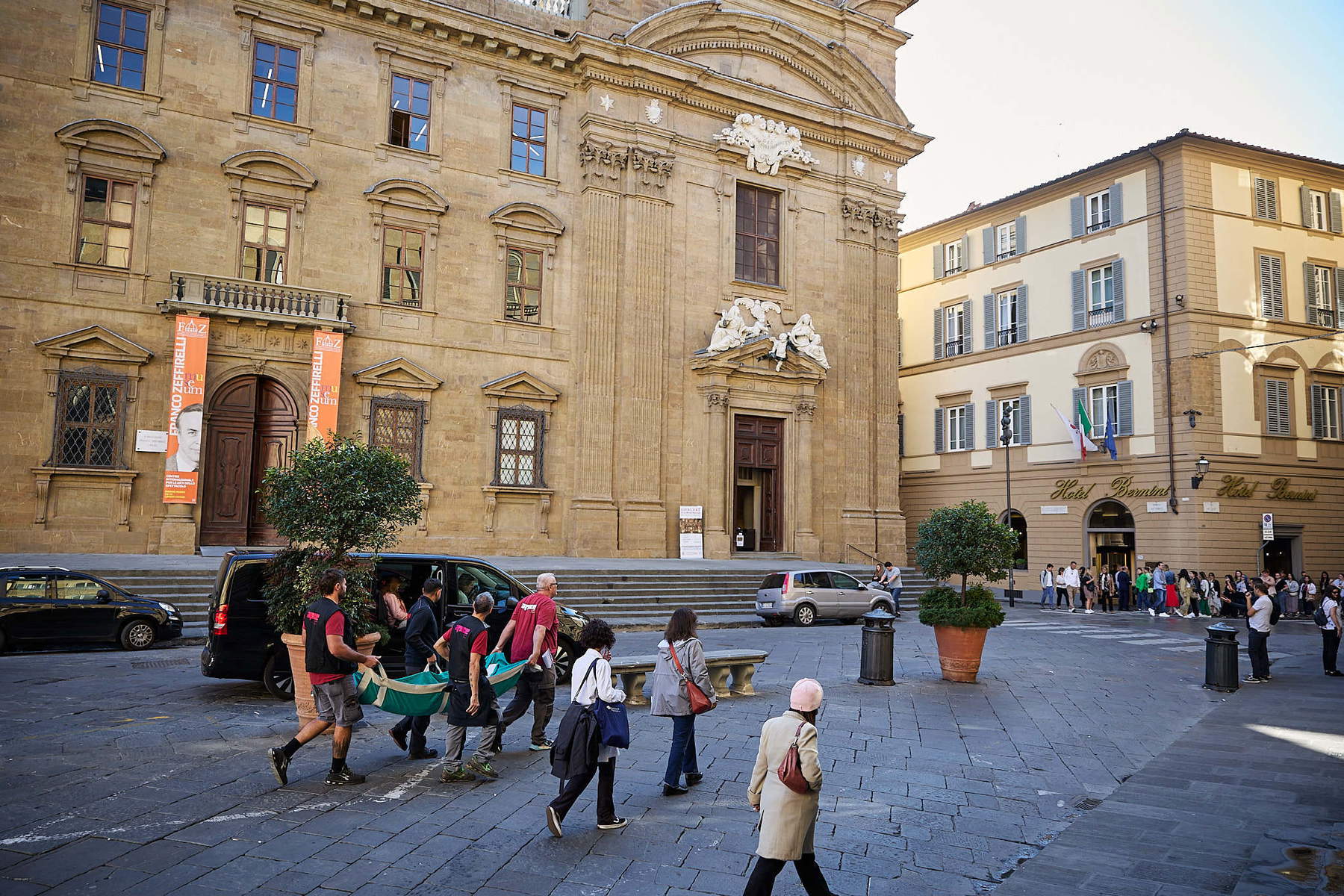
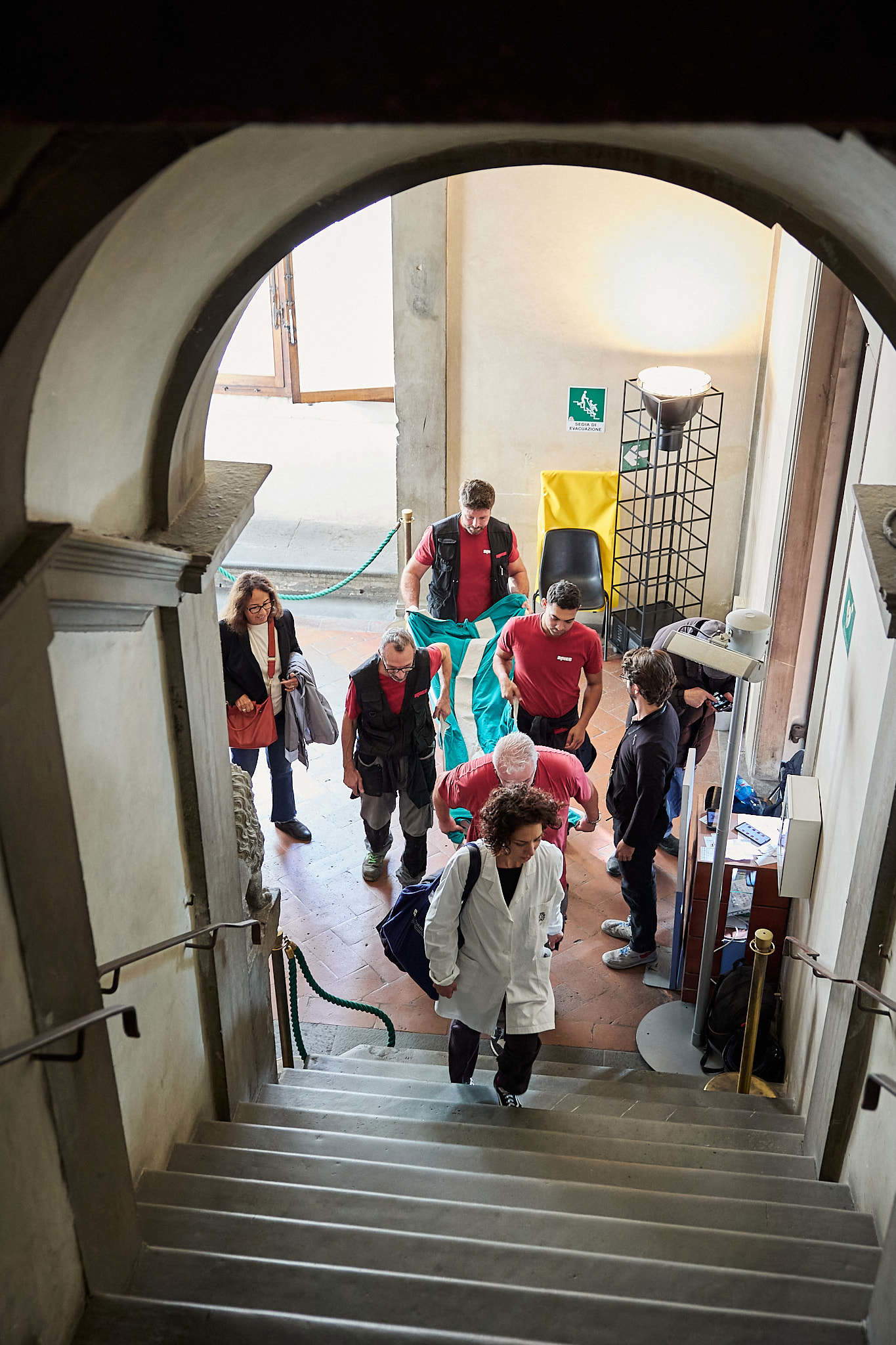
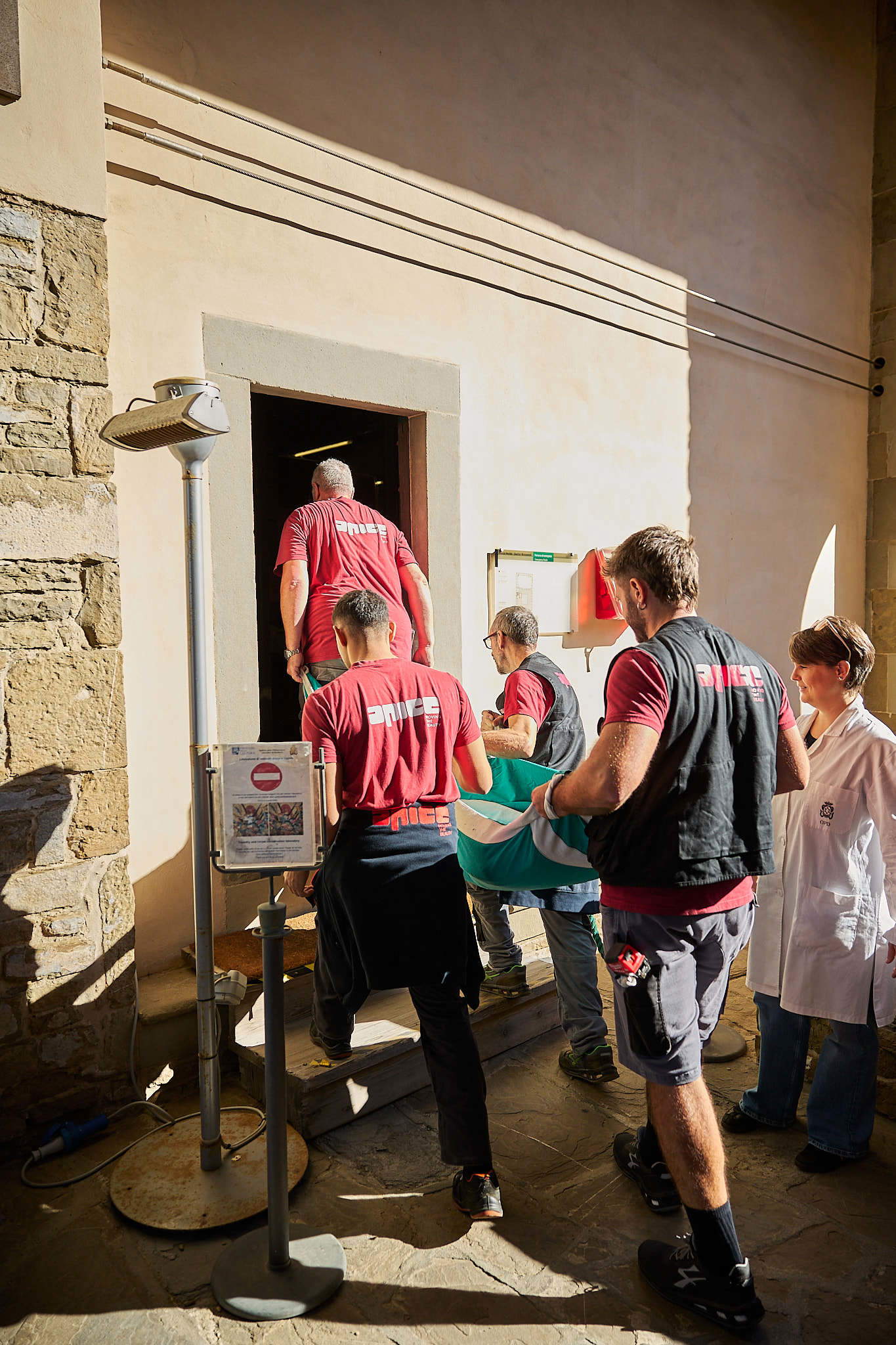
The transfer of the tapestry, which took place on Monday, October 19, required particularly delicate handling. The work, rolled up and secured in a special sling, was carried on foot by technicians from the Apice company to the workshop of the Tapestries and Carpets Department of the Opificio delle Pietre Dure, set up in the Sala delle Bandiere of Palazzo Vecchio. The operations were carried out under the supervision of officials and conservators from the Bargello National Museum and the Opificio. This relocation marks the first step in a project that goes beyond the physical recovery of the artifact; it also includes a research phase aimed at gaining a deeper understanding of its materials, production techniques, and conservation history. Before working on the fibers and weave, the conservators will first document the work and conduct the diagnostic tests necessary to determine its characteristics and condition.
The need for intervention stems from the presence of surface deposits, unstitched areas, cuts, gaps, and missing weft threads. The critical issues are particularly evident in the silk sections, while some previous restorations have contributed to altering the tapestry’s structural stability (the project will therefore need to address various challenges, ranging from cleaning to the consolidation of the fibers and damaged sections of the weave, all the way to lining, which is planned to ensure appropriate conditions for a future exhibition). The program will span approximately 30 months and involve at least four specialized conservators; the work will be carried out through a collaboration between the technical and scientific staff of the two institutions, based on an agreement dedicated to the study, restoration, and promotion of the work.
The Tapestry and Its History
The Banquet of Psyche entered the collections of the Bargello National Museum in 1888, thanks to the bequest of Louis Carrand (1827–1888), a French collector and merchant who had settled in Florence during the final years of his life: The tapestry is therefore part of a group of works that came to the museum through the Carrand collection, which also includes two other large textile pieces. These are *The Final Assault on Jerusalem* and *The Battle of Roncesvalles*, two tapestries from the Carrand collection attributable to 15th-century Franco-Flemish workshops. Both have already undergone conservation work at the Tapestry Department of the Opificio delle Pietre Dure. The Banquet of Psyche, on the other hand, is the only one of the three large tapestries from the Carrand collection housed at the Bargello that has not yet been restored.
The differences in chronology and craftsmanship compared to the other two pieces make this new restoration project an opportunity for further exploration from a historical and artistic perspective as well. As Emanuela Daffra, superintendent of the Opificio delle Pietre Dure, noted, the department has already worked on important textile works from the Bargello, but this 17th-century piece has distinct characteristics. “With *The Banquet of Psyche*, we’ve come full circle, tackling a work that is very different in terms of chronology and craftsmanship—one that has been virtually unexplored by scholars,” she stated. Daffra also emphasized the importance of the collaboration between the two institutions, stating: “I am certain that our joint work with the museum’s technical and scientific staff will once again yield results of great significance.”
At the center of the tapestry is a scene from the myth of Cupid and Psyche. The protagonist is seated before a lavishly set table, surrounded by maidservants and young musicians. The scene unfolds in a setting punctuated by colonnades that open onto the landscape, while a border richly decorated with cherubs, friezes, and floral garlands frames the composition. The reference to the iconographic models of Michiel Coxcie places the work within a figurative tradition that predates its creation. Coxcie, a Flemish painter who lived between 1497 and 1592, is in fact the primary reference for the repertoire from which the scene derives. The tapestry is also attributed to Girard Laurent and Maurice Dubourg, two tapestry makers in the service of the royal workshop during the reigns of Henry IV and Louis XIII.

The Restoration
The textile structure of this artifact, made from a combination of wool and silk, is currently in a state of preservation that requires a comprehensive restoration. In particular, the most evident weft losses in the silk sections highlight the complexity of the work awaiting the restorers. Preliminary investigations will gather information on the materials and techniques used, thereby guiding subsequent operations. Cleaning will address surface deposits, while consolidation will focus on the fibers and damaged sections of the weave. Lining will complete the restoration process with the aim of ensuring greater stability for the artifact in preparation for its exhibition.
The restoration therefore also represents an opportunity for learning, combining conservation with the study of a work that has received little attention from researchers to date: documentation and diagnostic investigations will allow for a deeper understanding of its material characteristics, while collaboration between specialists from the Bargello and the Opificio will bring together museum expertise and conservation techniques for textile artifacts.
The project is made possible by a generous donation of 100,000 euros from the Fondazione Il Bargello ETS Ente Filantropico, made through the Art Bonus, the program that supports patronage in favor of public cultural heritage. Andreina Contessa, general director of the Galleria dell’Accademia in Florence and the Bargello Museums, described the restoration as “an important step in the process of rediscovering and highlighting an extraordinary, often little-known heritage preserved in our museums.” The director also noted that “bringing attention back to a work that has not been visible to the public for about a century means not only ensuring its preservation but also opening up new avenues for study and knowledge.”
For the Accademia Gallery in Florence and the Bargello Museums, Andreina Contessa herself is the sole project manager. Scientific coordination is entrusted to Ilaria Ciseri and Benedetta Cantini. At the Opificio delle Pietre Dure, however, Riccardo Gennaioli and Marta Cimò are in charge of the activities. The project, which has just begun, is expected to be completed after approximately two and a half years of work. Upon completion, the Banquet of Psyche will be ready for evaluation under renewed conservation conditions and with more in-depth scientific documentation. For a work that entered the Bargello in 1888 and remained hidden from the public for about a century, this restoration thus marks the beginning of a new phase of study and a potential rediscovery.
|
| Florence: The Tapestry of the Banquet of Psyche Undergoing Restoration After a Century Away from the Public |
Warning: the translation into English of the original Italian article was created using automatic tools. We undertake to review all articles, but we do not guarantee the total absence of inaccuracies in the translation due to the program. You can find the original by clicking on the ITA button. If you find any mistake,please contact us.