



by Redazione 16/11/2026


Categories: Ancient art / Disclaimer
The Im Kinsky auction house in Vienna had listed it as a work from Murillo’s circle, but the small Madonna and Child painted on volcanic rock—which went up for auction at just 5,000 euros and sold for a whopping 286,000—has been identified as an extremely rare autograph painting, once part of the Walpole collection and later acquired by the Hermitage. It would be the fourth Murillo on obsidi


A *Madonna and Child* attributed to the circle of Bartolomé Esteban Murillo is not a rarity on the market. However, the one that went up for auction on November 11 in Vienna, at Im Kinsky, has a unique feature: it is painted not on canvas or wood, but on obsidian, a dark volcanic rock. The small painting, measuring 30.5 by 25 centimeters, was offered for sale by Im Kinsky with an estimate ofjust 5,000 euros, and would have gone completely unnoticed had it not caught the attention of collectors and antique dealers from around the world, ultimately fetching a price of 286,000 euros. And this impressive auction result sheds light on the reasons behind the interest: it may be a work by Murillo himself, with an illustrious provenance and a history that spans 18th-century England and Tsarist Russia.

In fact, Murillo rarely used obsidian as a support; so much so that only three of his paintings on this stone are known today. One is the Nativity housed at the Museum of Fine Arts in Houston, and the other two are at the Louvre:the Agony in the Garden and Christ at the Column with Saint Peter. If the attribution to Murillo is confirmed, the Vienna Madonna will be the fourth work in this small group.


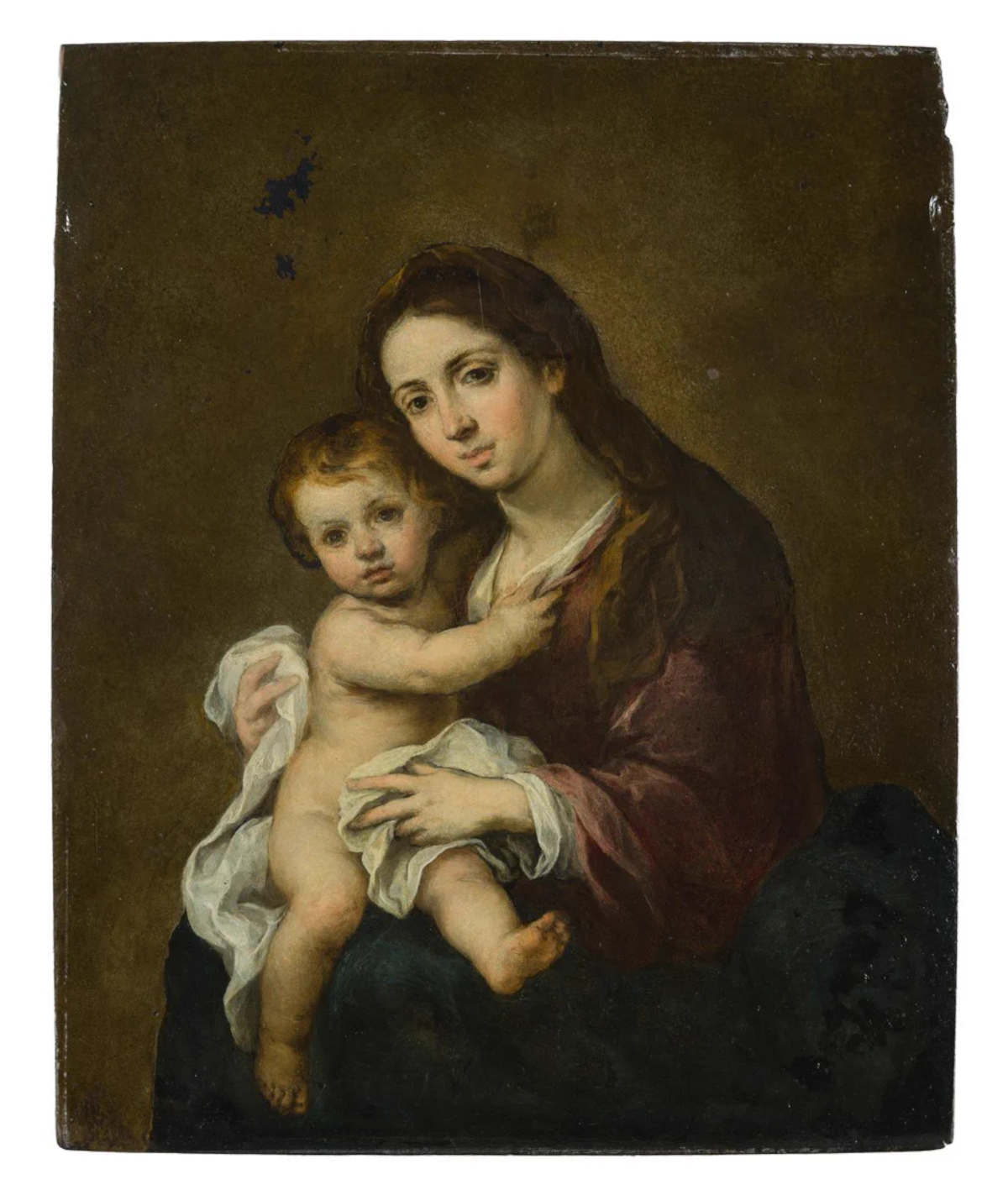
The identification is attributed to scholar Pablo Hereza, who, on the very day of the auction, published a post on X stating that, in his opinion, the work is indeed by Murillo. According to Hereza, as reported by ARS Magazine, the painting sold by Im Kinsky corresponds to the work recorded in the collection of Robert Walpole (1676–1745), 1st Earl of Orford, which was inventoried in 1752. The painting had been given to Walpole by Benjamin Keene, the British ambassador to Spain. The dimensions listed in the inventories—30.4 by 24.3 centimeters—match almost exactly those of the work sold at auction.

The rest of the story takes us to Russia: around 1779, the Walpole collection was purchased by Empress Catherine II for the Hermitage in St. Petersburg, and with it, the small Madonna on Stone. About fifty years later, the painting was moved to the Gatchina Palace and, after World War II, to the Pavlovsk Palace, both located near St. Petersburg. At some point, all traces of it were lost, and it was believed to have been destroyed during the war. Its discovery in Vienna, however, suggests—according to ARS Magazine’s reconstruction—that it was stolen or sold during the Soviet era.
The work was not unknown to scholars. It was cited by Charles B. Curtis in 1883, by Diego Angulo in 1981, by Lyudmila Kagané in 1995, and by William B. Jordan in 2002. No one, however, had seen it again: for decades, it existed only in the pages of scholarly literature.
Today, the painting appears in a condition that makes it difficult to interpret, with repainting evident even to the naked eye: this could explain the auction catalog’s caution and the low estimate. A restoration should remove the later additions and reveal the original panel on which Murillo painted. It is almost certain that the painting will be restored, and after restoration it will presumably be presented to the public, likely at an art fair next year. If Hereza’s identification is accepted by scholars, the Sevillian painter’s catalog will regain a work that was believed to be lost—and, moreover, a rare one at that.
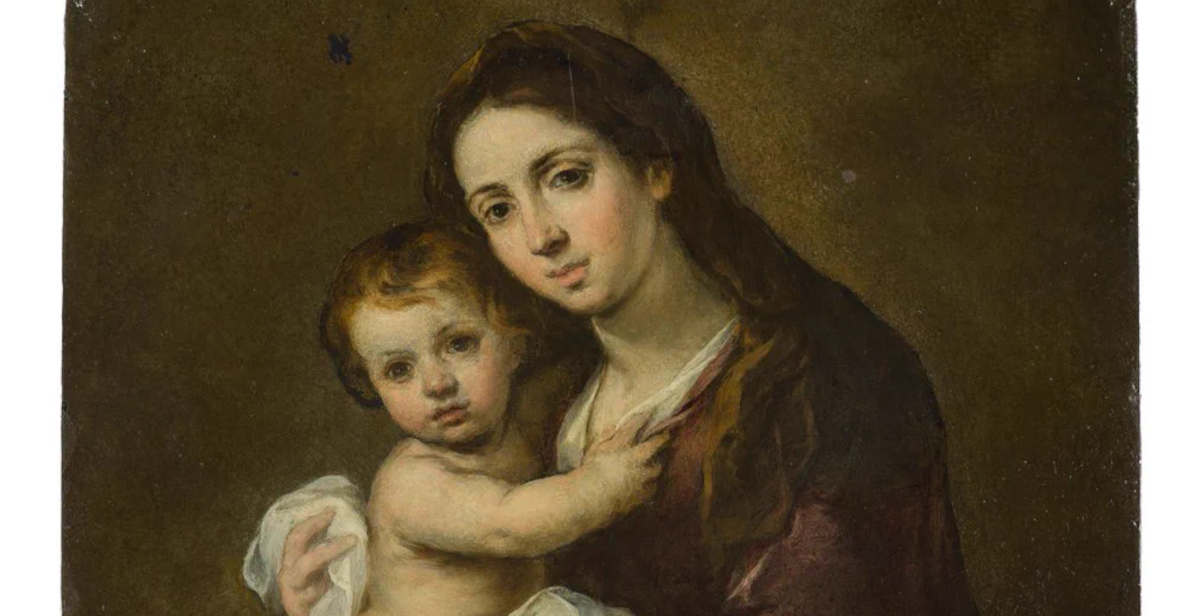 |
| It went up for auction at 5,000 euros and sold for 286,000: Has Catherine II’s Murillo resurfaced in Vienna? |
Warning: the translation into English of the original Italian article was created using automatic tools. We undertake to review all articles, but we do not guarantee the total absence of inaccuracies in the translation due to the program. You can find the original by clicking on the ITA button. If you find any mistake,please contact us.