





In Arezzo, the story of St. Francis and his cultural, artistic, and spiritual legacy is enriched by a new chapter. As part of the celebrations marking the 800th anniversary of the saint’s death, the Tuscany Regional Directorate of National Museums of the Ministry of Culture is presenting two closely related initiatives that offer visitors the opportunity to rediscover the figure of Francis through relics, works of art, and testimonies of the Franciscan tradition.
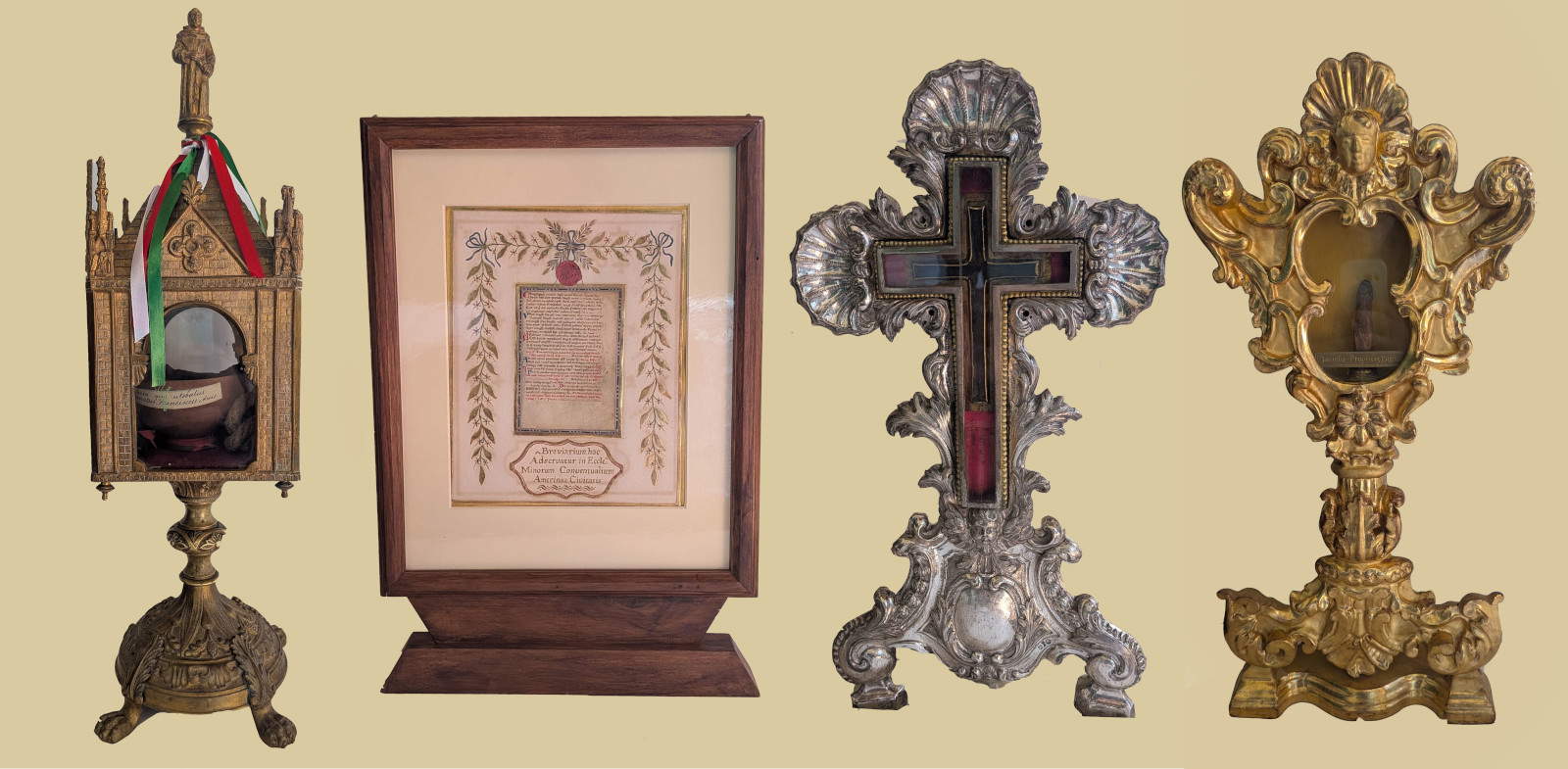
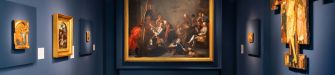
The first event is scheduled for Monday, October 12, 2026, at 11:00 a.m., when the Basilica of St. Francis will present to the public for the first time a collection of seven reliquaries that have been preserved until now in the adjoining convent. The objects will be permanently displayed in the Chapel of St. Anthony and the Chapel of St. Benedict. On Wednesday, October 14, at 5:30 p.m., the program will continue at the National Museum of Medieval and Modern Art in Arezzo with the opening of the exhibition-dossier *St. Francis: A Guest at the Museum from the National Art Gallery of Siena, open from October 15, 2026, to January 10, 2027. The exhibition will center on two precious panel paintings by Margarito d’Arezzo, among the oldest known depictions of the saint, although they were created after his death.
The new exhibition at the Basilica is the result of a collaboration with the Friars Minor Conventual of Arezzo and the support of the Misericordia of Arezzo. The goal is to establish a direct connection between the relics and the history and great masterpieces housed in the church, beginning with Piero della Francesca’s frescoes depicting the Legend of the True Cross. The seven reliquaries have more than just religious and devotional value: they are also important testimonies to the history of the applied arts, because the reliquary, in addition to housing a relic, has traditionally been designed to make its preciousness visible and perceptible. The exhibition thus allows visitors to trace the evolution of aesthetic taste through a wide variety of forms: from the dramatic and exuberant Rococo designs, created to capture the eye, to the more austere Neo-Gothic reliquaries of the late 19th century, inspired by medieval architecture.
The Chapel of St. Anthony houses two particularly significant artifacts directly linked to the memory of St. Francis of Assisi. The first is a brass reliquary from 1901, shaped like a small Gothic temple. Inside are preserved a bowl that, according to tradition, was used by the saint for his daily meals; a portion of his “cingolo”—the cord with which he tied his habit; and a vial containing his blood, associated with the stigmata he received at La Verna in 1224. Next to the reliquary is a simple, recently crafted wooden frame displaying both sides of a page of illuminated parchment, dating to the early decades of the 13th century. Its very small size attests to the pocket-sized nature of the manuscript, intended for prayer while traveling and traditionally associated with St. Francis’s personal use. The text is dedicated to several episodes from the life of Pope Sylvester (285–335), traditionally regarded as the key figure in the conversion and baptism of Emperor Constantine (274–337). This reference creates a special connection with Piero della Francesca’s cycle of the Legend of the True Cross, in which Constantine and his mother Helena—who is credited with discovering the Cross in Jerusalem—play a central role.
In the Chapel of St. Benedict, on the other hand, there are five other artifacts related to Franciscan history and hagiography. The first is a small brass reliquary in the shape of a temple, crafted in the Neo-Gothic style in the late 19th century. Decorated with small statues of the Virgin Mary, Saint Peter, and Saint Paul, it contains a vial with fragments of the skin and hair of Saint Anthony of Padua (1195–1231), a contemporary of Francis. In 1220, Anthony left the Augustinian Order to join the Friars Minor. One of the basilica’s chapels is dedicated to St. Anthony and is decorated with frescoes by Lorentino d’Andrea (c. 1430–1506), a collaborator of Piero della Francesca.
The second reliquary holds a portion of the cingolo of Saint Joseph of Cupertino (1603–1663), the traditional Franciscan cord made of white wool and characterized by three knots. The friar appears in the large painting by an unknown artist, *Saint Joseph of Copertino Adores the Cross*, preserved in the sacristy of the convent attached to the Basilica and dating to the second half of the 18th century. The relic is housed in an elegant embossed and silver-plated brass monstrance, embellished with a rich Rococo sunburst that attests to its 18th-century origin.
The third is the only bodily relic: it is a finger, identified by the inscription *Digitus Danielis Prophetae* as belonging to the prophet Daniel. It is housed in a 19th-century reliquary made of wood gilded with gold leaf and richly decorated. According to tradition, the relic—which is said to date back to the 6th century B.C.—was discovered in Persia by Blessed Benedetto Sinigardi (1190–1282), one of the first Franciscans, who spent a long time in the Middle East. A native of Arezzo, Sinigardi joined the order after hearing a sermon by St. Francis in his hometown. His remains are preserved in the Basilica, inside a sarcophagus located along the right wall of the nave.
Finally, the tour is completed by two stauroteci, reliquaries designed to hold fragments of the Cross. Although not strictly part of the Franciscan tradition, their contents evoke one of the central tenets of Francis’s spirituality: the Passion of Christ and his relationship with sacrifice, which culminated in the stigmata he received at La Verna in 1224 and helped define him as the “Alter Christus.”
The exhibition was curated by Stampa in Stampa based on a design by architects Rossella Sileno and Raffaele Fuschino of the Regional Directorate of National Museums of Tuscany.
The idea has its roots in 2014, when the director of the Basilica was the art historian Paola Refice, who recently passed away. The project builds on the initial concept by architect Andrea Gori of the Regional Directorate of National Museums of Tuscany, developing it through a deliberate color choice: a dark, intense, and vibrant red, intended as a reference to blood and sacrifice.
The second event in the program, on the other hand, is dedicated to the artistic representation of the saint. From October 15, 2026, to January 10, 2027, the National Museum of Medieval and Modern Art in Arezzo will host the exhibition-dossier *St. Francis: A Guest at the Museum* from the National Art Gallery of Siena. The exhibition compares two precious panel paintings by Margarito d’Arezzo, considered among the oldest known painted images of St. Francis. Although they are posthumous works, they offer one of the most archaic depictions of the saint and preserve his spiritual power intact.
Francis, patron saint of Italy since 1939, has become over the centuries a universal symbol of peace, brotherhood, and love for creation. The exhibition allows visitors to observe how his image was constructed and transmitted as early as the decades immediately following his canonization. This initiative is linked both chronologically and thematically to the exhibition *The Image of Francis: From the Middle Ages to the Twentieth Century*, scheduled to take place in Arezzo at the Municipal Gallery of Modern and Contemporary Art and the Church of Sant’Ignazio from October 4, 2026, to January 10, 2027. The project is organized in collaboration with the National Art Gallery of Siena and the Guido d’Arezzo Foundation, with the support of the City of Arezzo and the CR Florence Foundation.
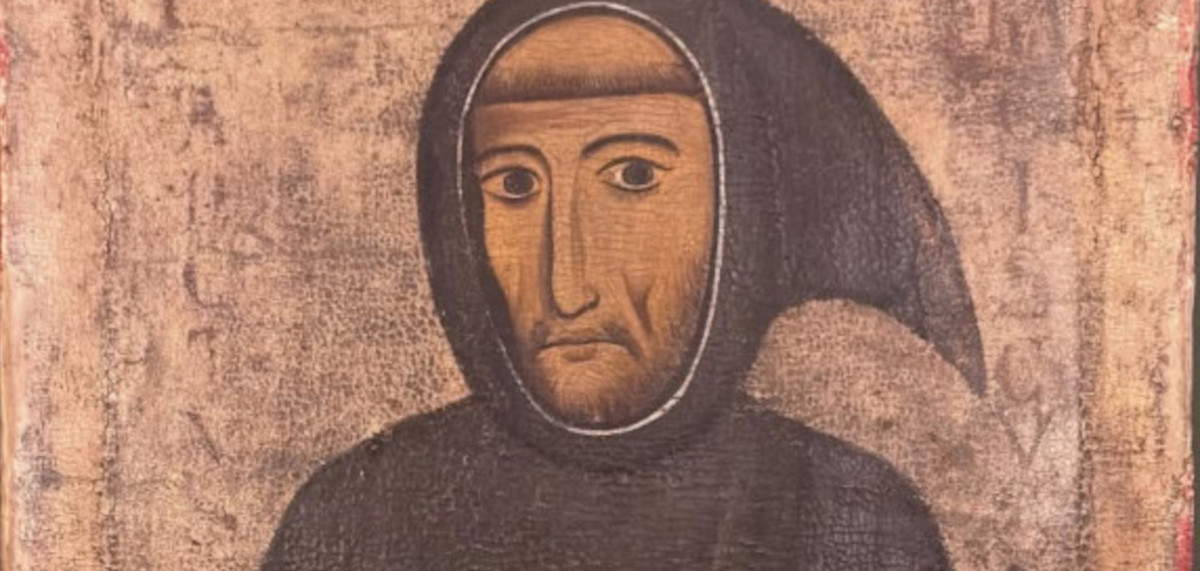
The National Museum of Medieval and Modern Art has contributed to the city’s exhibition by lending the *San Francesco* by Margarito d’Arezzo, which comes from the church attached to the Convent of Sargiano in Arezzo; this work was also chosen as the official image for the initiative’s promotional materials. This exhibition-catalog now allows visitors to compare this panel with the “Saint Francis” from the church of the Ganghereto Convent, near Terranuova Bracciolini—currently in storage with the Diocese of Arezzo-Cortona-Sansepolcro—and with the painting housed in the National Art Gallery of Siena. The three works share numerous common elements from both an iconographic and a technical perspective.
Margarito d’Arezzo is considered the oldest known painter from Arezzo by name and one of the first Italian artists whose works have survived with signatures. Above all, however, he is the most prolific and recognizable artist among those who depicted St. Francis in the 13th century, just a few years after his canonization in 1228. Seven panels depicting St. Francis are known today. Six bear the inscription “MARGARITUS DE ARETIO ME FECIT” at the figure’s feet and are regarded by critics as works autographically executed by Margarito, though sometimes with the assistance of his workshop. The panels, ranging in height from 129.5 to 95 centimeters, follow a very similar iconographic scheme: Francis is depicted standing full-length, clad in a habit and with his head hooded. One leg is slightly bent, while in his left hand he holds the Gospel. His right hand shows the palm bearing the stigmata of La Verna or, in some cases, a processional cross.
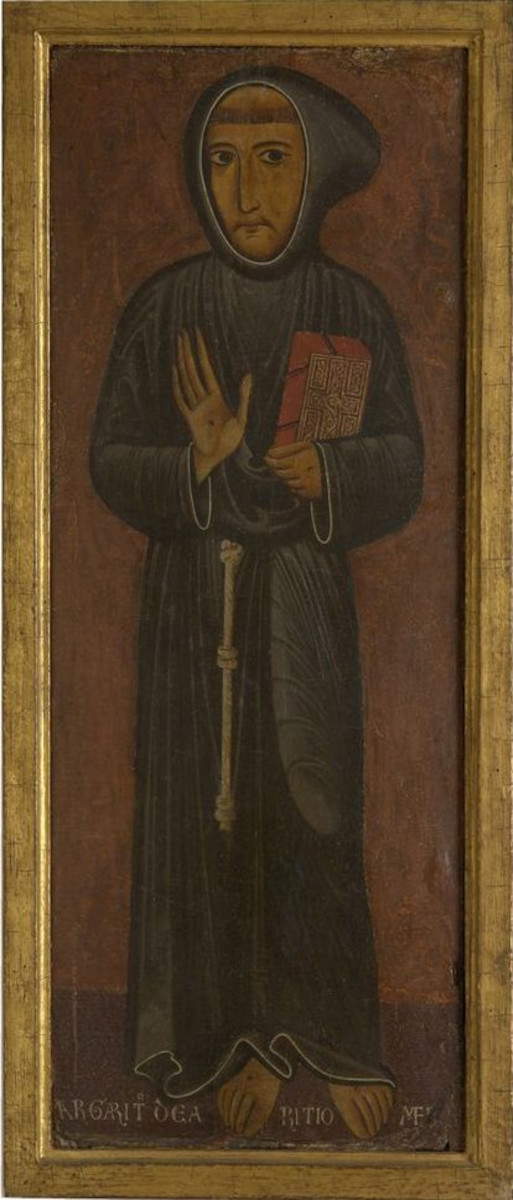
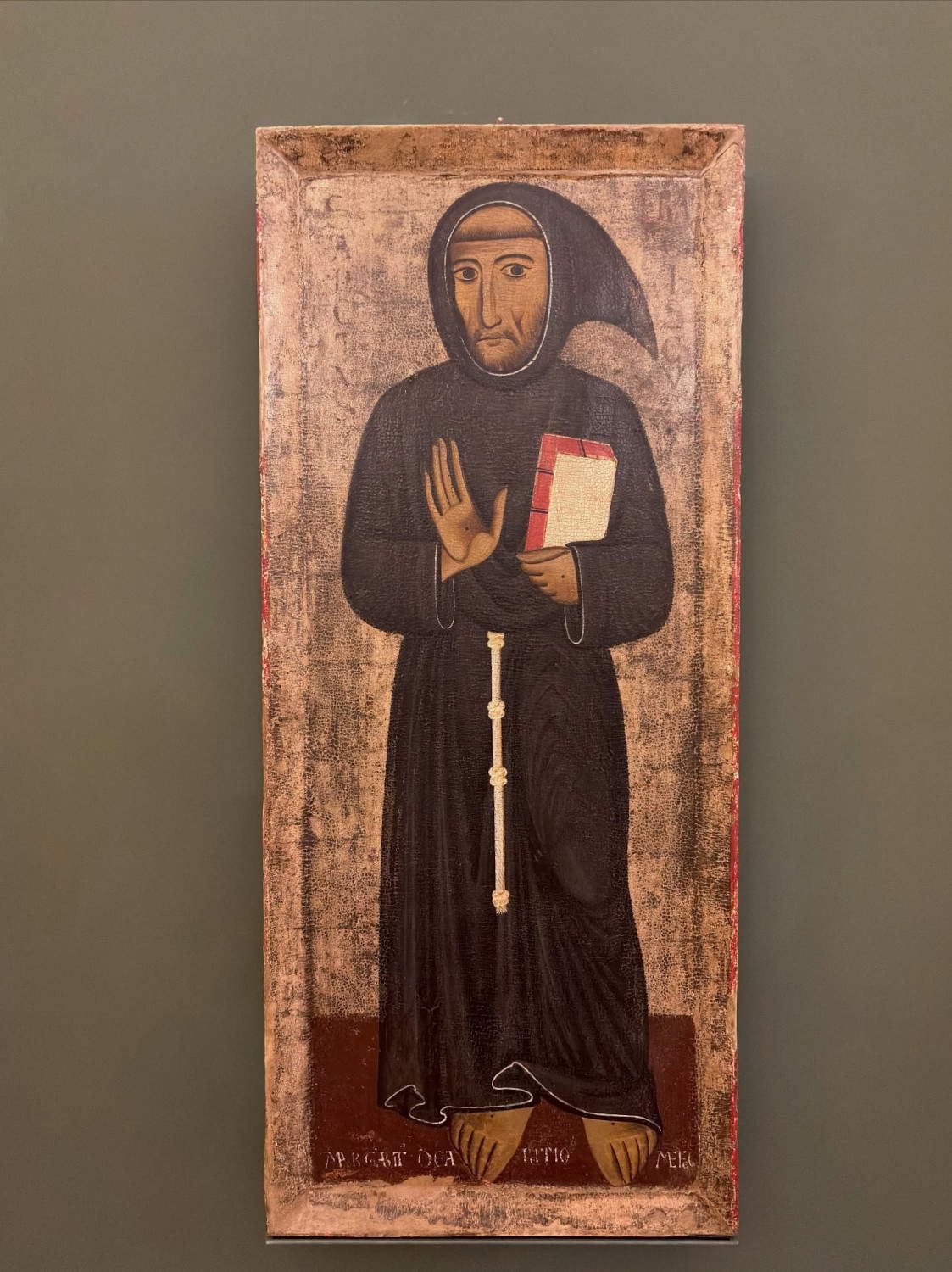
Among the seven panels, the one from the church attached to the Convent of St. Francis in Ganghereto, near Terranuova Bracciolini, is today considered the oldest. It is dated to between the fourth and fifth decades of the 13th century.
The convent of Ganghereto is one of the first settlements founded by the Franciscan Order and, according to tradition, was built on the site where Giovanni di Pietro di Bernardone—the future Francis of Assisi—is said to have caused a miraculous spring to gush forth while traveling the road from Arezzo to Florence. In the painting, Francis is depicted full-length, without a halo, with his right hand bearing the stigmata and the closed Gospel in his left hand. Of particular interest is the cord tied around his waist: it has four knots, rather than the three traditionally associated with the Franciscan tradition, a detail that may be linked to a specific request by the patron. At the bottom edge appears the inscription “MARGARITUS DE ARETIO ME FECIT,” considered the artist’s signature, while on either side of his head the words “SANCTUS FRANCISCUS” are written vertically. The popularity of this image attests to the spread of Franciscan devotion in the Arezzo area. The mendicant orders, in fact, played an important role in the development of local artistic culture: by the end of the 13th century, there were eleven Franciscan monasteries in Arezzo and its surroundings.
Probably a contemporary work, the Saint Francis in the National Art Gallery of Siena shares numerous similarities with Ganghereto’s panel. Both paintings are distinguished by the simplicity of their composition and a subdued color palette, elements that evoke the ideal of poverty associated with the founder of the Franciscan Order. The *Formula vitae*, or the first Franciscan rule, was approved by Pope Innocent III around 1209. Francis is depicted wearing a habit made of coarse fabric and the traditional cord with three knots, generally interpreted as a reference to the vows of poverty, chastity, and obedience—the evangelical counsels mentioned in the Rule. The two works also share numerous similarities on a technical and iconographic level. The figures assume similar poses and have a comparable relationship with the surrounding space; furthermore, the positioning of their feet and the gestures of their hands coincide. Even their faces exhibit nearly identical characteristics, with the same oval shape, tonsure, and gaunt, austere features.
The exhibition-dossier also serves as an appendix to the Margarito Research Project, an international and multidisciplinary initiative launched in 2022 to further the study of the painting and techniques used by Margarito d’Arezzo. The project involved the National Museum of Medieval and Modern Art in Arezzo, the National Gallery in London, the National Gallery of Art in Washington, the University of Applied Sciences and Arts of Italian-speaking Switzerland (SUPSI), the National Research Council (CNR), and other research institutions. Finally, the exhibition will be accompanied by a public program of talks and in-depth discussions, designed to further explore the themes addressed by the research and convey to the public the historical, artistic, and documentary value of the works brought together in Arezzo.
 |
| St. Francis in Arezzo: Seven Reliquaries and Margarito’s Ancient Portraits Tell the Story of the Saint |

Warning: the translation into English of the original Italian article was created using automatic tools. We undertake to review all articles, but we do not guarantee the total absence of inaccuracies in the translation due to the program. You can find the original by clicking on the ITA button. If you find any mistake,please contact us.
























 IT
IT FR
FR DE
DE ES
ES CN
CN


