




Joint acquisition by two Dutch museums: the Mauritshuis in The Hague and the Rijksmuseum in Amsterdam have jointly acquired a masterpiece by Hendrick Avercamp (Amsterdam, 1585 – Kampen, 1634), *Players of Kolf on Ice*, a painting dating from around 1625. The acquisition marks the return to the Netherlands of one of the most important winter landscapes in the entire history of Dutch painting. The 17th-century masterpiece will be shown for the first time in Kampen, the city where Avercamp worked for many years, where it will be on display starting October 3 as part of the exhibition “Avercamp Back in Kampen: the 17th Century through the Eyes of Hendrick & Barent”; after which the work will alternate between the Rijksmuseum and the Mauritshuis. This addition to the Dutch national art collections has been described as “exceptional” in a statement released by the two museums.
This painting is considered one of the high points of Avercamp’s entire body of work. Unlike his earlier winter landscapes, which are crowded with human figures, in this painting the artist focuses his attention on a small group in the foreground. The low vantage point makes the viewer feel as though they, too, are present on the ice, an integral part of the scene. At the center of the composition are two men playing kolf (or colf), one of the oldest ball games played in the Netherlands and a precursor to golf (the objective of the game, which took place on a marked-out field, was to hit a ball with a club and send it as far as possible), while fishermen, passersby, and other spectators watch the game. The painting, therefore, is not only a splendid winter scene but also the oldest known depiction of the game of kolf.
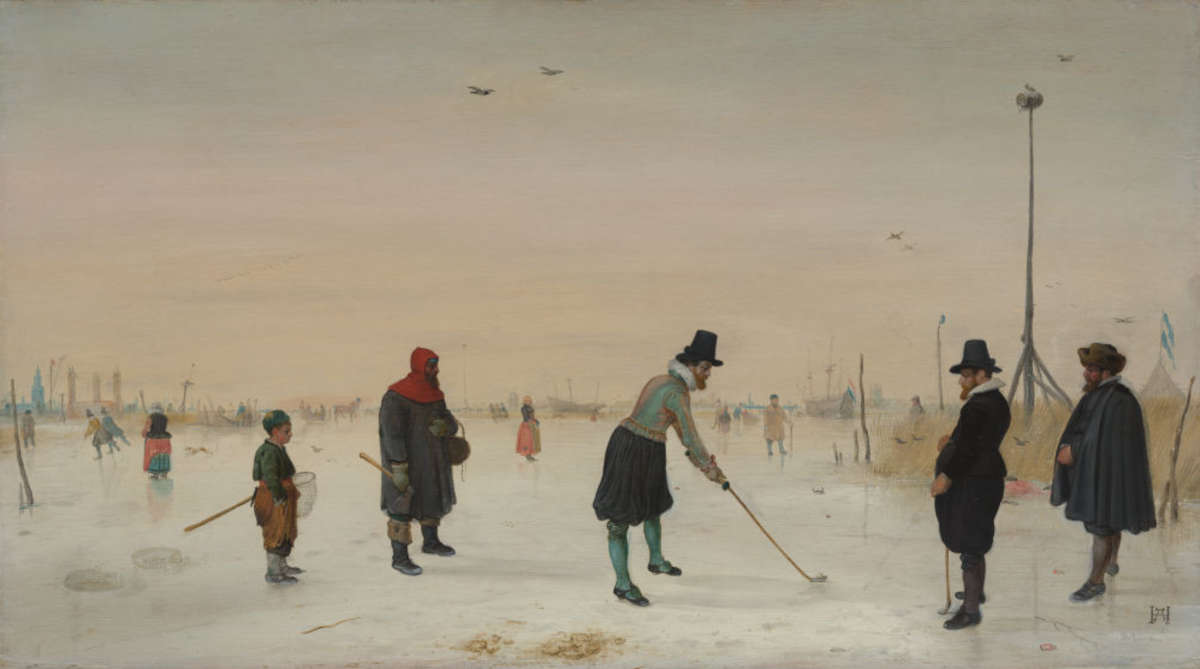
The work also provides a vivid glimpse into daily life during the so-called “Little Ice Age, ” a period spanning roughly from 1575 to 1625 and characterized by particularly harsh winters. Avercamp depicts both the enjoyment of skaters, hikers, and people riding sleds, as well as the harshness of the winter season. The clothing worn by the figures in the painting also offers a varied glimpse into the fashion of the early decades of the 17th century. The details and liveliness of the depicted characters make this painting one of the most intimate and innovative compositions in Avercamp’s entire body of work.
The numerous surviving preparatory studies for this painting also tell a similar story: some of Avercamp’s drawings preserved in Dresden show just how carefully the artist developed the composition, making changes during the creative process to make the image more expressive. Experts at the Mauritshuis and the Rijksmuseum expect that material analysis will provide further insight into the artist’s creative process.
Hendrick Avercamp was born in Amsterdam and worked in Kampen for many years. He is considered the father of ice scenes in Dutch painting, having been the first artist to specialize almost exclusively in winter landscapes depicting people from all walks of life gathered on the ice. His paintings, among the most famous images of Dutch winter culture, continue to captivate the collective imagination more than four centuries after they were created.
“Ice and winter fun,” comments Taco Dibbits, director general of the Rijksmuseum, “have been inextricably linked here in the Netherlands for centuries. Few things bring the entire population together quite like these two. As soon as canals, rivers, and lakes freeze over, we pour out onto the ice in droves: young and old, rich and poor. This painting by Avercamp is among the most beautiful winter landscapes.”
“The image evokes the Netherlands’ great love for frosty winter days,” adds Martine Gosselink, director of the Mauritshuis. “It also invites us to reflect on mobility, sports, national identity, and, of course, climate change. Harsh winters are becoming increasingly rare, so Avercamp’s masterpiece takes on even greater significance today. This is the first time the Mauritshuis and the Rijksmuseum have acquired a work of art together. We are proud that it is such a typically Dutch scene.”
The acquisition is of particular importance to the Netherlands. Although several paintings by Avercamp are already held in Dutch public collections, they are almost always early works. *Kolf Players on Ice*, on the other hand, demonstrates the innovative character of his stylistic maturity, making it an essential addition to the Dutch national collection.
Following the acquisition, the painting will be exhibited for the first time at the Stedelijk Museum in Kampen, the city where Avercamp worked for most of his career. The work will be on view to the public starting October 3, as part of Avercamp Year 2026 and the major exhibition *Avercamp Back in Kampen: the 17th Century through the Eyes of Hendrick and Barent*. The painting will subsequently be exhibited alternately at the Mauritshuis in The Hague and the Rijksmuseum in Amsterdam, so that visitors to both museums can admire this extraordinary masterpiece.
The joint acquisition underscores the close collaboration between the Mauritshuis and the Rijksmuseum in the field of 17th-century Dutch painting. For many years, the two institutions have collaborated in the areas of research, conservation, exhibitions, and loans, and the joint acquisition of the Avercamp painting is a further manifestation of the vision of a Dutch national art collection managed, studied, and shared for the benefit of the widest possible audience. The work was acquired jointly by the two museums with support from the Mondrian Fund, the VriendenLoterij, the Friends of the Mauritshuis Foundation, and the Rembrandt Association, the latter through its Van Rijn Fund, the 17th-Century Painting Fund, a special donation from the Debman Foundation, and the annual contribution from the Culture Fund.
|
| The Netherlands: The Mauritshuis and the Rijksmuseum Jointly Acquire a Masterpiece by Avercamp |

Warning: the translation into English of the original Italian article was created using automatic tools. We undertake to review all articles, but we do not guarantee the total absence of inaccuracies in the translation due to the program. You can find the original by clicking on the ITA button. If you find any mistake,please contact us.
















 IT
IT FR
FR DE
DE ES
ES CN
CN


