



by Redazione 08/11/2026


Categories: Ancient art / Disclaimer
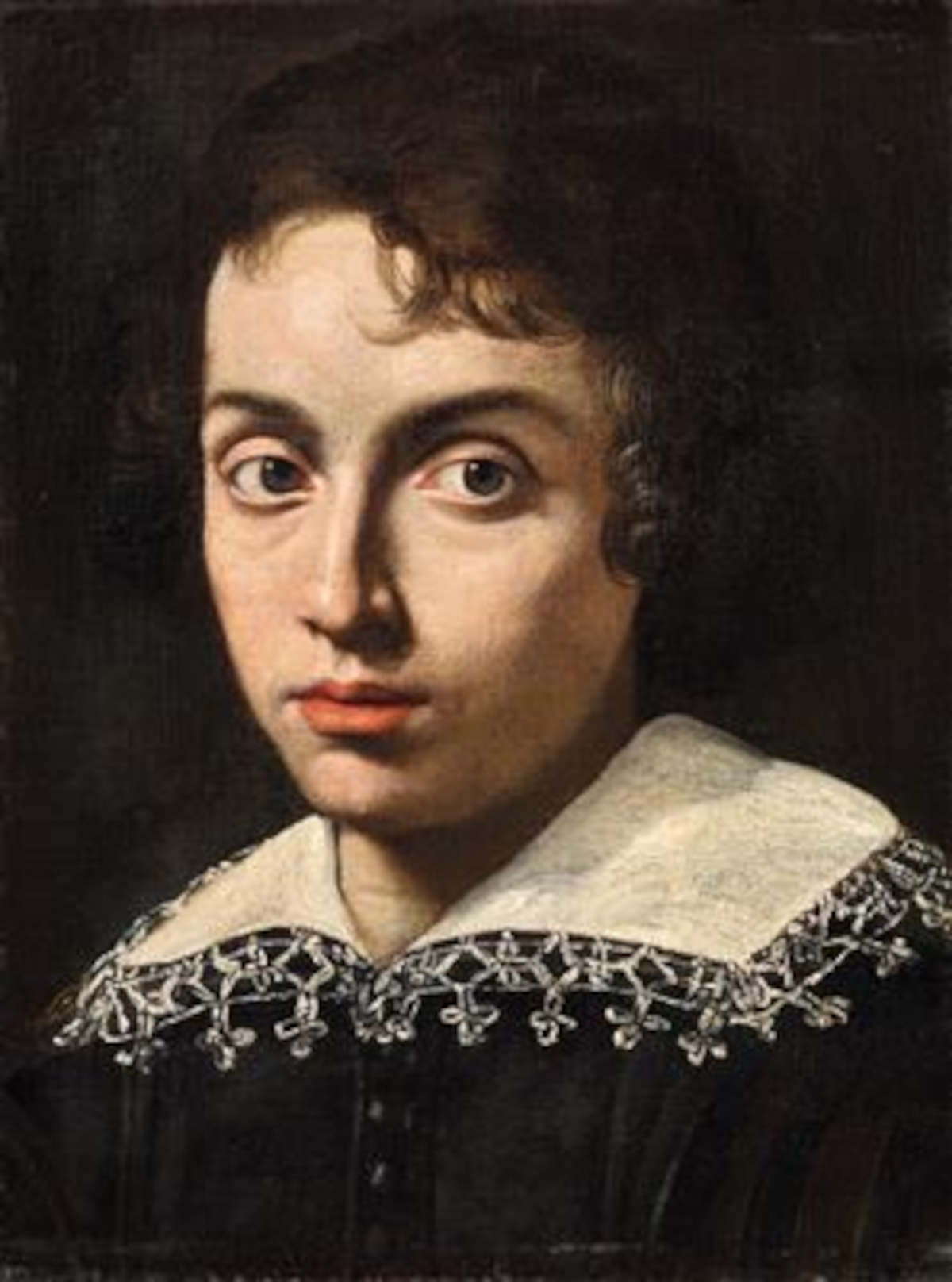
Two new attributions to Caravaggio in just 24 hours—a record: Maria Cristina Terzaghi identifies a painting rediscovered in Paris as the lost original of *The Young Man with a Vase of Roses*, known until now only from copies. Yesterday, meanwhile, Gianni Papi attributed to Merisi a portrait that had been sold years ago at Dorotheum as a 16th-century Tuscan school work.

Two new works attributed to Caravaggio in just twenty-four hours: a record, and it happened between yesterday and this morning. Yesterday, November 7, in Montepulciano, art historian Gianni Papi attributed to Michelangelo Merisi a portrait of a young man that had been auctioned several years ago at Dorotheum as a work of the 16th-century Tuscan school. The following day, November 8, Maria Cristina Terzaghi announced in *La Repubblica* that she had identified a painting housed in France as the original *Young Man with a Carafe of Roses*, a work that until now was known only through copies and had been sought for more than a century—although, as will be seen later, news of its discovery had already been previewed in January 2025 by the Spanish magazine *Ars Magazine*.


The two claims, however, are backed by very different levels of documentation. Papi presented his proposal at the conference *Identity Portrayed at the Dawn of the Seventeenth Century*, held yesterday at the Pinacoteca Civica in Montepulciano, although the organizers cut off the live stream right at the start of his presentation, and the details of his arguments will be made public only with the publication of the conference proceedings. Until then, the proposal remains an announced hypothesis.


Terzaghi, on the other hand, revealed some details in her article in *La Repubblica* , although the discovery had already been previewed in the catalog for the *Caravaggio 2025* exhibition, where the scholar, in discussing the similarities between *The Boy Bitten by a Green Lizard* and *The Young Man with the Carafe of Roses* (the latter being a work of which no authentic original has ever been identified, though several copies are known), wrote: “I am aware of a fifth version of the highest quality, which I have identified as an autograph, housed in France in a private collection (oil on canvas, 66 x 52.5 cm). It is possible to trace the provenance of the canvas back to the seizure of Cavalier d’Arpino’s collection in 1607, through the Borghese collection, where it remained until at least 1831. Since 1909, it has been in Paris as part of a famous bookseller’s collection. I will provide a full account of all its movements and details about the painting in a forthcoming publication.” According to reports at the time, the essay was to be titled Caravaggio “Forever Young”: *The Young Man with a Carafe of Roses*, and in an early draft of that catalog—which circulated in the first days of the major exhibition at Palazzo Barberini—it was listed as scheduled for publication in 2025 (in the final version of the catalog, however, the bibliographic reference had been removed). And someone had noticed this: Giuseppe Frangi, reviewing the exhibition in *Alias*, wrote: “Incidentally, this is a season of Caravaggio that could soon be enriched by a new rediscovery, announced by Terzaghi in a note in her essay: it is *The Young Man with a Pitcher of Roses*, a work known to date in four versions. A fifth version, tracked down by the scholar in a private collection in France, could be the autograph version and will be the subject of an upcoming publication.”


Terzaghi’s painting was found by chance, as she herself recounts in the novelistic opening of her article: “I found myself standing before this magnificent *Young Man with a Carafe of Roses* on a gray winter day, in the back room of a Parisian gallery. Although covered in grime, I immediately recognized the Caravaggio painting that has inspired dreams for nearly a century.” There are four known antique copies of the composition, one of which is housed at the High Museum in Atlanta, and it was precisely these copies that fueled the suspicion for decades that the original still existed. Giovanni Baglione, a painter and rival of Caravaggio, had already described the painting more than thirty years after seeing it: “He painted a vase of flowers with the transparency of the water and the glass, and with the reflections from a bedroom window, the flowers scattered with the freshest dew.” The painting had been commissioned by Cardinal Del Monte, patron of the young Merisi.
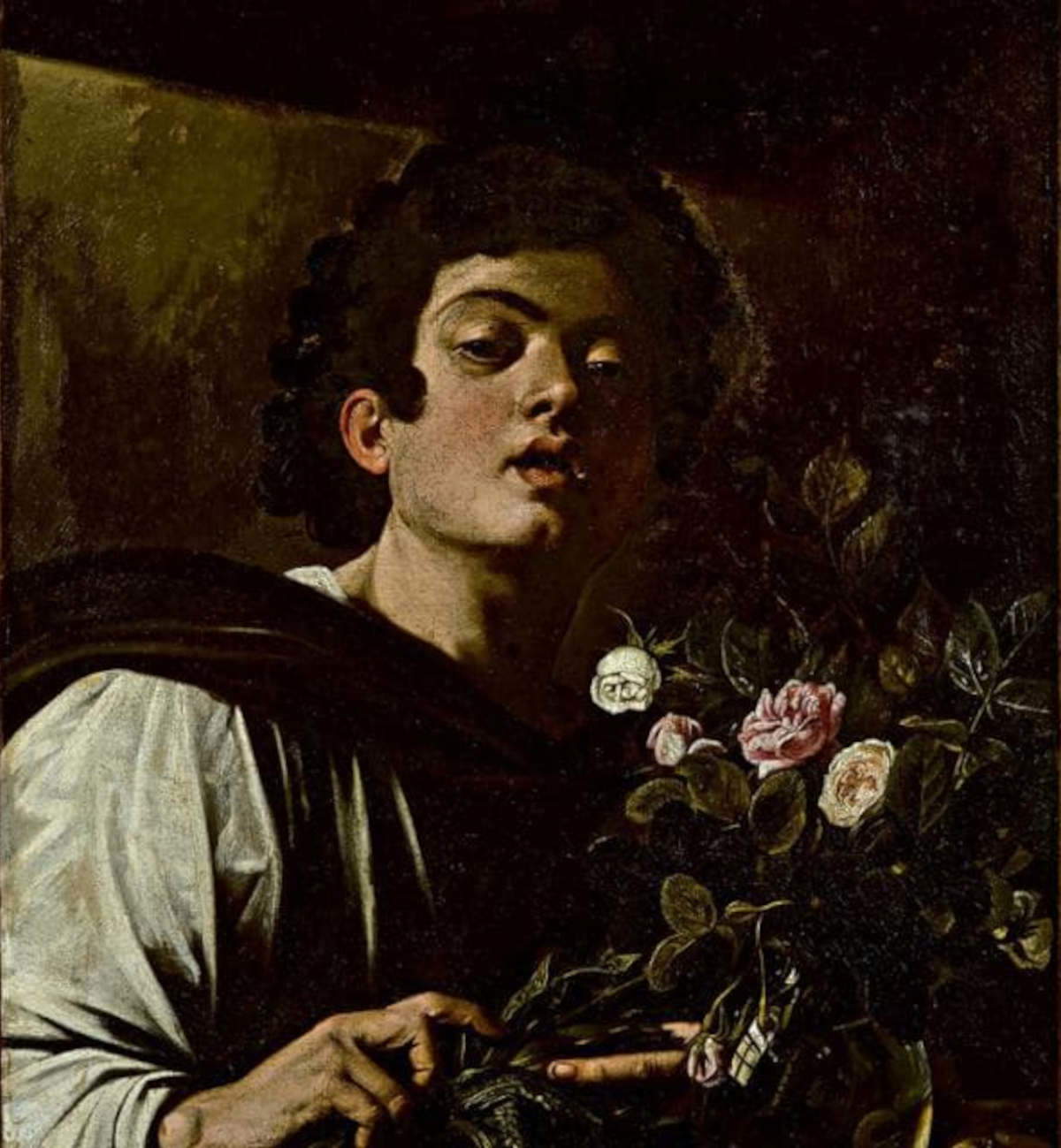
According to the scholar, the quality of the painting she discovered is “exceptionally high, evident not only in its compositional ingenuity: a magical harmony of youth (the boy in his shirt and the budding roses), but also in the boy’s extraordinary face, his moist eyes, the iridescent whites of his shirt, and the marvelous still life—leaving no doubt as to the painting’s authenticity. It immediately takes its place among the masterpieces of a twenty-year-old Caravaggio who had recently arrived in Rome from Milan, relegating all other versions to the status of copies.”
Terzaghi has been working on this painting for three years. According to his reconstruction, the painting had been in Paris since at least the early 20th century and belonged to a bookseller. In 1909, the bookseller’s widow put it up for auction as the work of an anonymous Italian painter, and on that occasion it was purchased by the ancestors of the current owners. The composition, however, was already known and appreciated in Caravaggio’s time. On August 1, 1607, it appeared in the list of paintings by Giuseppe Cesari, known as Cavalier d’Arpino, a painter and businessman in whose workshop Merisi had worked for eight months around 1596. Arpino had been put on trial on charges of brutally disfiguring a colleague, Cristoforo Roncalli, known as “il Pomarancio,” and to escape papal justice, he secured his freedom in exchange for the confiscation of his collection, which passed to Pope Paul V (the pontiff immediately donated it to his nephew, Cardinal Scipione Borghese). In 1693, the painting is still documented at the Borghese Gallery, in the same room as *Il Fruttaiolo*, Caravaggio’s other famous painting that is still in the museum (today known as *The Young Man with a Basket of Fruit*). It remained in the possession of the Borghese princes until 1831, as attested by several 19th-century copies; after that, in that same year, it was removed from the entail—the legal restriction that would have bound it forever to the collection—and was thus able to leave the collection. Terzaghi’s reconstruction ends here: the link connecting Italy to France is missing.
The scholar, as mentioned, links the painting to another early work by Caravaggio, *The Boy Bitten by a Green Lizard*, to which it is closely related in both concept and form. In the past, when the *Young Man with a Carafe of Roses* was known only from copies, it had already been hypothesized that the two paintings belonged to an allegorical series depicting the five senses—a common theme in the workshops Caravaggio frequented upon his arrival in Rome. In this interpretation, *The Green Lizard* would represent touch, and *The Young Man with a Pitcher of Roses* would represent smell.
We know from Giulio Mancini, Caravaggio’s physician, friend, and biographer, that *The Boy Bitten by a Green Lizard* was painted “to sell”—that is, for the market and not for a specific patron—in the wake of the success his half-length portraits were achieving in Roman artistic circles. According to Terzaghi, the striking resemblance between the two works suggests that *The Young Man with a Pitcher of Roses* also had the same origin and intended market, and that it was painted shortly thereafter, between 1596 and 1597. Contemporaries considered *The Green Lizard* to be the painting that had made Caravaggio famous: at first, the painter earned little from it, but the canvas soon fetched extremely high prices.
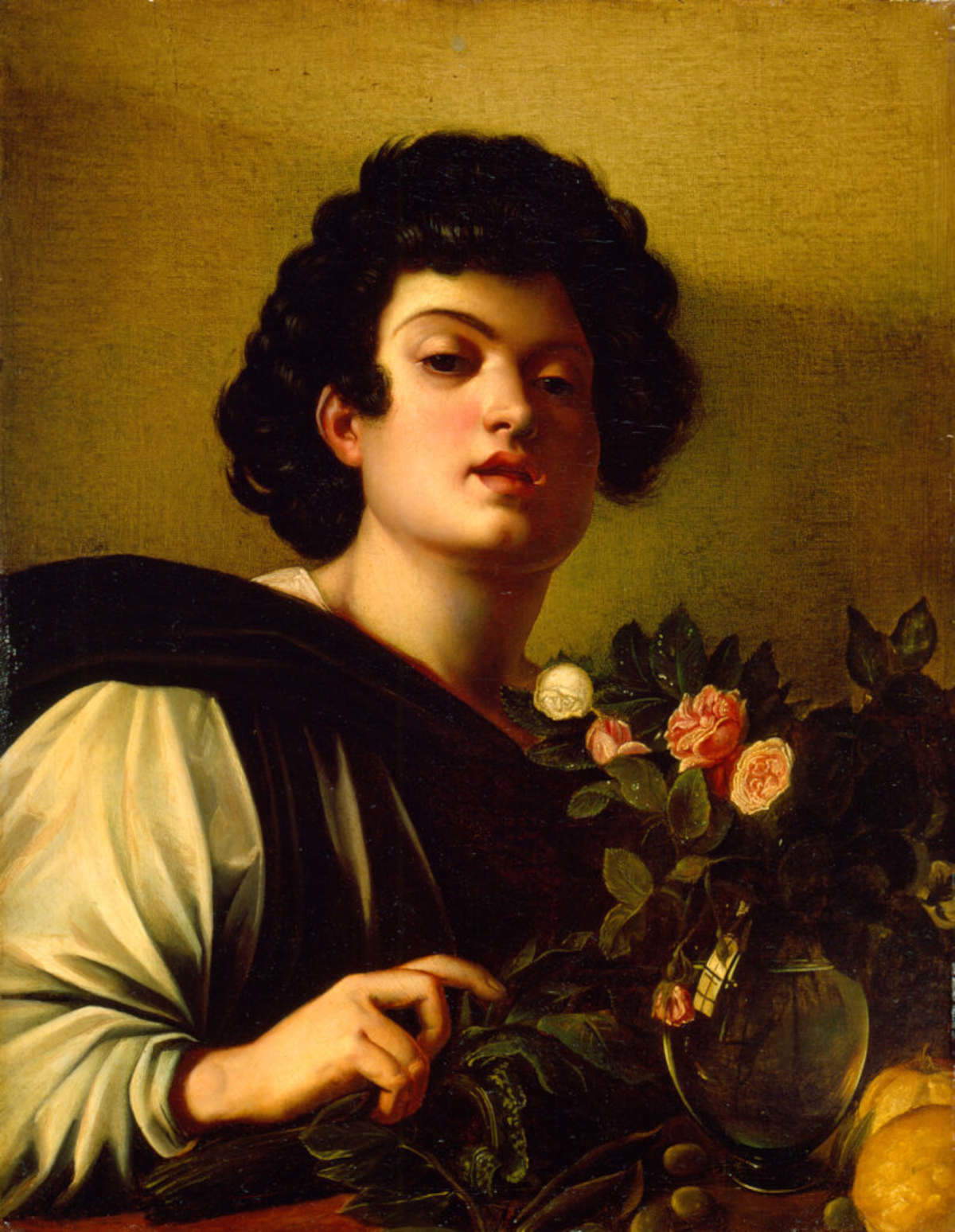
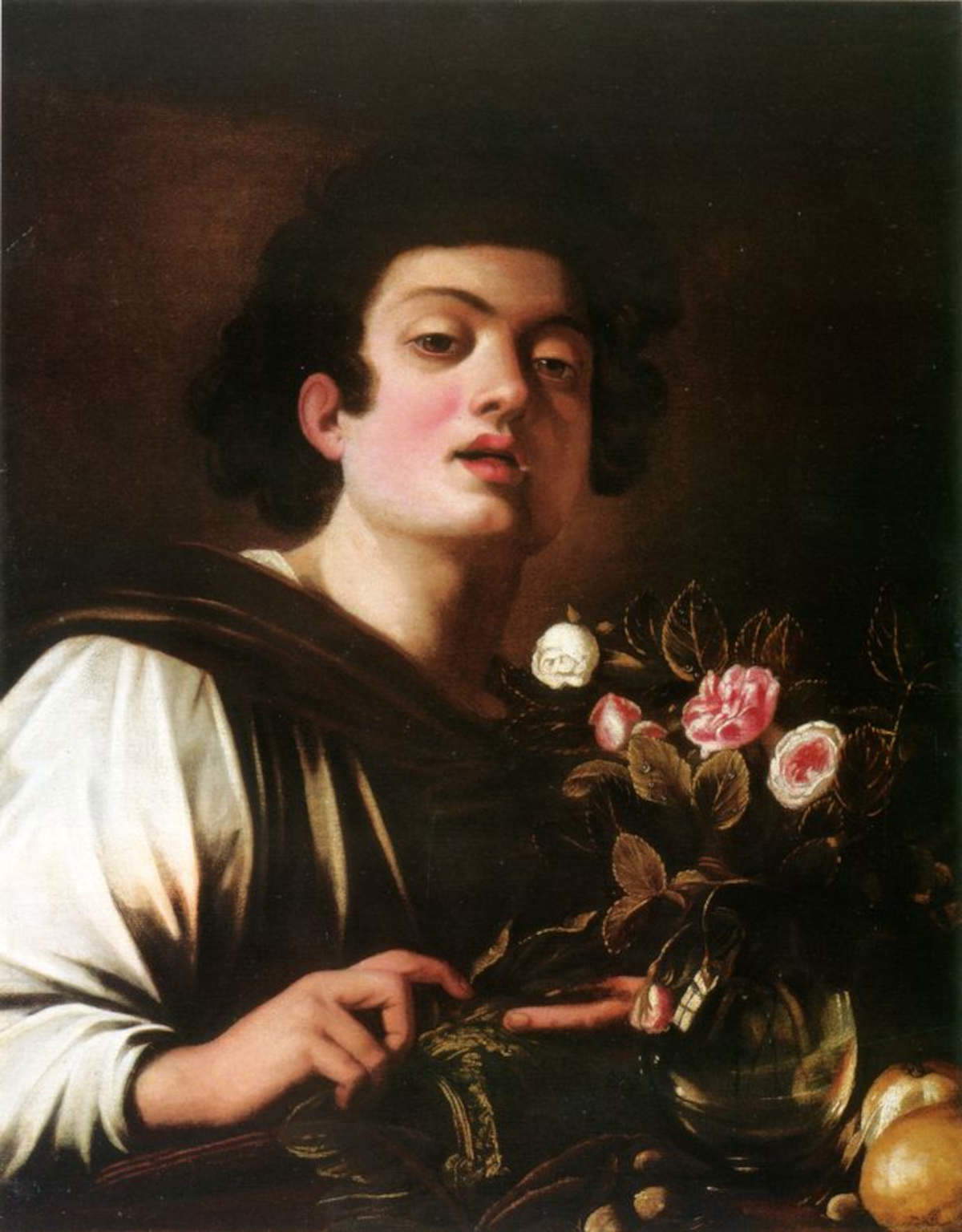
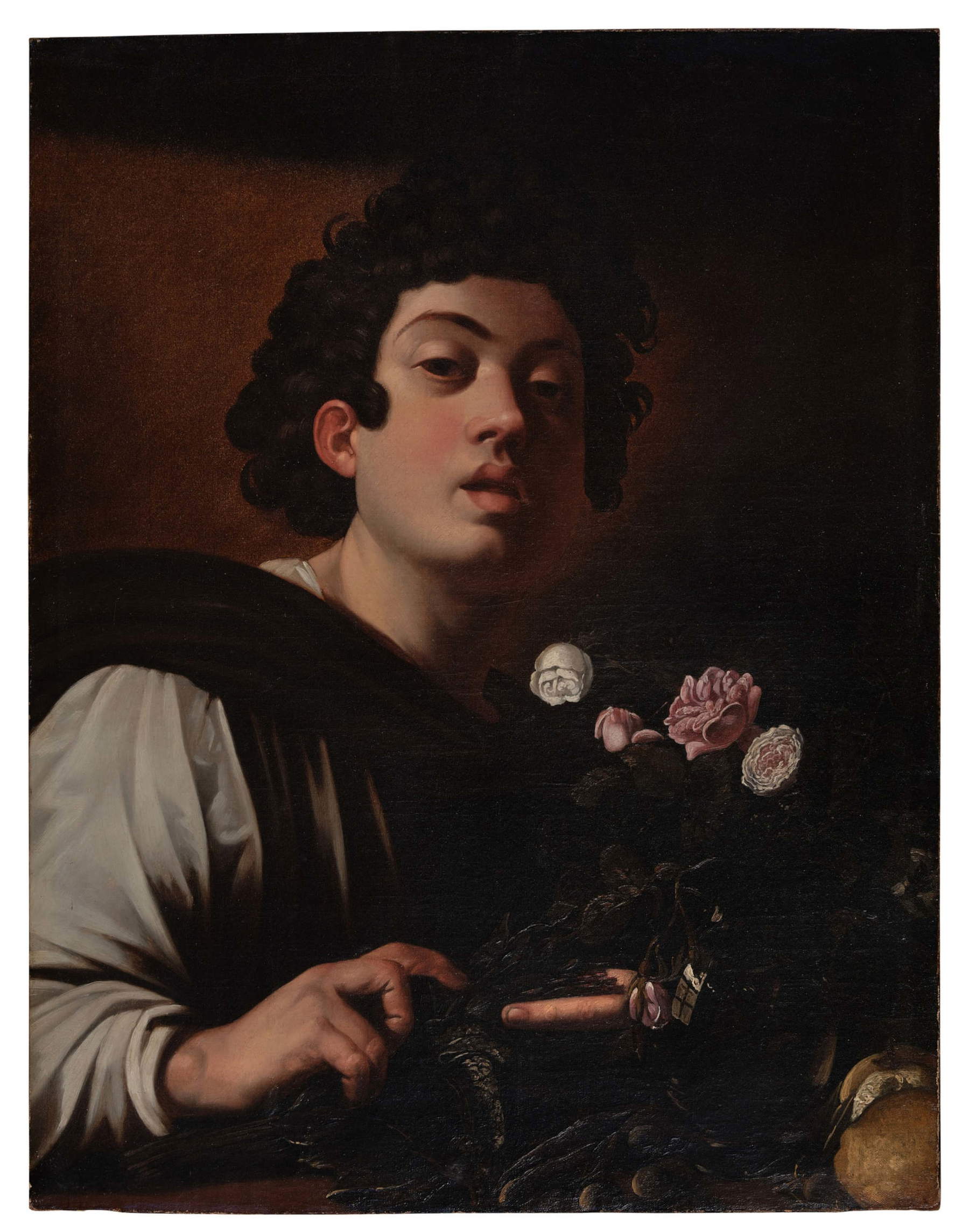
Terzaghi, however, also sees a difference between the two paintings. In *The Green Lizard*, the boy’s sudden reaction is so intense that it almost overshadows the still life, whereas *Young Man with a Vase of Roses* has a calmer tone and a face tinged with melancholy. At the center are the roses, which in Baroque poetry were the quintessential symbol of love. Among buds and wilted blossoms, they mark the passage of time, and the thorns evoke the ambivalence of a love that attracts and at the same time wounds. According to the scholar, the painting lends itself to multiple levels of interpretation and, in its sorrow over the passing of youth, already foreshadows the drama of Caravaggio’s mature period.
News of this discovery, however, had been circulating for some time. On January 30, 2025, the Spanish magazine *Ars Magazine*, in an article by Fernando Rayón, reported that about a year earlier, a prominent French family had claimed to own a Caravaggio painting measuring 67.5 by 52.5 centimeters. According to the magazine, the family had commissioned an unnamed art historian to trace the work’s provenance, which reportedly showed it had been recorded in the inventories of Napoleon Bonaparte’s collection and, before that, in the Borghese collection—which was related to the French imperial family by marriage: this would likely, therefore, be the link between France and Italy. The painting was then compared with the numerous copies of *The Young Man with a Carafe of Roses*.
The Spanish article, however, presents some differences from Terzaghi’s reconstruction. *Ars Magazine* dated the work to around 1592–1593, while the scholar places it in 1596–1597. Furthermore, the magazine mentions a period in the Napoleonic collection—of which there is no trace in the reconstruction published now—which traces the painting from the Borghese family to the 1909 Paris auction. Even then, the magazine reported that the painting was in good condition, that a minor restoration was being considered, and that leading Caravaggio experts had endorsed the attribution. Finally, it added that the Louvre would not easily let the work slip through its fingers, and concluded the article by announcing that… the bombshell was about to drop. Now that the painting has been made public, it remains to be seen what will become of it.
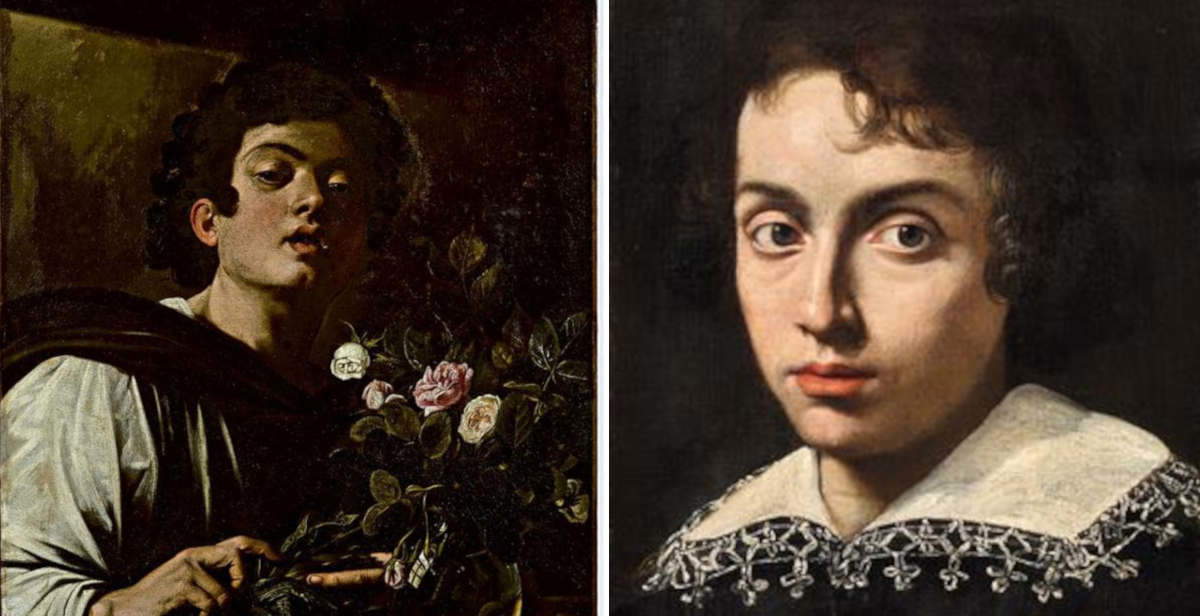 |
| Two works attributed to Caravaggio in 24 hours! Terzaghi proposes *The Young Man with a Vase of Roses*, Papi a portrait |
Warning: the translation into English of the original Italian article was created using automatic tools. We undertake to review all articles, but we do not guarantee the total absence of inaccuracies in the translation due to the program. You can find the original by clicking on the ITA button. If you find any mistake,please contact us.