





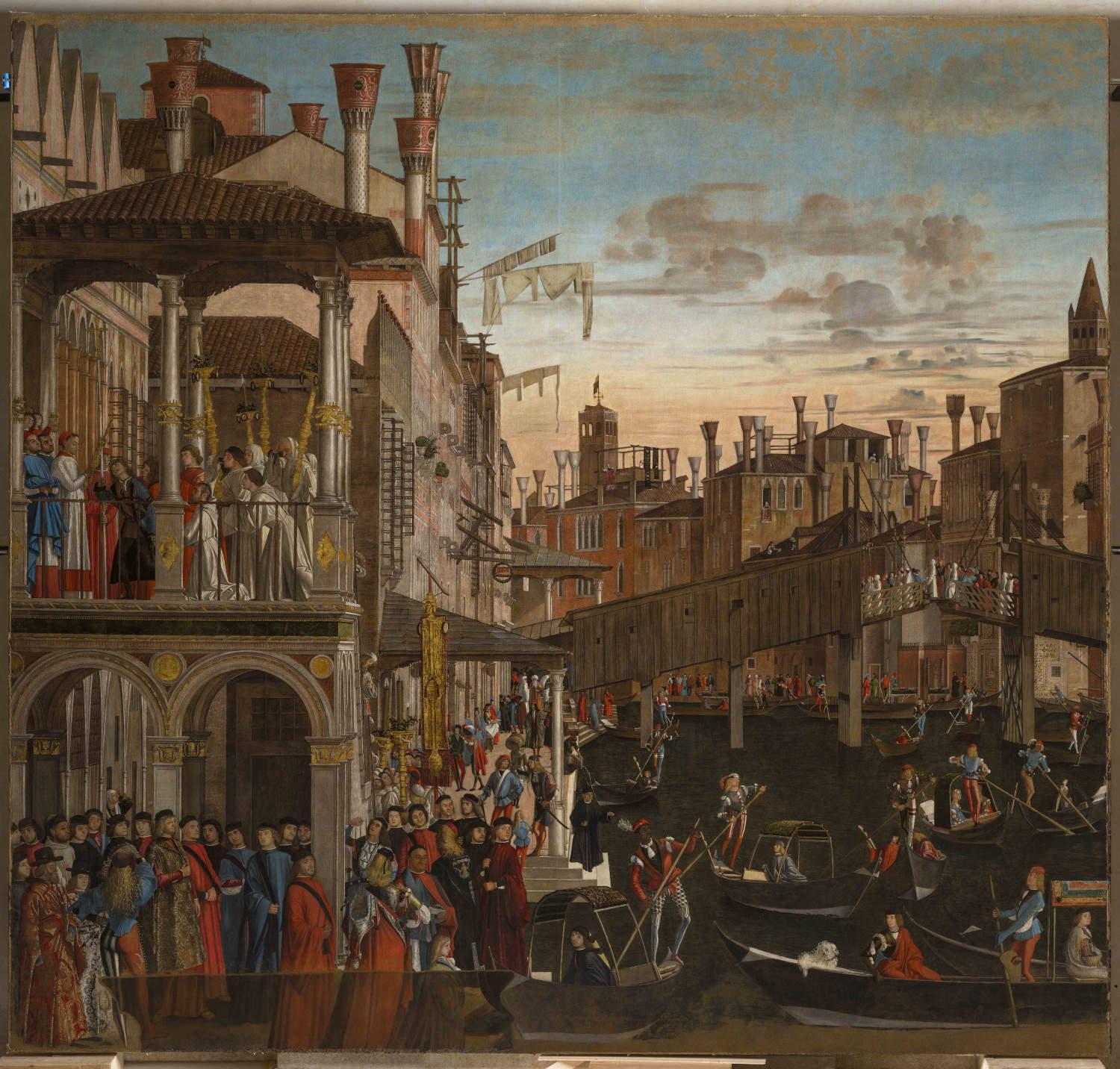
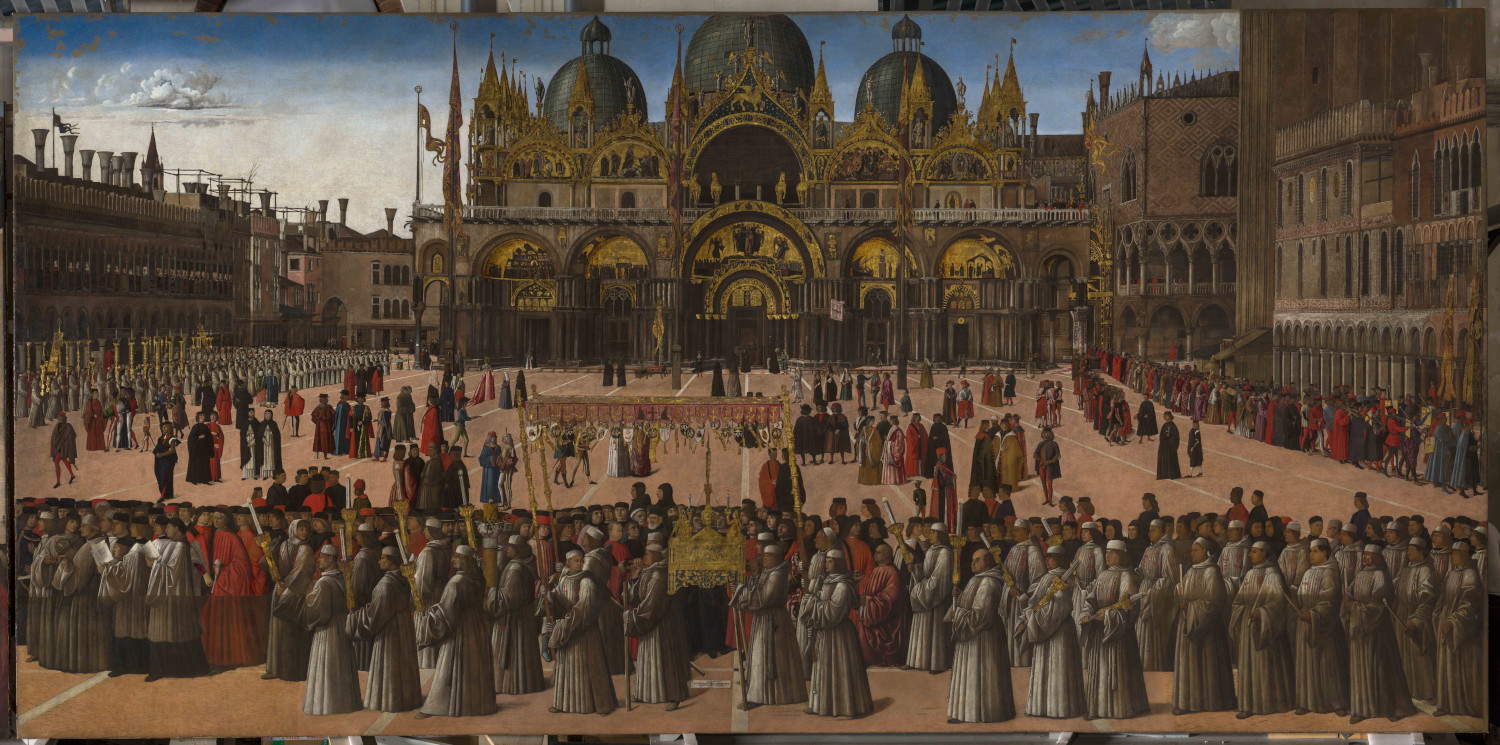
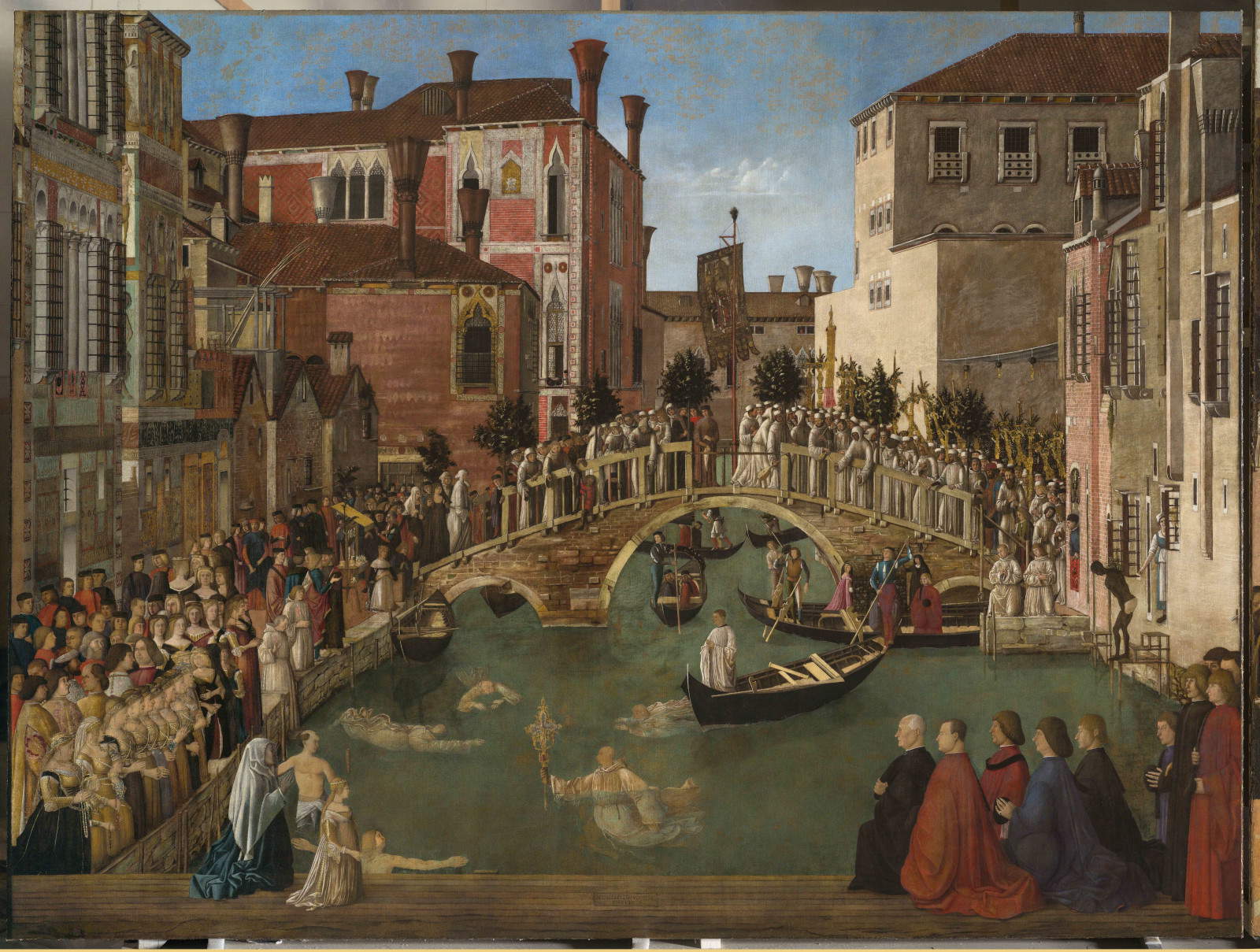
After six years of restoration work, three masterpieces of the Venetian Renaissance are once again on view to the public at the Gallerie dell’Accademia in Venice. The restoration of the first three paintings belonging to the monumental Cycle of the Miracles of the True Cross has now been completed; this series offers an exceptional glimpse into the city between the late 15th and early 16th centuries. The restored works are *The Procession in St. Mark’s Square* (1496) and *The Miracle of the Relic of the Cross at the San Lorenzo Bridge* (1500) by Gentile Bellini, along with *The Miracle of the Relic of the Cross at the Rialto Bridge* (1496) by Vittore Carpaccio. The value of the cycle extends beyond its religious and artistic dimensions. In fact, the paintings offer a sort of snapshot of Renaissance Venice, documenting the architecture, urban spaces, clothing, and faces of its inhabitants. Among the most significant depictions are the frescoed facades of the buildings along the San Lorenzo Canal—now lost—which reappear in Bellini’s canvas.
The series, originally consisting of eight large canvases, was commissioned to decorate a hall of the Scuola Grande di San Giovanni Evangelista and to celebrate a relic of the Cross donated in 1369 by Filippo de Mezières, Grand Chancellor of Cyprus. The painting project, coordinated by Gentile Bellini, involved some of the leading artists working in Venice, including Vittore Carpaccio, Lazzaro Bastiani, Giovanni Mansueti, and Benedetto Diana. The identification of the depicted scenes is made possible by a pamphlet from 1590, written by Giacomo de Melzi, Grand Guardian of the Scuola, which lists the artists, subjects, and dates of creation of the works.
The conservation project, carried out between 2020 and 2026, was directed by Giulio Manieri Elia, director of the Gallerie dell’Accademia, with technical direction by Maria Chiara Maida and Cristiana Sburlino. The work was entrusted to the CBC Conservazione Beni Culturali cooperative, under the coordination of Caterina Barnaba, thanks to the support of Save Venice Inc.
The first painting to undergo restoration was Vittore Carpaccio’s *The Miracle of the Relic of the Cross at the Rialto Bridge*, followed by the two works by Gentile Bellini. Diagnostic examinations and cleaning made it possible to reveal pictorial details and compositional elements, restoring greater clarity to the three scenes.
In the *Procession in St. Mark’s Square* (1496), Gentile Bellini depicts a solemn procession in which the Brescian merchant Jacopo de’ Salis also participates; he is the only figure kneeling in the entire composition. His prayer is for the healing of his son. The restoration of the original color tones has restored the square’s monumental character and highlighted the scene’s rigorous perspective. Diagnostic analysis also revealed numerous pentimenti by the artist and confirmed the use of precious pigments, including lapis lazuli. The precision with which Bellini depicts the city and its inhabitants is not merely an aesthetic choice: the faithful representation of reality helps reinforce the credibility of the miraculous event, making the painting a tool of visual and religious testimony.
The Miracle of the Relic of the Cross at the San Lorenzo Bridge, painted in 1500, has also regained its original chromatic brilliance. The painting depicts the recovery of the relic, which had fallen into the waters of the canal and was saved thanks to the intervention of the Grand Guardian Andrea Vendramin. The removal of the altered varnishes has restored clarity to the colors and depth to the buildings lining the banks, some of which feature facades entirely decorated with frescoes—frescoes that no longer exist today. The painting also serves as a valuable chronicle of Venetian society at the time. Among the distinguished figures depicted is Caterina Cornaro, Queen of Cyprus, on the right with her retinue of ladies. In the foreground, kneeling, some of the painter’s own family members may be recognized.
The third restored painting is Vittore Carpaccio’s *The Miracle of the Relic of the Cross at the Rialto Bridge*, dated 1496. The miraculous episode takes place in a loggia on the left, where the Patriarch of Grado heals a possessed man. In the background, a sweeping view of the Grand Canal unfolds, dominated by the ancient wooden Rialto Bridge, rebuilt after the fire of 1458. Infrared reflectography analyses have made it possible to identify the perspective grid and vanishing point established by the artist. Now freed from its dark patina, the composition has regained its spatial depth, once again guiding the viewer’s gaze from the loggia toward the urban landscape.
With the conclusion of the first phase of work, the conservation project will continue with the restoration of the other five paintings, which, beginning in the spring of 2027, will be restored directly in Room XX of the Gallerie dell’Accademia, in a workspace open to the public. The ability to work on the works without having to move them again was made possible during the room’s redesign, carried out in the spring of 2026 under the direction of Elena Azzolin and Serena Bidorini and executed by Uni.S.Ve srl. On that occasion, the structural consolidation of the canvases was carried out in advance by reinforcing their edges. This will make it possible to avoid further handling and the removal of the paintings from their respective frames, while keeping the already restored works on view. The public will thus be able to witness the various stages of the conservation work firsthand.
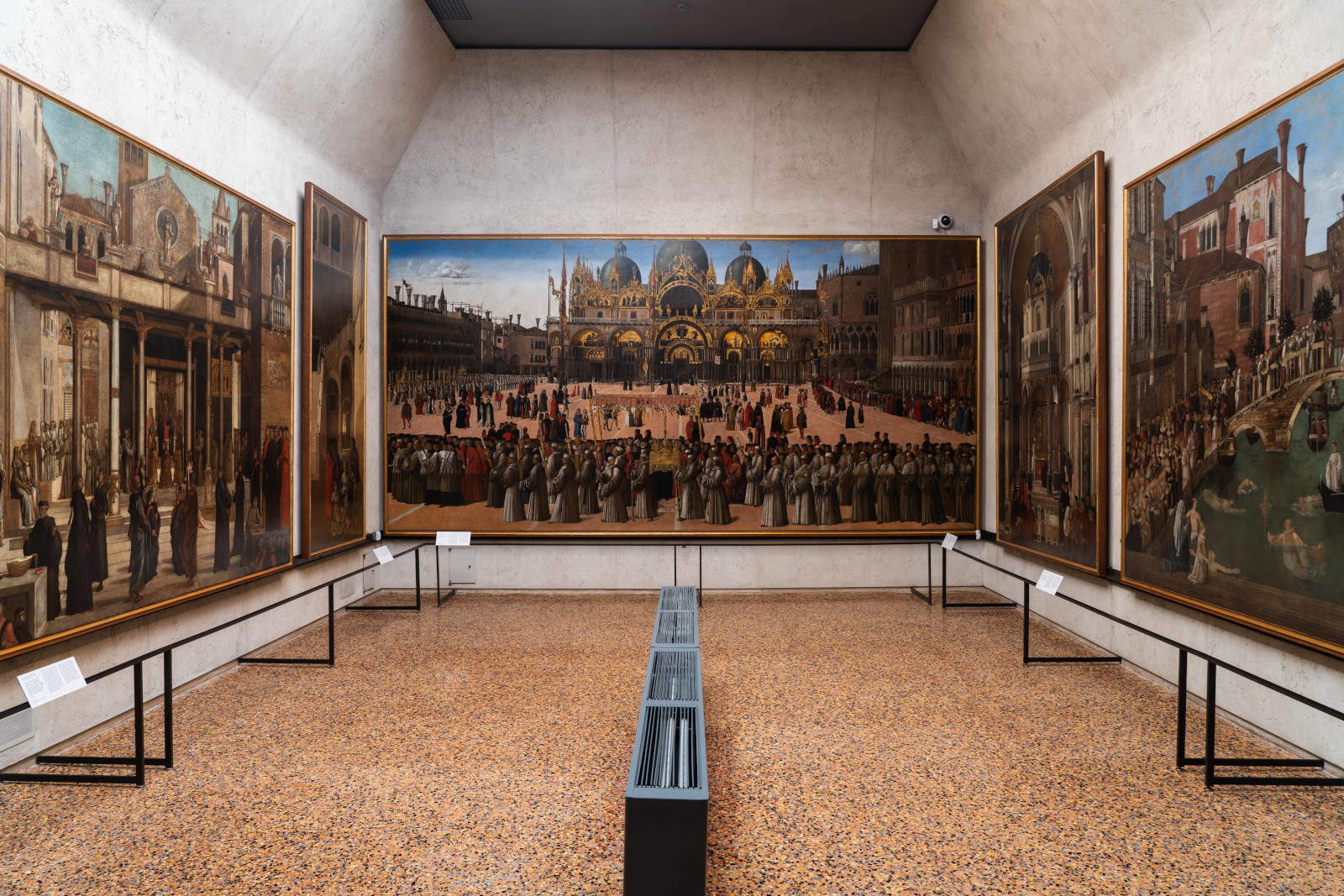
Among the works to be included in the upcoming restoration project is Gentile Bellini’s The Miraculous Healing of Pietro de’ Ludovici, dated 1501. The painting depicts the protagonist praying before an altar and being cured of a fever thanks to the proximity of a candle that came into contact with the relic.
Also to be restored is Giovanni Mansueti’s *The Miracle of the Relic of the Cross in Campo San Lio*, painted around 1496. The painting depicts the funeral of a less-than-devout brother, during which the relic suddenly becomes so heavy that it is impossible to carry—except for the parish priest of San Lio. In the scroll held by a figure on the left—perhaps a self-portrait of the painter—the inscription “bellini disc[i]p[u]li” appears, a reference to Mansueti’s artistic lineage.
Also by the same artist, *The Miraculous Healing of Benvegnudo’s Daughter from San Polo*, dated around 1506, will undergo restoration. The scene depicts the healing of a young woman who had been ill since birth, achieved through contact with three candles that her father had brought close to the relic. The scene is set in a palatial interior rich in details and references to the paintings of Carpaccio. The composition guides the viewer’s gaze through a succession of spaces, from the landing on the riverbank to the monumental staircase, and finally to the entrance to the hall.
The conservation program will also include Lazzaro Bastiani’s *The Offering of the Relic of the Cross to the Brothers of the Scuola Grande di San Giovanni Evangelista*, painted around 1495. Set in the church of San Giovanni Evangelista, the painting depicts the moment of the relic’s donation by Filippo de Mezières and documents the complex’s original architectural and urban layout, prior to the transformations that took place in subsequent centuries. Rounding out the collection is *The Miracle of the Relic of the Holy Cross* by Benedetto Rusconi, known as Diana, dated between 1505 and 1510. The painting depicts the healing, which took place on March 10, 1480, of the son of Alvise Finetti, a scribe at the Chamber of Loans, who had been seriously injured after falling from an attic.
The restoration of the first three paintings and the upcoming construction project represent two phases of an initiative that combines conservation and enhancement. Through these eight canvases, the Gallerie dell’Accademia present to the public not only a series of masterpieces of Venetian painting but also a unique testament to the city, its architecture, and the society that inhabited it between the 15th and 16th centuries.
As Director Giulio Manieri Elia emphasized, the conservation work carried out at the Laboratori della Misericordia “took the form of a critical and investigative process capable of understanding the various phases in the life of the paintings, supporting the restorers and the project management staff in their operational decisions.” Preliminary non-invasive diagnostic tests (UV fluorescence, IR reflectography, and XRF) guided a differentiated cleaning process, which aimed to preserve the historical alterations resulting from the removal of sections of the painting to create openings for ancient doors in the original hall, as well as to carry out an accurate yet respectful pictorial integration.
“Every nuance, every microstratum, every minute detail brought to light by the restoration not only restores material and color but also reveals a fragment of our history and, ultimately, of our very soul,” commented the mayor of Venice, Simone Venturini. “These canvases depict a living city—its rituals, its architecture, its faces—and a connection to tradition that remains alive today: just two weeks ago, on the Feast of the Exaltation of the Holy Cross, the relic housed by the Scuola Grande di San Giovanni Evangelista was once again solemnly displayed. Admiring this cycle means feeling almost enveloped by its scenes, in an embrace that conveys all that is Venetian. Our thanks go to the Gallerie dell’Accademia, the conservators, and Save Venice, one of the international organizations that has long been committed to safeguarding Venice’s heritage. It is a new, concrete gesture of love toward our city: not only toward its beauty, but also toward the genius of those who came before us and were able to convey its complexity with a power that continues to speak to us after more than five centuries.”
The removal of the varnishes—yellowed by time, altered, and pigmented—has eliminated that flattening effect, restoring the works’ true spatial depth and perspective. Thus, details of a vanished Venice—which the contemporary eye can no longer perceive in person—re-emerge from the paint, such as the extraordinary sequence of palaces entirely covered in frescoes along the canals.
|
| Venice: The first three canvases by Bellini and Carpaccio from the "Miracles of the True Cross" cycle have been restored |

Warning: the translation into English of the original Italian article was created using automatic tools. We undertake to review all articles, but we do not guarantee the total absence of inaccuracies in the translation due to the program. You can find the original by clicking on the ITA button. If you find any mistake,please contact us.


















 IT
IT FR
FR DE
DE ES
ES CN
CN


