



by Redazione 24/11/2026



Categories: Ancient art / Disclaimer
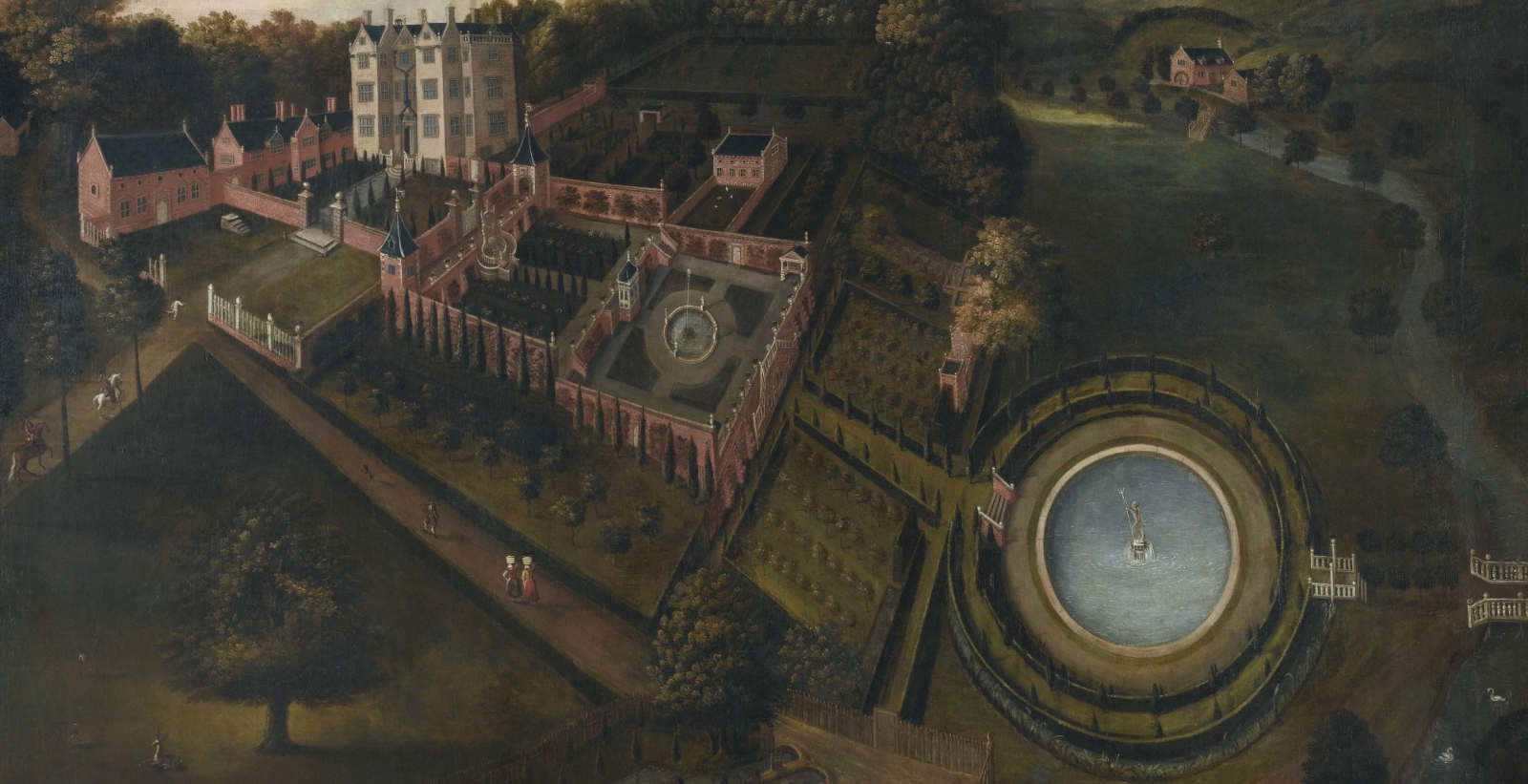
The British government has temporarily blocked the export of a bird’s-eye view from 1662, possibly the oldest of its kind depicting a British estate. It is the only surviving depiction of the Llannerch garden, filled with fountains and water features, which was created by Mutton Davies after a trip to Italy.


In a garden in North Wales, there was a sundial with an inscription that sounded like a playful threat: “Alas, my friend, time will soon catch up with you, and if you don’t cry, by God, I’ll make you cry.” The sundial, in fact, sprayed water in the face of anyone standing in front of it. This is recounted by Philip Yorke, author of *Royal Tribes of Wales*. It was just one of the water features in the garden at Llannerch, in Denbighshire—which, according to garden historian Elizabeth Whittle, was the most Italian-style garden ever built in Wales. Today, nothing remains of it, because the garden disappeared during the Victorian era, and the only surviving evidence of its appearance is a large painting from 1662, which is in danger of leaving the United Kingdom. Consequently, on November 20, the British government temporarily blocked the export of the work, hoping that a museum or institution in the country will be able to purchase it. It is a bird’s-eye view of Llannerch Park, an oil on canvas measuring 160 by 231.8 centimeters, by an unknown artist. It is believed to be the oldest view of its kind depicting a British country estate, a genre that would enjoy great popularity in the decades that followed. The painter remains anonymous, but the composition of the painting corresponds to the English style and suggests a British artist. For this reason, the work is cataloged as English School.


The garden was inspired by its owner’s travels. Mutton Davies (1633–1684) had visited France and Italy, where he stayed between 1654 and 1658. It was a formative journey similar to what would later be called the “Grand Tour.” Whittle speculates that Davies returned with gardens such as Villa d’Este and Pratolino in mind, and perhaps even the grand French terraces of Saint-Germain-en-Laye. Llannerch featured every element of the Italian garden, and water, in particular, played a dominant role: pools, fountains, a formal waterfall, hydraulic statues, and water features. Statues and water features were such novelties in North Wales that visitors were still talking about them in the 19th century. A 17th-century poem by Ffoulk Wynn describes Davies elegantly diverting streams of cold water through his gardens and strolling through the large garden laid out around his home, “and costly are his contrivances!”


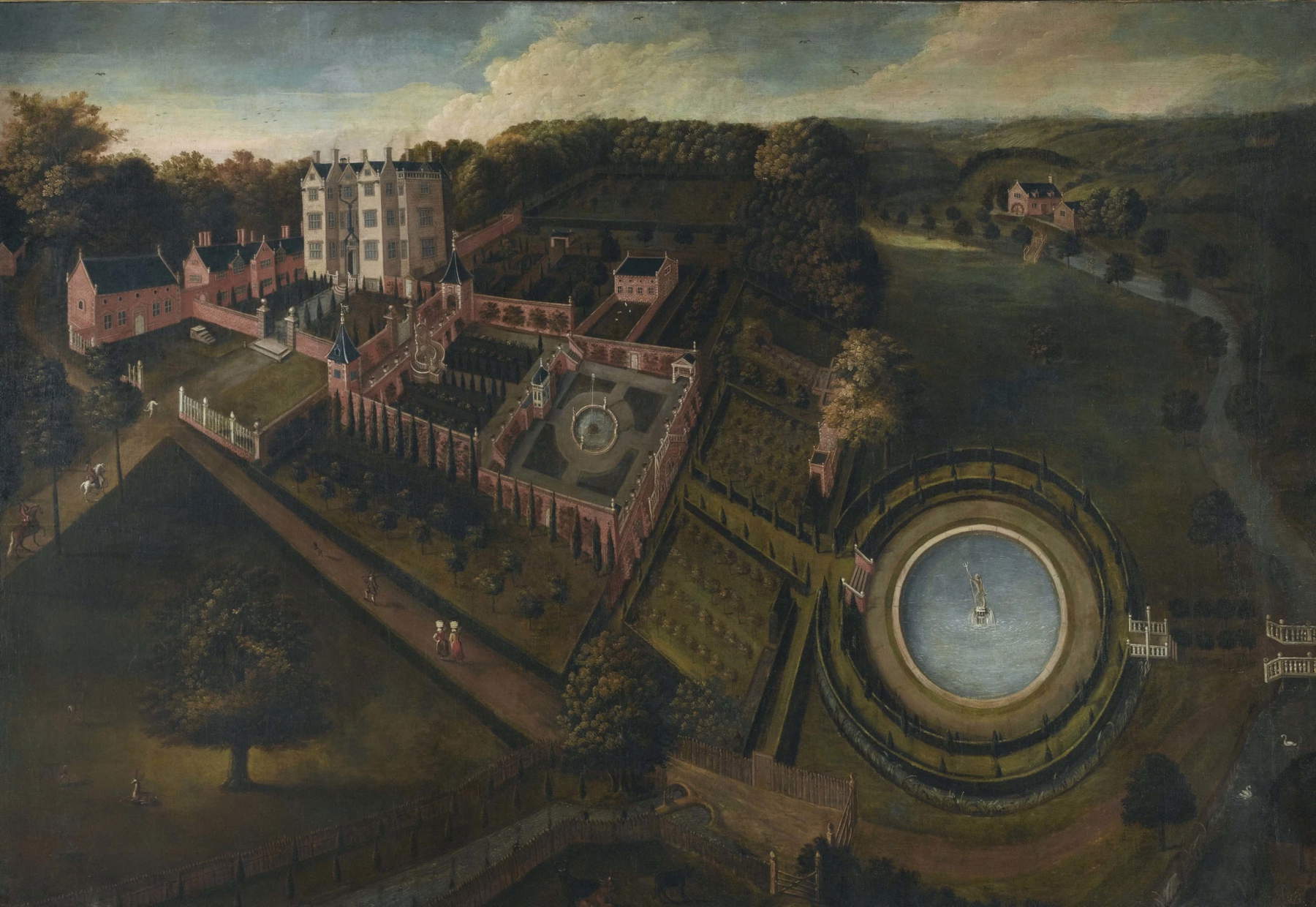
The painting allows us to explore the garden section by section. A horseman approaches the wooden entrance, from which he can ascend to a first garden that welcomes him. A gate on the right leads to the upper terrace, featuring a row of stone vases and two red-brick pavilions at either end. From there, a semicircular staircase descends to a flower garden with fruit trees growing against the wall. From a gazebo, one can see the third terrace, with a fountain in the center and two summer houses. A slope flanked by solitary trees then descends to the Neptune basin, while at the bottom right a bridge leads to the River Clwyd. Rows of slender trees are also visible; Whittle notes that they closely resemble Italian cypresses. The layout across three terraces is very refined, of a type recommended by William Lawson in his treatise *A New Orchard and Garden*.


Pippa Shirley, a member of the advisory committee that reviewed the case, summarizes the painting’s significance as follows: “This extraordinary painting—as far as we know, the oldest bird’s-eye view of a country house in Great Britain—is the only surviving record of this Welsh Italianate garden.” Davies, Shirley notes, was a royalist landowner who created the garden following his travels in France and Italy—a century before the Grand Tour became fashionable. “Nothing even remotely similar had ever been seen before in Wales, and the fact that the garden is now completely lost makes the painting all the more important.” The government’s press release adds that Llannerch predates the famous Baroque garden at Hampton Court by decades.
Even in Wales, the garden was unparalleled. Many large estates had formal gardens, sometimes terraced, some dating back to the Tudor era, but the grand Baroque gardens of Powis Castle and Chirk Castle would come later. Thomas Dineley’s sketches in the 1684 *Beaufort Progress* show some formal elements in the gardens of residences of the time: a fountain at Powis, pools at Margam Abbey, and walled enclosures at Ruperra Castle—all of which have since disappeared. Chirk’s first terraced garden, at Whitehurst, was created by Sir Thomas Myddleton in 1651 and featured “exotic” plants, including orange and lemon trees. According to Whittle, it is very likely that the same plants also grew at nearby Llannerch. Denbighshire and the Flint area had several fine Jacobean-era houses, such as Plas-Teg, Nerquis Hall, Pentrehobyn, and Gwysaney, and the region’s proximity to Chester, along with the ties between the North Wales coast and Lancashire, had brought considerable prosperity to the area.
The house itself also has a layered history. It was likely built by Fulk Griffyth in the late 16th century, and in the early 17th century, Sir Peter Mutton probably added a brick service wing. His daughter Anne married Robert Davies of Gwysaney, and it was their son, Mutton Davies, who created the garden and commissioned the painting.
The painting marks the beginning of a long tradition. Bird’s-eye-view depictions of country houses in England would later become famous through artists such as Jan Sibrechts, Leonard Knyff, and Jan Griffier, but their works mostly date from the late 17th and early 18th centuries and are by foreign painters who came to England in search of aristocratic patrons. The Llannerch painting is significant not only because of its early date but also because it attests to a local tradition that was familiar with the work of continental artists through engravings. The date itself has a curious history: an old inscription, visible in a photograph published in *Country Life* magazine in 1943 and later apparently removed, indicated the year 1662. According to the catalog, however, that date more likely refers to the start of work on the garden. Whittle dates the painting to the 1660s, with probable completion in 1665.
There are two versions of the painting. A smaller one, nearly identical but featuring St. Asaph’s Cathedral on the horizon, was purchased in 1968 by the Yale Center for British Art in New Haven, United States, from the London art dealers Leggatt Brothers. It had previously belonged to Mrs. Patrick Hardman, and in the 19th century, A. Whitehall Dod of Llanerch had loaned it to an exhibition in Wrexham. Whitehall Dod had inherited the estate in 1841 upon the death of his grandmother, the last of the Davies family. This suggests that the larger version hung for a long time at Gwysaney, another property owned by Mutton Davies. Commissioned around 1662, the work remained in the family until its sale at Sotheby’s in London on December 3, 2014, as lot 41.
There is also a Welsh counterpart. Llanfihangel Court, in Monmouthshire, is a garden contemporary with that of Llannerch and, unlike the latter, has largely survived. Its terraces, summer pavilions, and park avenues—created in the 1670s by the Whig politician John Arnold—are also depicted in a large painting from that period. But Llanfihangel, Whittle notes, is formal without being Italianate like Llannerch.
The decision by the Minister for Heritage, Baroness Twycross, follows the recommendation of the Reviewing Committee on the Export of Works of Art and Objects of Cultural Interest (RCEWA). The committee found that the painting meets the first and third of the Waverley criteria, namely its close connection to national history and life and its exceptional importance for scholarship. In particular, it is significant for the history of gardens and landscape architecture in Wales and Great Britain, for the educational travels of the mid-17th century, and for artistic activity in the Chester area during those years. “This painting offers an extraordinary window into the development of gardens and landscape art in Wales and throughout the United Kingdom,” said Twycross. “Keeping it in the United Kingdom would be of enormous benefit to the public and to researchers.” If the painting remains in the country, scholars will be able to investigate how people and ideas circulated in the 17th century between Wales, England, and continental Europe, and how the painting of country estates developed in Great Britain.
The decision on the export license is on hold through February 19, 2027. By that date, potential buyers may come forward: museums and galleries—which may raise funds through donors—or private individuals willing to purchase the work to donate it to the country. The recommended price is 550,000 pounds, plus 11,000 in VAT (657,000 euros plus approximately 13,000). Upon expiration, the owners will have fifteen business days to evaluate the offers. If an offer is accepted, the signing of an option agreement will trigger a second four-month suspension period. Interested parties may contact the RCEWA at 02072680534 or via email at rcewa@artscouncil.org.uk. “If this garden still existed today,” Whittle wrote in the past, “it would be an extraordinarily unusual little piece of Italy transported into the rural idyll of the Clwyd Valley.” And he added a question: who knows what lies buried beneath the lawn.
 |
| Wales’ Lost Italian Garden: London Blocks the Export of the Llannerch Painting |
Warning: the translation into English of the original Italian article was created using automatic tools. We undertake to review all articles, but we do not guarantee the total absence of inaccuracies in the translation due to the program. You can find the original by clicking on the ITA button. If you find any mistake,please contact us.