





The University of Salento’s 18th excavation campaign inthe ancient Roman city of Aquinum, located within the territory of the present-day municipalities of Castrocielo and Aquino (in the province of Frosinone), has unearthed two archaeological finds of particular interest for reconstructing the colonial city’s architectural, religious, and civic history. A stone stele decorated with garlands, festoons, and bucrania, depicting an ox, a ram, and a pig, and a marble votive altar—a new fragment of which has made it possible to reconstruct an important part of the inscription—were presented to the public for the first time on Saturday, October 3, during the Archaeology Weekend that concluded the research season at the Aquinum archaeological site.
The new discoveries were presented during a public event held in Castrocielo, attended by archaeologists from the University of Salento and colleagues from the Superintendence of Archaeology, Fine Arts, and Landscape for the provinces of Frosinone and Latina. The event marked the conclusion of the 2026 campaign and provided an opportunity to take stock of the findings, reconstructing for each artifact the circumstances of its discovery, the archaeological context, and the interpretive questions that remain open.
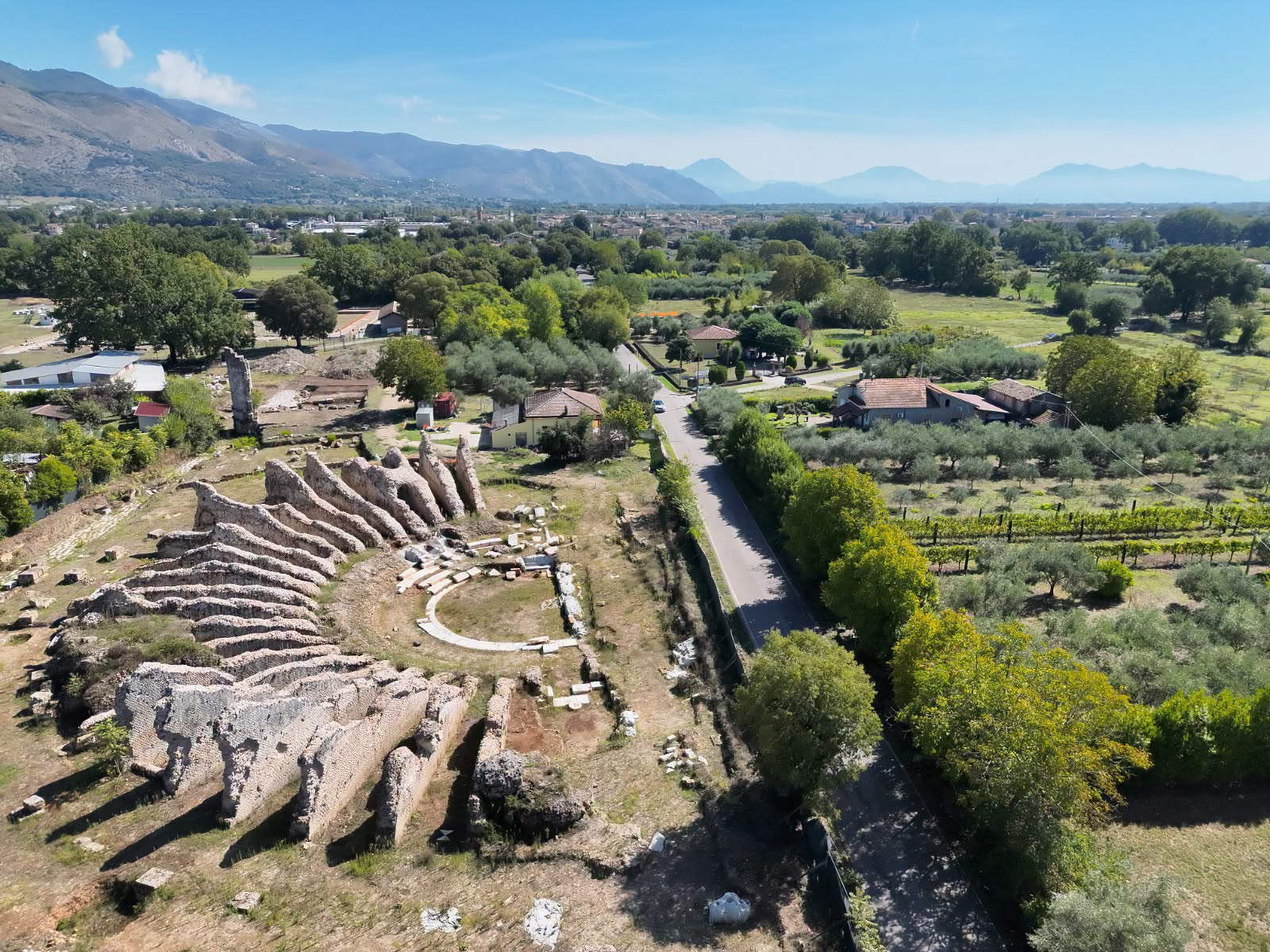
The excavations at Aquinum are directed by Giuseppe Ceraudo, professor of Ancient Topography at the University of Salento, and have been ongoing for eighteen years as an ongoing project of research and university education, complemented by activities aimed at the preservation and promotion of the archaeological heritage. The research is conducted in collaboration with the Superintendence of Archaeology, Fine Arts, and Landscape for the provinces of Frosinone and Latina, and with the municipalities of Castrocielo and Aquino, within whose territories the ancient Roman city lies. The 2026 field season also marked a further milestone in fieldwork, with the launch of the project’s first excavations in the municipality of Aquino.
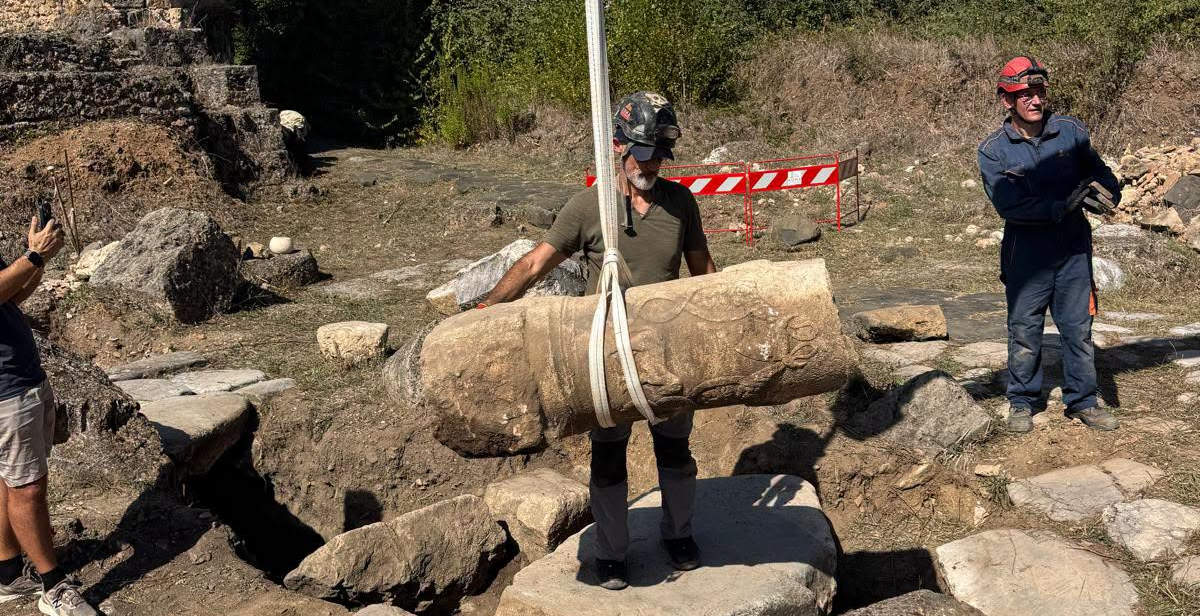
The first of the two artifacts presented is a richly decorated stone marker, found in a location that likely does not correspond to its original placement. The monument had, in fact, been reused as a paving stone near one of the ancient city’s main intersections. Its presence within a secondary context thus makes it more difficult to reconstruct its original function, but certain elements of the decoration and inscription allow for an initial set of hypotheses regarding its meaning.
The name of the dedicant appears on the stele; it may be Caius Ammius Cammarus, although the complete reading of the name is not yet considered certain. The inscription is accompanied by a decorative arrangement consisting of garlands, festoons, and bucrania, within which three animals are depicted: an ox, a ram, and a pig. It is precisely the combined presence of these three animals that makes the artifact particularly significant from a historical and religious perspective.
The depiction, in fact, evokes the animal triad of the suovetaurilium, one of the most solemn sacrificial rites of Roman religion. The ritual involved the sacrifice of three animals: a pig, referred to by the term *sus*; a sheep, *ovis*; and a bull, *taurus*. Their association within a single monument can therefore be linked to sacrificial practice and the ritual dimension of Roman public life. The depiction may preserve the memory of a sacrifice or evoke a ceremony in which the rite played a central role.
However, given the current state of research, it is not possible to establish with certainty what the function of the stone was or which specific ritual episode it was intended to commemorate. The *suovetaurilium* could have been used in various contexts and could have been associated, in particular, with ceremonies of purification, consecration, or the ritual demarcation of a space. The fact that the stone was found outside its original location therefore calls for caution in its interpretation. The decoration and inscription are important elements for understanding the monument’s function, but the context of its reuse does not allow us to automatically reconstruct its original position and meaning.
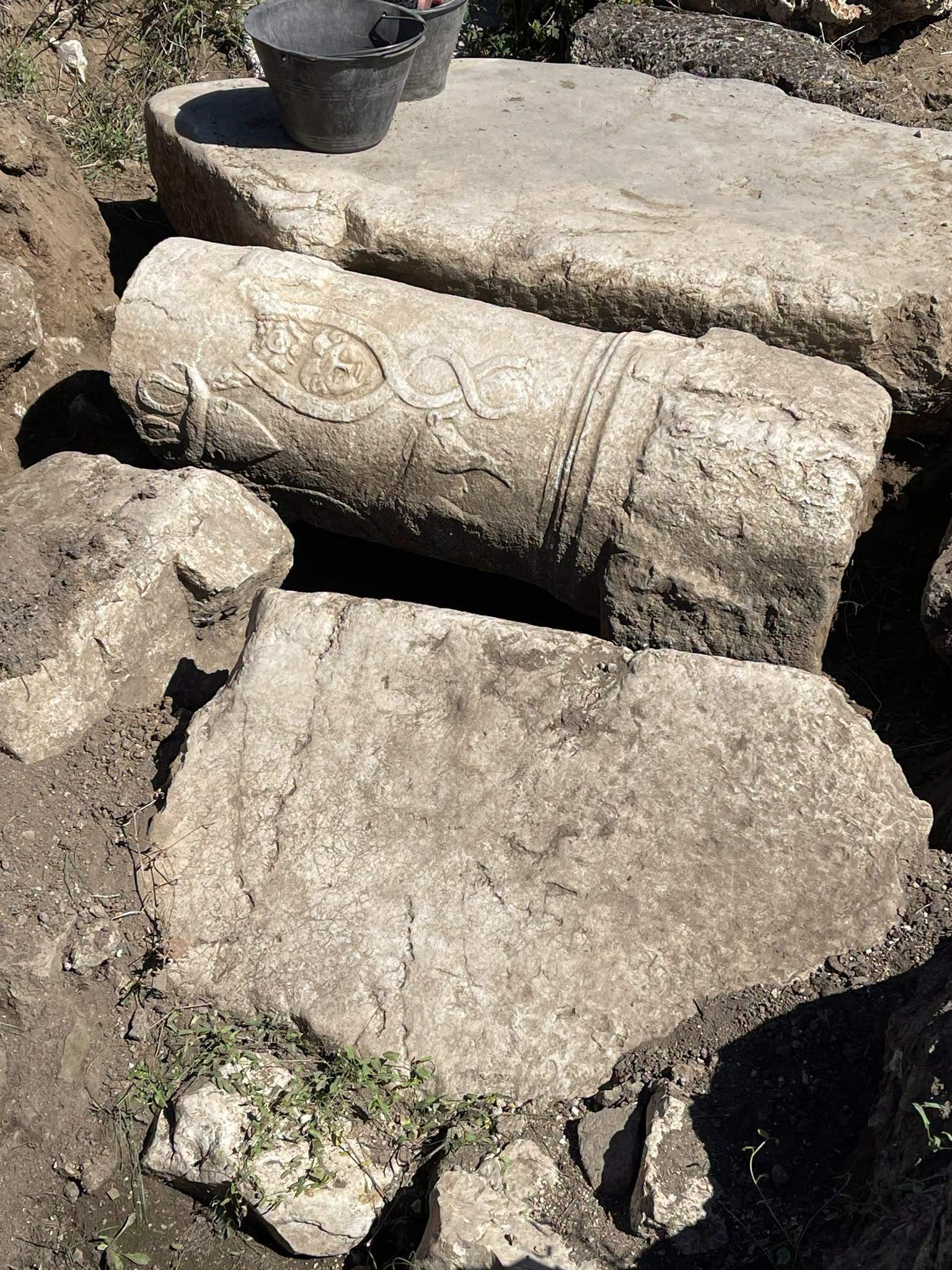
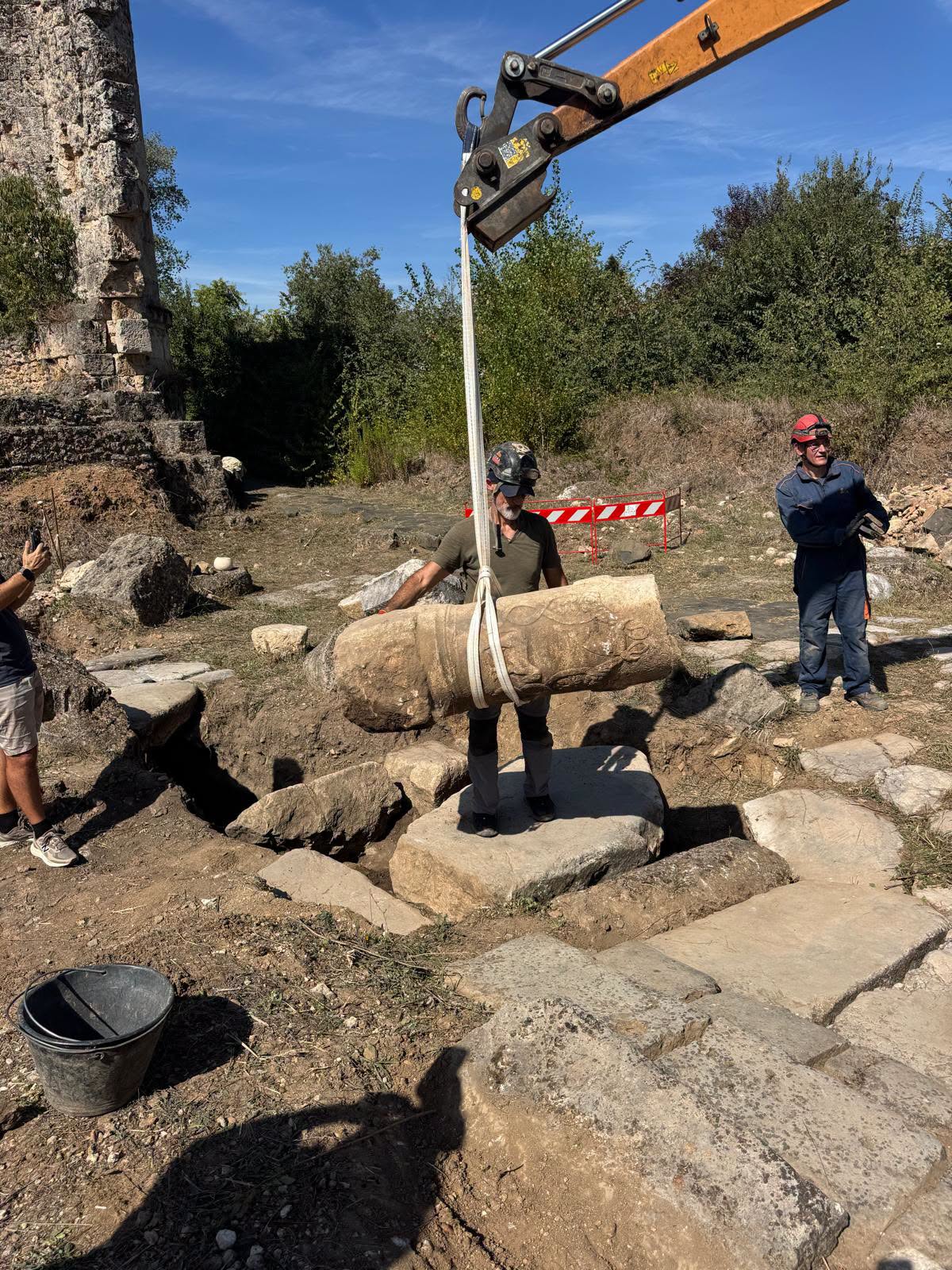
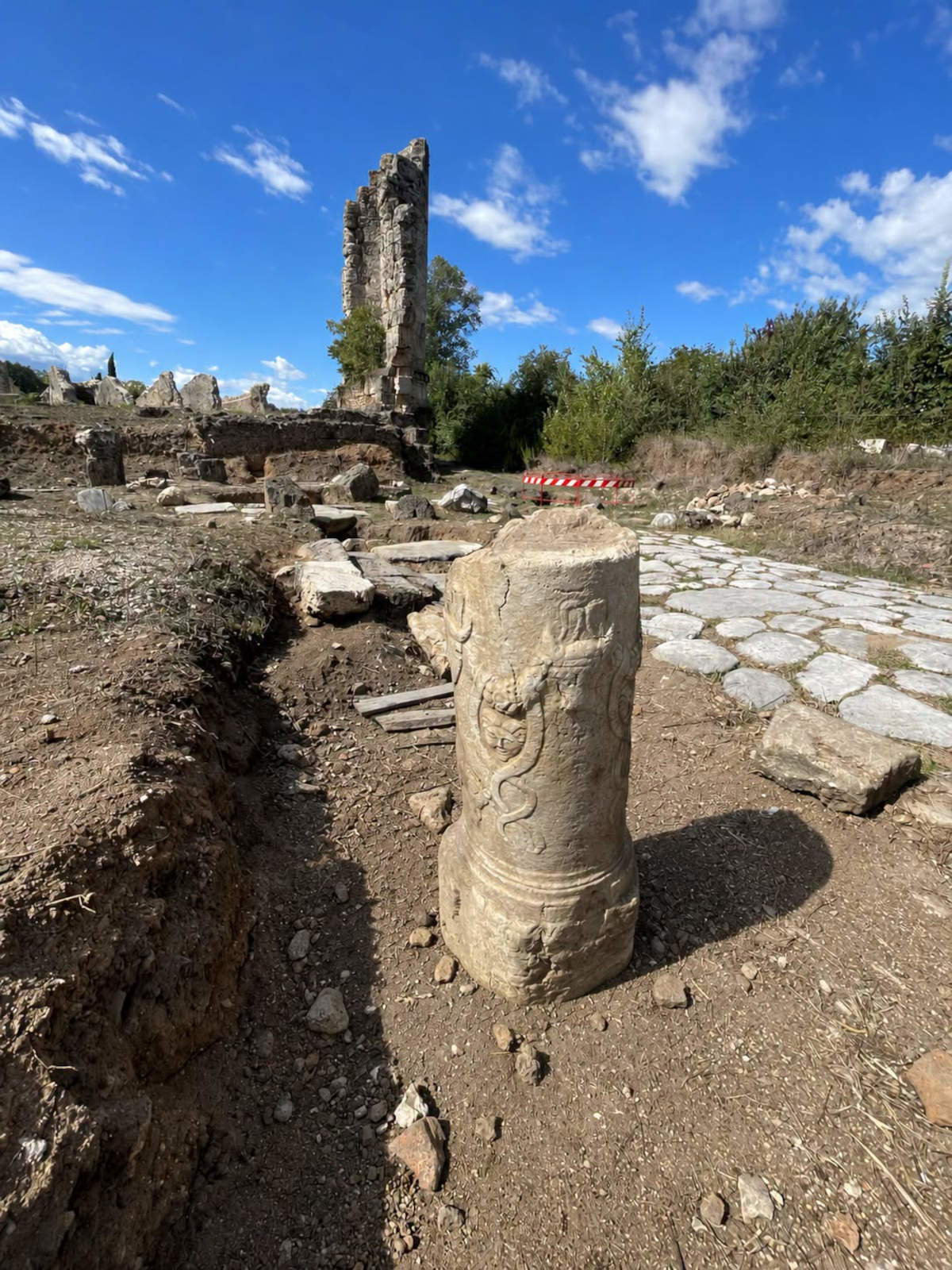
The second artifact presented during the Archaeology Weekend, on the other hand, points directly to the religious and political dimensions of the Roman colony. It is a marble votive altar, to which a new fragment discovered during the excavation campaign belongs. The newly discovered piece has made it possible to reconstruct a portion of the inscription that, until now, had been known only in part. The new reconstruction allows for a more complete reading of the dedication text and enables a more precise identification of the deities to whom the altar was consecrated.
The monument was dedicated to the Genius of Augustus, the Lares of Augustus, and the Genius of the Colony. The ensemble of deities invoked in the dedication links the cult of the emperor and the imperial house with that of the city community, providing a useful insight into how public religion and civic identity were expressed in the urban space of Aquinum. The dedication was made by Manius Popidius Anteros, a wealthy freedman who had held the office of aubustal sevir. His status allows us to situate the monument within the social context of the colony and the ways in which freedmen participated in public life. The connection to imperial worship—through the deities to whom the altar was dedicated and the role held by the dedicant—provides, in fact, insight into the social and political organization of the community.
The new fragment of the altar thus helps to expand the available documentation on public life in Aquinum and on the relationships between religion, institutions, and civic identity. The cult of the Genius of Augustus and the Lares of the Augustosicomplements that of the Genius of the Colony, creating a synthesis in which the imperial and civic dimensions are closely intertwined. This aspect can also be explored in greater depth through comparison with other epigraphic and archaeological materials recovered from the area. The two finds are part of a campaign that has also yielded other significant results. Among the investigations conducted in 2026 were new excavations at the Roman theater, where a marble slab bearing the inscription FVL(GVR) C[ONDITVM] was discovered. The inscription is linked to a specific ritual of the Roman religion: the one used to bury and consecrate a site struck by lightning.
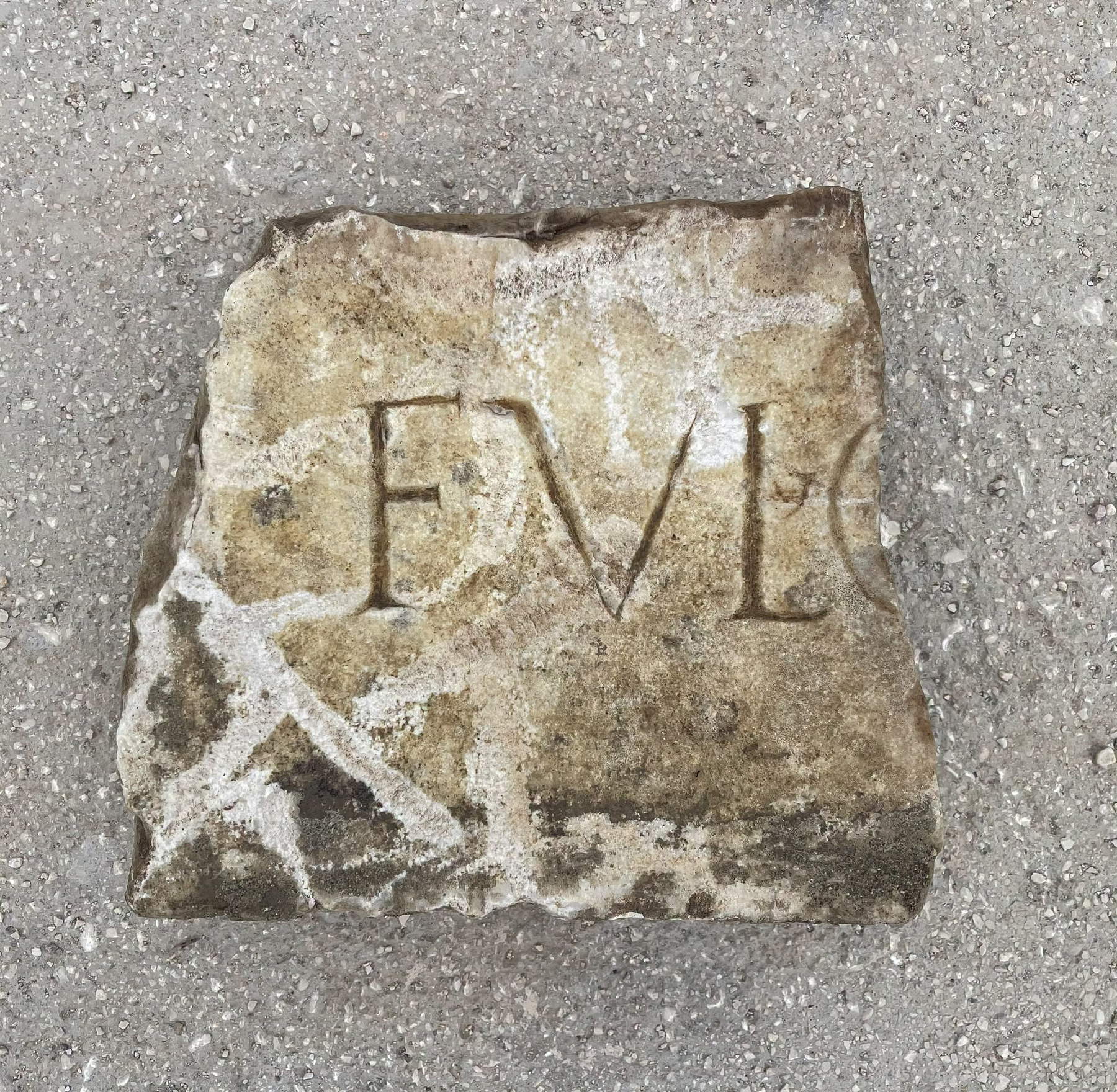
The formula constitutes a rare piece of evidence and raises a new interpretive question regarding the theater of Aquinum. The presence of the slab could in fact indicate that the building, in ancient times, was affected by a weather event interpreted, according to Roman religion, as a manifestation of divine will. In such cases, lightning could be interpreted as a sign from the divine realm. The site affected by the event could therefore be subjected to specific ritual practices, through which it was set apart and consecrated.
The discovery of the slab adds another piece to our understanding of the religious practices associated with the colony’s public spaces. Even in this case, however, the documentation will need further study to determine the relationship between the inscription on the slab, the context of its discovery, and the history of the theater building. During the Archaeology Weekend, the recent restoration project involving five marble heads from the archaeological site was also presented. Among these are the so-called “Caesar of Aquinum” and a portrait head attributed to Drusus the Elder.
The 2026 excavation campaign has thus expanded the body of available information on the colony through artifacts related to various aspects of urban life: from religious practice to monumental representation, from civic organization to the presence of figures belonging to the social groups that participated in the city’s public life. The stele depicting the three animals of the suovetaurilium and the altar dedicated to the Genius of Augustus, the Lares of Augustus, and the Genius of the Colony belong to different contexts, but both provide insights into the relationship between religious practices and the organization of urban space.
“After eighteen years of research, Aquinum continues to surprise us,” states Giuseppe Ceraudo, scientific director of the excavations and research at Aquinum. “The 2026 field season has yielded discoveries of particular significance, opening up perspectives we could not have imagined just a few months ago. We have chosen to share with the public not only the results of our research but also the excitement of discovery by revealing the nature of the two exceptional finds unearthed during our Open Day, thereby opening the excavation site to the community and transforming knowledge into a shared heritage.”
“Archaeology Weekend renews the deep bond between Castrocielo and the millennia-old history of Aquinum,” emphasizes the mayor of Castrocielo, Gianni Fantaccione. “Thanks to the collaboration with the University of Salento and the Superintendency, Aquinum is now a vibrant place, capable of attracting scholars, students, and visitors and offering new cultural opportunities to our region.”
“The new discoveries confirm the importance of an ongoing research project, in which scientific investigation goes hand in hand with the protection and conservation of cultural heritage,” notes Alessandro Betori, Superintendent of Archaeology, Fine Arts, and Landscape for the provinces of Frosinone and Latina. “The collaboration between the Superintendency, the University of Salento, and the municipalities of Castrocielo and Aquino is a concrete example of how institutions with different areas of expertise can work together toward a common goal: to understand, protect, and return the vestiges of our past to the community.”
Carlo Molle, an archaeologist with the Superintendency, states that the Aquinum excavation “has become a landmark in classical archaeology, not only because of the significance of the discoveries, but also due to the ongoing experimentation with innovative investigative tools, which fully involve students and researchers from both Italy and other countries.”
“It is a great source of satisfaction for the entire Roma Sotterranea team to have been able to contribute to this important discovery,” says Francesco Artibani, head of the Aquinum Project. “The resources invested in technology and safety have allowed us to provide concrete support for the research. This result crowns a period of intense and exciting work.”
 |
| Aquino (Frosinone): The University of Salento Discovers Two Artifacts Linked to Roman Religion |


The author of this article: Noemi Capoccia
Originaria di Lecce, classe 1995, ha conseguito la laurea presso l'Accademia di Belle Arti di Carrara nel 2021. Le sue passioni sono l'arte antica e l'archeologia. Dal 2024 lavora in Finestre sull'Arte.Warning: the translation into English of the original Italian article was created using automatic tools. We undertake to review all articles, but we do not guarantee the total absence of inaccuracies in the translation due to the program. You can find the original by clicking on the ITA button. If you find any mistake,please contact us.


























 IT
IT FR
FR DE
DE ES
ES CN
CN


