



by Redazione 22/11/2026


Categories: Archaeology / Disclaimer
Crafted from white marble and adorned with lion’s paws, the ancient Roman sundial is once again on display at the Oreste Nardini Civic Archaeological Museum in Velletri, following a restoration project that has restored the artifact’s legibility and stability.


An ancient instrument used by the Romans to measure time is once again on display in Velletri: the Roman sundial housed at the Oreste Nardini Civic Archaeological Museum has been restored. This precious artifact, carved from white marble, has been returned to the public after a long period of neglect and various conservation efforts. The official unveiling took place on Saturday, November 14, 2026, in the Sala Tersicore of City Hall, in the presence of museum director Raffaella Silvestri and representatives of local institutions.

The restoration and conservation project was made possible thanks to the support of the LoveItaly association, using funds raised during the WeLoveItaly charity initiative, in collaboration with the Municipality of Velletri and the Museum Grand Tour network. This project made it possible to restore an object of great significance to the city’s history, bringing together institutions, museums, and associations.
During the presentation, Director Raffaella Silvestri emphasized the historical value of every archaeological artifact, describing it as a fragment of memory to be preserved and passed on to future generations. The clock, identified as a hemicyclium—that is, a concave sundial—is, in fact, a testament to the scientific and astronomical knowledge of antiquity. Another unique feature is that it was specifically designed for Velletri’s latitude: it not only served to indicate the hours but also allowed users to track the passage of time throughout the year.



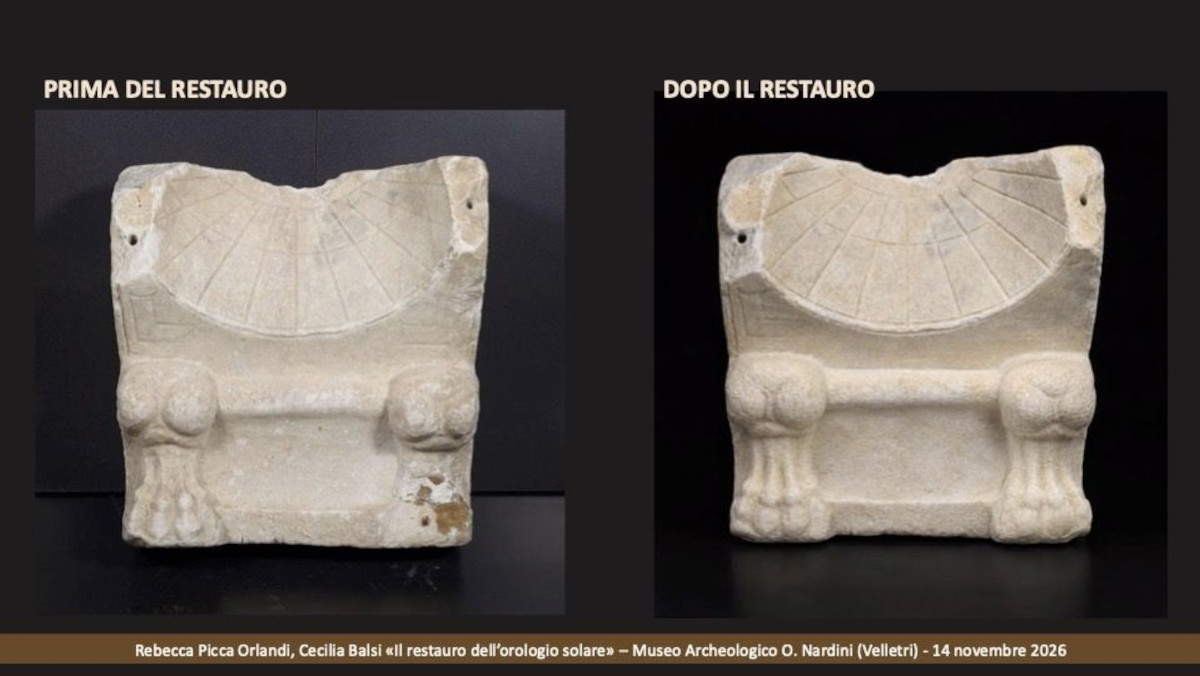
The restoration combined conservation requirements with the use of contemporary technologies. In particular, 3D printing was used to reconstruct the missing lion’s paw, a solution that made it possible to integrate the lost part without compromising the artifact’s authenticity. The restoration was designed according to the principle of reversibility: the added element can, in fact, be removed at any time without damaging the original artifact.
The history of the sundial was explored in depth by conservators Rebecca Picca Orlandi and Cecilia Balsi, who, during the presentation, traced the main stages of its history through documents, historical accounts, and archival photographs.
One of the earliest known references dates back to 1790, when Carlo Antonini published the *Manual of Various Ornaments Drawn from Ancient Structures and Fragments*. In the volume, which also covers sundials, three plates depict three examples located in Velletri. The one now preserved at the Nardini Museum is identified as originating from the Velletri area and located in the so-called Piazza di Corte, now known as Piazza Cesare Ottaviano Augusto. The other two, however, were housed in the Borgiano Museum and the Villa Borgia. This distinction is important because, in subsequent accounts, the sundial has often been associated with the Borgia family and its famous collection of antiquities. The most recent research, however, has not yet identified any documents capable of confirming this attribution with certainty. It therefore remains to be verified whether the local tradition—according to which Cardinal Stefano Borgia donated the artifact to the Confraternity of Pilgrims and Convalescents, which was based in the Tempietto di Santa Maria del Sangue—is accurate.
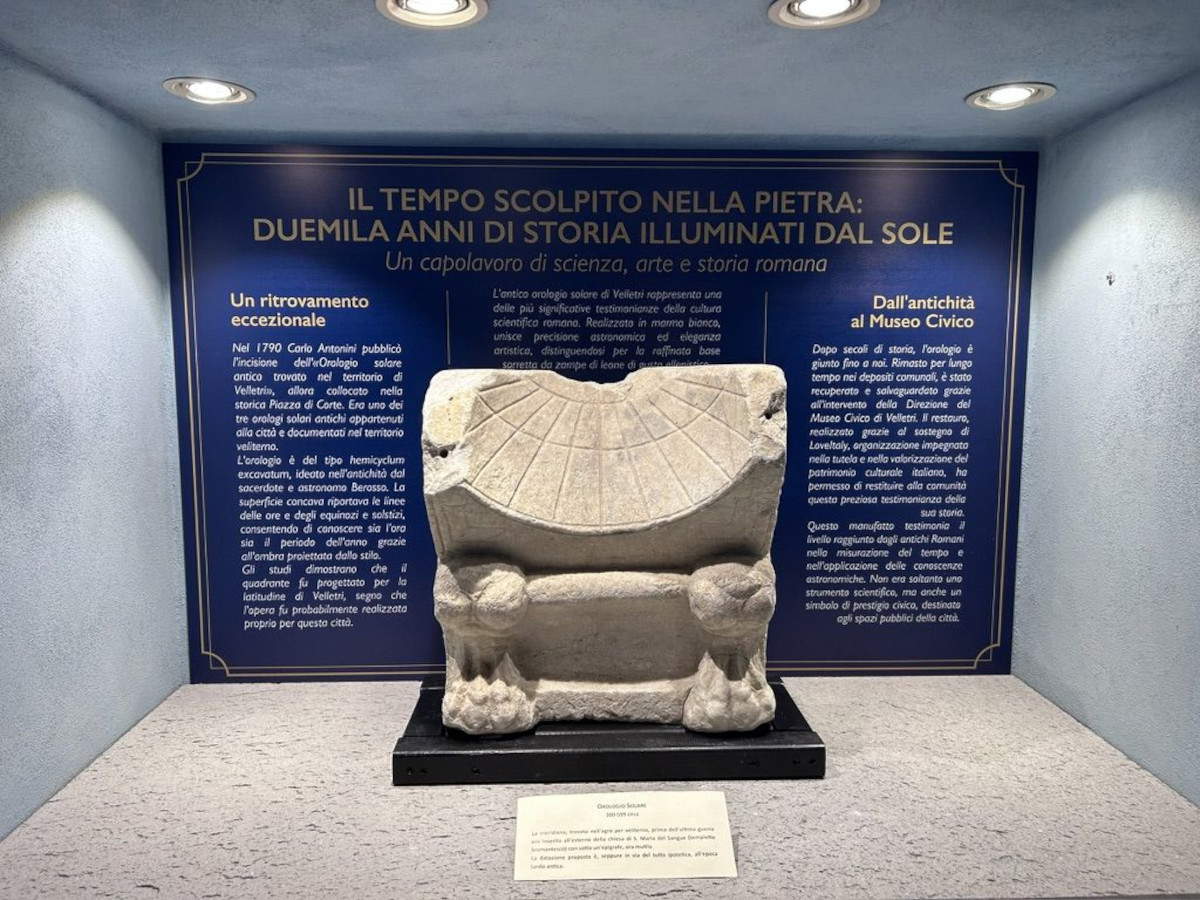
According to scholars, different events may have become intertwined over time: on the one hand, the presence of other sundials in settings associated with the Borgia family; on the other, the cardinal’s donations of relics to the confraternity. This offers a possible explanation for the origin of this tradition, though it requires further investigation.
The presence of the sundial on the facade of the Tempietto, however, has been documented since at least 1829. In that year, the Velletri historian Tommaso Bauco described it as being located above the entrance portal, supported by a stone base decorated with ovule and palmette motifs, likely constructed at a later date. The clock was accompanied by an inscription identifying it as the *Horologium Berosianum* and noting its discovery in the territory of Velletri. The clock remained on the façade of the Tempietto until the 1930s, when the building was converted into a memorial dedicated to those who fell in World War I. On that occasion, it was removed and replaced by two marble fasces and a large commemorative inscription; just a few years later, the bombings of 1944 caused severe damage to the structure. After its removal, the clock was transferred to and housed at City Hall.
Another key milestone in reconstructing its history dates back to the summer of 1971, when the American archaeologist Sharon Gibbs traveled to Velletri to study the artifact firsthand. On that occasion, she took measurements and made sketches, which were subsequently published in 1976 as part of her study on Greek and Roman sundials, in which the Velletri specimen was included in the catalog. The documentation produced by Gibbs is now a particularly useful source for reconstructing the artifact’s state of preservation. In her drawings and photographs, likely dating from the same period, both of the lion’s paws that supported the artifact are still visible. A different situation is evident in the photographic documentation attached to the 1972 ICCD record, in which one of the two paws is missing. Further losses are documented in the photographs published in 2003 by Nicola Severino, who revised and updated Gibbs’s catalog. The images, in fact, reveal new gaps in the upper part of the dial compared to the condition recorded in the early 1970s. Finally, in 2015, the Veliterno Archaeological Group dedicated a publication to the clock, helping to refocus attention on its importance and its historical and conservation history.
By comparing the various sources, Rebecca Picca Orlandi and Cecilia Balsi were able to reconstruct, at least in part, the changes the artifact has undergone and to identify the main parts lost over time. This research was essential for properly planning the recent restoration project.
Before the widespread use of mechanical clocks, instruments such asthe hemicyclium allowed people to tell the time through the shadow cast by the gnomon onto a graduated surface. The measurement of solar time played an important role in the organization of daily life, public activities, and religious practices.
As Director Raffaella Silvestri noted during the presentation, the purpose of the restoration can be summed up in one sentence: “The ancients built it to measure time; we are restoring it so that time does not erase their memory.”
|
| Velletri Welcomes Back Its Roman Sundial: Restored Using 3D Printing, It Returns to the Nardini Museum |
Warning: the translation into English of the original Italian article was created using automatic tools. We undertake to review all articles, but we do not guarantee the total absence of inaccuracies in the translation due to the program. You can find the original by clicking on the ITA button. If you find any mistake,please contact us.