



by Redazione 20/10/2026


Categories: Crafts / Disclaimer
In Urbino, two young artisans, Eugenia Hemmeler and Luig De Lucia, founded KAMERA, a workshop dedicated to the handcrafted creation of geometric solids that span the history of art and mathematics. The first chapter of the project draws inspiration from Plato, Euclid, and the five Platonic solids, in keeping with Urbino’s humanistic tradition.


What connects the compass held by the surveyor in Raphael’s *School of Athens* to a wooden object crafted today in a workshop in Urbino? At first glance, nearly five centuries separate the fresco painted in the Vatican Rooms from the work of Eugenia Hemmeler and Luigi De Lucia, founders of KAMERA, an artisan workshop dedicated to the handcrafted creation of polyhedra. Yet geometry itself provides a common thread: the solid shapes that engaged mathematicians and philosophers of antiquity have also become objects to be built, observed, and studied through the work of the hands.

The project originated in Urbino, a city with a long tradition of mathematical and artistic studies, and combines craftsmanship, research, and outreach. Hemmeler and De Lucia create wooden polyhedra and accompany the objects with stories about their origins, geometric properties, and connections to art history. The first chapter of this journey takes its cue from *The School of Athens*, the fresco that Raphael painted between 1509 and 1511 in the Stanza della Segnatura in the Vatican for Pope Julius II. At the center of the composition are Plato and Aristotle, while in the lower right corner a man bent over is drawing a figure with a compass, surrounded by several students; he is traditionally identified as Euclid. A little further on, a young man wearing a black cap looks toward the viewer: according to established identification, this is Raphael himself. For KAMERA, this scene serves as a starting point to explore how geometry evolved from ancient texts to Renaissance images and, from there, to the possibilities of contemporary construction.


Plato, Euclid, and Geometric Knowledge in The School of Athens
Raphael’s *School of Athens* depicts the rational pursuit of truth, embodied by some of antiquity’s leading thinkers. In the painting, Plato and Aristotle occupy the center of the composition: the former holds the *Timaeus* and points upward; the latter holds the *Nicomachean Ethics* and extends his hand before him. A common interpretation sees in their gestures two distinct philosophical orientations: Plato’s reference to intelligible realities and ideal forms, on the one hand, and Aristotle’s focus on the concrete world and experience, on the other.

For KAMERA’s narrative, the decisive detail is the book Plato is holding: the *Timaeus* is the dialogue in which the philosopher addresses the origin and order of the universe, attributing a fundamental role to geometry in explaining the structure of the cosmos. This text serves as the starting point for the section dedicated to the five Platonic solids—geometric figures that have spanned the history of mathematics and can still be studied today through their physical construction.
The second point of reference is the geometer depicted in the lower right corner of the fresco. Traditionally identified as Euclid, he is shown drawing a figure with a compass, demonstrating a geometric construction to his students (his face, in turn, is recognized as that of the architect Donato Bramante). The geometer’s gesture closely mirrors the practice of a workshop that constructs solids: a form is not merely observed but takes shape through a sequence of operations. Geometry becomes visible in the drawing, in the relationships between the parts, and in the precision required to achieve a coherent structure.
What Are the Five Platonic Solids (and How KAMERA Constructs Them)
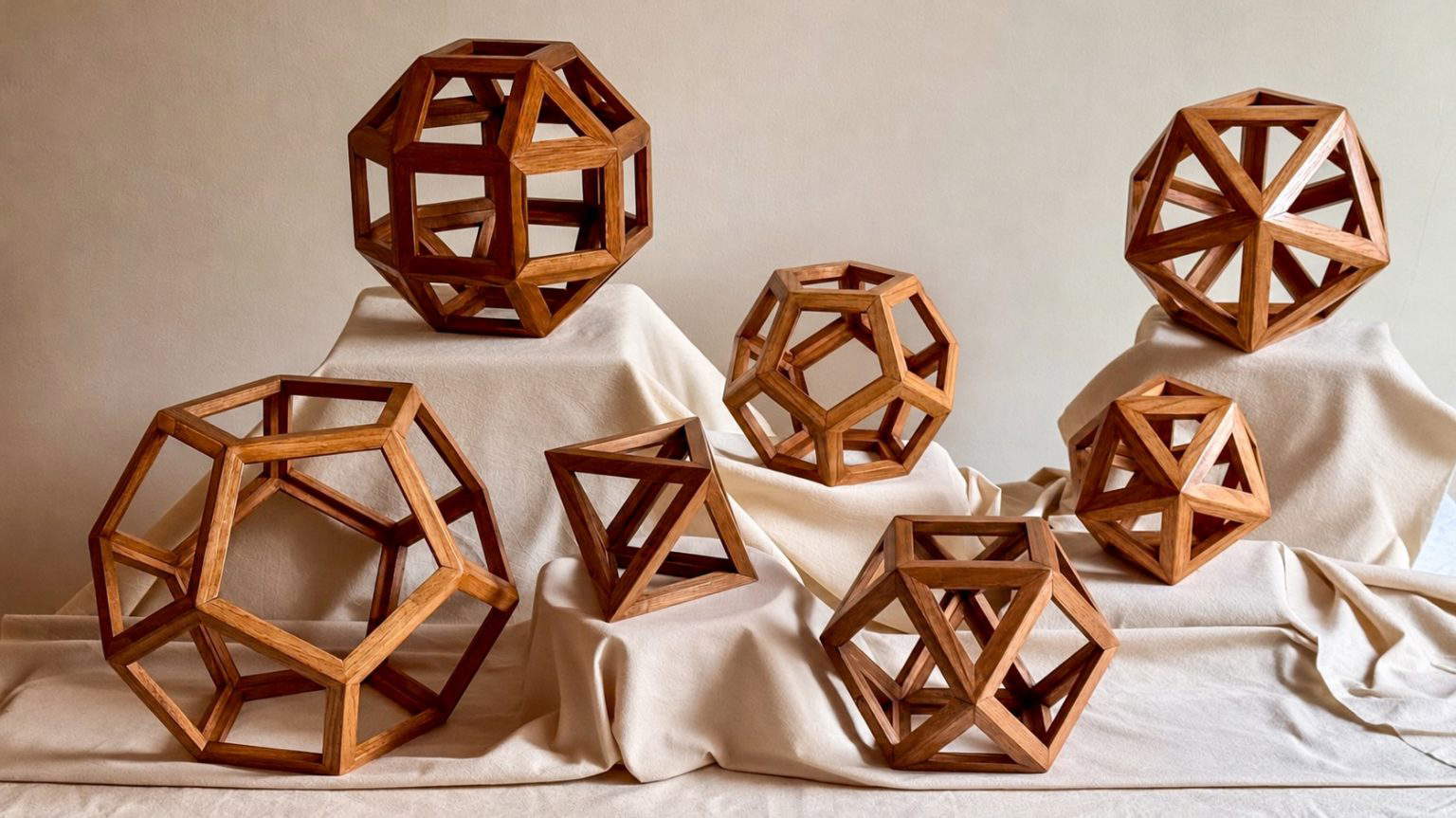
Platonic solids are regular convex polyhedra characterized by faces consisting of identical regular polygons and by an identical arrangement of the faces around each vertex. There are five such shapes: the tetrahedron, the cube, the octahedron, the dodecahedron, and the icosahedron. The tetrahedron has four equilateral triangular faces; the cube is composed of six squares; the octahedron has eight equilateral triangles; the dodecahedron is formed by twelve regular pentagons; and the icosahedron comprises twenty equilateral triangles. In each case, the regularity of the faces and their arrangement define a solid with precise geometric properties. To form a vertex, at least three faces must meet, and the sum of the angles converging at that point must be less than 360 degrees. In the case of equilateral triangles, three arrangements are possible: three, four, or five triangles around a vertex. With squares, only one arrangement is possible—with three faces—as is the case with regular pentagons. Three regular hexagons, on the other hand, already add up to 360 degrees and lie flat on the plane, without forming a vertex of a convex solid. These conditions explain why there are only five regular convex polyhedra: the limit applies precisely to this family of solids; other geometries, including those of stellated polyhedra, allow for the exploration of different configurations.
The history of these figures predates Plato: research on regular polyhedra developed within Greek mathematics, and Theaetetus, a contemporary of the philosopher, played an important role in their study. The name by which they are known, however, refers above all to the meaning Plato attributed to them in his interpretation of the structure of the universe. In the *Timaeus*, four of the five solids are associated with the elements. The tetrahedron corresponds to fire, the octahedron to air, the icosahedron to water, and the cube to earth. The dodecahedron occupies a distinct position, linked to the universe as a whole. The different shapes of these figures thus become part of a philosophical explanation of matter and the cosmic order.
It is precisely this transition from abstraction to matter that is central to KAMERA’s work: a polyhedron can be described through mathematical properties, represented on a surface, or reconstructed mentally, but its construction also allows one to directly understand its spatial relationships. In wood, the faces become tangible surfaces, and the edges reveal the solid’s structure.
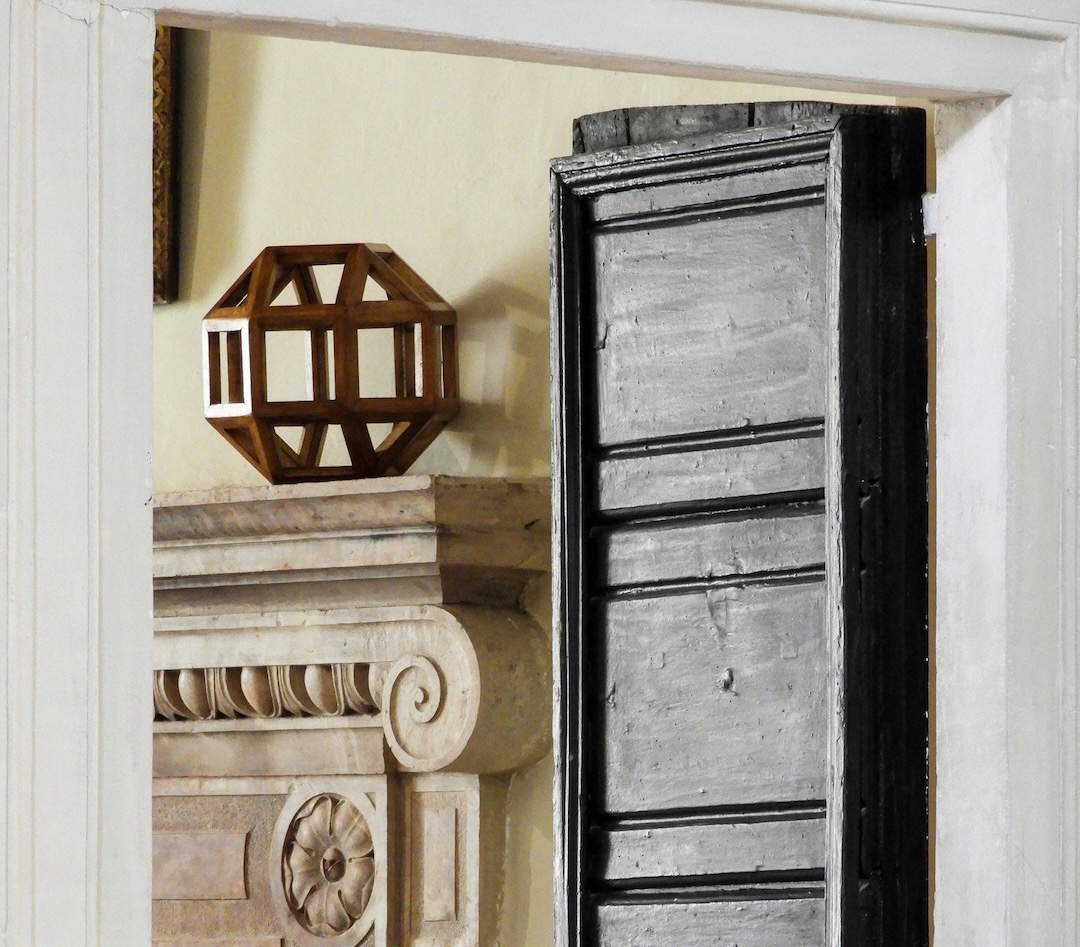
The workshop’s collection includes various polyhedra made of chestnut wood, including the cubottahedron, the dodecahedron, the icosahedron, the octahedron, and the rhombicubottahedron. The Platonic solids serve as the initial reference point for the project, but the research also extends to more complex shapes, which broaden the range of possible constructions. They are all available for purchase in the workshop’s online store, with prices ranging from 90 to 190 euros.
Why a workshop crafting polyhedra in Urbino
The choice of Urbino as the workshop’s location is linked to the city’s cultural history. In the 15th century, under Federico da Montefeltro, Urbino became one of the centersof Italian humanism, with a court where art, philosophy, and mathematics developed in close connection. Geometry was not merely a theoretical discipline: it interacted with perspective, the representation of space, architecture, and artistic practices. Piero della Francesca, a painter and mathematician who delved deeply into the study of perspective and geometric forms, is part of this tradition. Another key figure was Luca Pacioli, author of *De divina proportione*, published in 1509, in which polyhedra play a central role in his reflections on proportions. The work is accompanied by drawings by Leonardo da Vinci, who depicted the solids using open structures capable of illustrating the relationships between faces and edges.
The tradition of such studies did not end with the Renaissance: in Urbino, it continued with Federico Commandino and the Urbino school of mathematics, which helped keep geometric research alive and ensure the circulation of scientific texts. Meanwhile, in the rest of Europe, polyhedra became the subject of research by artists and mathematicians such as Albrecht Dürer, Wenzel Jamnitzer, Augustin Hirschvogel, and Lorenz Stoer. Between the 16th and 17th centuries, these shapes were used in the study of perspective, optics, and the relationship between art and science.
It is this rich cultural tapestry that KAMERA aims to explore through its objects. The workshop does not merely reproduce geometric figures: the objects are accompanied by a narrative in which each shape can serve as a starting point for exploring texts, images, and key figures in the history of mathematics and art. In short, craftsmanship also serves as a means of outreach.
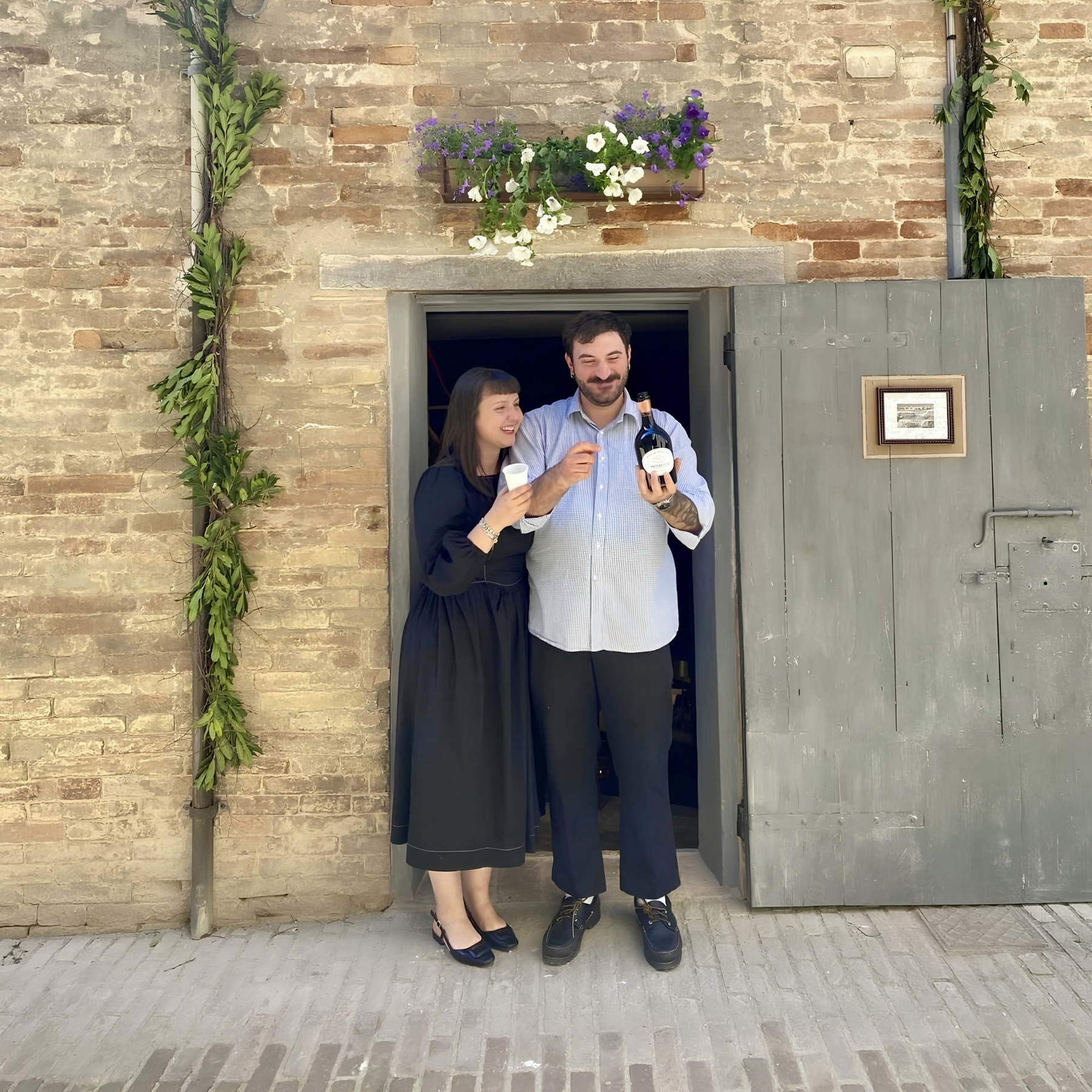
Eugenia Hemmeler and Luigi De Lucia thus returned to Urbino and founded KAMERA, a space that combines an artisan workshop, an exhibition space, and educational activities. The project stems from the convergence of expertise in communication and manual labor, with the aim of pairing the objects—crafted from materials that tell their own story—with that narrative.
The construction of polyhedra thus becomes part of a journey of discovery: it is not merely a matter of achieving a precise shape, the two artisans explain, but of engaging with a wealth of ideas that spans mathematics, philosophy, and the visual arts. The solids are brought back into everyday life through objects that can be observed from different angles and understood in terms of their spatial relationships. For KAMERA, the return to Platonic solids is not an endpoint, but the beginning of a journey that continues toward other polyhedra, other books, and new creations. In Urbino, centuries after Plato and Raphael, a contemporary workshop picks up that thread and brings it to the workbench, transforming figures studied by mathematicians into objects to be built and observed. The connection between art and geometry is thus not confined to the history of the Renaissance but finds concrete form in the work of the hands.
|
| Urbino: Two Young Artisans Create Wooden Polyhedrons Inspired by the Renaissance |
Warning: the translation into English of the original Italian article was created using automatic tools. We undertake to review all articles, but we do not guarantee the total absence of inaccuracies in the translation due to the program. You can find the original by clicking on the ITA button. If you find any mistake,please contact us.