





In 1616, Pope Paul V Borghese officially bestowed an exceptional honor upon Marcello Provenzale, describing him—in the Rome of the nascent Baroque era—as the inventor of “a new style of mosaic-making that is quite different from and far more beautiful than the ancient one.” That declaration marked the culmination of an extraordinary career. Born in Cento in 1576, Provenzale moved to Rome at the end of the sixteenth century, where he developed an innovative mosaic style that would profoundly influence the history of art. His work would usher in a golden age for mosaic art, one that would last for at least two centuries.
To mark the 450th anniversary of the artist’s birth, the “Il Guercino” Civic Art Gallery in Cento is dedicating its first major monographic exhibition to him, running from October 2, 2026, to January 10, 2027, to restore him to his rightful place in the history of Italian art.
The exhibition *Marcello Provenzale da Cento. A Genius of Baroque Mosaic Art in the Rome of the Borghese aims to highlight Provenzale as a great innovator of mosaic technique, an interpreter of the Catholic Church’s new spirituality, and a refined creator of precious collectible mosaics commissioned by Rome’s most prominent families, particularly the Borghese. Curated by Francesca Cappelletti, Paolo Di Buono, and Giovanni Sassu, the exhibition was developed in collaboration with the Galleria Borghese in Rome. An initial thematic exhibition dedicated to his masterpieces in fine easel mosaics was presented at the Galleria Borghese from March 17 to May 10, 2026. The exhibition now comes to Cento in an expanded version, enriched with new works, comparative displays, and evocative images. The initiative is the result of an agreement between the Municipality of Cento and the Cento Entrepreneurs’ Association for Culture, with the support of the Cassa di Risparmio di Cento Foundation and the collaboration of the Friends of the Cento Art Gallery Association. To carry out the project, the Municipality and the Association of Entrepreneurs have also entered into a special public-private partnership, as provided for in Article 134 of Legislative Decree 36/2023, a mechanism designed to foster new forms of collaboration between public administrations and the business community.
Provenzale was born into a wealthy family that was well-established in Cento society. After receiving his early training in painting in his hometown, he moved to Rome to study under the master Paolo Rossetti, who was also a native of Cento and already an expert in the art of mosaic. It was primarily on the construction sites of St. Peter’s Basilica that Provenzale found his main field of experimentation. There, he became part of the renewed interest in mosaics promoted by Gregory XIII in the Gregorian Chapel between 1578 and 1580, when this technique was rediscovered as a language capable of expressing the continuity between the early Church and the Church renewed after the Council of Trent.
Between 1600 and 1602, and again in 1611 and 1612, Provenzale worked on Michelangelo’s great dome and the Clementine Chapel, creating figures of saints and angels of exceptional beauty. In 1614, he painted the Borghese coat of arms on the vault of the nave of St. Peter’s Basilica for Pope Paul V. In 1617–1618, he also oversaw the restoration of Giotto’s famous Navicella, a project that Giovanni Baglione praised for its ability to harmoniously blend tradition and modernity.
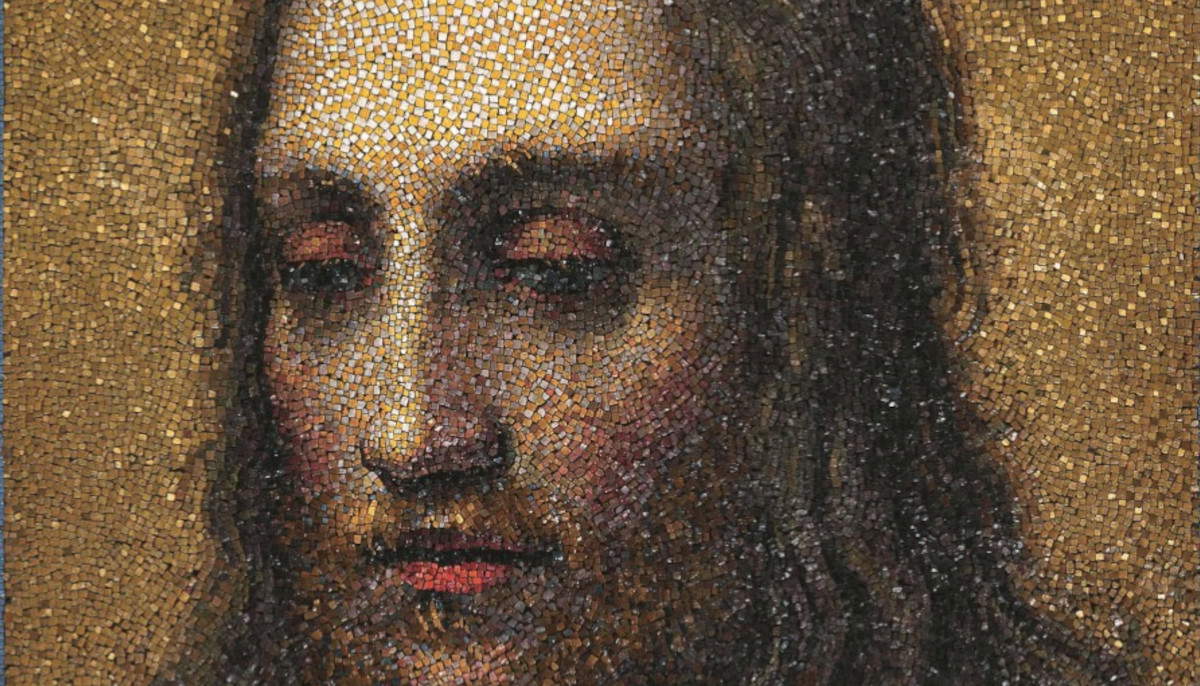
The pinnacle of Provenzale’s artistic exploration is represented by his extraordinary easel mosaics. Beginning in 1600, the artist developed an innovative technique based on the use of tiny glass tesserae and the pioneering application of what is known as “thread mosaic.” This process allowed him to achieve effects of extraordinary refinement, rendering the nuances of light and color with great precision. The glazes were fused into extremely thin glass rods, which were then cut into tiny segments and arranged with extreme precision. In this way, Provenzale was able to create soft color transitions, nuances, and graphic details that were a far cry from the appearance of traditional mosaics. His innovation thus foreshadowed some of the future developments in 18th-century Roman micromosaics. His works could rival painting in terms of expressiveness, yet offered a quality that painting could not provide: the extraordinary durability of the glass material. The portrait thus became a sort of portable monument, while the sacred image could be transformed into an object intended for contemplation and prayer, capable of preserving its intensity over time.
Among the highlights of the exhibition is the Face of Christ, signed OPUS MARCELLI. The work belonged to Cardinal Pietro Aldobrandini as early as before 1603, subsequently passed into the collection of Federico Zeri, and today belongs to the Grimaldi Fava Collection in Cento. It is a work of extraordinary spiritual intensity, in which the silent and meditative dimension of Christ’s face achieves exceptional expressive depth. Intended for personal and intimate devotional use, the mosaic represents one of the most significant moments in the artist’s creative journey. Alongside The Face of Christ, several of the major masterpieces housed at the Borghese Gallery will be on display, including the Madonna and Child from 1600,Orpheus from 1618, and the Portrait of Paul V from 1621.
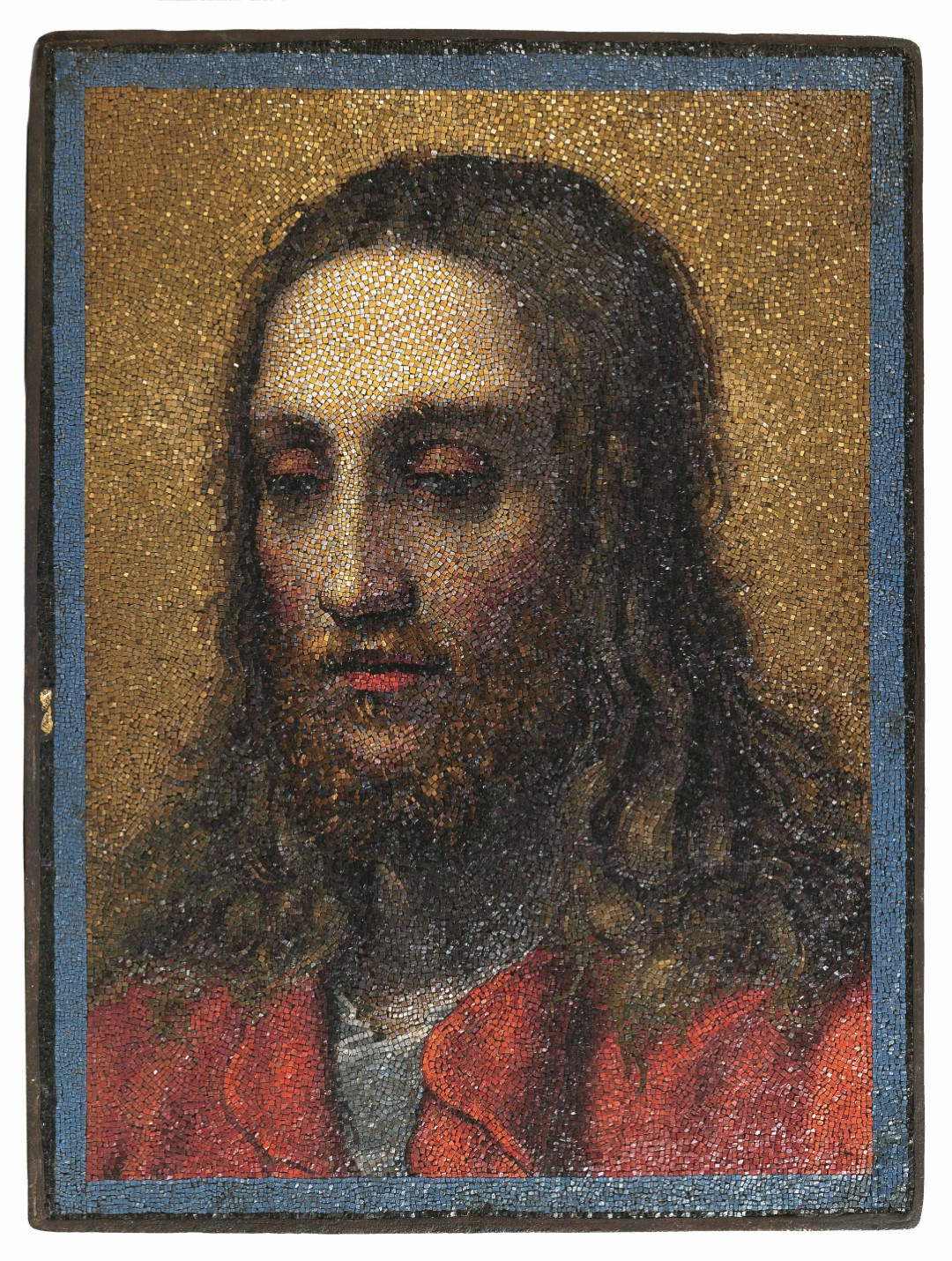
Added to these is the *Owl with Birds* from 1615, now housed at the Museo degli Argenti in Florence. The works were created for Cardinal Scipione Borghese and Pope Paul V, patrons who recognized Provenzale’s talent and his ability to transform an ancient technique into a new, refined, and deeply spiritual artistic language. The exhibition also aims to explore Marcello Provenzale’s artistic roots, which are particularly evident in his hometown. In Cento, in the Collegiate Church of San Biagio, the artist painted the altarpiece depicting the Transfiguration, signed and dated 1606, while another significant work,The Agony of Jesus in the Garden, is now housed in the Pinacoteca. The latter is said to have left a profound impression on the young Guercino. It was precisely from the relationship between the two artists that a collaboration arose, one destined to have significant consequences for the career of the painter from Cento: in 1619, in fact, the first painting by Guercino to reach Rome was *Erminia Comes to the Aid of the Wounded Tancredi*, commissioned by Marcello Provenzale. The work is said to have helped pave the way for the young artist’s recognition in Rome.
The exhibition will be enriched by ultra-high-resolution projections of the mosaics created by Provenzale in St. Peter’s Basilica. Some of these works have recently been restored and will be presented through photographs taken for the first time.
The exhibition also features portraits of the artist, whom Giovanni Baglione described as a “loving man… of excellent character.” Of particular rarity is the bronze funerary bust preserved in the entrance corridor to the Collegiate Basilica of San Biagio. This is a self-portrait created by Provenzale himself with remarkable sculptural skill, just one year before his death. Likethe *Prayer in the Garden*, the bust will also be restored for the exhibition and presented to the public for the first time.
The exhibition concludes with a section dedicated to the popularity and evolution of Roman micromosaics between the 18th and 19th centuries. The exhibition thus allows visitors to understand the scope of the innovation introduced by Provenzale and the lasting influence exerted by his technical experimentation.
The exhibition in Cento thus aims to present a comprehensive portrait of an artist who was able to blend painting, mosaic technique, spirituality, and formal exploration, transforming the mosaic into a refined and modern art form. A leading figure of Baroque Rome who, thanks to his extraordinary inventiveness, helped breathe new life into an ancient art form, leaving a legacy destined to endure through the centuries.
 |
| Cento is hosting the first major solo exhibition dedicated to Marcello Provenzale, the 17th-century mosaic genius |

Warning: the translation into English of the original Italian article was created using automatic tools. We undertake to review all articles, but we do not guarantee the total absence of inaccuracies in the translation due to the program. You can find the original by clicking on the ITA button. If you find any mistake,please contact us.























 IT
IT FR
FR DE
DE ES
ES CN
CN


