




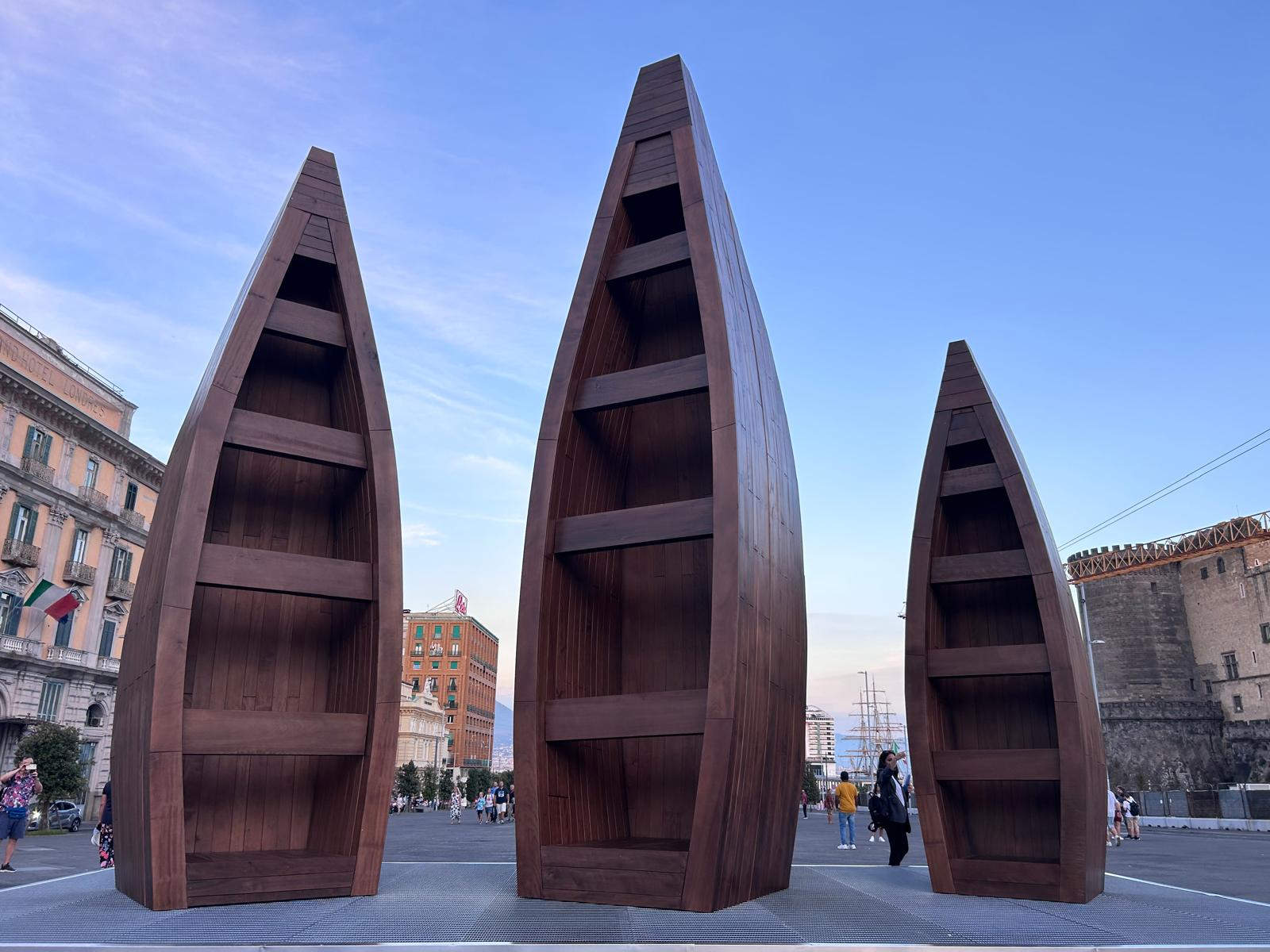
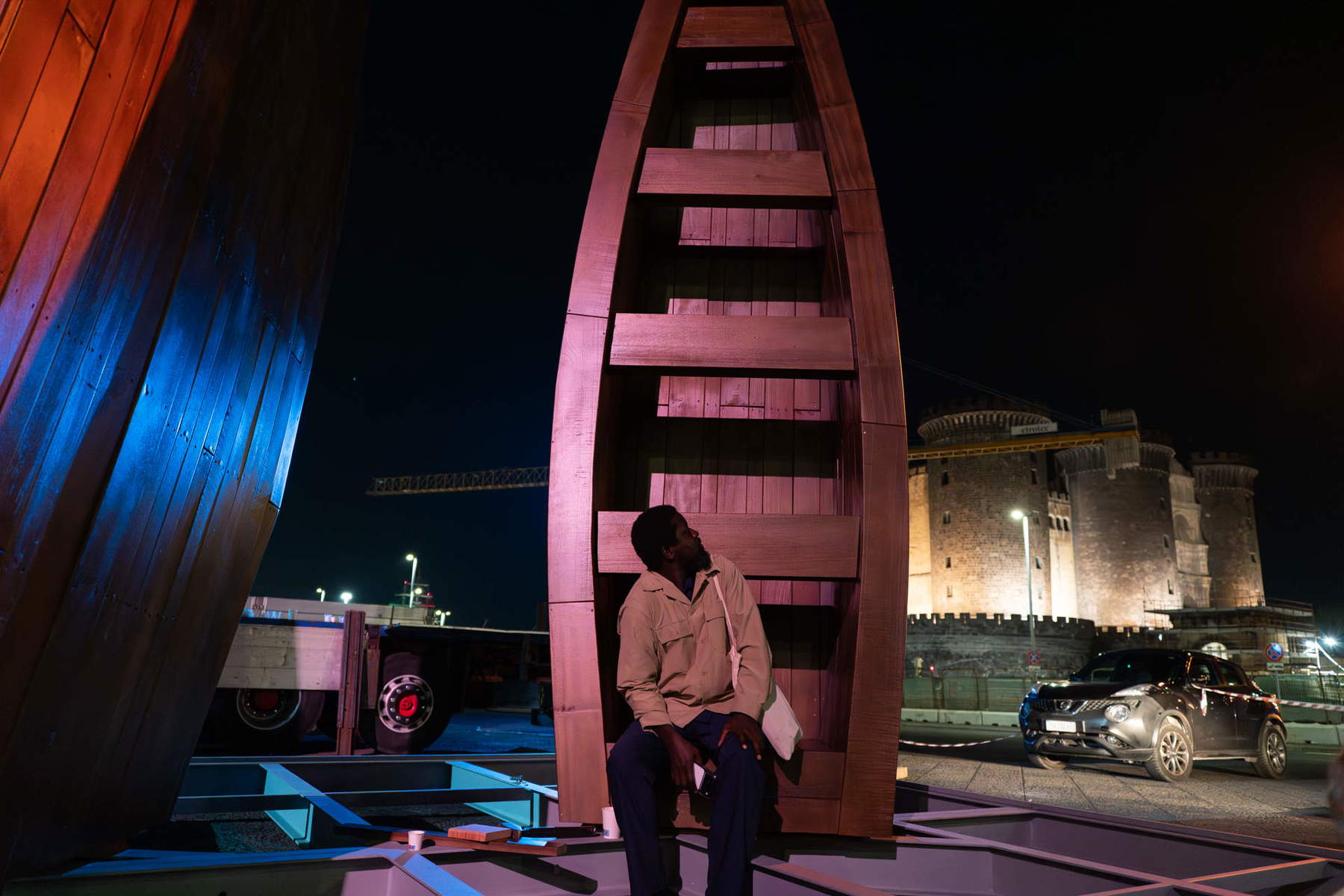
From September 21 to November 18, 2026, Piazza Municipio in Naples will host “Voyageur,” a new public art installation by Ibrahim Mahama, curated by Vincenzo Trione. The Ghanaian artist, one of the leading figures in international contemporary art, has been commissioned to engage with one of the city’s most iconic public spaces through a monumental, never-before-seen work consisting of three boats built specifically for the occasion.
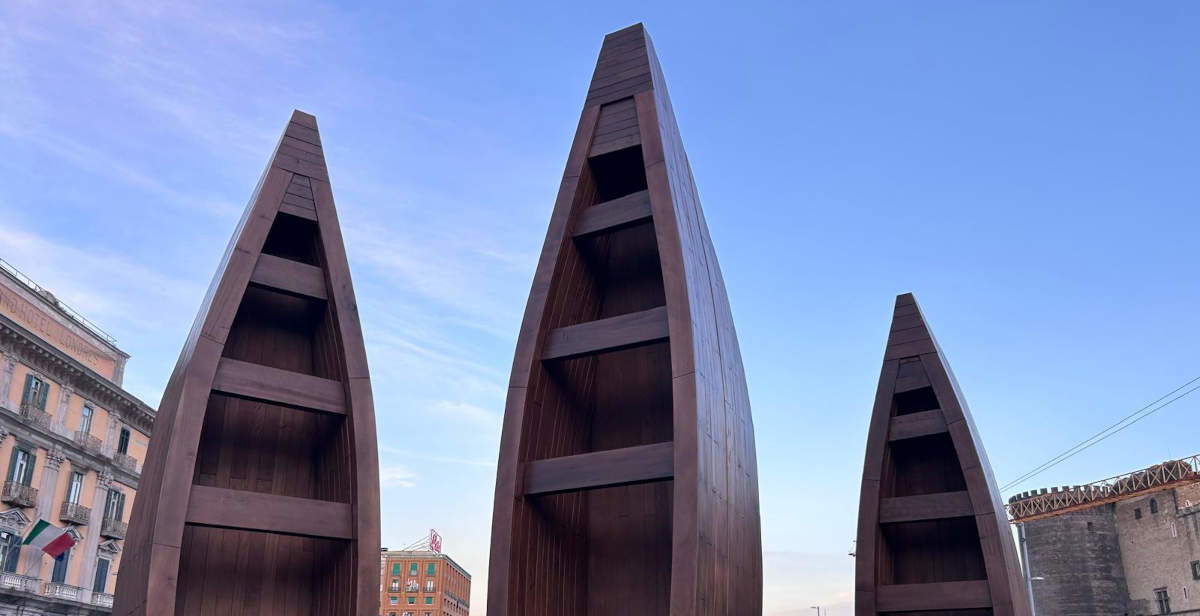
The three boats, built of wood using traditional Ghanaian designs and techniques, stand approximately 5, 7, and 8 meters tall, respectively. Partially embedded in the square’s ground, they take on a tangible yet alienating presence, altering the perception of urban space and introducing an element linked to travel into a place that, by its very nature and location, is connected to mobility and exchange. The installation thus establishes a relationship between the idea of movement and that of permanence, through objects designed to sail but here stripped of their original function.
The boats are situated in the center of Piazza Municipio, recently restored according to a design by Portuguese architect Álvaro Siza and overlooking the port of Naples. Their presence connects two geographical areas—West Africa and the Mediterranean—united by a long history of navigation, trade, exchange, and crossings. It is precisely this relationship with these geographies that constitutes one of the central elements of the installation, which is part of Mahama’s research dedicated to themes such as migration, the circulation of goods, labor, memory embedded in materials, intercultural exchange, and the transformations of communities.
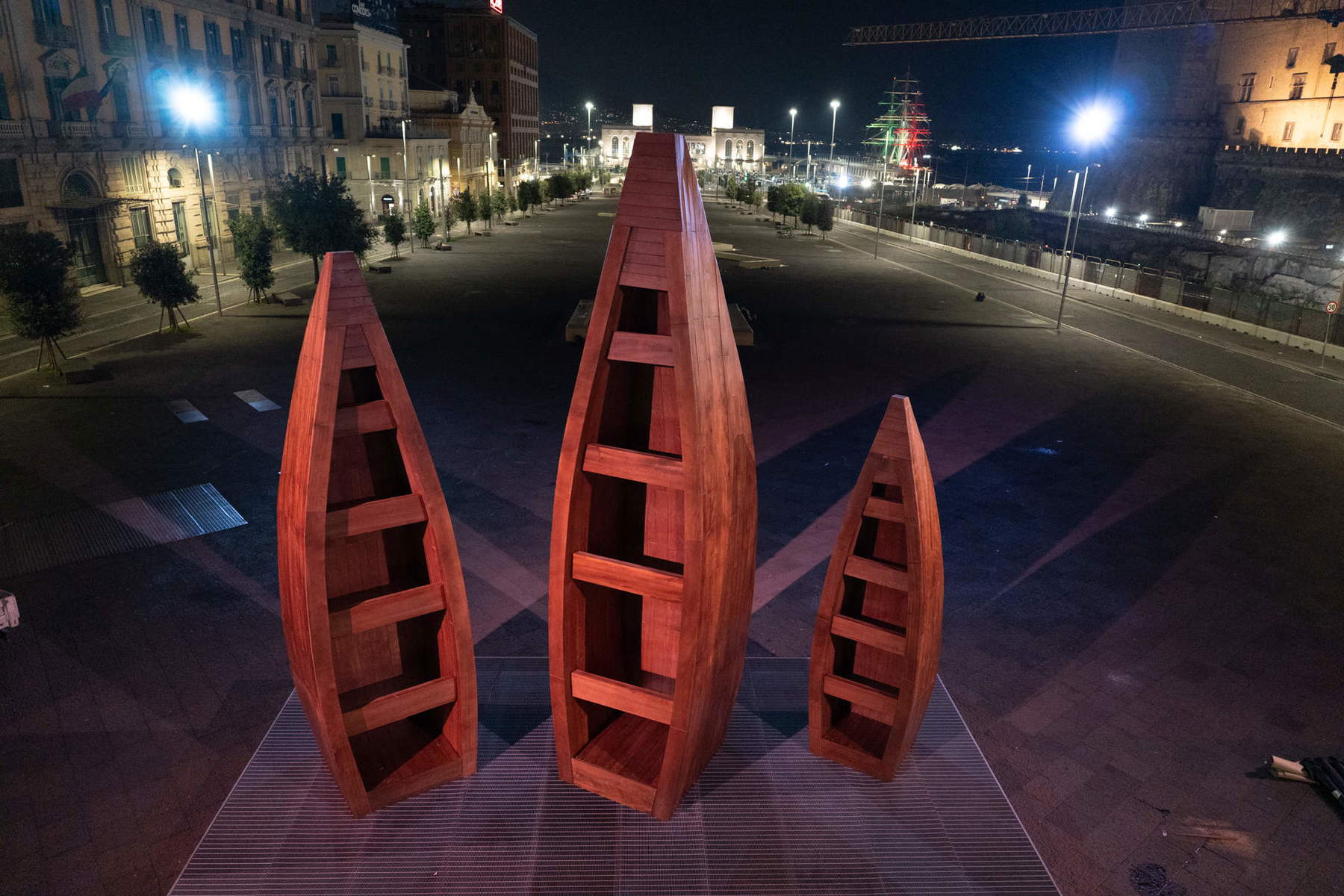
The title *Voyageur* introduces into the interpretation of the work the figure of the traveler who crosses a geographical and human space in search of an “elsewhere.” The three boats can be associated with contemporary travelers crossing the Mediterranean—often under conditions dictated by difficult economic, social, and political circumstances—and with the experiences of those who brave the sea in search of safety and a new chance at life. The placement of the boats, partially embedded in the ground of the square, also evokes the tragic dimension of these crossings and the fate of those who fail to reach the shore.
The decision to build new boats using traditional Ghanaian techniques also introduces a specific material memory into the Neapolitan square. Wood—a material destined to interact with water and navigation—is removed from its original context and transferred to an urban space that looks directly out onto the Mediterranean. The boats do not sail, but their form retains a reference to movement and the possibility of departure.
In this state, they can also be interpreted as sails still in the wind—presences that, though no longer able to move on the water, continue to embody the idea of the journey. Facing the port of Naples, they thus become images of possible journeys and evoke the possibility of crossing borders, coming into contact with other communities, and imagining new forms of coexistence. The sea is conceived not only in its geographical dimension but also as a place of passage, encounter, welcome, and peace.
The installation thus offers multiple levels of interpretation, linked both to the history of the materials and techniques used and to the contemporary experiences of those crossing the Mediterranean. The placement of the boats in the square also makes the relationship between Naples and the sea immediately apparent—an element that constitutes a historical and geographical component of the city. In this context, Voyageur addresses the theme of travel through a work that connects a West African building tradition with a Neapolitan public space.
“Voyageur” is the second event in the “Napoli Contemporanea 2026” series, a program of exhibitions and installations launched in 2023 with the aim of strengthening the presence of contemporary art in the city through projects designed for public spaces and symbolic sites in Naples. The program was initiated by Mayor Gaetano Manfredi and curated by Vincenzo Trione, the mayor’s advisor on contemporary art and museum activities.
The 2026 program was inaugurated by the exhibition*C attivi pensieri* by Robert Crumb, held from late May through August at Castel Nuovo – Maschio Angioino. The exhibition route included the Palatine Chapel, the Chapel of the Souls in Purgatory, and the archaeological area of the complex. With *Voyageur*, the program returns to the urban space and brings a monumental work to the heart of the city.
In previous years, *Napoli Contemporanea* has brought together exhibitions, installations, and projects by Italian and international artists. In 2025, the exhibitions *Elysian Fields* by Jim Dine and *Napoli metafisica* by Mimmo Jodice were presented, along with the urban installations *Silent Hortense* by Jaume Plensa and *OH! * by Marcello Jori. The year 2024 featured the works *Tu si ’na cosa grande* by Gaetano Pesce and *Io contengo moltitudini* by Marinella Senatore. The program had been launched in 2023 with Michelangelo Pistoletto’s *Venere degli stracci * and Antonio Marras’s *Questi miei fantasmi *. That same year, Francesco Vezzoli created *Lacrime di coccodrillo * for the Castel Nuovo Prisons. In 2024, projects were also developed for MetaPan, the Museum in the Metaverse, featuring works by Chiara Passa, Davide Quayola, Auriea Harvey, and Bianco-Valente.
The creation of *Voyageur* is sponsored and funded by the City of Naples as part of *Napoli Contemporanea*, with organization and communications handled by Bam Arte. The Academy of Fine Arts of Naples is involved in the photographic documentation of the project. Performances by Maestro Enzo Avitabile are also scheduled for the opening.
“Mahama’s new installation in Piazza Municipio, for Napoli Contemporanea 2026, brings several highly topical themes to the heart of the urban space: cultural exchange, peaceful coexistence among peoples, and the sea as a crossroads of encounters,” says Mayor Gaetano Manfredi. “In the square overlooking the Port of Naples, three large wooden boats, built using traditional Ghanaian techniques, will face the sea, symbolizing—in the week leading up to the America’s Cup pre-regattas—the city’s commitment to peace and hospitality. I am very pleased with the contemporary art projects curated by Vincenzo Trione. Naples, a city of immense historical and cultural heritage, proves every day that it is a destination of choice for art lovers. Its commitment to contemporary art continues to grow, hosting exhibitions, installations, and performances of great value—often premieres—in unconventional venues: squares, streets, and spaces open to the public. I thank the artist Ibrahim Mahama for his work and all those who, in various capacities, have believed in Voyageur. A busy week lies ahead, a week in which the spotlight will be on the city: Naples, through public art as well, can tell the world that peace, solidarity, and the coming together of peoples are a force capable of enriching the entire community.”
“The arrival of Ibrahim Mahama’s *Voyageur* in Piazza Municipio marks a moment of extraordinary significance,” states Sergio Locoratolo, cultural coordinator for the City of Naples. “Having one of the most powerful and authoritative voices on the global art scene represented in Naples demonstrates just how much our city continues to be a cultural hub of the highest order. This project is part of the strategic vision that Mayor Manfredi and the City Administration are pursuing with determination. Through the *Napoli Contemporanea* program, we have sought to strengthen the city’s public and international role, transforming squares and symbolic sites into spaces dedicated to dialogue and collective reflection. At the same time, our cultural policy is based on the idea of complementing the works of the great masters with widespread support for local creativity. Through public calls for proposals—such as the one that launched the “Visioni Contemporanee” exhibition—we have sought to promote young talents, artists, and local organizations, bringing contemporary art outside traditional circuits and spreading it throughout the neighborhoods—from Scampia to San Giovanni a Teduccio, all the way to the historic center. We believe that art should not merely enrich the cultural landscape, but serve as an important tool for understanding and interpreting the present—one capable of helping us rediscover a sense of community, respect for the common good, and a vision for the future.”
“Mahama’s Three Boats,” says curator Vincenzo Trione, “placed at the center of the square redesigned by Álvaro Siza, accentuate the mysteriously metaphysical dimension of this space and become ambiguous images: on the one hand, they evoke the tragic fate of those attempting to cross the Mediterranean; on the other, they recall sails hoisted in the wind, facing the port of Naples. Together, they are monuments to memory and to the possibility of travel, metaphors for small yet necessary utopias, forms of hope.”
“In Naples, a city so deeply connected to archaeology, the sea, and a long history of exchanges and crossings, I thought of these three vessels as forms of travel,” says Ibrahim Mahama. “They are boats that do not sail, but stand within the city’s space: they carry with them the idea of movement and, at the same time, that of something that remains.”
 |
| Ibrahim Mahama brings three wooden boats from Ghana to the heart of Naples |

Warning: the translation into English of the original Italian article was created using automatic tools. We undertake to review all articles, but we do not guarantee the total absence of inaccuracies in the translation due to the program. You can find the original by clicking on the ITA button. If you find any mistake,please contact us.



















 IT
IT FR
FR DE
DE ES
ES CN
CN


