




by Redazione 01/09/2026



Categories: Exhibitions / Disclaimer
In Milan, on Sunday, September 6, Barbara Nahmad will present “Eden, Infinite Love” at the Franco Parenti Theater, an exhibition dedicated to commemorating the founding of the State of Israel and the daily lives of its first generations.

On the occasion of the 27th European Day of Jewish Culture, dedicated this year to the theme of “Love,” artist Barbara Nahmad presents “Eden, Infinite Love,” an exhibition curated by Vittoria Coen that focuses on the memory and lives of those who, in the post-World War II era, contributed to the building of a new society in the State of Israel. The exhibition will be open to the public on Sunday, September 6. The presentation is scheduled for 3:00 p.m. on the same day at the Franco Parenti Theater in Milan, with the artist in conversation with curator Coen.
The project draws on the idea of Eden as the “childhood” of a nation: a space associated with hopes, dreams, ideals, and a connection to a rediscovered land, understood as a defining element of Jewish history and memory. The exhibition, which opened in Tel Aviv in 2014, subsequently embarked on an international tour that brought it, after several stops, to the Jewish Museum of Bologna on the occasion of the European Night of Museums. Nahmad’s work focuses on a period of rebirth marked by material hardships and a strong collective commitment—that of the pioneers who worked in the fields while also studying, dedicated to building a new social reality.


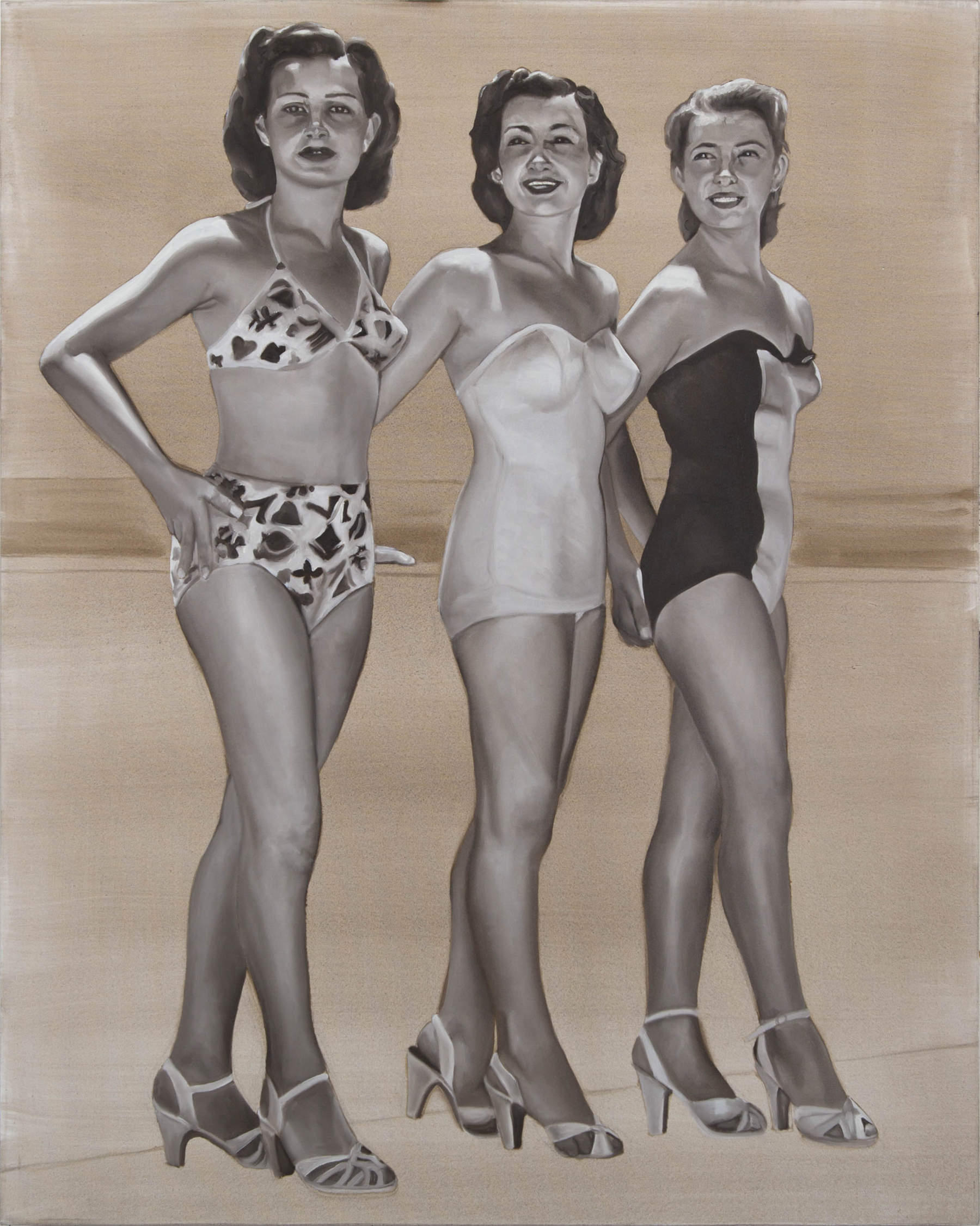
The works convey this context through a low, suspended light, set within a visual dimension that combines memory and dreamlike imagery. At the center are not only historical events, but above all the people and gestures of daily life: the cities, the schools, the streets, the kibbutzim on the edge of the desert. The images document a world still in its infancy, characterized by strong social cohesion, a desire to build a new society, and the presence of culture, religion, tradition, and history as elements of continuity.
The exhibition catalog features essays by Martina Corgnati and Ambassador Avi Pazner, while Vittoria Coen authored the essay *Pitture di Sabbia* dedicated to the project.
The text“ : Pitture di Sabbia,” edited by Vittoria Coen
As curator Coen writes, Barbara Nahmad’s artistic journey has long revolved around the relationship between painting and memory. In the past, the artist has worked on portraits of historical and cultural figures as well as international film stars, approaching her subjects from an aesthetic perspective and through psychological exploration. The starting point is often a photograph taken from magazines—some recent, others not—which is reactivated through painting. The transition from the photographic image to the painted work thus becomes a tool for intervening in memory and restoring vitality to images already filtered by the media’s gaze.
This is the process that has also characterized works dedicated to Pier Paolo Pasolini, Primo Levi, Mao, Elvis Presley, and Marilyn—recognizable figures whom Nahmad has subjected to a painterly reinterpretation capable of elevating them beyond the purely documentary realm. In the essay *Pitture di Sabbia*, the curator identifies memory as the central theme of the artist’s practice. Photography, already interpreted by a first glance, is once again transformed by painting, in a process that combines distance and reappropriation.
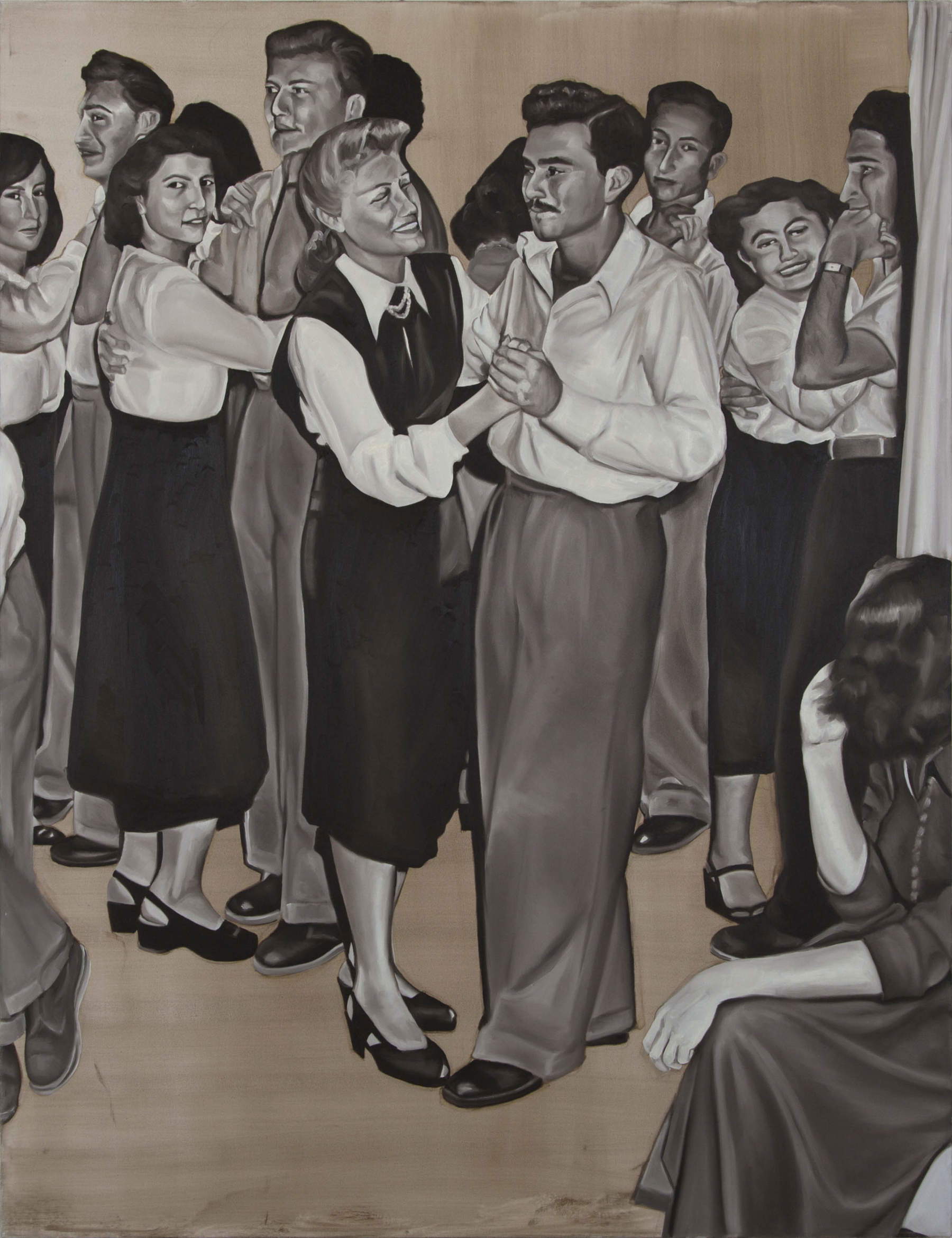
With *Eden*, however, the subject changes. The images no longer depict only public figures and recognizable historical figures, but rather ordinary people—some from the artist’s family memory, others encountered in the pages of magazines. Nahmad reconstructs the period of her return to Israel following the establishment of the new state, focusing on the drive for life and the building of a society through daily labor marked by hardship, sacrifice, and collective mobilization.
This narrative features the artist’s family—his father, mother, and grandfather—alongside nameless men, women, children, and the elderly, all united by the same hopes. The private sphere thus overlaps with the collective one. The scenes depict a simple and arduous life, but also the vision of a future to be built: smiles, gestures, habits, moments of childhood, relationships between couples, work, and community life become fragments of a broader narrative.
A significant change also concerns technique and color palette. In an interview conducted some time ago by Cristiana Curti for ArtsLife, Nahmad described his process as a gradual process of subtraction, aimed at achieving greater simplicity.
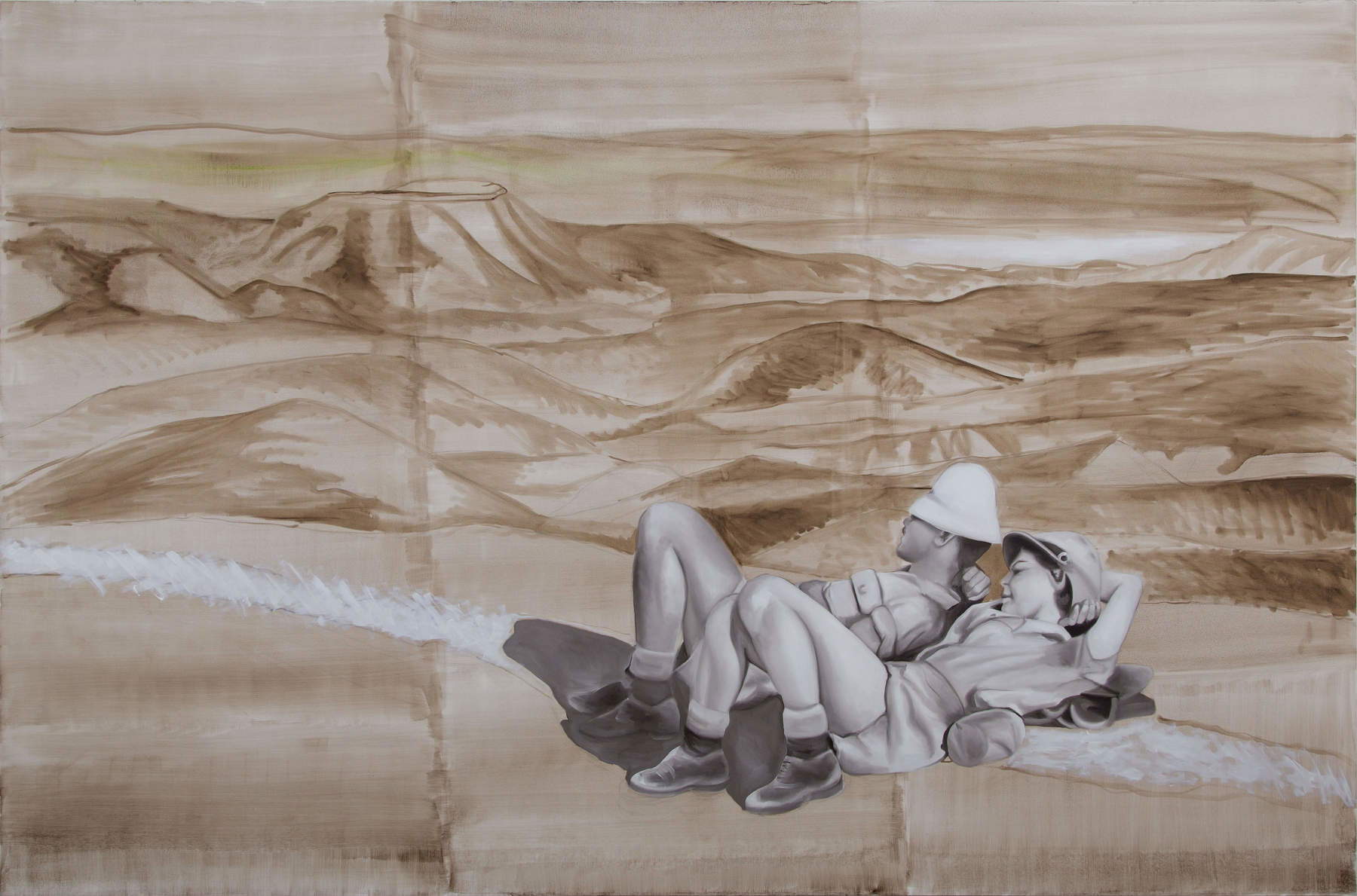
“I began to ‘subtract,’ in search of the clarity and essentiality I needed: I gave up the glossy finish that had defined my artistic style,” Nahmad stated. “I eliminated the clean lines that were my other hallmark. I removed the incisiveness of the perfect form. I simplified the subjects; I lightened the canvas, which had become superfluous. However, I made the scene more complex and intricate, because now I draw from old magazines distributed by the Israeli government in the 1950s to promote immigration by new families.”
This choice is reflected in the appearance of the works. The Pantone colors—the reds and greens that characterized other works—give way predominantly to ochre, interrupted in some cases by black and white. A particular series of small works created specifically for the exhibition is built around an almost monochromatic palette. Coen recounts having seen these works in the artist’s studio in the Navigli district of Milan a few days before the exhibition.
The painting preserves the image in its entirety but transforms it through a reduced color palette, resulting in works that appear to be composed of sand. The images are gathered in fragments and enriched by the addition of small pearls from a necklace that holds particular significance for the artist, linked to her childhood. Markings, overlays, and layers give these small works the appearance of well-worn objects, akin to family heirlooms preserved over time.
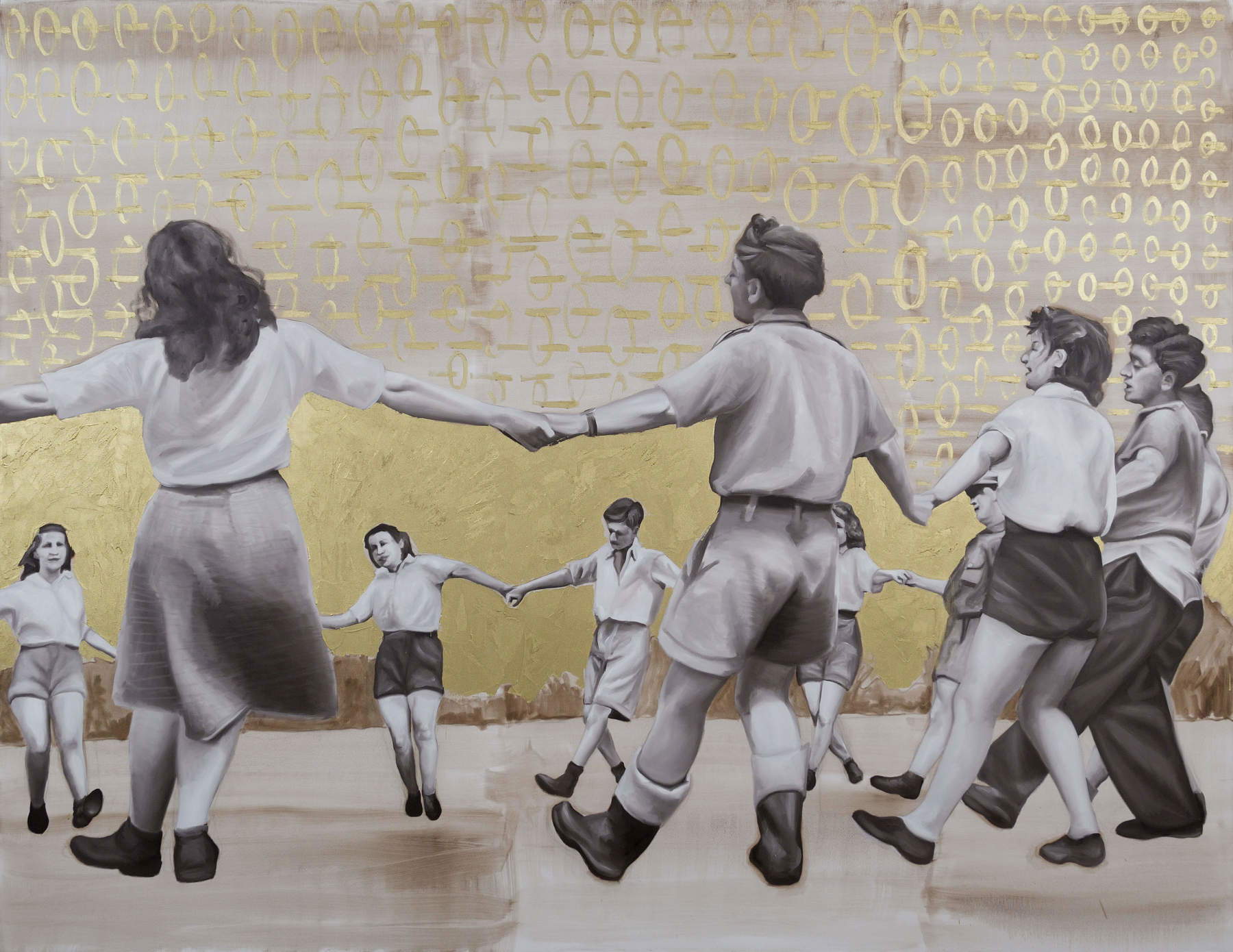
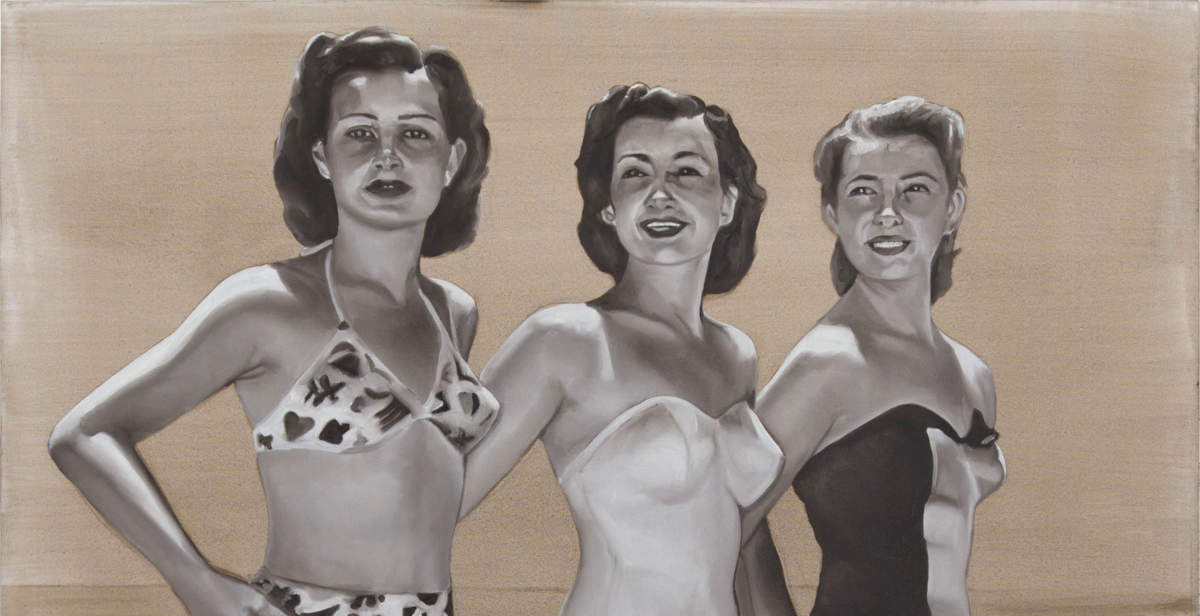
In the canvases, color seems to envelop the faces and situations depicted. Children at play, students on their way to school, an elderly man sitting with his forehead resting on his hand, young men on an armored vehicle, girls striking poses, maternal embraces, and men at work make up a repertoire of everyday scenes. In the background appear furniture, sinks, armored vehicles, and faintly sketched landscapes, within a deliberately sparse space that may evoke the simplicity of a child’s drawing.
History and current events thus remain present, yet take a back seat to the human dimension of the images. The focus is on the life of a community engaged in building a state through collective mobilization. The works seek to convey simultaneously the concreteness and the sense of participation implicit in those experiences, through faces, expressions, shadows, and sudden bursts of light. Shades of ochre and gray accompany a narrative marked by the harshness of living conditions and a vision of the future.
The relationship between space and time constitutes one of the central elements of Nahmad’s artistic exploration. Subtraction—understood as the reduction of superfluous elements—allows signs and figures to emerge, while the shadows of bodies are defined on the ground and contribute to the construction of a suspended dimension. This shift in pictorial language represents a further evolution within a style that has changed and enriched itself over time.
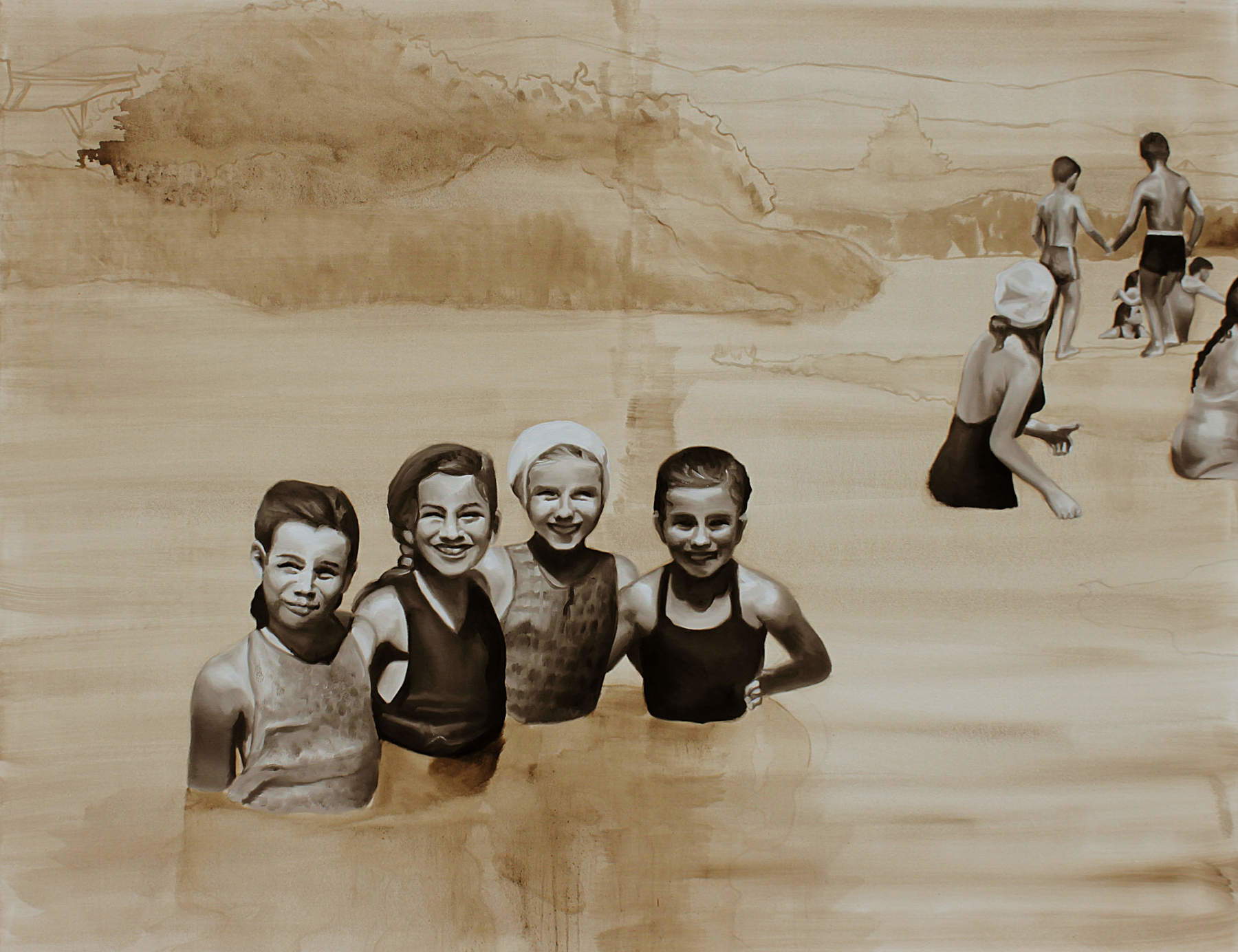
Eden, infinite love is, in fact, part of a journey that has spanned different themes and artistic languages, from the works created for the installation *Allarmi* to *Le tavole della protesta* and *Reportage tradotto in poesia*, all the way to portraits of movie stars and prominent figures from history and culture. The project, however, marks a shift in focus toward lesser-known individuals, transforming the faces encountered on the pages of magazines into protagonists of fragments of life. Even when they are unrecognizable, these figures can seem familiar, as if they already belonged to the viewer’s memory. It is a familiarity built through simple, relatable situations: play, school, work, relationships, and waiting.
The Eden experience—which began in Tel Aviv, continued in Milan, and later moved to Bologna—represents for Nahmad an opportunity to deepen her exploration of origins and memory. The reconstruction of the personal and collective past proceeds through vintage photographs, family images, and documents originally intended to narrate a new national reality. The artist reworks these images to convey not only a historical period but also the everyday reality of those who lived through it.
In his work, according to Coen’s interpretation, the artist engages with time through a reconstruction that brings together art, history, politics, and thought, avoiding the reduction of images to stereotypical representations. Memory thus becomes the ground upon which to compare what has been documented, what has been experienced, and what painting can once again make visible. *Eden, Infinite Love* unfolds precisely through this overlapping of times and perspectives, transforming fragments of a collective history into images focused on the presence of individuals and the traces left by their experiences.
 |
| In Milan, Barbara Nahmad explores Israeli society through the exhibition “Eden, Infinite Love” |
Warning: the translation into English of the original Italian article was created using automatic tools. We undertake to review all articles, but we do not guarantee the total absence of inaccuracies in the translation due to the program. You can find the original by clicking on the ITA button. If you find any mistake,please contact us.