



by Redazione 10/09/2026



Categories: Exhibitions / Disclaimer
From September 10, 2026, to March 7, 2027, Berlin’s Neue Nationalgalerie will host the first major solo exhibition in Germany by Maurizio Cattelan, winner of the 2026 Preis der Nationalgalerie, designed for Mies van der Rohe’s Glass Hall, which the Padua-born artist transforms into a large contemporary church. The exhibition features both historic and new works, including a reproduction of the Bra
Maurizio Cattelan Sets Out to Conquer Germany: After winning the 2026 edition of the Preis der Nationalgalerie, the Padua-born artist is set to have an exhibition at the Neue Nationalgalerie in Berlin, which opens today: “NIGHT” is the first major solo exhibition in Germany dedicated to the artist. The exhibition, curated by Lisa Botti, curator at the Neue Nationalgalerie, together with Klaus Biesenbach, the museum’s director, and conceived specifically for the glass hall designed by Mies van der Rohe, will be open to the public from September 10, 2026, to March 7, 2027, and brings together key historical works alongside new pieces in a presentation that gives the museum the character of a contemporary church—conceived as a space for contemplation, elevation, and reflection.
NIGHT revolves around the themes of history, power, memory,identity, and faith. Throughout the exhibition, familiar images and figures are shifted just enough to destabilize their meaning, opening the door to interpretations that oscillate between irony and ambiguity. In a continuous dialogue with Mies van der Rohe’s architecture, Cattelan’s works do not merely occupy the building as a simple container but become an integral part of it. The title aims to evoke a state in which things are not perceived less clearly, but differently. As Maurizio Cattelan himself explained, night does not simply represent the absence of light, but a condition in its own right: the exhibition is not about darkness, but rather the loss of certainty, and night, by its very nature temporary, always holds the possibility of a morning, even when it is not yet visible.


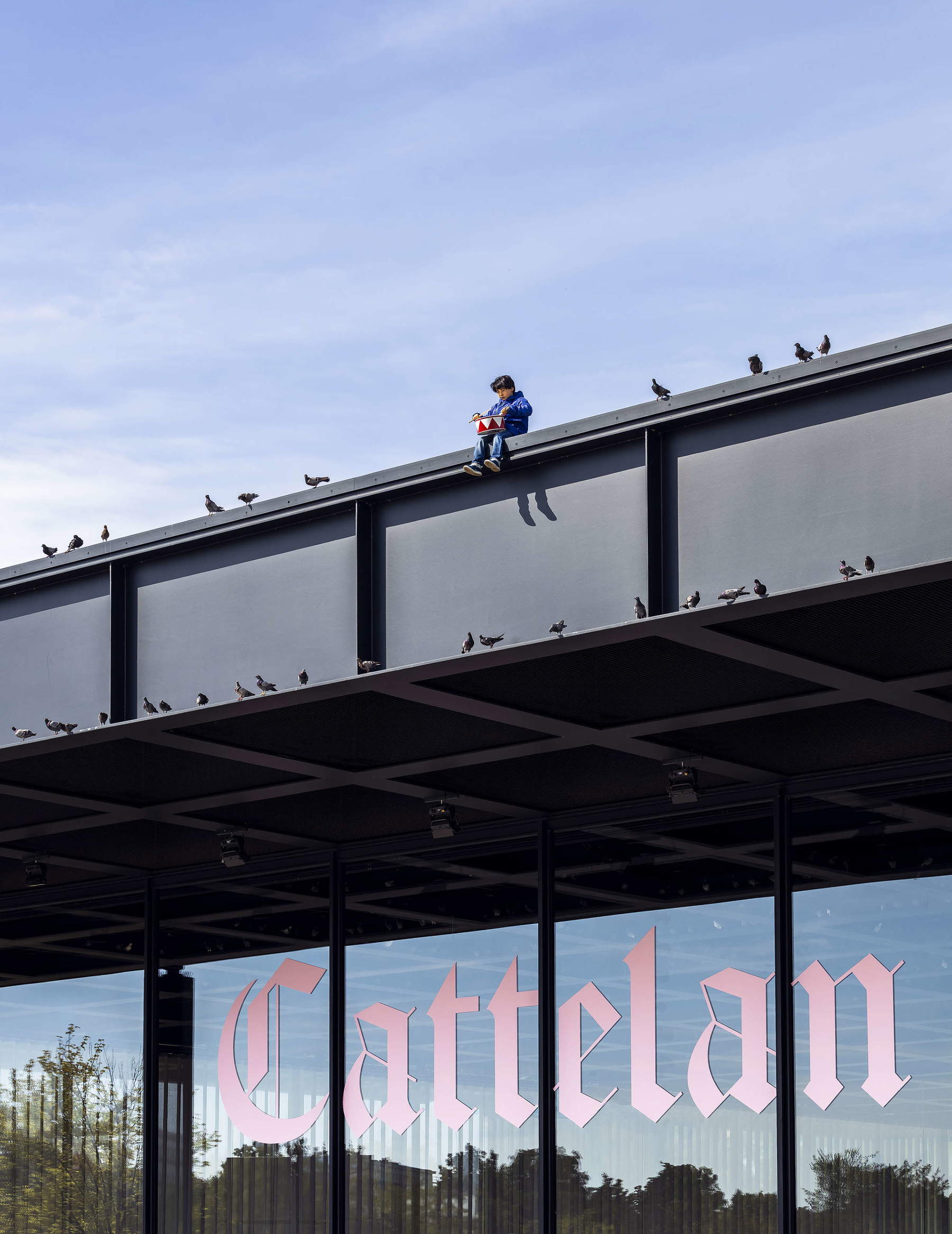
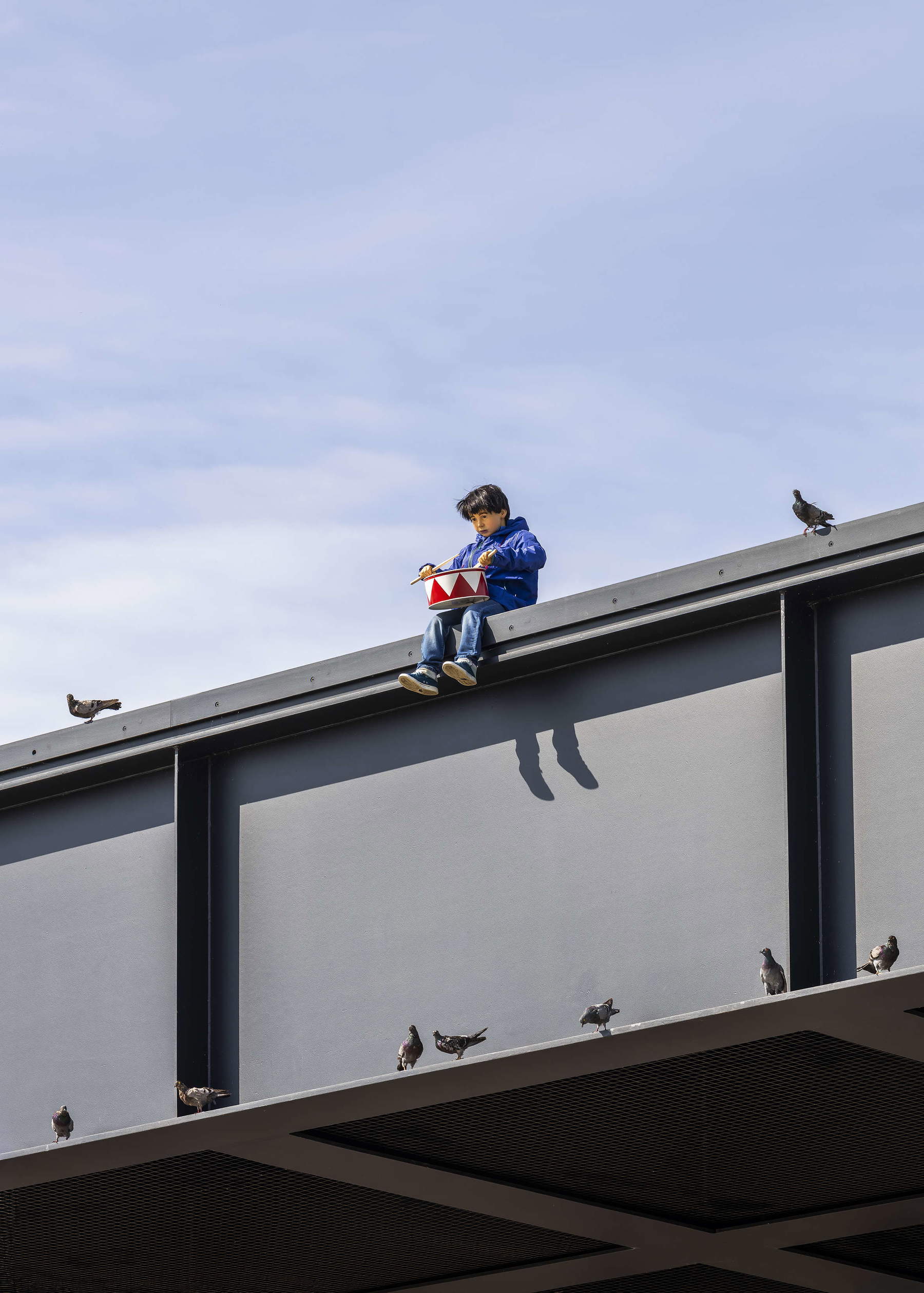
The exhibition extends beyond the confines of the glass-enclosed gallery. On the museum’s terrace stands *Scar* (2026), a cast-iron manhole cover engraved with the titles of all the works in the exhibition, which condenses the entire exhibition into a language legible from street level. High above, on the building’s roof, *Never* (2003) appears as an animatronic child drummer inspired by the protagonist of Günter Grass’s *The Tin Drum* —a figure of resistance and warning whose irregular rhythm resonates over the city, suspended between a parade and an alarm.
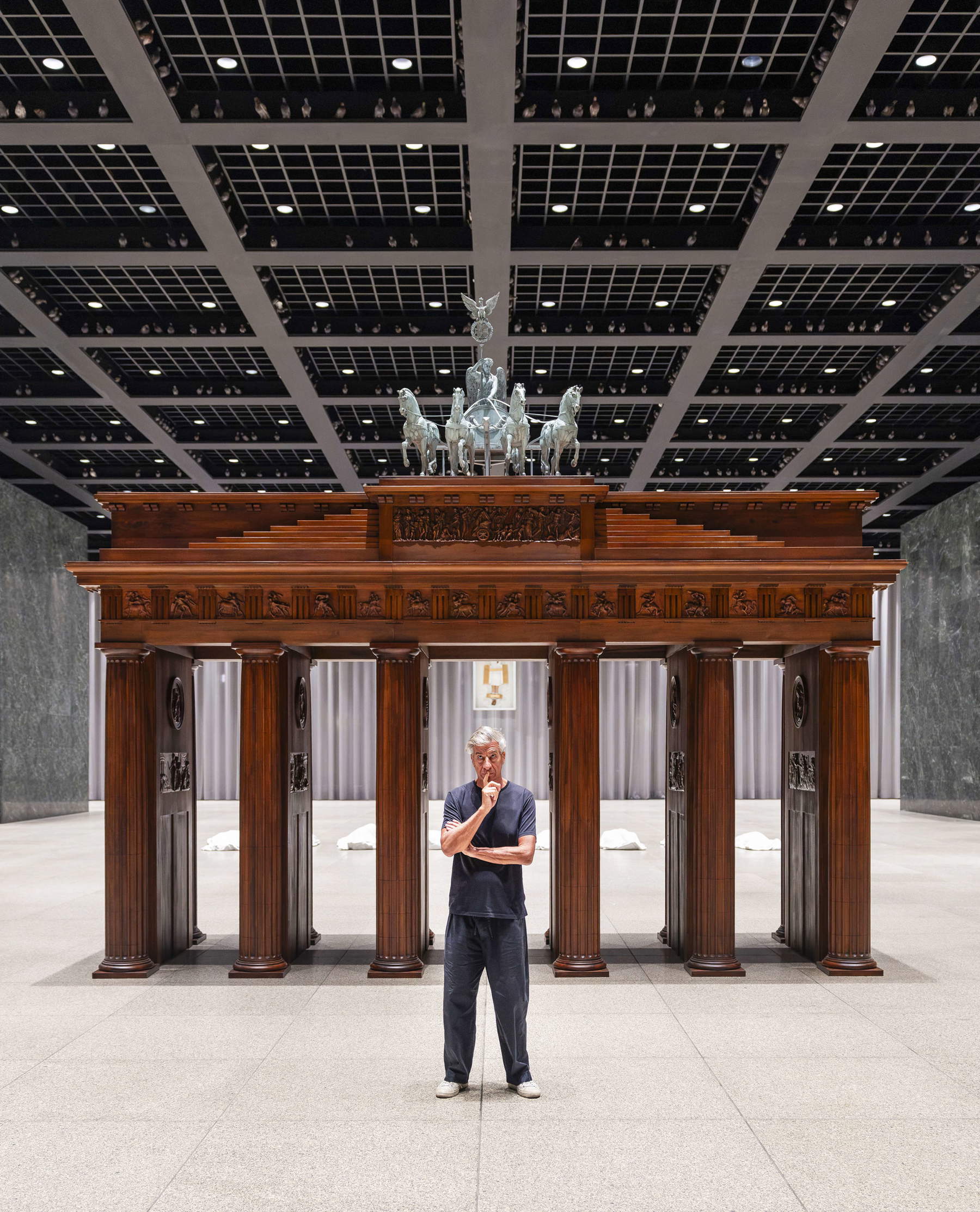
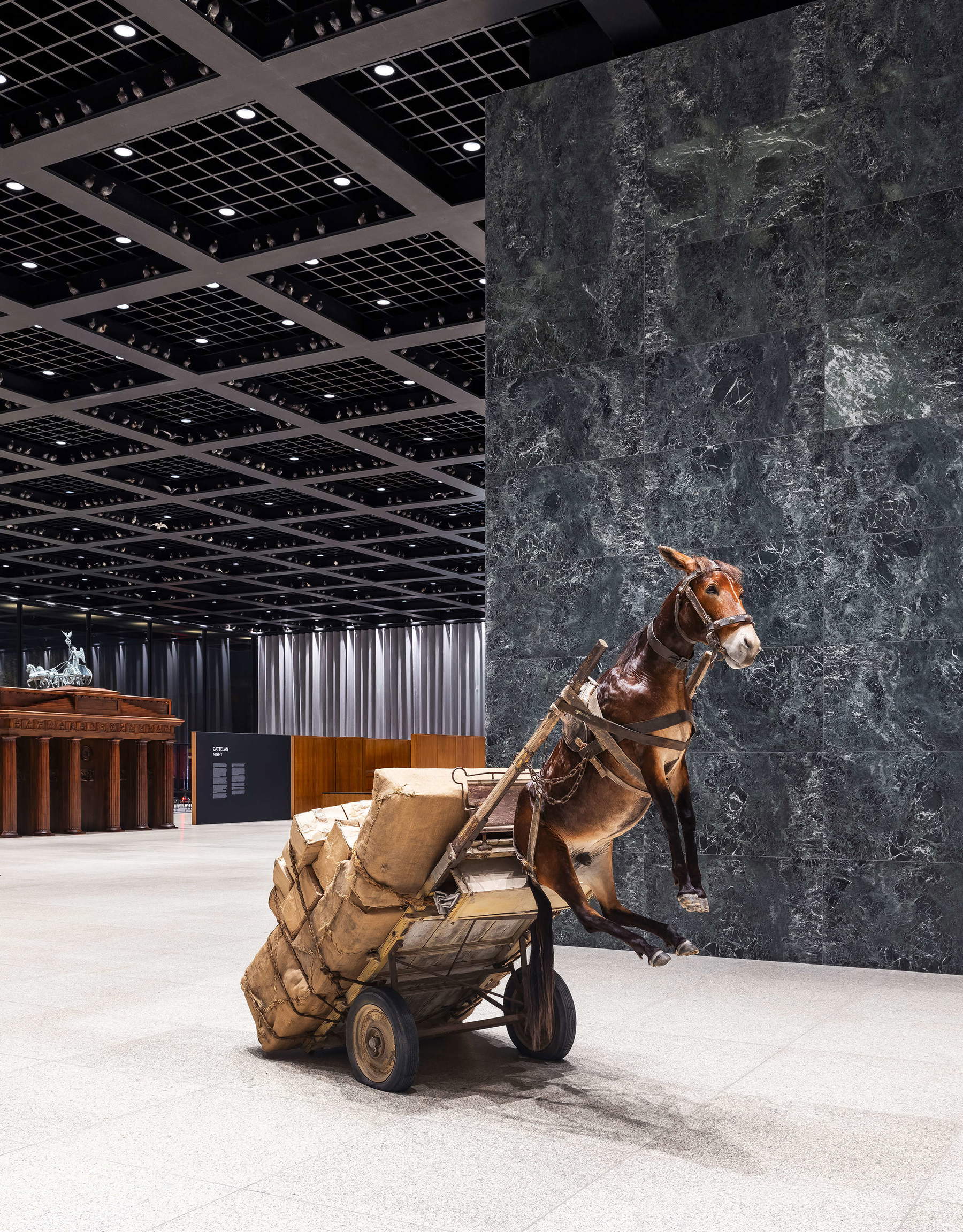
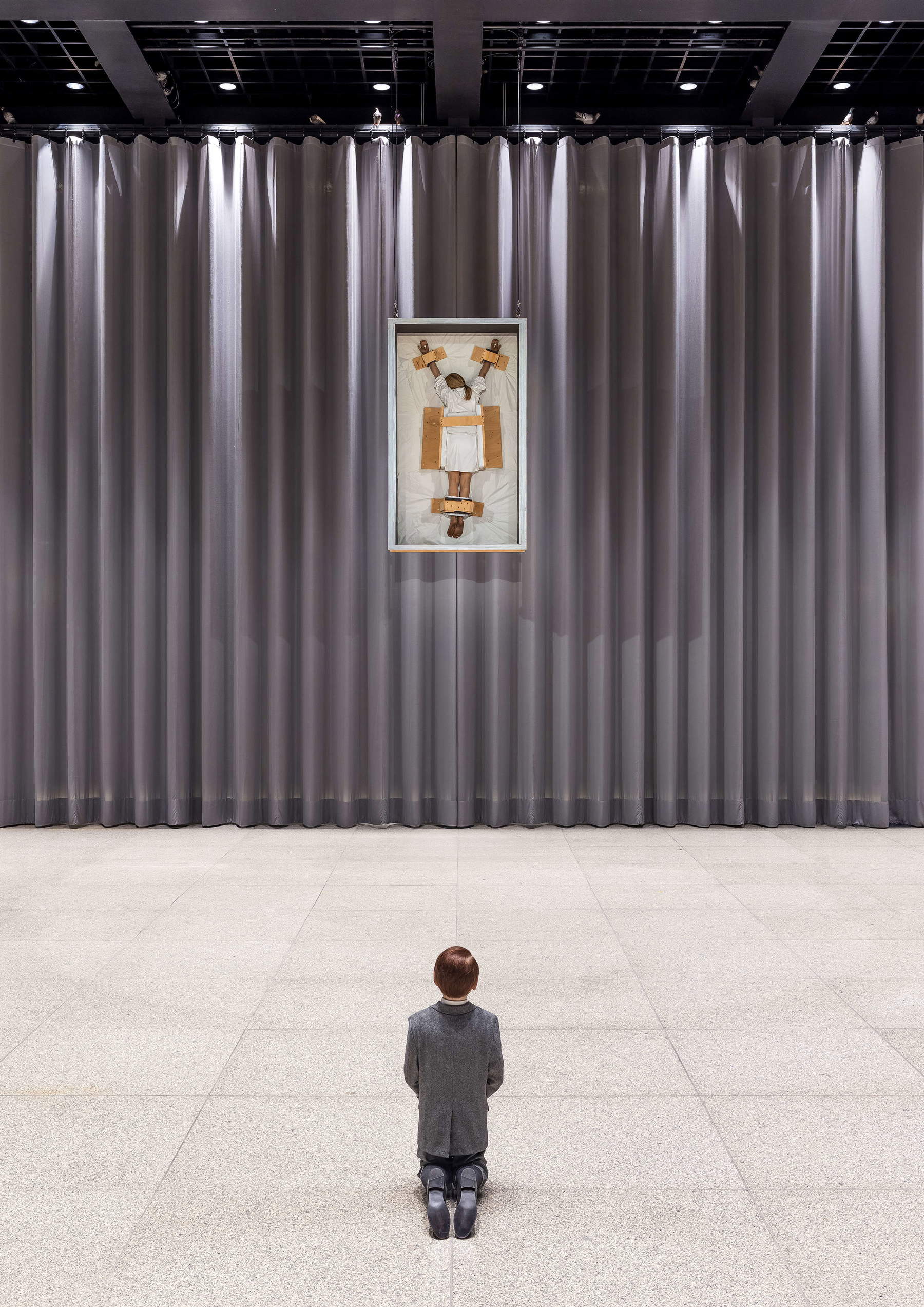
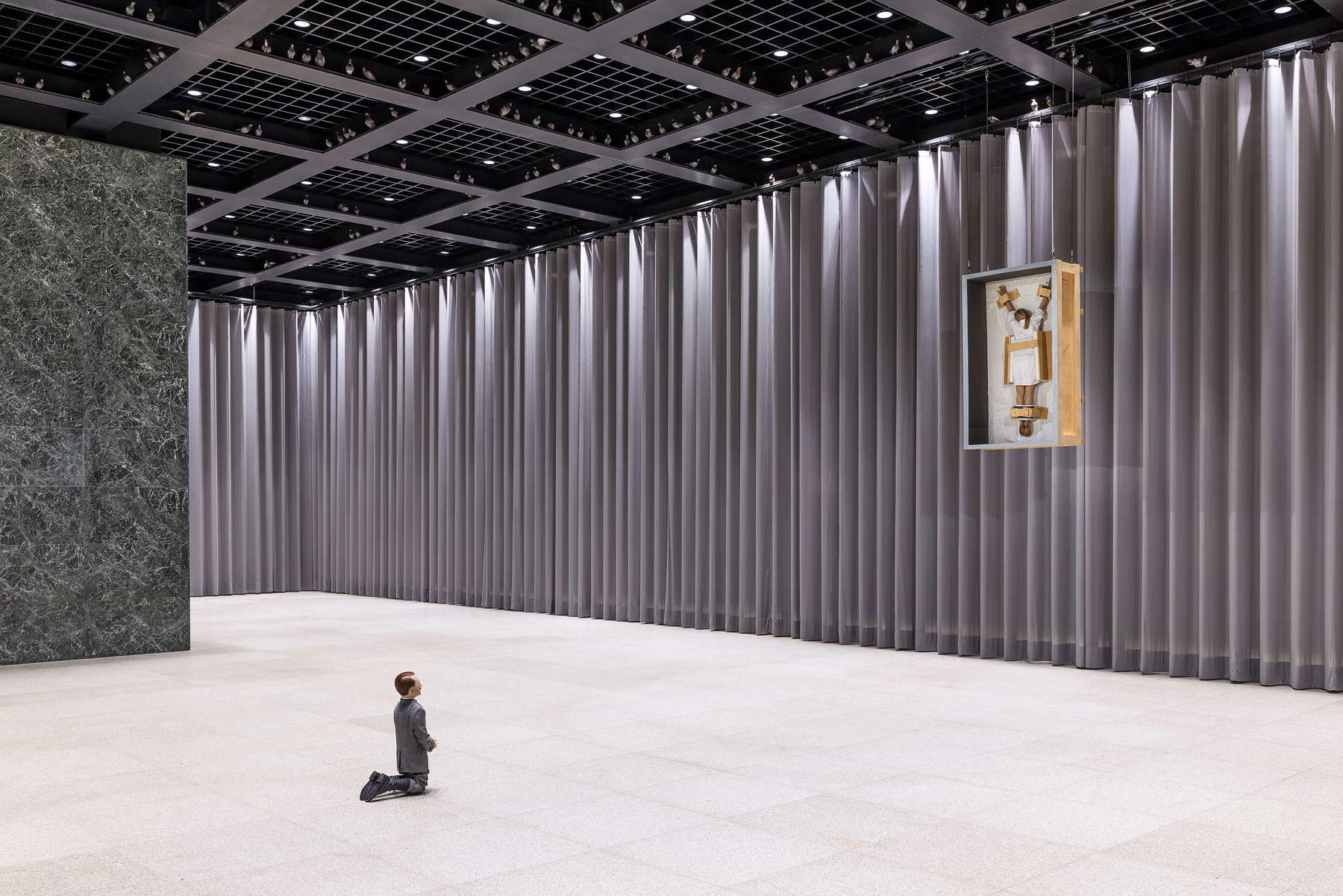
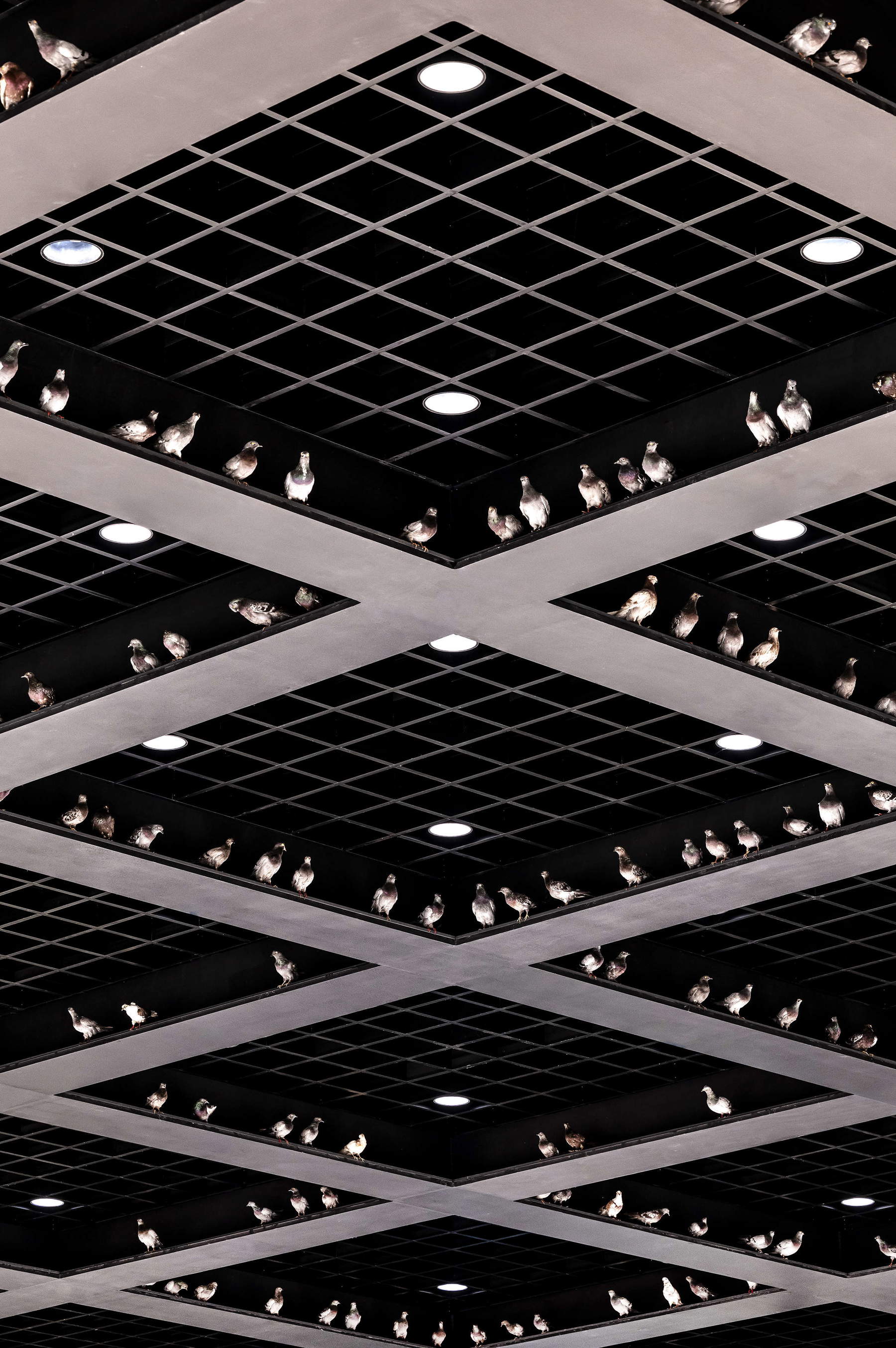
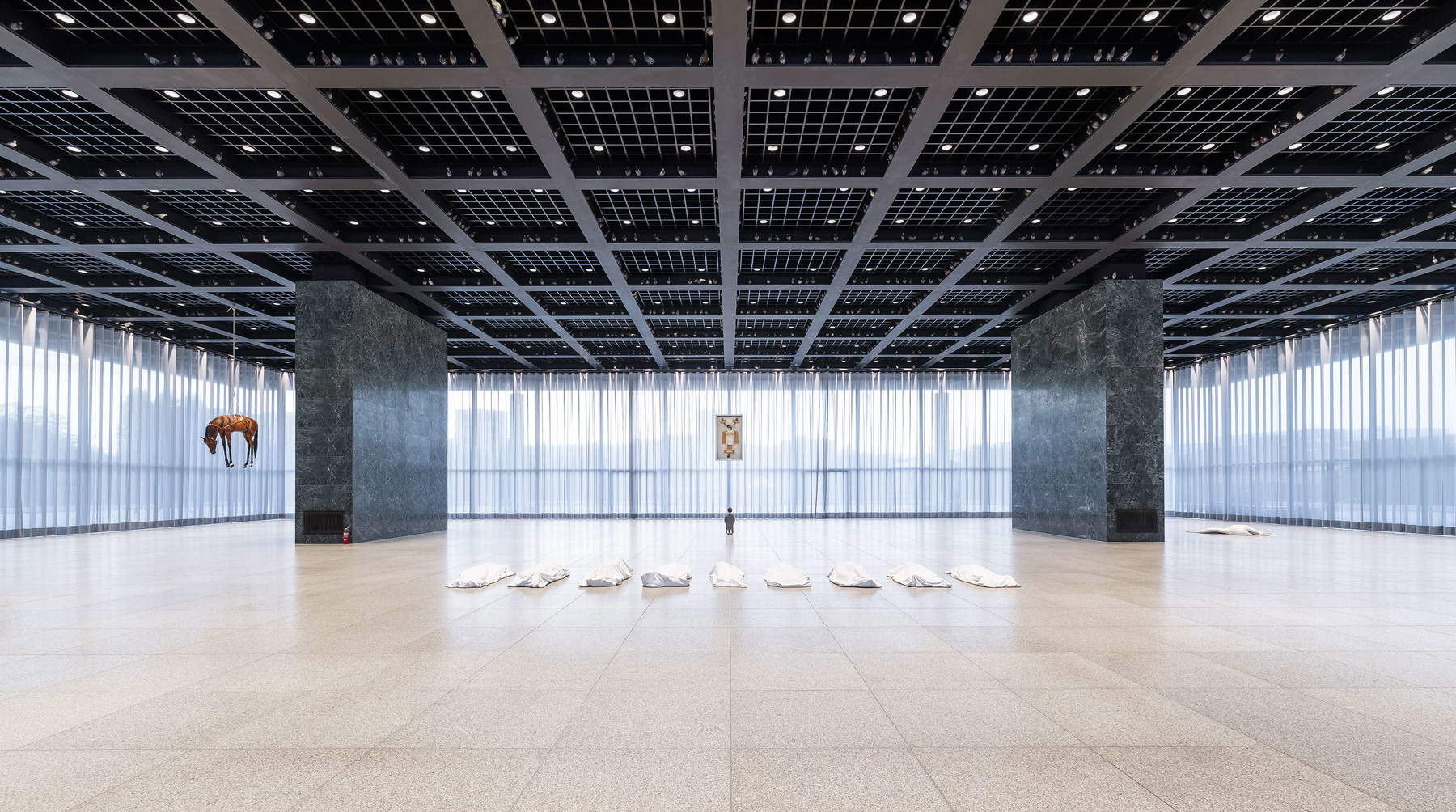
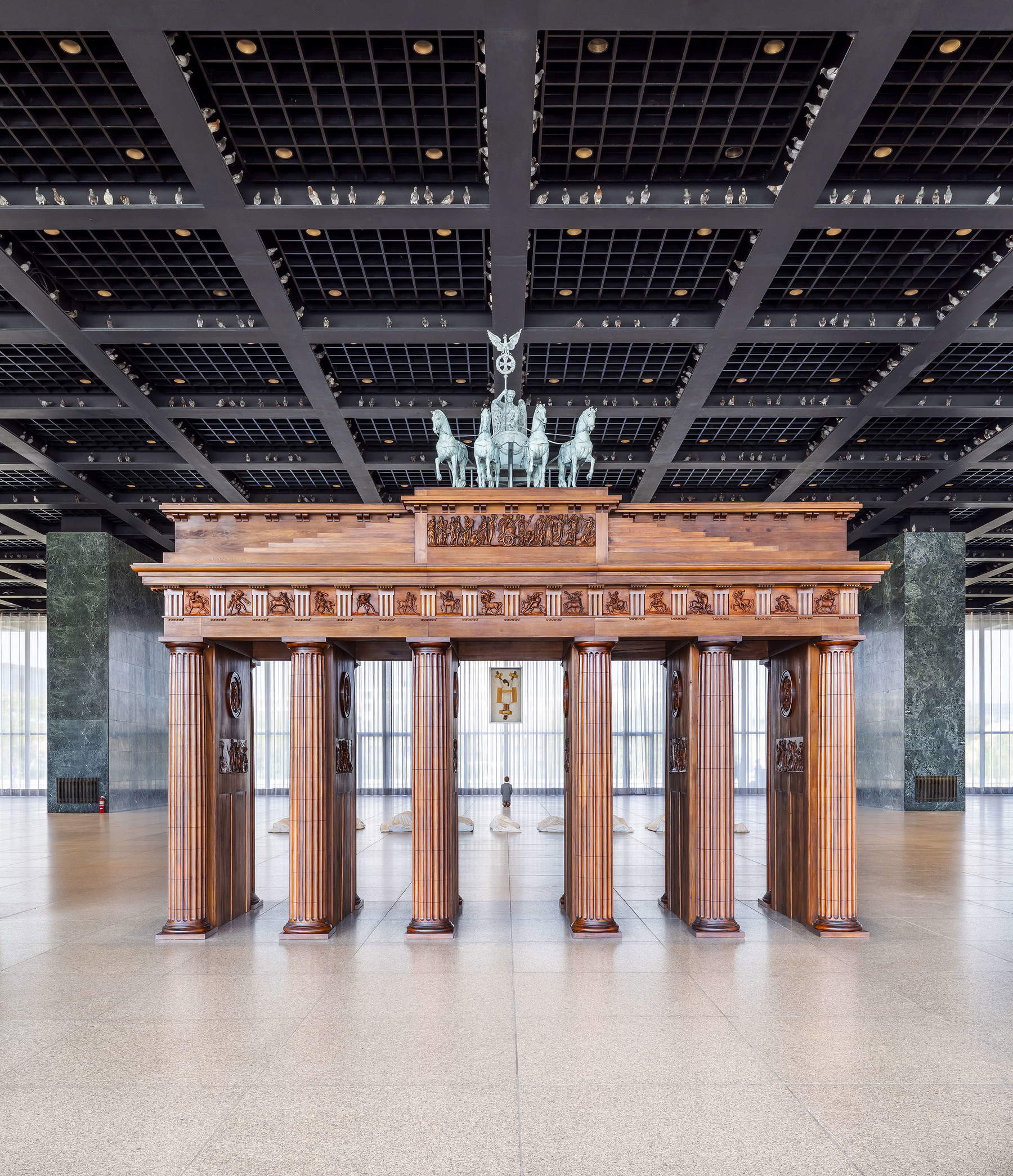
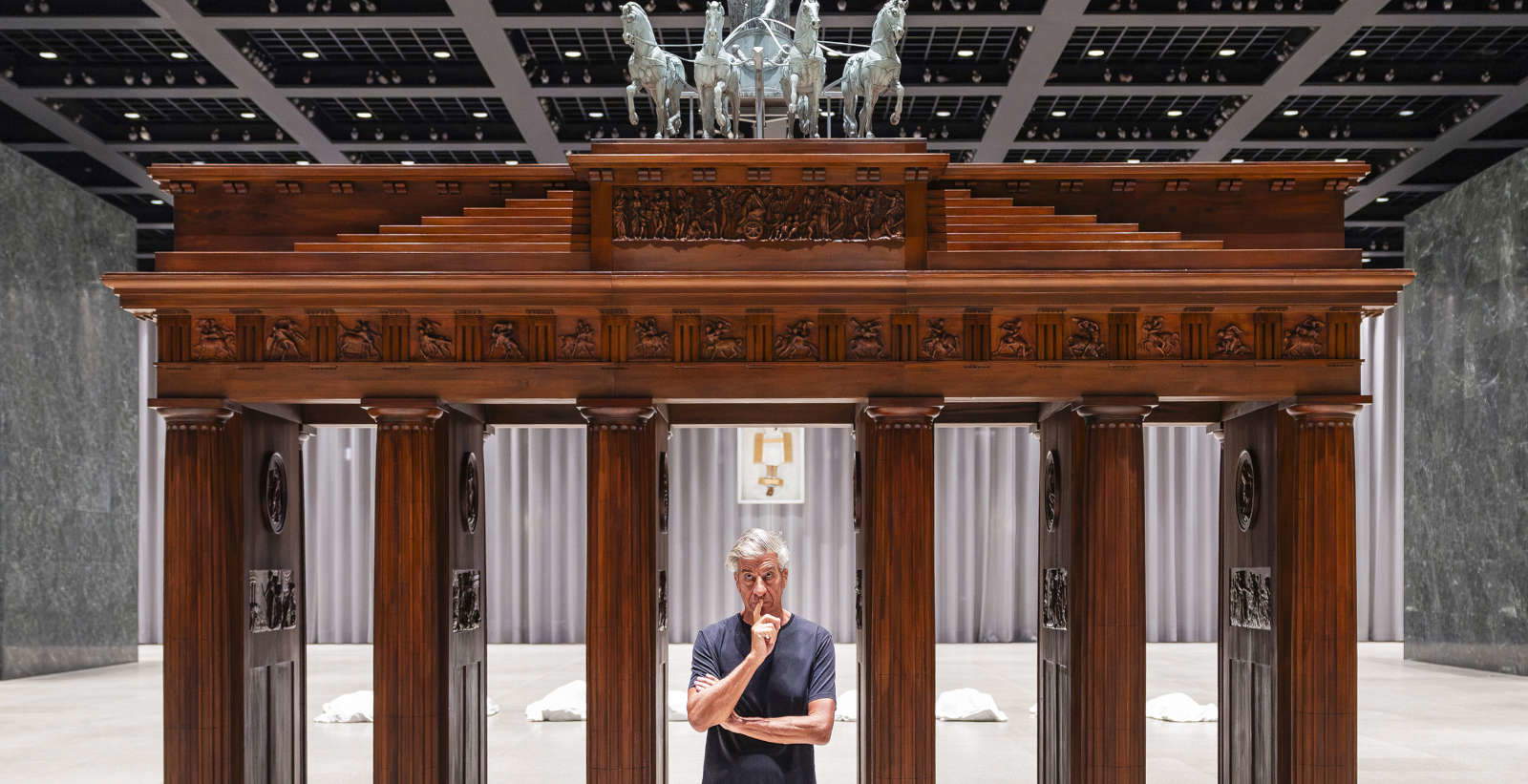
Visitors enter the exhibition through *Purgatory* (2026), a newly commissioned work that places a scaled-down version of the Brandenburg Gate inside the museum: one of Germany’s most recognizable monuments thus becomes a threshold to be traversed, repositioned as a space of passage, reflection, and historical ambiguity. In the center of the room, a strong vertical axis is established between *Him* (2001)—the famous wax figure of Hitler kneeling in a contemplative pose—and *Dawn* (2007), a female figure suspended in a cruciform posture inside a shipping crate. Above, thousands of stuffed pigeons comprising the work *People* ( 2026, a sort of remake of the work first presented in Venice in 1997) perch on the ceiling structure, transforming the space into a place of collective contemplation and silent observation.
“A church is a splendid invention because it gives form to something invisible,” says Maurizio Cattelan. “The Neue Nationalgalerie already possesses a ritual dimension: its size, symmetry, silence, and distance from everyday life. I imagined the space almost as a contemporary church: a central nave, side aisles, and a sequence of figures.”
Among the works gathered in the grand hall is, as previously mentioned, *Him*, a small yet deeply unsettling sculpture that appears from behind as a child kneeling in prayer—until the viewer recognizes the facial features of Adolf Hitler. A group of marble works draws on the Italian sculptural tradition: *All* (2007) features nine life-size bodies wrapped in shrouds, carved from Carrara marble as a horizontal monument to a universal and anonymous death; *Bones* (2025) depicts a monumental eagle fallen to the ground, crafted from statuary marble, an emblem of power brought to its knees; *First* (2025), on the other hand, shows a marble egg pierced by a single iron nail. Elsewhere, Novecento (1997) suspends a life-size stuffed horse in mid-air, an allegory of a century of wear and tear, while Pentecost (2002) depicts a stuffed donkey harnessed to an overloaded cart, on the verge of collapsing.
The exhibition repeatedly returns to the themes of self-portraiture and failure. *Charlie Don’t Surf* (1997) depicts a schoolboy sitting at a desk, with pencils piercing his hands; La Rivoluzione Siamo Noi (2000) features a small, miniature Cattelan, dressed in a felt suit in the style of Joseph Beuys, hanging from a coat hanger in one of the wardrobes designed by Mies van der Rohe; We (2010), on the other hand, features two identical figures of the artist lying side by side on a bed. Two additional new commissions explore time and mortality: *After* (2026), a six-meter-long iron tube struck like a bell, inside which a dog sleeps, and *Dust* (2026), a fire extinguisher containing the ashes of a friend of the artist, created in accordance with the wishes expressed by the deceased.
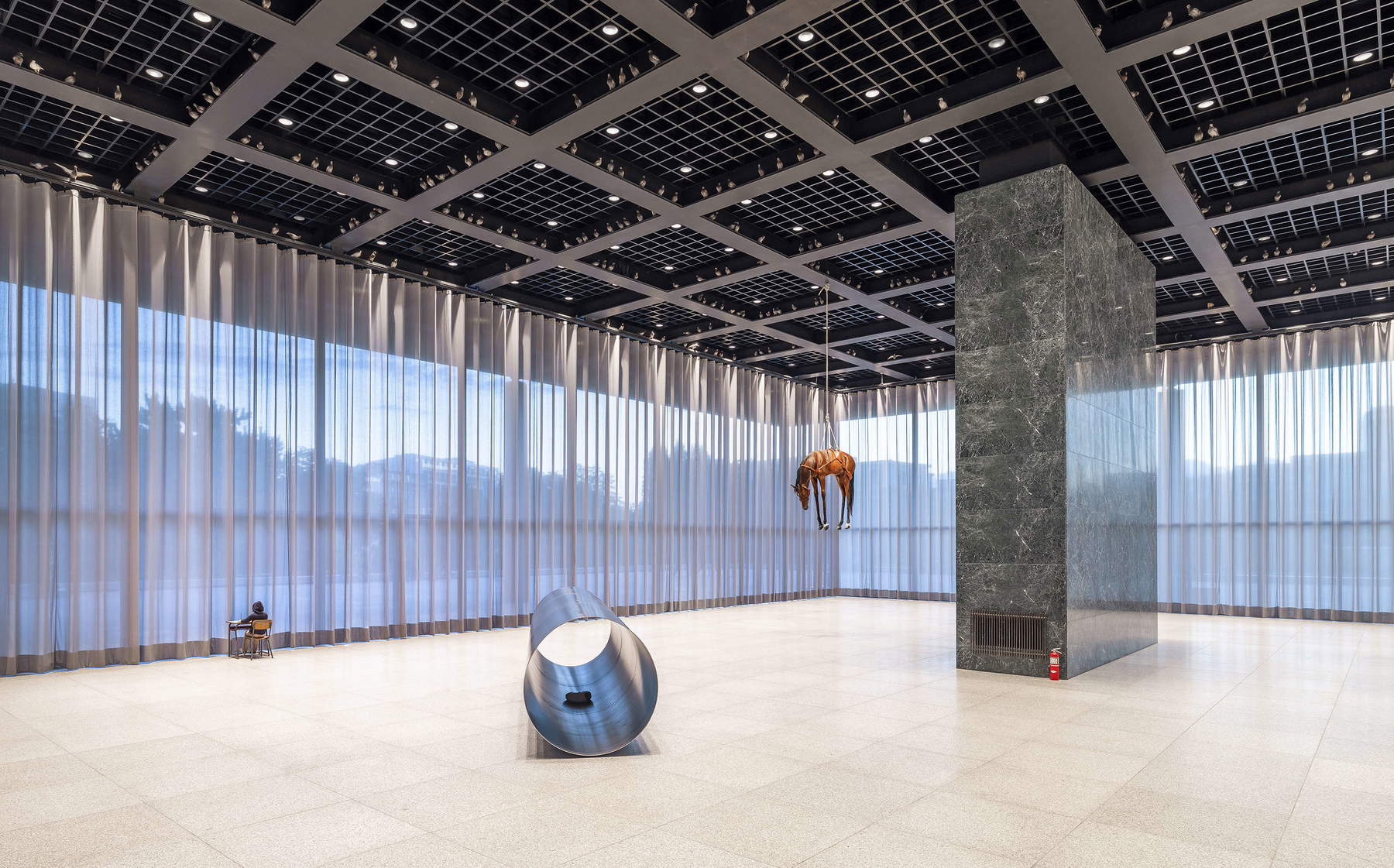
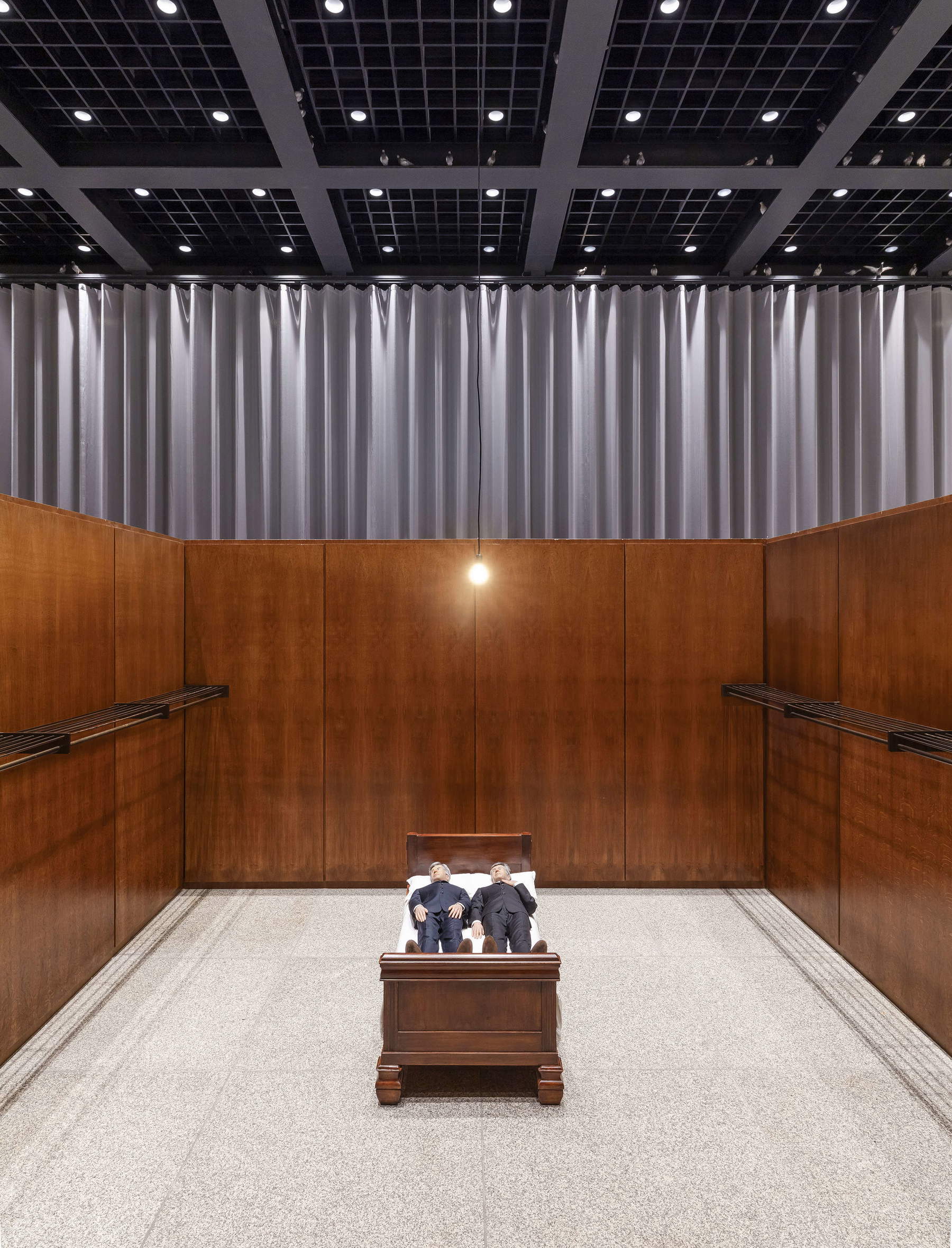
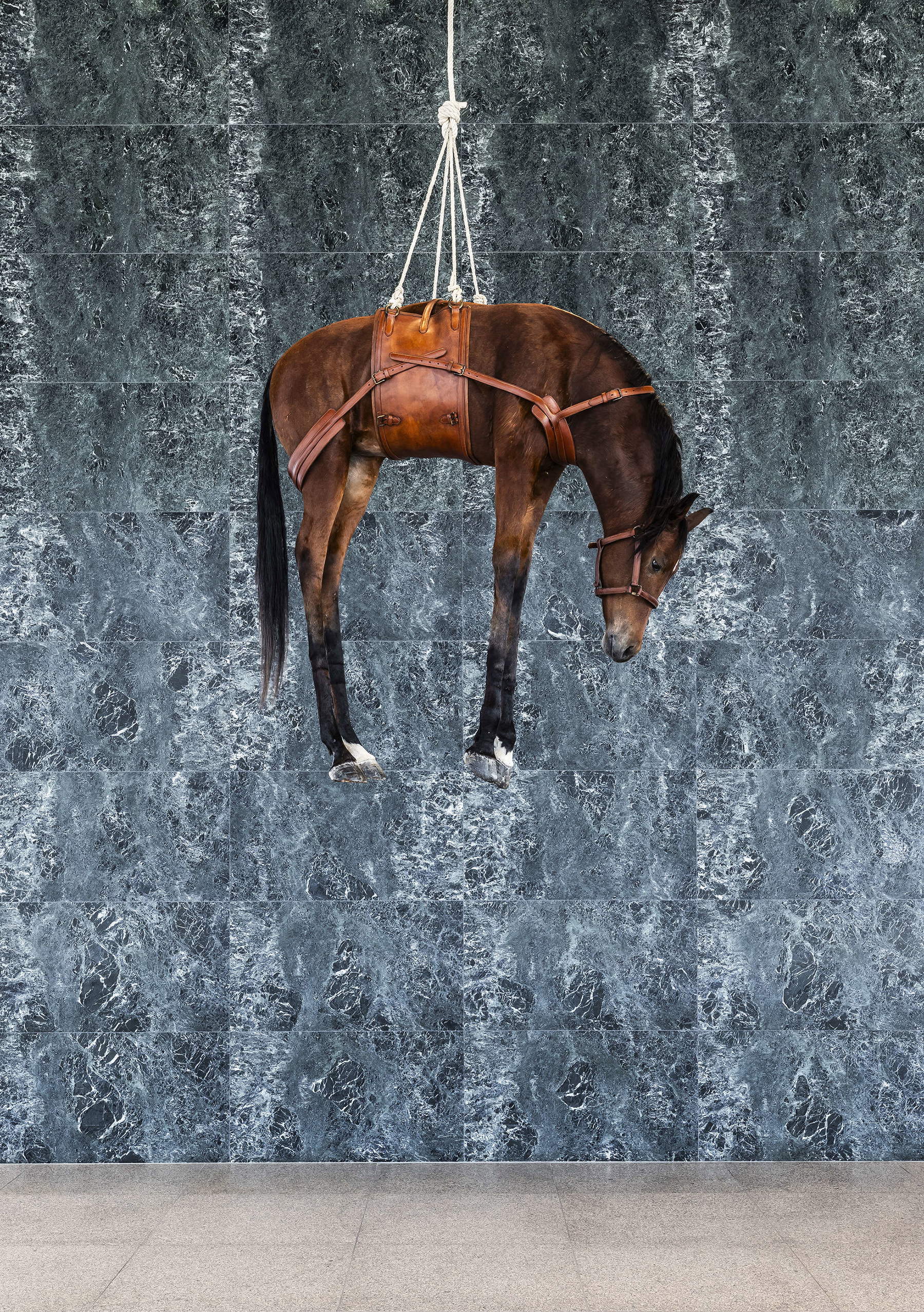
“Throughout the exhibition,” the two curators explain, “familiar images and figures are slightly altered in order to destabilize their meaning, opening them up to multiple interpretations that oscillate between irony and ambiguity. Presented in Berlin, the exhibition unfolds within a context characterized by historical layers and constantly evolving processes of memory. In dialogue with the museum’s architecture, the works transform the building not into a mere container, but into an integral part of the exhibition itself. Through a sequence of encounters that range from the monumental to the intimate, and from visibility to concealment, NIGHT invites the public to reflect on how images, symbols, and structures of meaning circulate and transform over time.”
Presented in Berlin, NIGHT is set within a context marked by historical layers and processes of memory that are still unfolding. Through a sequence of encounters that oscillate between monumentality and intimacy, visibility and concealment, the exhibition invites the public to reflect on how images, symbols, and structures of meaning circulate and transform over time. For over three decades, Maurizio Cattelan, born in 1960 in Padua, has been one of the most significant voices in international contemporary art, with a body of work comprising sculptures, installations, and conceptual interventions centered on authority, collective memory, and social power. His works have been exhibited worldwide, including at several editions of the Venice Biennale and in major solo exhibitions at the Solomon R. Guggenheim Museum in New York, with *All* in 2011, and at the Monnaie de Paris, with *Not Afraid of Love* in 2016. NIGHT also marks his return to Berlin twenty years after he co-curated the fourth Berlin Biennale in 2006.
The Preis der Nationalgalerie, established in 2000 by FREUNDE der Nationalgalerie, has established itself over the past twenty-five years as one of the most significant awards dedicated to contemporary art. In 2026, the prize enters a new phase with its move to the famous glass hall of the Neue Nationalgalerie, becoming a unique opportunity for an artist to create a focused and ambitious presentation. The jury for the 2026 prize consisted of Emma Lavigne, director of the Pinault Collection in Paris; Sam Keller, director of the Fondation Beyeler in Basel; and Klaus Biesenbach, director of the Neue Nationalgalerie; In addition to the jury members, curators at the Nationalgalerie and members of FREUNDE der Nationalgalerie were also eligible to submit nominations. The Preis der Nationalgalerie is made possible by FREUNDE der Nationalgalerie and supported by BMW, with Monopol as media partner. Accompanying the exhibition is a pop-up book published by Papersmyths Ltd, available in an English edition limited to 750 copies, priced at 75 euros, and available for purchase at the museum’s bookshop and online at the SMB and FREUNDE der Nationalgalerie stores. During Berlin Art Week, the exhibition’s opening hours will be extended from Thursday, September 10, through Sunday, September 13, 2026, from 10 a.m. to 10 p.m.
 |
| Maurizio Cattelan Transforms a Museum in Berlin into a Contemporary Church |
Warning: the translation into English of the original Italian article was created using automatic tools. We undertake to review all articles, but we do not guarantee the total absence of inaccuracies in the translation due to the program. You can find the original by clicking on the ITA button. If you find any mistake,please contact us.