




by Redazione 17/10/2026



Categories: Exhibitions / Disclaimer
From November 7, 2027, to February 6, 2028, the Metropolitan Museum of Art in New York will present more than 125 works, including approximately 70 paintings, prints, and drawings by Rembrandt, to explore the Dutch artist’s relationship with ancient culture. The exhibition will then move to the Louvre.


Rembrandt reinterpreted the ancient world in the light of his own time, transforming figures, stories, and models from Greco-Roman culture into images with a strong personal imprint: This fundamental yet still relatively unexplored relationship is the focus of “Rembrandt and the Ancients,” an exhibition that the Metropolitan Museum of Art in New York will present from November 7, 2027, to February 6, 2028—the first comprehensive exhibition dedicated to this theme. The exhibition will bring together over 125 works, including approximately 70 paintings, prints, and drawings by the Dutch artist—many of which will be on view for the first time in the United States—alongside examples of ancient and Renaissance art that helped shape his understanding of the past.


Organized by the Metropolitan Museum of Art and the Musée du Louvre in Paris, the exhibition marks the return of a major Rembrandt exhibition to the New York museum more than twenty years after the last such event. The exhibition will trace the various phases of the painter’s career, from the ambitious historical compositions of his early years to his later depictions of heroes and heroines, highlighting how the culture of antiquity fueled some of his most original experiments.


The exhibition aims to explore how Rembrandt Harmenszoon van Rijn (Leiden, 1606 – Amsterdam, 1669) engaged with the history, art, and literatureof ancient Greece, Rome, and the broader Mediterranean world. This was not merely a revival of established subjects and models: for the artist, the past became a tool for interpreting the present, through images capable of combining emotional intensity, irony, and attention to the human dimension of his characters. Rembrandt’s artistic exploration unfolded in a context where interest in antiquity was particularly vibrant in seventeenth-century Holland: Amsterdam, in particular, was a cosmopolitan center where collections of ancient works were being formed, while theaters staged plays set in the Greek and Roman worlds and Dutch translations of numerous ancient texts were being published. This rediscovery of the past was also intertwined with a period of global expansion by the Dutch Republic, with advances in science, and with new philosophical reflections, all of which contributed both to broadening knowledge and to challenging the authority traditionally attributed to the wisdom of the ancients.


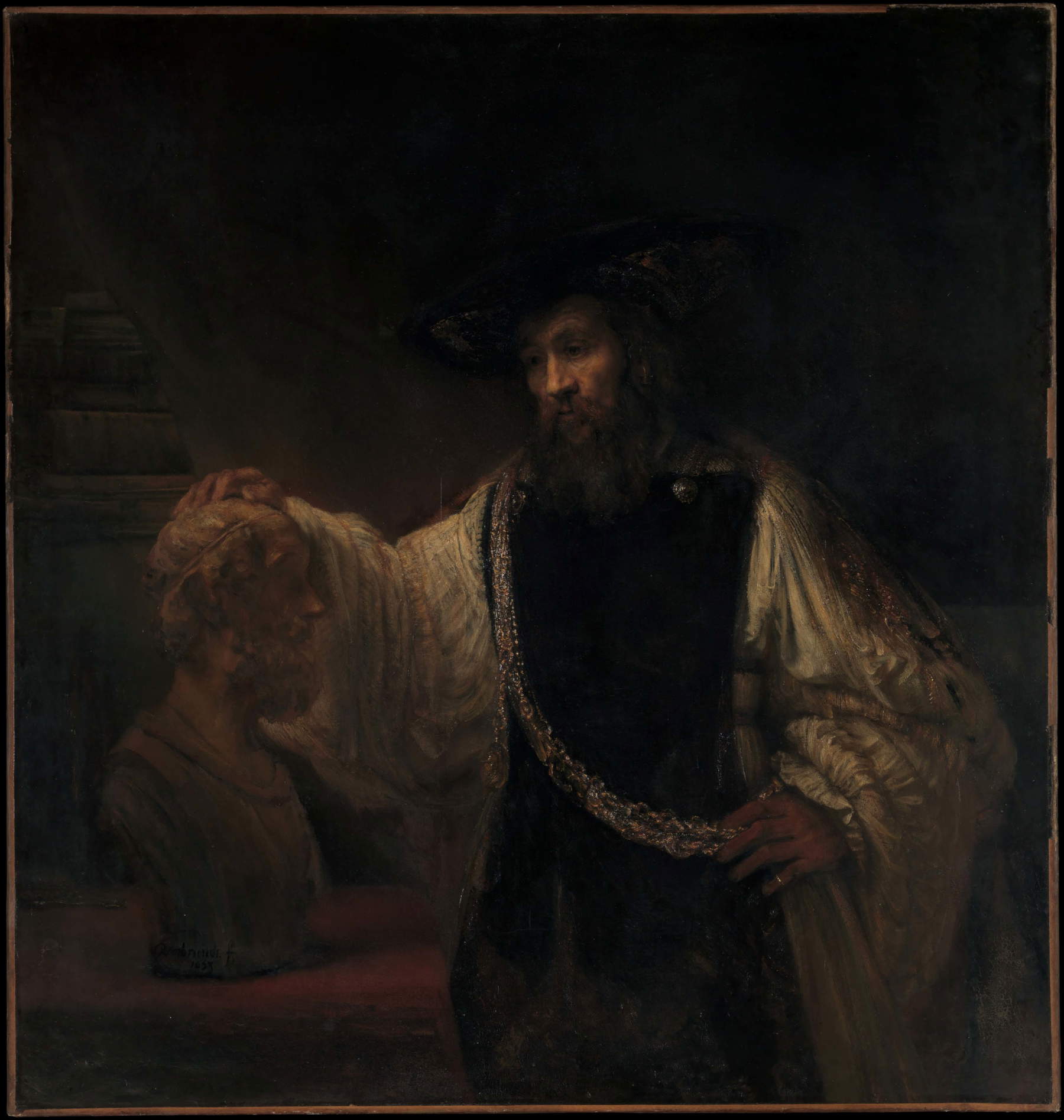
It was against this backdrop that Rembrandt developed a personal vision of antiquity, drawing on its themes and motifs to address issues close to his own experience. The result, according to the exhibition’s concept, is a body of work that transcends mere imitation of tradition: the past is freely reinterpreted through approaches that are at times playful, at times dramatic, yet always attentive to the psychological and physical complexity of the subjects. Among the most notable works are several masterpieces from the Met’s collections, such as the famous *Aristotle with the Bust of Homer*, in which the painter brings together two central figures of ancient culture. Alongside the works housed in New York, important international loans will be on display, allowing visitors to compare different phases and approaches in the artist’s dialogue with the classical world.
From the Gemäldegalerie Alte Meister in Dresden will come *The Abduction of Ganymede*, a particularly significant example of Rembrandt’s personal interpretation of ancient tales. The artist approaches the myth with a naturalism far removed from traditional idealization, endowing the scene with intense physicality and a strongly distinctive character. Among the works making their U.S. debut is *Woman Bathing in a Stream*, held by the National Gallery in London: the painting demonstrates how Rembrandt engaged with the human body through an intimate and concrete depiction, in which the observation of reality plays a central role.
From the Louvre, meanwhile, will come “Bathsheba with a Letter from King David,” which will be exhibited alongside an ancient Roman relief housed at Palazzo Altemps, in Rome, along with graphic works related to its creation; here, the comparison will allow visitors to take a closer look at the process through which Rembrandt appropriated earlier models, reworking them to create new images.
Another exceptional loan will be the monumental *The Oath of the Batavians*, from the Konstakademien, the Royal Swedish Academy of Fine Arts in Stockholm: the work, which depicts an episode from the ancient history of the Netherlands, will be presented for the first time in the United States, and its inclusion will offer deeper insight into how Rembrandt transformed even the historical memory of his own territory into an autonomous pictorial subject, capable of transcending the conventions of celebratory representation.
The exhibition will also devote ample space to drawings, featuring works rarely on display. Among these are all three of Rembrandt’s studies of ancient Roman busts, on loan from the Albertina in Vienna, the Royal Library of Turin, and the Kupferstichkabinett in Berlin, sheets that document the artist’s focus on ancient sculpture and his interest in rendering volumes and individual characteristics.
Also on display will be the drawing *Diana and Actaeon*, housed at the Kupferstich-Kabinett in Dresden, in which the mythological theme is approached with an inventive freedom that helps define the unconventional nature of Rembrandt’s artistic exploration. Rounding out the selection is *The Idolatry of Solomon*, an extraordinary red chalk drawing housed at the Louvre, which demonstrates the artist’s ability to use drawing as a tool for narrative development and formal experimentation.
Following its run in New York, the exhibition will move to the Musée du Louvre, where it will remain on view from March 22 to July 3, 2028. This two-part exhibition will thus offer audiences in the United States and Europe the opportunity to view a collection of works—including paintings, prints, drawings, and ancient artifacts—that reconstructs the role of classical culture in the imagination of one of the leading figures of 17th-century European painting.
 |
| Rembrandt and the Ancient World: The First Major Exhibition on the Subject at the Met |
Warning: the translation into English of the original Italian article was created using automatic tools. We undertake to review all articles, but we do not guarantee the total absence of inaccuracies in the translation due to the program. You can find the original by clicking on the ITA button. If you find any mistake,please contact us.