





From October 13, 2026, to January 30, 2027, the Federica Schiavo Gallery in Rome presents *On Leaning*, an exhibition of new works by the painter Svenja Deininger, focused on a painterly practice that rejects a predetermined starting point and proceeds through trials, shifts, overlays, and successive revisions. In the paintings, the image does not derive from the translation of a pre-existing drawing but is constructed progressively, leaving traces of the decisions that preceded it.
The working process is, in fact, one of the central elements of the works. Shapes are placed, modified, partially covered, allowed to emerge, and reimagined. Accumulation thus becomes a method of observation: what matters is not only what appears on the finished surface, but also the pressure exerted by what was present beforehand. This history rarely remains explicit and survives in the form of residue, visible in shifts in density, in colors that seem to slip beneath other colors, or in edges whose precision is shaped by surrounding elements.
Deininger’s surfaces are neither overtly layered nor explicitly textural. The raw linen, the opaque passages, and the areas characterized by a greater concentration of paint establish a shifting balance between what is revealed and what remains hidden. The calmness of the compositions does not, therefore, correspond to a static condition: their stillness stems from a process of calibration, in which the image appears to have been progressively measured and modified rather than simply composed.
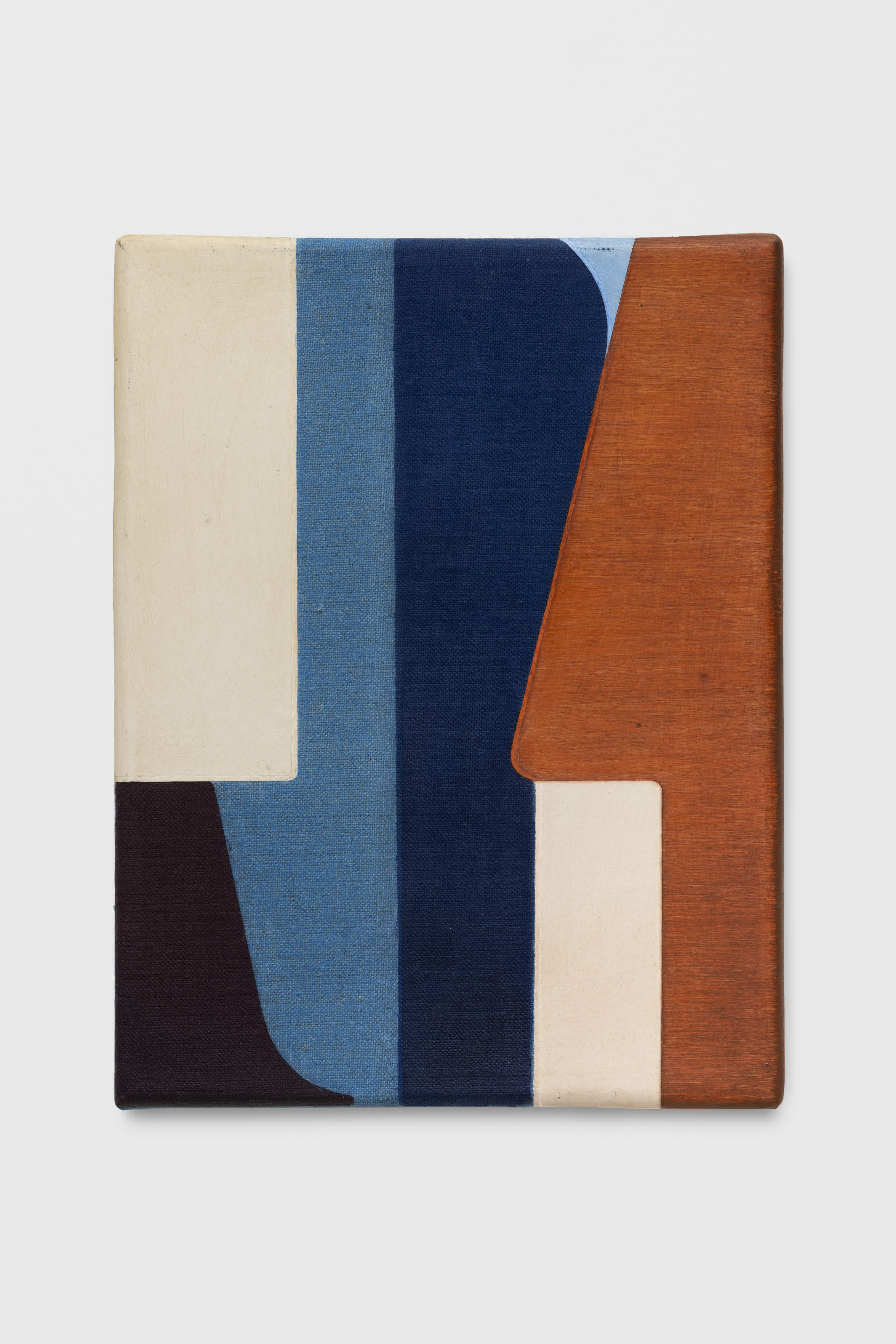
The question of what the viewer is observing also remains deliberately open. A curve may suggest a body, a vertical line may recall an architectural element, while a horizontal plane may evoke a fragment of a landscape. None of these possibilities, however, crystallizes into a recognizable representation. The paintings thus occupy an unstable zone, where abstraction approaches figuration without becoming a figurative image. Recognition is suggested and immediately withdrawn, prompting the eye to formulate hypotheses that are subsequently brought back to the pictorial surface.
This visual condition becomes apparent as soon as one enters the exhibition. One of the canvases is, in fact, installed perpendicular to the wall and, when viewed head-on, appears almost reduced to a line. The work cannot, therefore, be perceived from a single vantage point but requires the viewer to physically walk around and through it. The distinction between image and object is thus blurred, while elements normally considered neutral—such as the wall, the viewer’s position, and the frontal orientation of the painting—become part of the work’s perceptual construction. Looking also becomes a bodily experience.
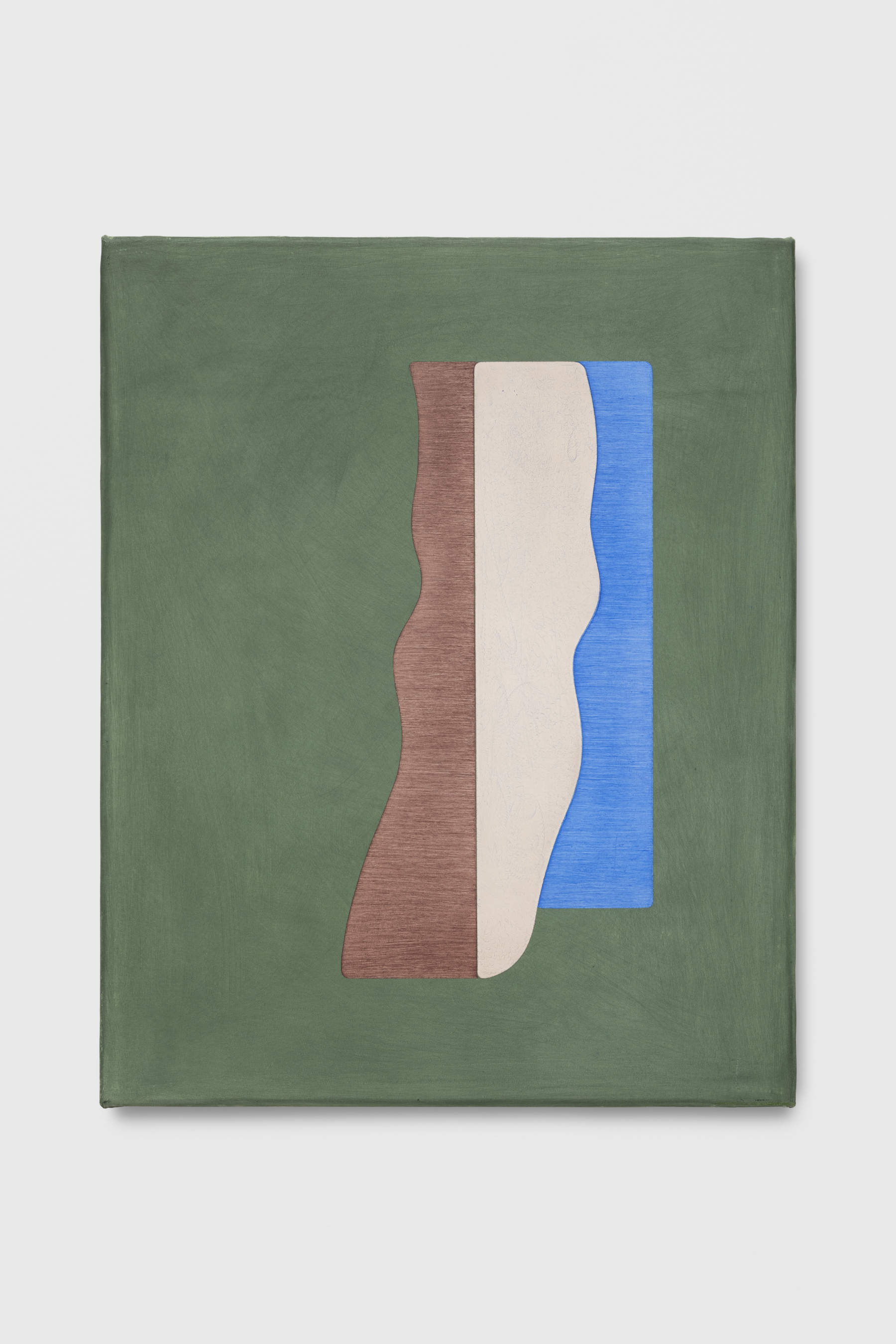
Scale also plays a specific role. A monumental painting, composed of subtle tones and a wealth of detail, transcends the possibility of an immediate reading. Its dimensions do more than simply enlarge the image; they alter the time required for its perception. What might be perceived as a fragment on a smaller scale takes on an environmental dimension, composed of a succession of minute decisions. Texture, depth, and rhythm emerge gradually, making the duration of viewing an additional component of the painting. Thus, lingering before the work progressively alters one’s first impression.
The works also engage in dialogue through indirect means. A line may reappear with a different emphasis, a form may shift in character, while a color or an interval may find an unexpected counterpoint in another painting. These correspondences do not constitute a unified system, and the exhibition is not reduced to a single visual grammar. Rather, rhythm arises from recurrences and shifts. Each painting retains its autonomy but is simultaneously redefined by its relationship with the other works.
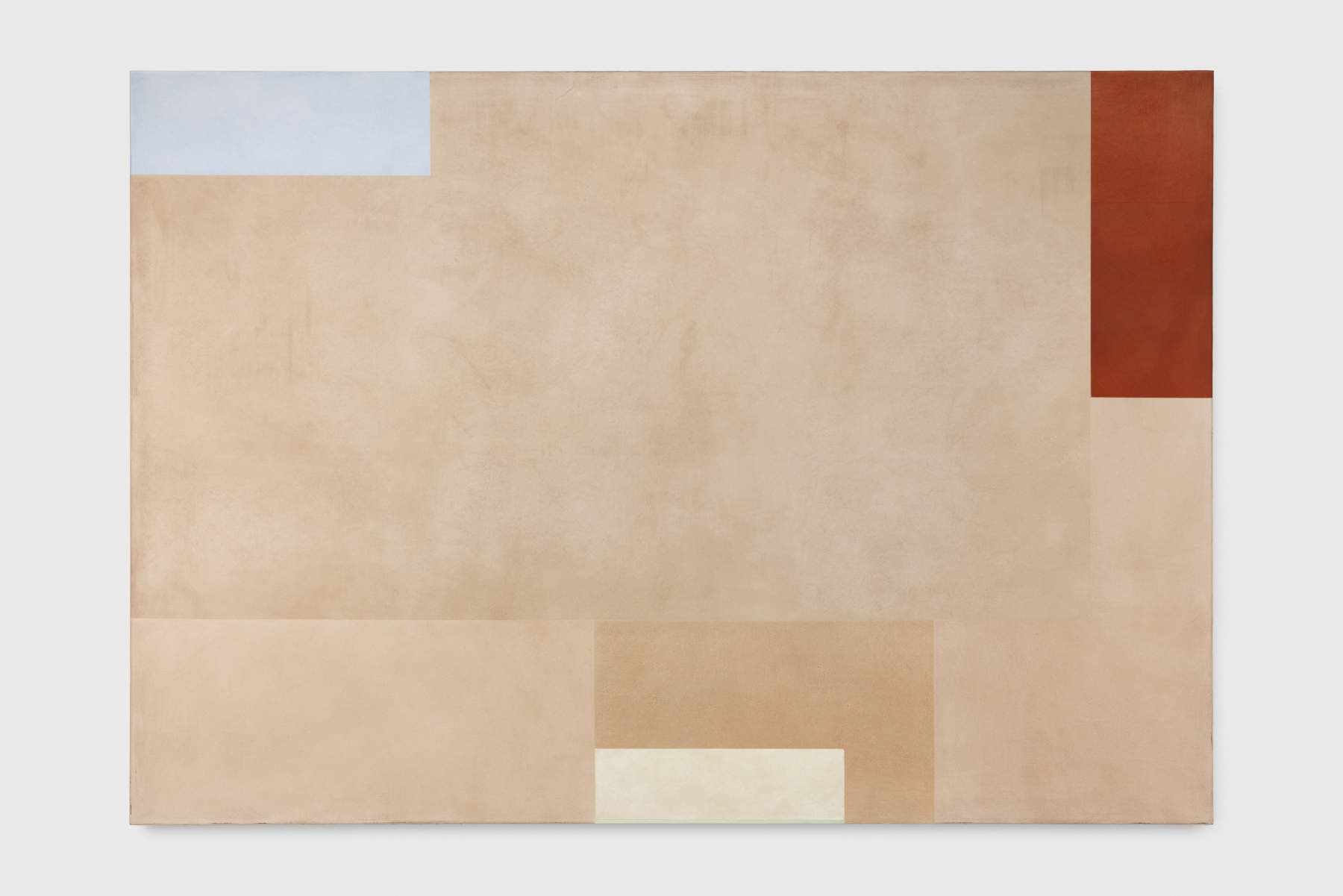
Even the title*On Leaning* introduces a condition of this kind. The expression evokes the act of leaning—and thus a relationship based on support, pressure, and dependence—but remains deliberately incomplete: no object upon which to lean is specified, and the action remains suspended. The incompleteness of the title reflects the nature of the works, in which the forms support one another without settling into a definitive configuration, and the layers remain present without becoming fully accessible.
The viewer’s position is, in turn, unstable and shifts continuously between distance and proximity, as well as between perceiving the painting as an image and perceiving it as a physical presence in space. Ambiguity, however, is not the goal of the experience. The works are complete but not closed: their surfaces retain the decisions that shaped them without making them fully explicit, just as they hold memories whose origins are not revealed.
On Leaning thus proposes a form of painting that requires a vision that is neither immediate nor exclusively analytical, allowing certain elements to remain partially concealed. Meaning is not presented as a definitive endpoint, but rather as a fluid relationship between surface and depth, image and object, memory and perception—between what is visible and what continues to exist just beyond the surface.
 |
| Svenja Deininger: Forms Poised Between Abstraction and Figuration at Federica Schiavo Gallery in Rome |

Warning: the translation into English of the original Italian article was created using automatic tools. We undertake to review all articles, but we do not guarantee the total absence of inaccuracies in the translation due to the program. You can find the original by clicking on the ITA button. If you find any mistake,please contact us.



















 IT
IT FR
FR DE
DE ES
ES CN
CN


