



by Marco Ferri 06/11/2026


Categories: Interviews / Disclaimer
Iranian artist Atefeh Majidi Nezhad reinterprets Isfahan’s historic architecture through columns of fabric and ink that appear to be suspended in mid-air. At Luxembourg Art Week 2026, she presents an installation that reflects on the weight of memory, the fragility of structures, and the possibility of reinventing the past. The artist discusses all of this in this interview with Marco Ferri.

According to Giorgio Vasari, drawing can be considered the father of the three arts; in fact, every work of architecture, sculpture, or painting (before it becomes such) exists first and foremost as a drawing, conceived directly by the intellect. This is an inevitable process, one that is virtually impossible to reverse: if an architectural or sculptural work acquires three-dimensionality the moment it materializes as a physical object, it loses that dimension as soon as it returns to being merely a drawing. It might seem like an axiom, but this is not always the case.


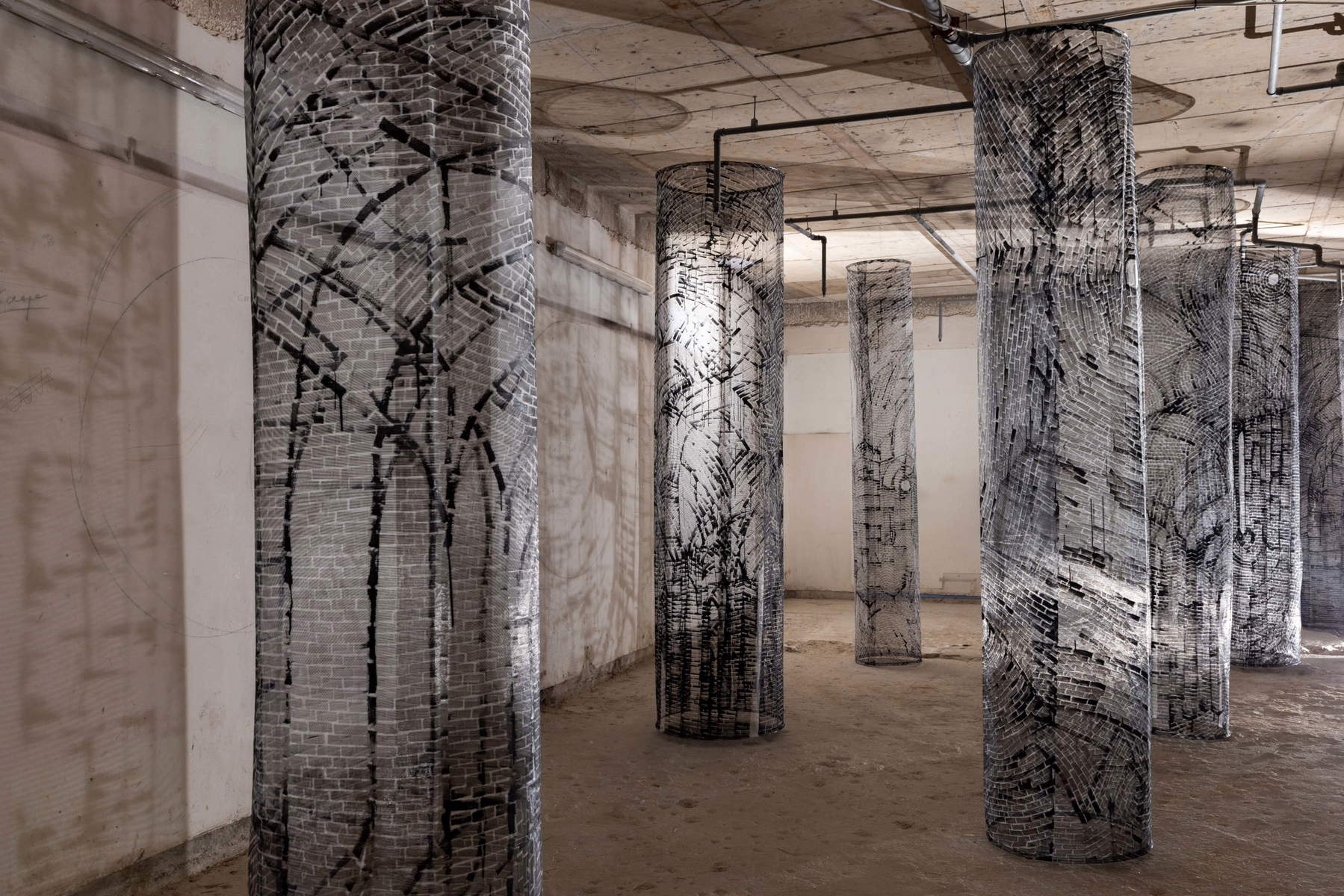
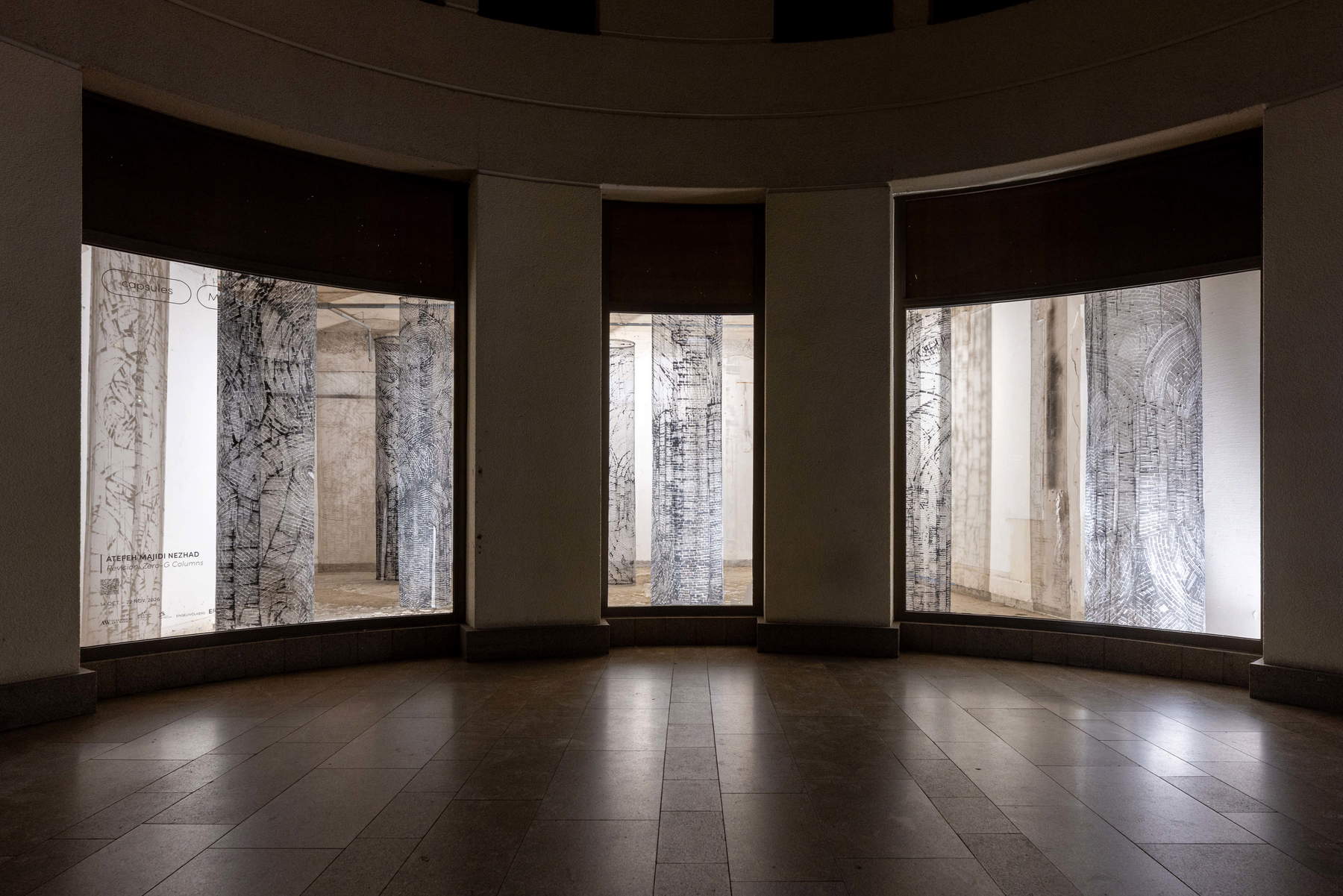
Atefeh Majidi Nezhad (Isfahan, 1983) knows this well. The Iranian artist is currently featured at Luxembourg Art Week 2026 (held in the Grand Duchy of Luxembourg, nestled between Belgium, France, and Germany) with an installation titled *Revision: Zero-G Columns*, part of her *Columns* series. The work is part of the Art Walk program: situated in a public space, it is accessible 24 hours a day, seven days a week. Thus, it is always visible.


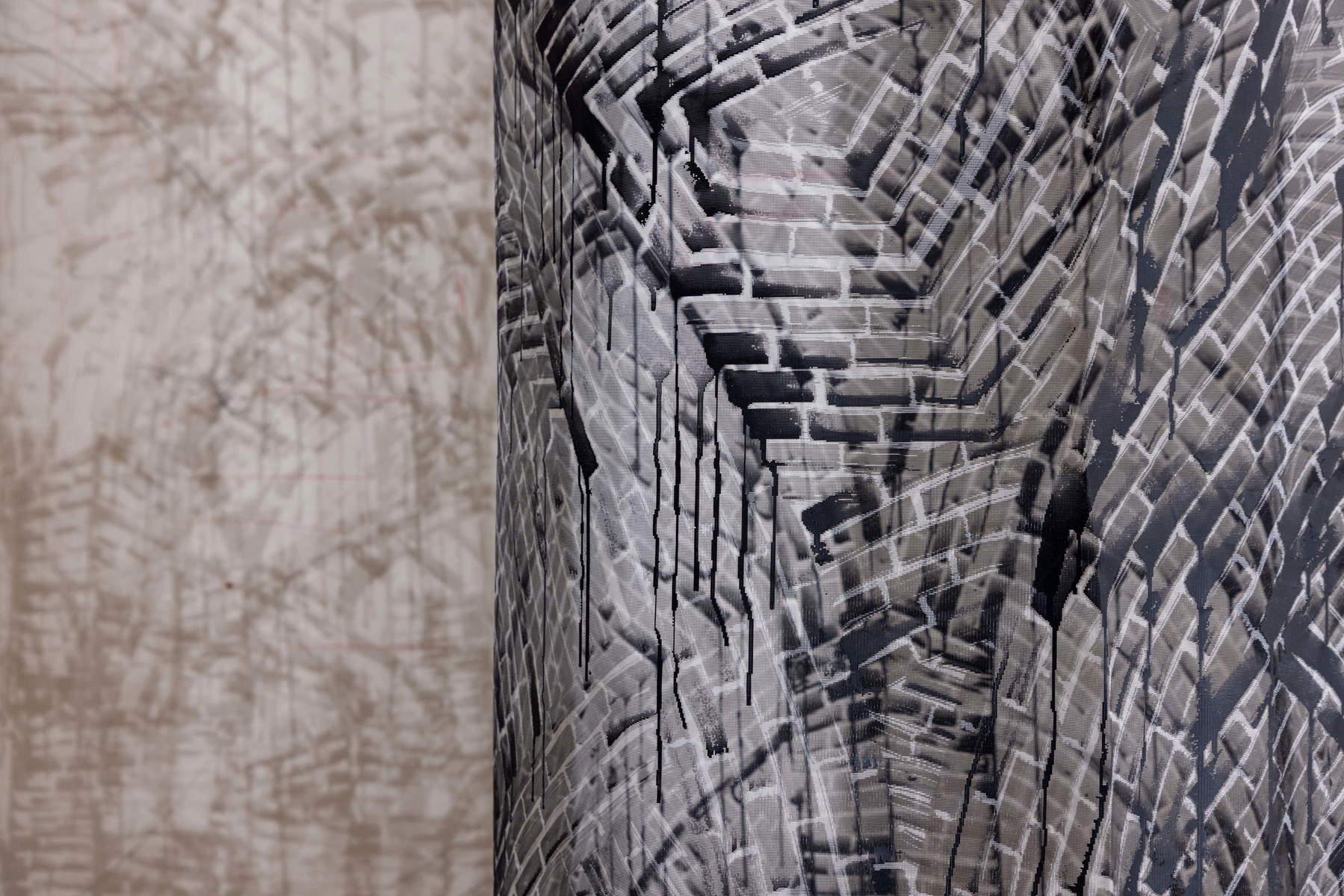
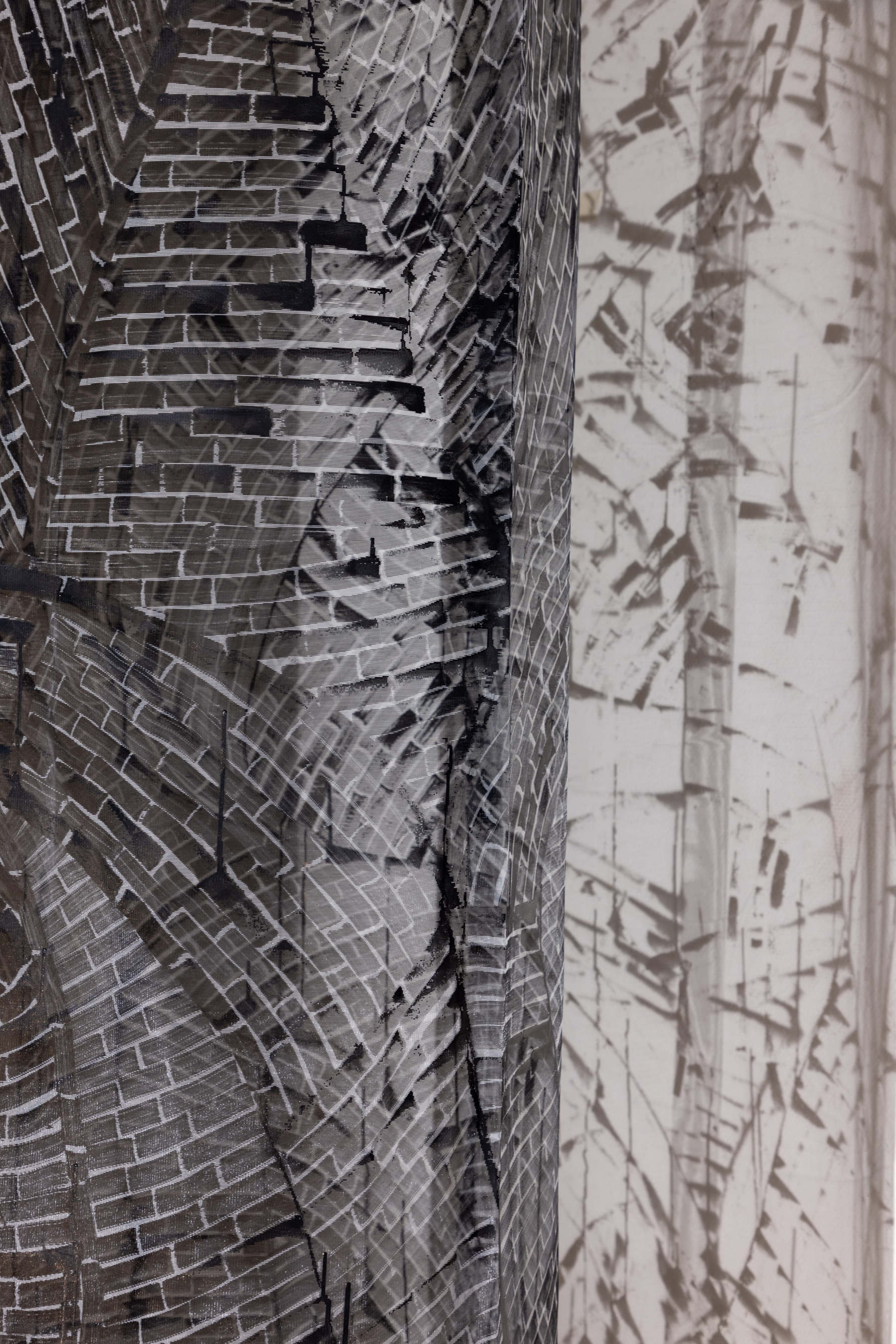
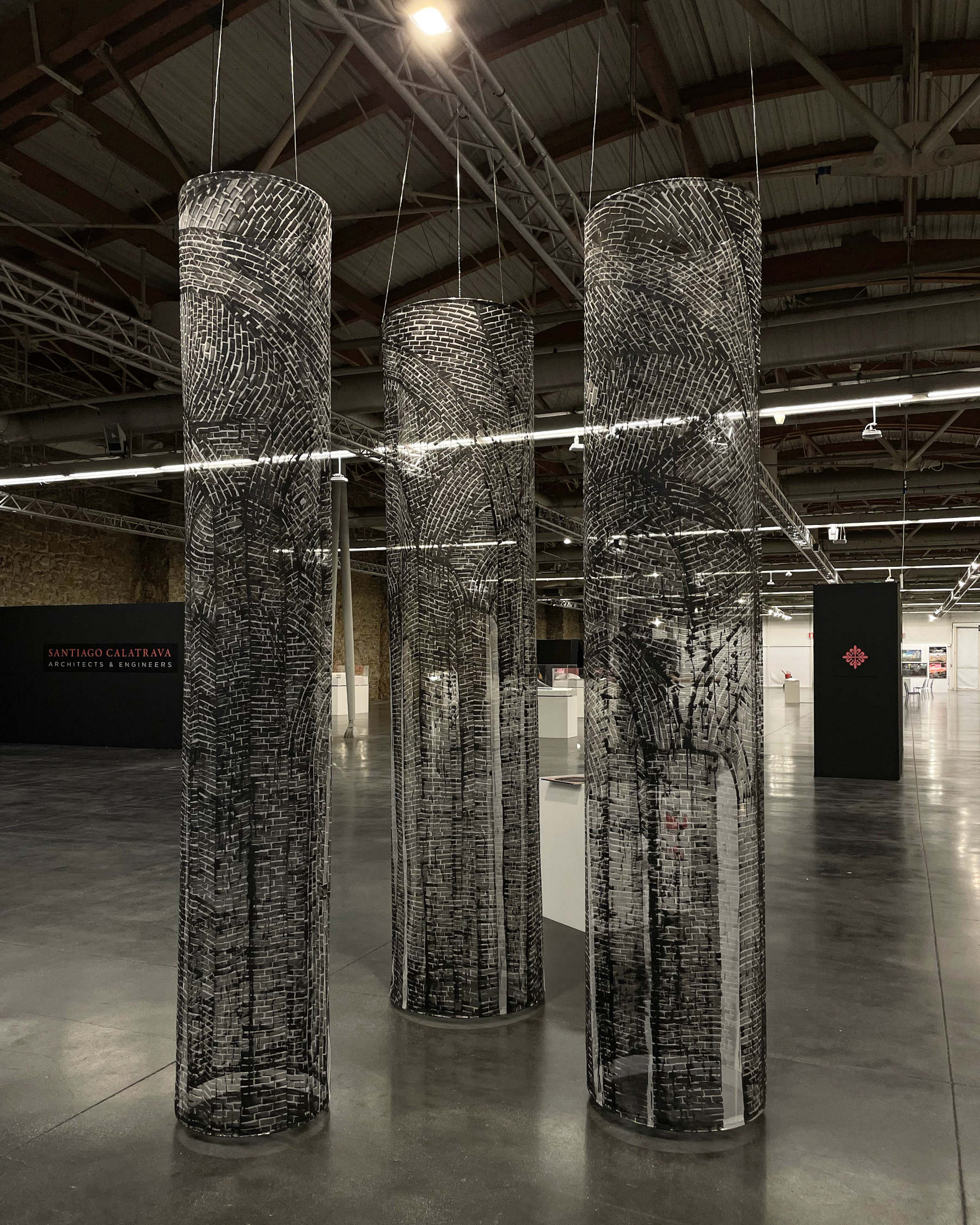
Essentially, the artist has created 30 suspended columns, each about 3 meters tall. Painted in ink on a delicate mesh fabric and suspended from the ceiling by nearly invisible threads, they appear to float in mid-air. The forms draw inspiration from the shabestan (the hypostyle hall) of the famous Friday Mosque in Isfahan, as well as from the architectural rhythm of the dome of the Taj al-Molk in Iran. Atefeh Majidi Nezhad’s artistic approach strips the monumental columns of their load-bearing function and historical weight, transforming ideologically burdensome and authoritarian structures into ephemeral, floating elements that invite the public to reflect on space, weight, and memory. We asked the artist a few questions; she has a special connection to Italy, a country where her work has received significant recognition over the past three years.

MF. Let’s start from the beginning: what was your educational background?
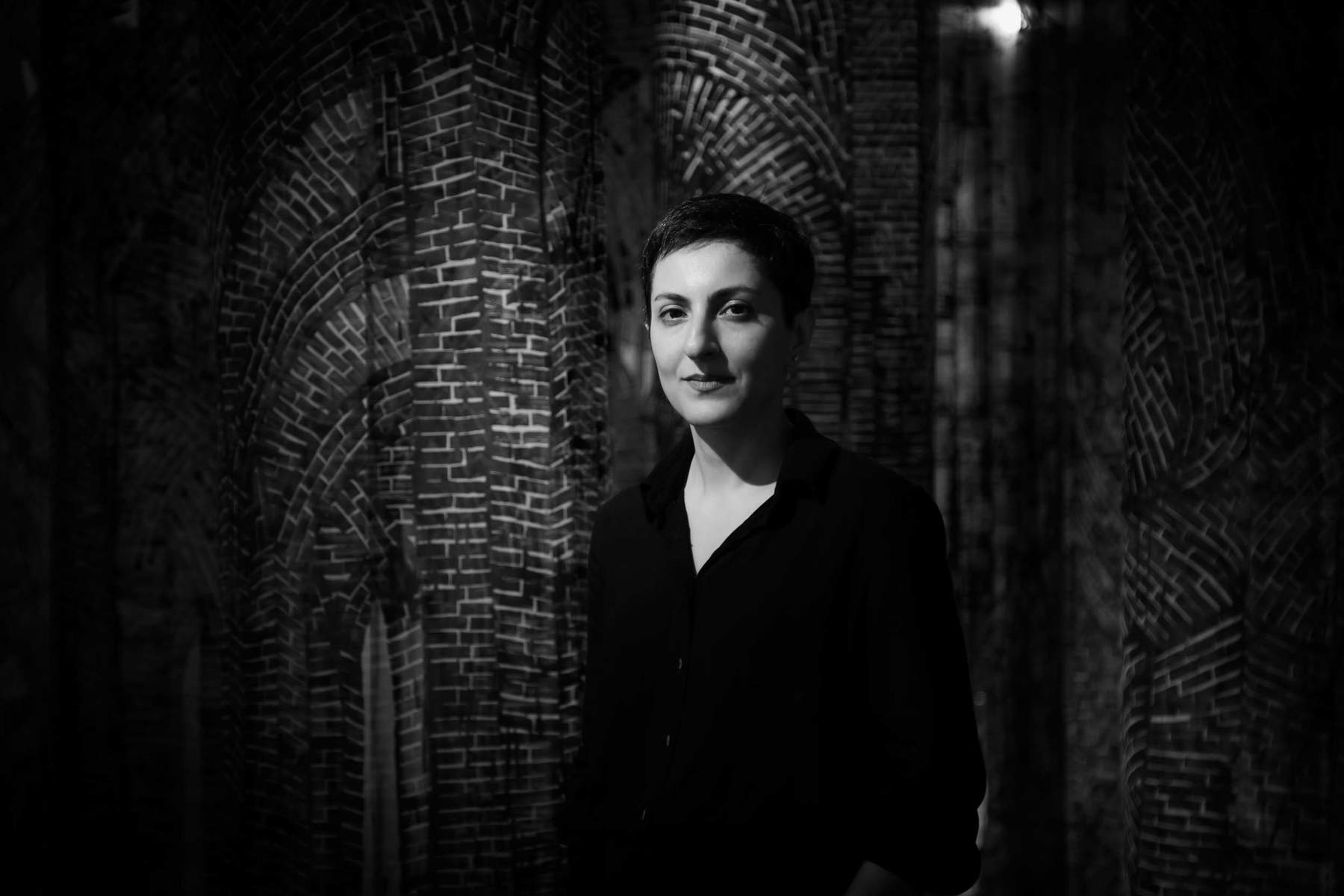
AMN. Pablo Picasso once said, “Art washes away from the soul the dust of everyday life.” I believe that everyone is born with a door wide open to art. It serves as a refuge for those who feel words stuck in their throats, for those who struggle to express their emotions. Art is the eloquent voice of our silent spaces. I spent my childhood in the quiet company of paper: I created little figures, drew clothes and furniture onto their lifeless forms, and tucked them away in a corner of my imagination, breathing life into them. In that world of paper, I was in control of everything; even my dolls were born from the strokes of my hands. At age ten, I joined the Institute for the Intellectual Development of Children and Youth. Three years later, at age thirteen, I overheard my art teacher talking to my sister: he confided in her that he had noticed a special talent in me. A wave of enthusiasm filled my chest, and at that very moment, the dream of attending art school took root in my heart. The journey was not without obstacles: I grew up in an environment where art was not considered a legitimate profession; everyone expected me to become an engineer or a doctor. I persevered, followed my own path, and eventually entered this magical world—a realm from which there is no turning back. My journey began with studying painting at the Isfahan University of Art and continued until I earned a master’s degree from the University of Tehran.
What is your artistic background?
I believe there comes a turning point when a person chooses their path with a deep inner conviction. It’s the moment when art ceases to be a mere passion and becomes who you truly are. I vividly remember the day this realization took hold of me: it was the day of the final project evaluations. Dr. Halimi, my advanced painting instructor, looked at my work and exclaimed enthusiastically, “You dive fearlessly into the heart of the ocean!” Yet, at that very moment, he gave me the lowest grade in the entire class! At first, I was over the moon that my talent had been recognized. But a few days later, when I saw the grade (14 out of 20), my world came crashing down. Even today, I can’t say whether it was a veiled form of encouragement or a subtle way of belittling me. Yet that moment marked the true beginning of my journey. It was then that Vincent van Gogh’s words came back to me: “There’s a storm at sea, but the secret to surviving it is to never forget the call of the shore.” This perspective ignited a rebellious determination within me: to remain an artist, to keep creating, and to assert my artistic identity. It was a journey that taught me the true meaning of perseverance and resilience.
What awards or recognitions have you received?
The moment I hold most deeply in my heart—and which helps me stay steadfast on this path—is winning second prize (“Lorenzo il Magnifico”) at the 14th Florence Biennale in 2023. For an artist, such recognition is like a mountaineer finally being able to set down a heavy backpack to catch their breath. That breath reminds you to walk with a lighter step, yet one that’s even more steady: you know full well that even steeper climbs await you—climbs that will demand even more from your spirit and your strength.
So, you also need a good dose of resilience…
Resilience? My answer is simple: I’m experiencing it right now. I’m in the heart of the Grand Duchy of Luxembourg: Luxembourg Art Week, 2026. Yet, when I submitted my application for Luxembourg Art Week 2026, my life was completely different. I had returned to Isfahan to take care of my father, right in the middle of the war. The internet was blocked throughout the country; a VPN cost a fortune, and the connection hung by a thread, ready to snap at any moment. During those difficult days, a quote by Albert Camus came to mind: “In the depths of winter, I finally learned that within me there is an invincible summer.” I told myself I had to find a way to save myself and my dreams from all that chaos. Against all odds and despite all my doubts: here I am at Luxembourg Art Week 2026.
Well, then, shall we try to describe your art, its characteristics, and your sources of inspiration?
At Luxembourg Art Week 2026, I’m presenting a new chapter of the project I’ve been working on for a decade: a reinterpretation and reimagining of Isfahan’s historic architecture. *Revision: ZeroG Columns* is an installation of suspended columns, inspired by Isfahan’s Friday Mosque (Jameh Mosque) and its twelve centuries of architectural transformations. Through this work, I continue to explore the relationship between historical architecture, the passage of time, and the fragility of structures. I created them using a transparent mesh and layers of ink. No longer having to bear the weight of stone or brick, they have become light, almost floating. When light (natural or artificial) passes through the mesh, it casts soft, flickering, almost ghostly shadows onto the floor, walls, and ceiling; it is as if the columns were breathing where the air meets the light. With every movement of the observer, the density of the ink and the transparency of the mesh shift, playing on the boundary between presence and absence. For me, this project revolves around the concept of durability. The columns retain their historical identity, yet their relationship with gravity and the void surrounding them has been radically transformed. Jacques Derrida wrote: “Deconstruction is not mere destruction; it is a way of reading that reveals hidden meanings.” Suspending these columns embodies precisely this: they challenge the power and authority of solid architecture, while at the same time revealing themselves as a gesture of profound care and tenderness. Furthermore, exhibiting this work in a space facing the city integrates art directly into the rhythm of daily life. Without having to cross the threshold of a gallery, passersby find themselves pausing, experiencing a moment of reflection and curiosity in the midst of the hustle and bustle of a busy day. The roots of the Revision series lie in the Jameh Mosque of Isfahan; its square shape represents stability and permanence in the physical world. However, for me, this building is also part of the inner life and lived experience of the people who frequent it. Architect and theorist Christian Norberg-Schulz wrote: “A place is not just physical geography; it is a quality of being that shapes human identity and memory.” Isfahan is my hometown, and these columns are part of my visual unconscious; working with them means reinterpreting my personal memory within a shared history.
What does it mean to you to present such an intimate work outside your home country?
My response to the present does not consist of a direct representation of instability; rather, I seek to create the conditions under which the very idea of stability is called into question. My work does not offer the public absolute or immutable truths, but invites them to perceive fragility, fluidity, and different perspectives. For me, presenting this installation in different countries is not merely a geographical shift, but rather a spatial and semantic one. Edward Said observed: “Ideas and forms, when they travel and are inserted into new contexts, acquire new languages and establish unpredictable relationships with their new containers.” When a familiar form arrives in a new land, its meaning shifts. The installation establishes a living dialogue with the layers of the city that hosts it, transforming into something that exists in an intermediate dimension: between the “memory of origin” and the “reality of the destination.”
Will we see your work in Italy again? And if so, when?
The ideas underlying my work, as well as my previous experiences in Italy—particularly at the Florence Biennale—are of inestimable value to me. I have a deep desire to return to Europe to build stronger, more vibrant connections through projects that allow a work of art to sprout naturally from a specific context and geography, breathing in harmony with the light, the architecture, and the surrounding world.
Let’s try to imagine: is it possible to build an artistic bridge between Iran and Italy?
Both Iran and Italy are built upon the foundations of a history and architecture that span millennia. In this regard, I am reminded of the time Pier Paolo Pasolini spent in Isfahan; he traveled there to film *The Flower of the Thousand and One Nights*, captivated by the magic of the Jameh Mosque, and set his camera within this enchanting architecture. This demonstrates how a physical space in Iran can inspire an Italian creative mind—and vice versa. I believe that an authentic and sincere dialogue between contemporary art scenes is possible. Hans-Georg Gadamer wrote: “Conversation is a process in which two people come to understand one another… it is a fusion of horizons.” Even when political circumstances and economic pressures make the creative act difficult, art remains a refuge: a vital space where curiosity is awakened, a conversation begins, and a deeper understanding between people can flourish.
What is the situation like in your country?
In the art world (and in Iran, specifically), the path is far from easy. Yet many artists continue to experiment and forge their own independent and authentic paths. The greatest challenge for an emerging artist is finding solid ground amid the turbulent waters of today’s art world—waters that the entire global art community must navigate. For an Iranian artist, however, the burden is even greater. From personal experience, I can say that the problem is never a lack of ideas, creativity, or talent. The real challenge lies in finding the strength to keep going, along with the resources and support needed to make the creative act possible. As Friedrich Nietzsche said: “He who has a why to live can bear almost any how.” I believe that when passion and faith in the creative act burn within an artist, he or she will succeed in carving a path through the hard rock of reality; for the will to create is always stronger than any obstacle.
Warning: the translation into English of the original Italian article was created using automatic tools. We undertake to review all articles, but we do not guarantee the total absence of inaccuracies in the translation due to the program. You can find the original by clicking on the ITA button. If you find any mistake,please contact us.