



by Redazione 01/09/2026



Categories: Market / Disclaimer
The 1907 painting, considered one of the key works in Kandinsky’s development, will be offered by Christie’s in London on October 14, 2026. Returned in 2023 to the heirs of Hedwig Lewenstein-Weyermann, its history is linked to Nazi persecution and the dispersal of the family collection.
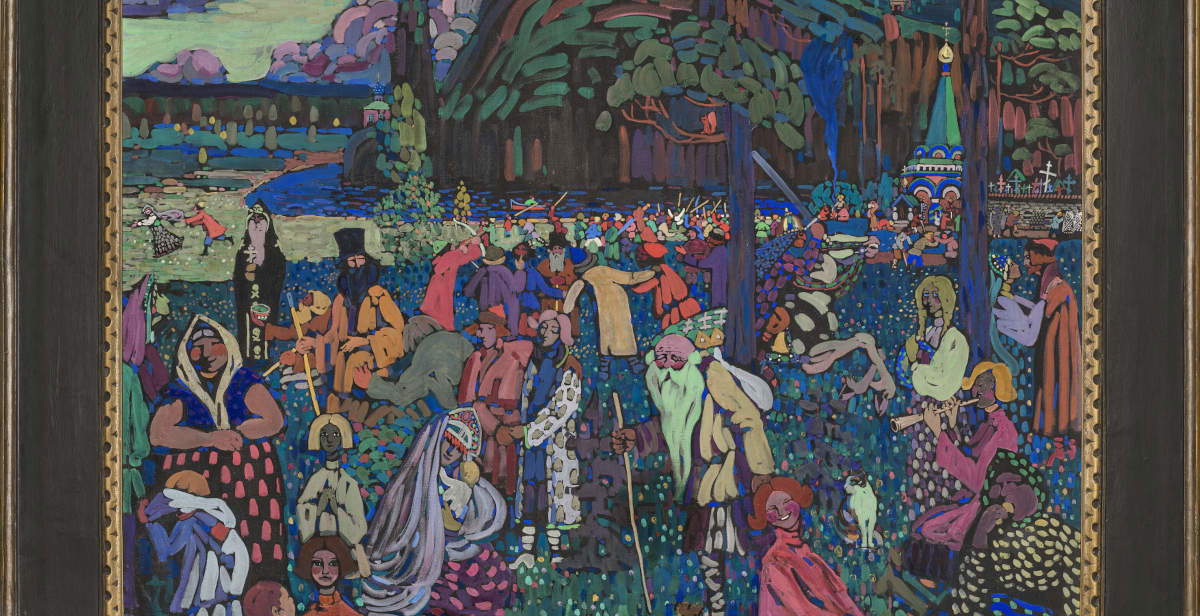
“Das bunte Leben” by Wassily Kandinsky ( Moscow, 1866 – Neuilly-sur-Seine, 1944), painted in 1907, will be one of the key works offered by Christie’s during Frieze Week in London. The canvas, measuring a monumental 130 × 163 centimeters, will be offered on October 14, 2026, as part of the 20th/21st Century: London Evening Sale. The work, returned in June 2023 to the heirs of Hedwig Lewenstein-Weyermann, is considered one of the most significant works from the artist’s formative years and was exhibited to critical acclaim at the Salon d’Automne in Paris in the same year it was painted.
The story behind *Das bunte Leben* takes place during a decisive phase of Kandinsky’s artistic exploration, linked in particular to his stay in Paris from 1906 to 1908. During those years, Paris was one of the leading centers of experimentation in European painting. Exhibitions showcased the work of artists such as Paul Cézanne, Georges Seurat, and Vincent van Gogh, alongside Pointillism, Post-Impressionism, Fauvism, and early Cubist experiments. Kandinsky arrived in the French capital in 1906 with the painter Gabriele Münter, with whom he was in a relationship, and initially settled on Rue des Ursulines, later moving to nearby Sèvres.


The two frequented the Salon des Indépendants and the Salon d’Automne and visited the galleries of Berthe Weill, Ambroise Vollard, and Clovis Sagot, as well as the Stein family’s collections. Their exposure to the works of the Parisian avant-garde helped profoundly transform Kandinsky’s artistic vision. The optical innovations of Pointillism, the chromatic intensity of Fauvism, the imagery of Symbolism andArt Nouveau, and Post-Impressionist experiments all converged in his work without leading him to align himself with any single movement. Color thus began to take on an autonomous role, no longer merely descriptive but capable of expressing emotions and spiritual meanings.
Painted in 1907, *Das bunte Leben* was, at that time, the largest canvas the artist had ever tackled. The choice of such a large format also reflected his ambition to reach a wide audience and establish his position in the Parisian art scene. Kandinsky addressed the theme of life in all its complexity, envisioning it within a pastoral and utopian universe. This choice was part of a broader context in which similar subjects had been explored by Henri Matisse in *Bonheur de vivre* (1905–1906) and by André Derain in *La Danse* ( 1906).
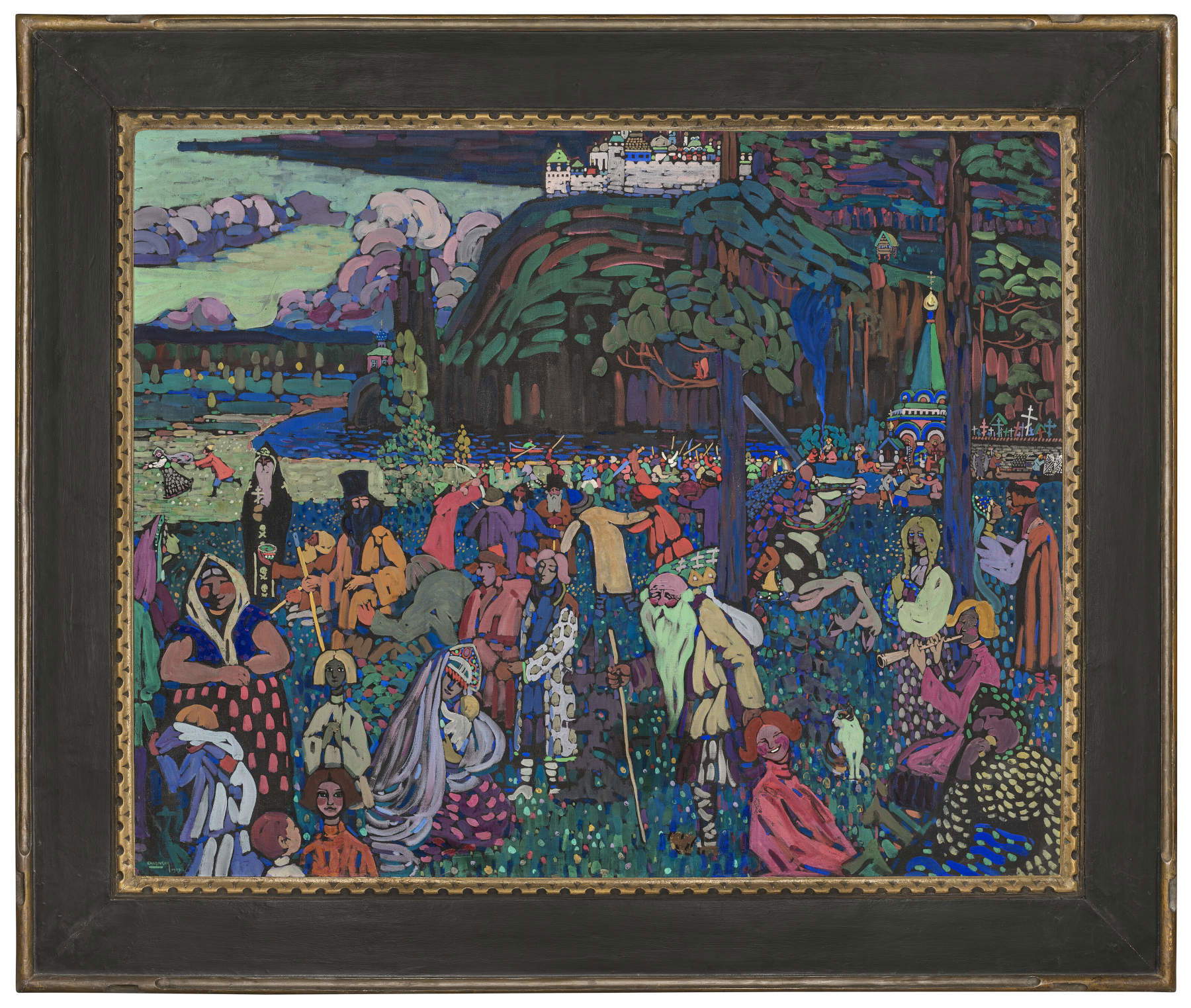
The surface of the canvas is enlivened by luminous fields of color and chromatic transitions of an almost mosaic-like nature. The landscape features pilgrims, peasants, saints, noble figures, mothers, and children, gathered in a space without a precise temporal setting. Joy and sorrow, love and loss, life and death coexist in the composition without being tied to a single narrative. Rather, the characters and situations become elements through which the artist constructs a reflection on the complexity of the human experience.
Numerous motifs draw on Russian legends, folklore, and religious traditions that had fascinated Kandinsky since earlier years. A horseman also appears among the trees, a motif destined to evolve in the subsequent iconography ofthe Blaue Reiter. Other figures evoke saints and heroes from the Russian iconographic tradition. These references take on symbolic value, linking the artist’s personal memory to a more universal representation of existence.
In addition to the painting’s artistic significance, its provenance is marked by the history of persecution and the restitution of works of art. In November 1927, *Das bunte Leben* was purchased by the Dutch entrepreneur and collector Emanuel Albert Lewenstein and his wife, Hedwig Lewenstein-Weyermann. Emanuel headed Lewenstein, a sewing machine company that was one of the most well-known industrial firms in the Netherlands. The couple had assembled a collection of modern art featuring Dutch artists and leading figures of the European avant-garde, thanks in part to their relationship with Emanuel’s cousin, Paul Citroen, an artist and photographer trained at the Bauhaus, who introduced him to Berlin’s progressive Expressionist and Modernist circles.
With the German occupation of the Netherlands, the family’s assets were confiscated. In October 1940, a few months after the invasion, the works in the Lewenstein collection were dispersed. *Das bunte Leben*, then on loan to the Stedelijk Museum, was removed from the museum, sold at auction, and purchased by the collector Salomon B. Slijper. The work subsequently remained in museum custody in the Netherlands for most of that time, until it was purchased by the Bayerische Landesbank from Slijper’s family in 1972. In 1973, it was granted on long-term loan to the Lenbachhaus in Munich, where it has been on public display for over fifty years.
After the war, Emanuel and Hedwig’s children, Robert and Wilhelmine Lewenstein, devoted decades to searching for the works that had belonged to their parents. Through a lengthy process of reconstructing the work’s provenance and legal action conducted with their own advisors and Mondex Corporation, the heirs of Hedwig Lewenstein-Weyermann secured the return of *Das bunte Leben* from the Bayerische Landesbank in June 2023.
Prior to the London auction, the painting will be presented by Christie’s in Zurich from September 2 to 4, in Paris from September 10 to 12, in New York from September 17 to 20, and in Hong Kong from September 22 to 29. In London, it will be on public view starting October 8, ahead of the auction on October 14, 2026.
 |
| A Kandinsky masterpiece is set to go up for auction at Christie’s after being returned to the heirs |
Warning: the translation into English of the original Italian article was created using automatic tools. We undertake to review all articles, but we do not guarantee the total absence of inaccuracies in the translation due to the program. You can find the original by clicking on the ITA button. If you find any mistake,please contact us.