





There is a jewelry designer who has found inspiration in the paintings of Claude Monet to create brooches and fine jewelry: the French artist’s brushstrokes become precious gemstones, the reflections of light are transformed into diamonds, and the nuances of Impressionist landscapes take shape in fine jewelry.
Feng J’s creations were showcased in Paris and Hong Kong during the major Le Temps Retrouvé auction: The Schlumberger Collection, one of the most valuable private collections of Impressionist and modern art ever to be auctioned in France, is scheduled to take place at Sotheby’s in Paris on October 22 and will also feature two previously unseen paintings by Claude Monet. The designer spoke with Lili Goksenin for Sotheby’s.
Before becoming a jewelry designer, Feng J dreamed of becoming a painter. She began studying ink painting and calligraphy as a child. Her great-grandfather had been a court painter during the Qing Dynasty, and this artistic legacy helped shape the way she views the world. At the Hangzhou Academy of Chinese Art, Feng J moved increasingly toward abstraction. However, she earned a degree in Furniture and Product Design. It was while studying in London at the London College of Fashion—where she specialized in fashion accessories—that she discovered jewelry design. Upon returning to China, she furthered her studies in gemology at the GIA in Shanghai. After several years of experimentation, she founded the Feng J – Joaillerie d’Art maison in Paris in 2016.
It is painting, however—and in particular the work of Monet—that lies at the heart of her creative exploration. Feng J recalls discovering Monet’s art during her school years as a true revelation. She was particularly struck by his relationship with nature, his attention to light and atmosphere, and the contemplative dimension of his works. These elements, according to the designer, share a deep affinity with the Chinese aesthetic tradition and have influenced generations of artists.
To create the Monet-inspired jewelry, Feng J visited the Musée des Impressionnismes in Giverny, where she admired the monumental canvas painted by the artist during World War I. What captured her attention were not so much the water lilies as the branches of the weeping willow and the modernity of the composition, characterized by an almost abstract quality—an aspect that immediately resonated with her artistic sensibility.
From this experience came *Libellule de Giverny*, a dragonfly-shaped brooch whose wings evoke the luminous tree branches painted by Monet. This creation is part of a series that also includes *Libellule aux rameaux de saule* (Dragonfly with Willow Branches) and *La foglia di Ginkgo dell’alba* (Ginkgo Leaf at Dawn). Through these works, Feng J seeks to convey in her jewelry not only the subjects of the paintings but also the movement of the brushstrokes and the rhythm of the composition. The goal is to translate Monet’s pictorial language into that of fine jewelry.
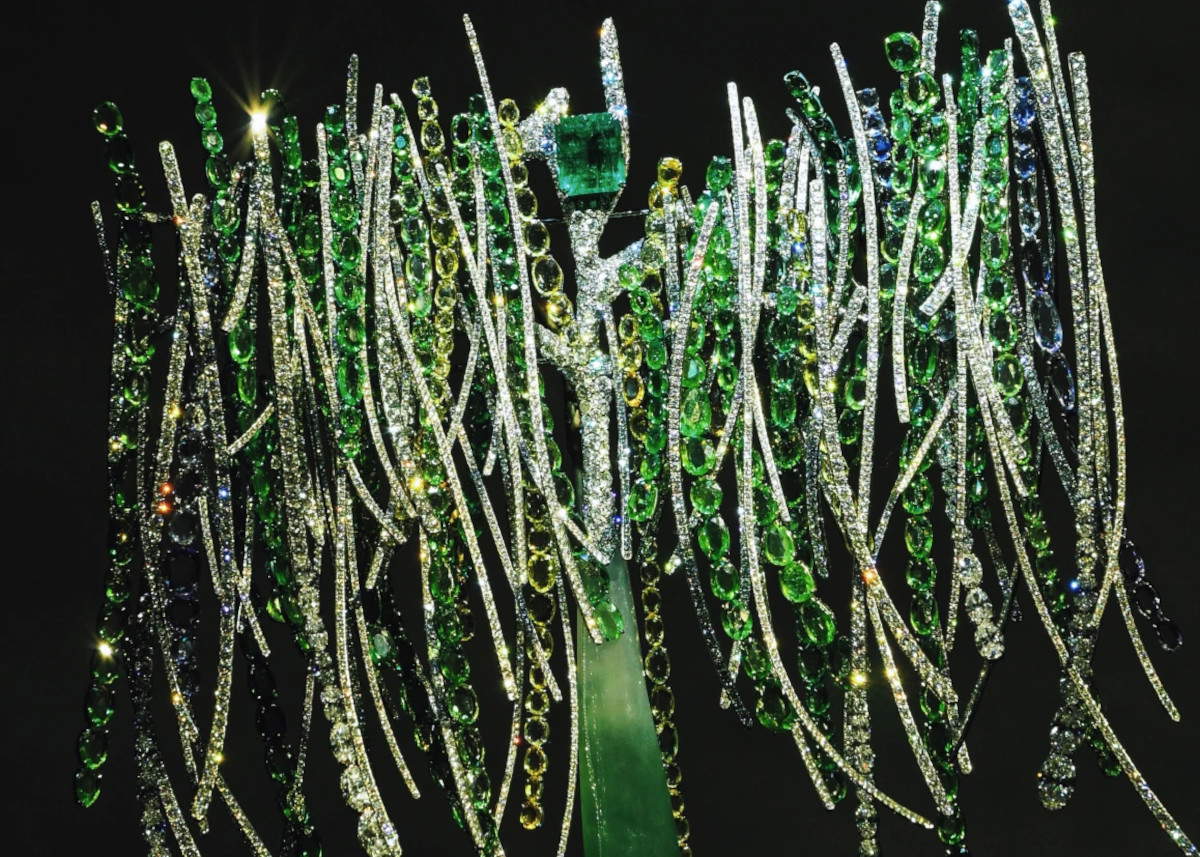
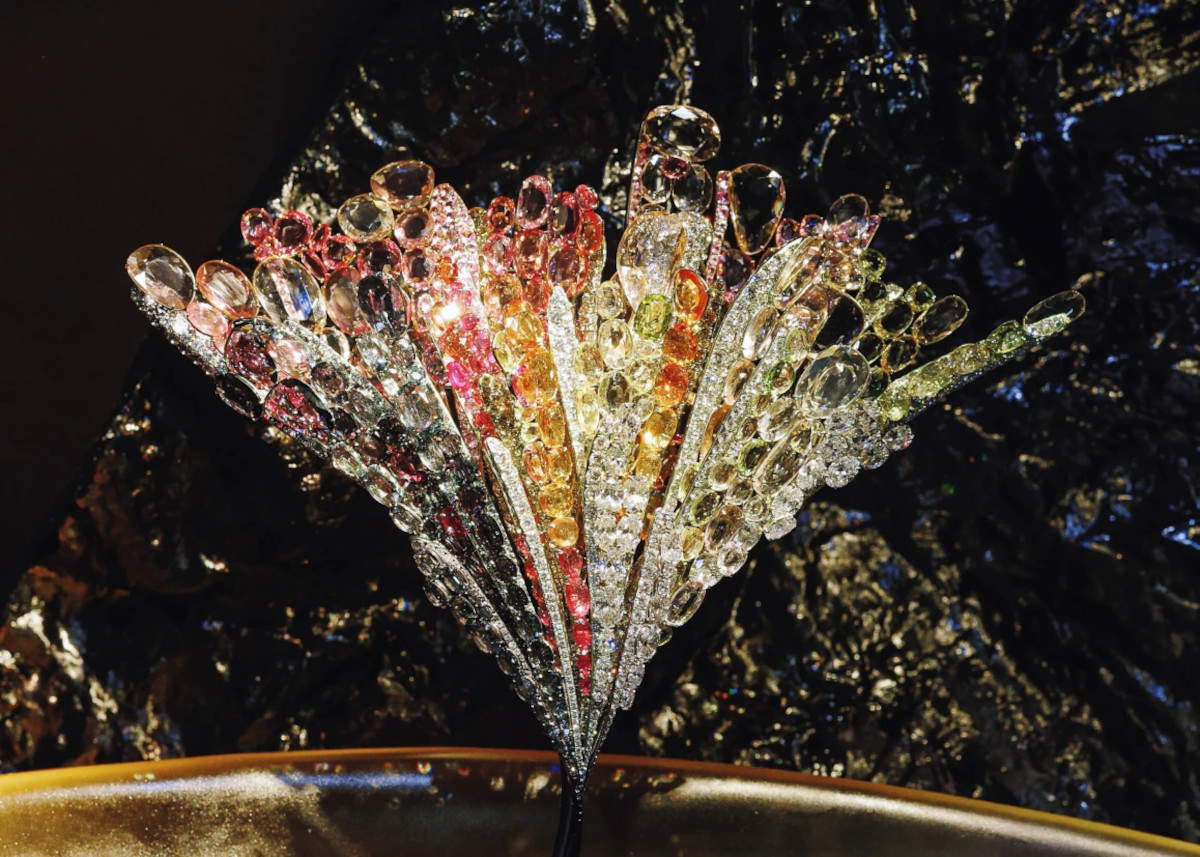
To reproduce the chromatic variations and luminosity of the paintings, the designer employs specialized techniques, including the “Floating Set”—a setting system she invented—and the “Double Rose Cut,” an ancient gem-cutting technique she rediscovered and adapted to her artistic vision. Precious stones and diamonds thus become true pigments: they are layered and arranged at different angles to create plays of color, transparency, and reflections. Each piece of jewelry requires months of work, involving experimentation, testing, and trial and error. The floating setting technique is particularly complex and unpredictable: it does not allow every detail of the composition to be determined in advance and requires each stone to be positioned by hand. Feng J begins by defining the arrangement of the gemstones and then works closely with the setter, following the creation of the piece step by step.
Over the years, he has built a veritable “library of colors”—a collection of gemstones organized by hue, shade, tone, and saturation. Her range of greens includes emeralds, tsavorites, green sapphires, and tourmalines, while her range of reds, pinks, and oranges includes rubies, spinels, and the rare peach-colored padparadscha sapphire. This chromatic repertoire allows her to approach painting through precious materials.
|
| Feng J, the designer who transforms Monet’s paintings into fine jewelry pieces |

Warning: the translation into English of the original Italian article was created using automatic tools. We undertake to review all articles, but we do not guarantee the total absence of inaccuracies in the translation due to the program. You can find the original by clicking on the ITA button. If you find any mistake,please contact us.

























 IT
IT FR
FR DE
DE ES
ES CN
CN


