



by Redazione 19/11/2026


Categories: Market / Disclaimer
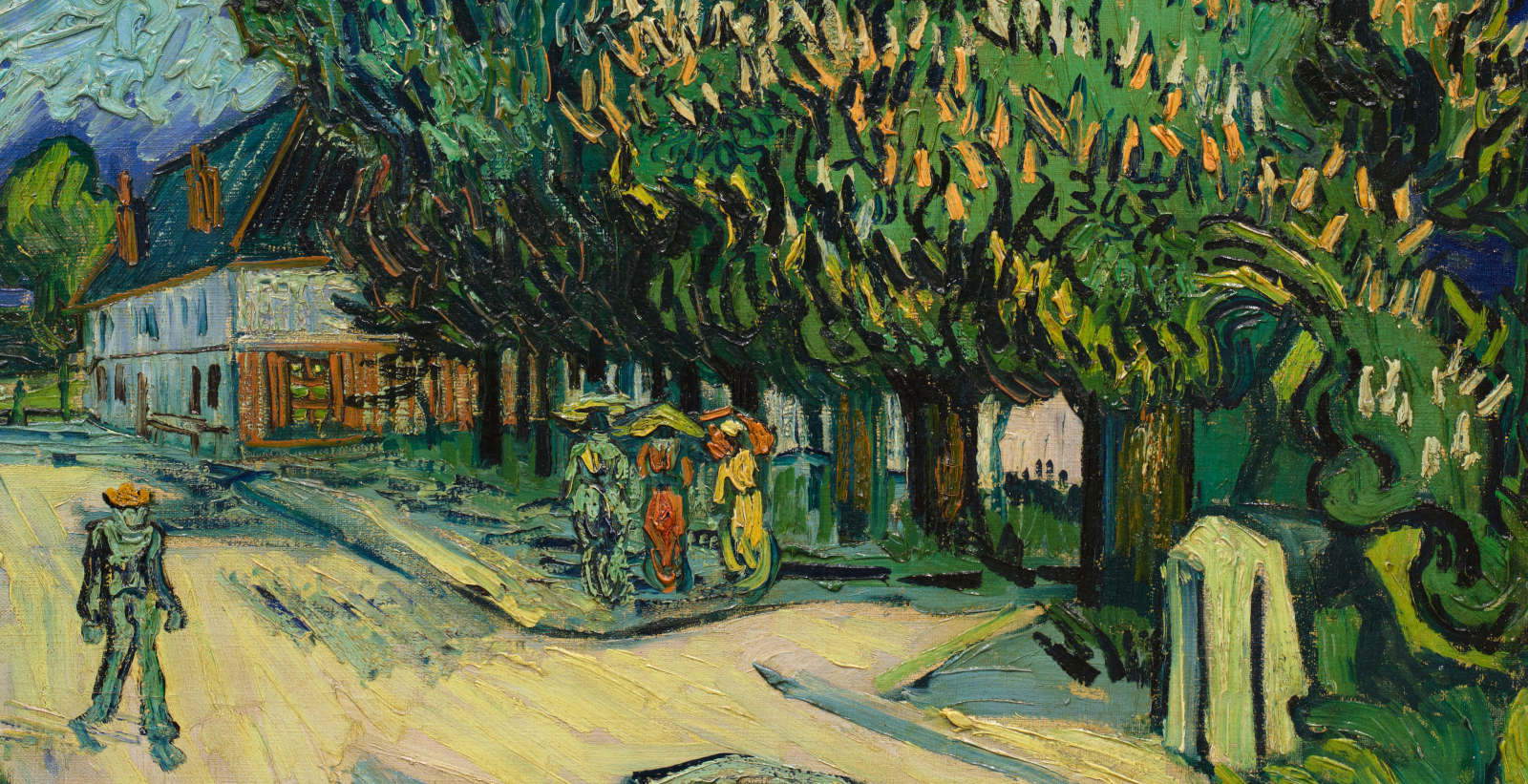
Van Gogh’s chestnut trees make history: *Châtaigniers en fleurs*, painted by Vincent van Gogh in May 1890, sold at Sotheby’s in New York for $190.43 million. This sets a new record for the artist—it is the most expensive Van Gogh ever sold at auction—following an agreement between the auction house and the Fischer heirs.


All-time record for Vincent van Gogh: his “Chestnut Trees in Bloom” (Châtaigniers en fleurs) were sold just a few minutes ago at Sotheby’s for $190.43 million, or 173.56 million euros: it is the most expensive Van Gogh painting ever sold at auction. It is one of Van Gogh’s final works, painted in late spring 1890, after—on May 25 of what would be his final year of life— Vincent wrote to his brother Theo that he had painted two studies of chestnut trees, one with “white” flowers and one with “pink” flowers. The painter had arrived in Auvers-sur-Oise just five days earlier and had little more than two months left to live. The study of the white chestnut trees is now housed at the Kröller-Müller Museum in Otterlo, while the study of the pink chestnut trees is the painting that fetched a record-breaking price at Sotheby’s in the Breuer Building on Madison Avenue in New York, in a packed auction room. The official estimate was available only upon request, but Sotheby’s had indicated a figure around $180 million (€164 million), and some in the market went so far as to speculate on $200 million or more. In the end, the hammer fell at $165 million, the hammer price, which reached a record $190.43 million including auction commissions. The result significantly surpassed the artist’s previous record: that record was held by *Verger avec cyprès* ( 1888), the orchard with cypress trees from the Paul G. Allen collection sold by Christie’s in New York in November 2022 for $117.2 million. The new record surpasses that figure by over seventy million. It is also the fourth most expensive work ever sold at auction (in nominal terms), preceded only by the *Salvator Mundi* attributed to Leonardo da Vinci ($450.3 million at Christie’s in 2017), Gustav Klimt’s Portrait of Elisabeth Lederer ($236.4 million at Sotheby’s in 2025), and Andy Warhol’s Shot Sage Blue Marilyn ($195 million at Christie’s in 2022).

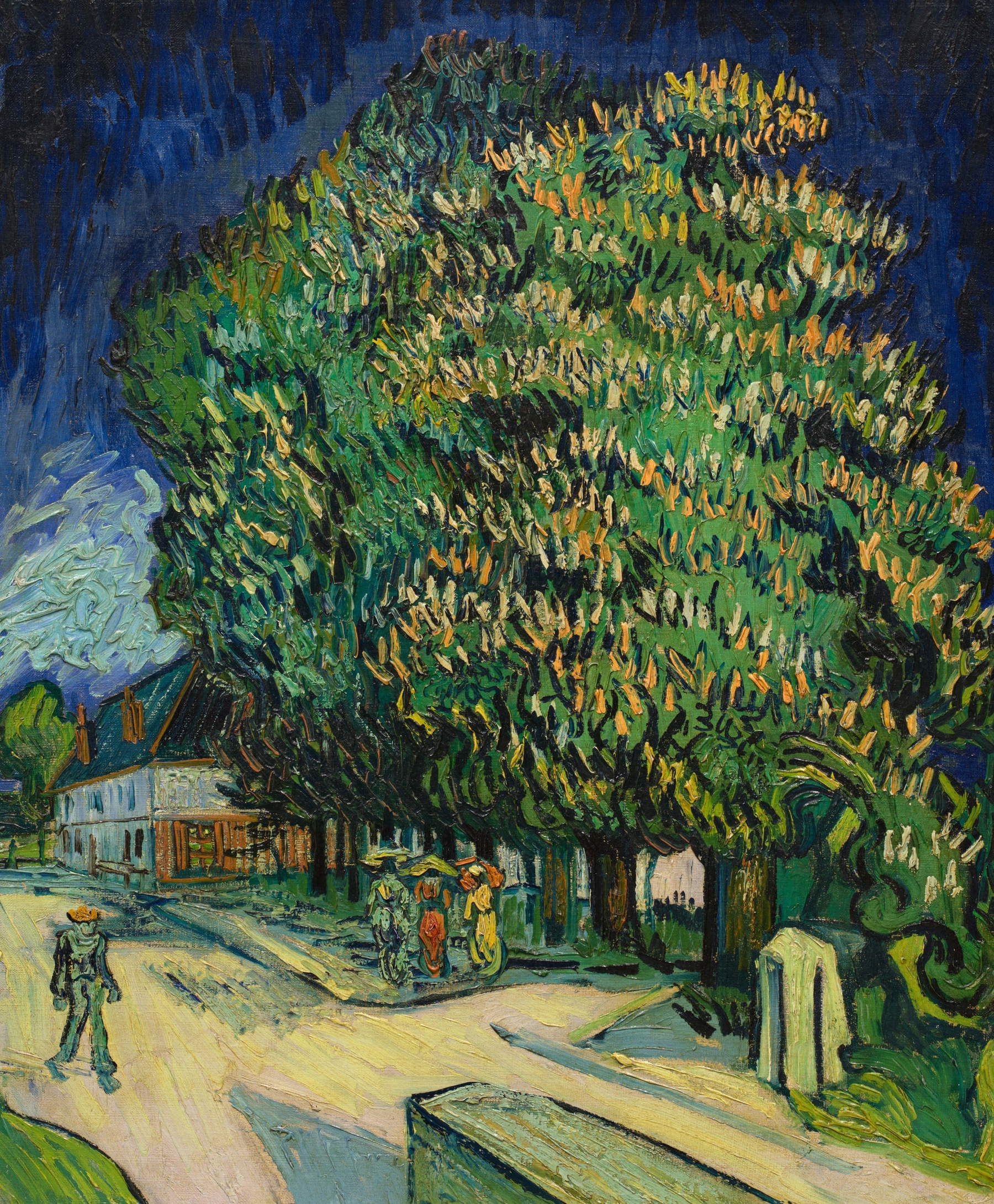
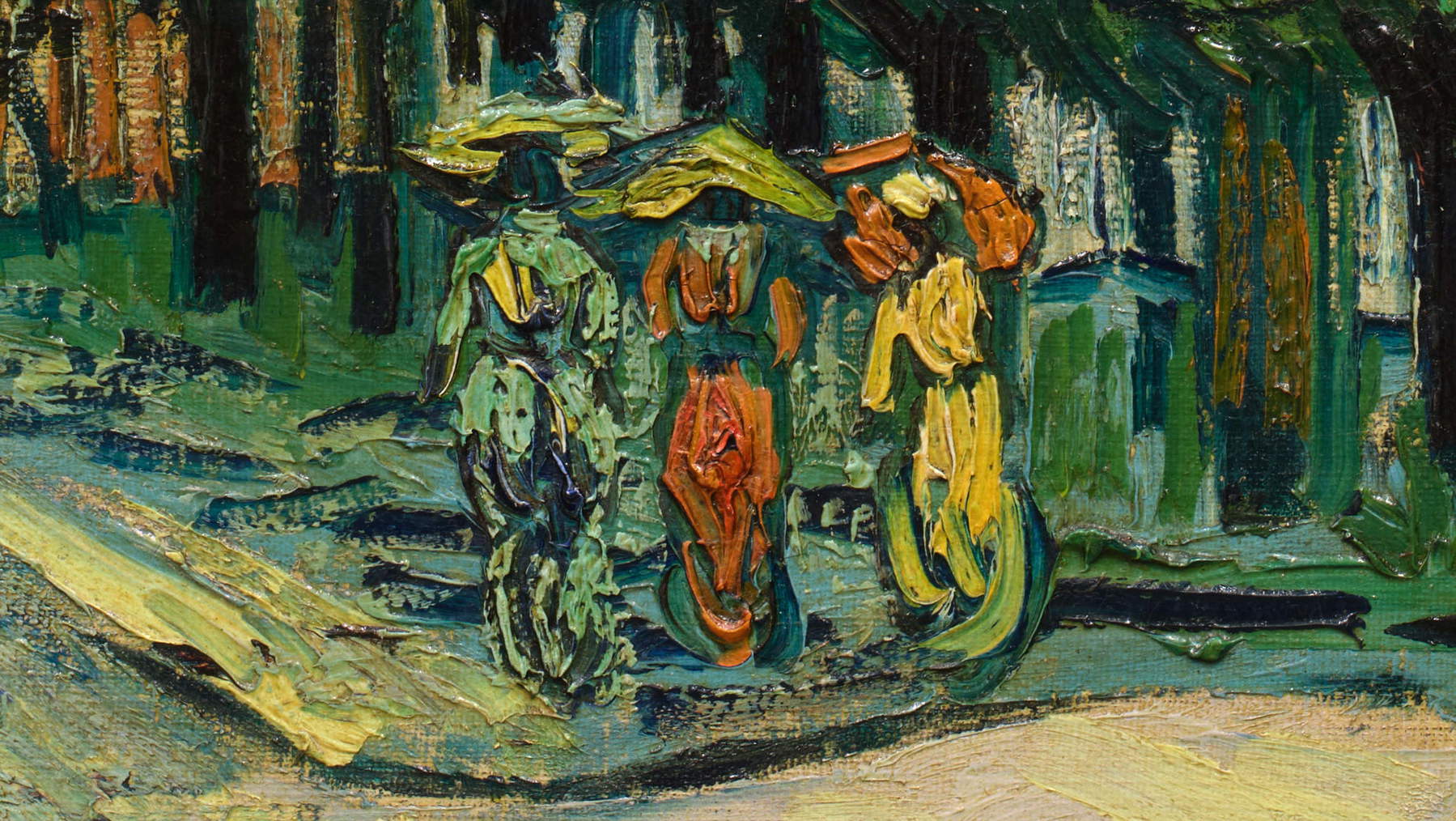
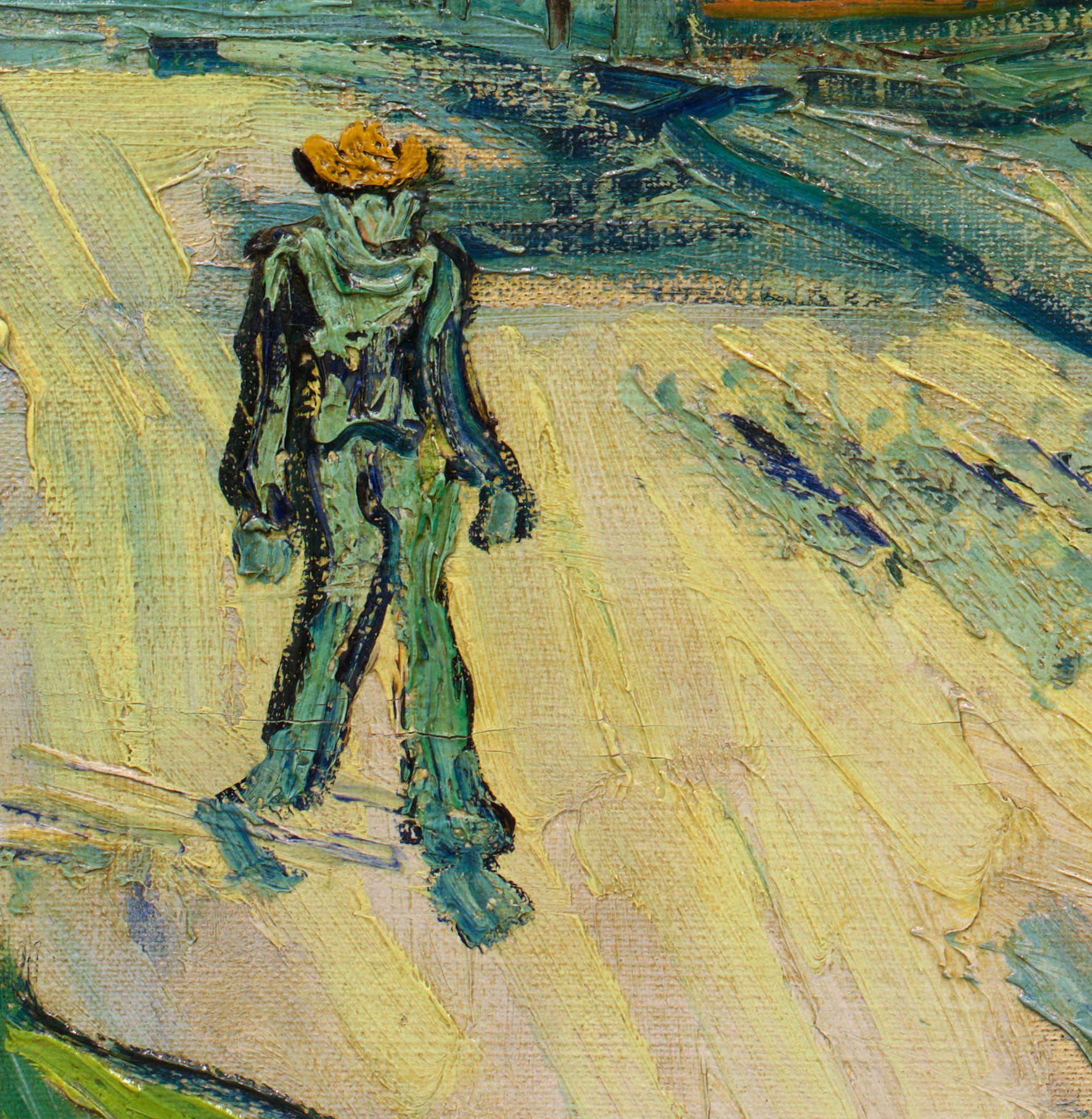
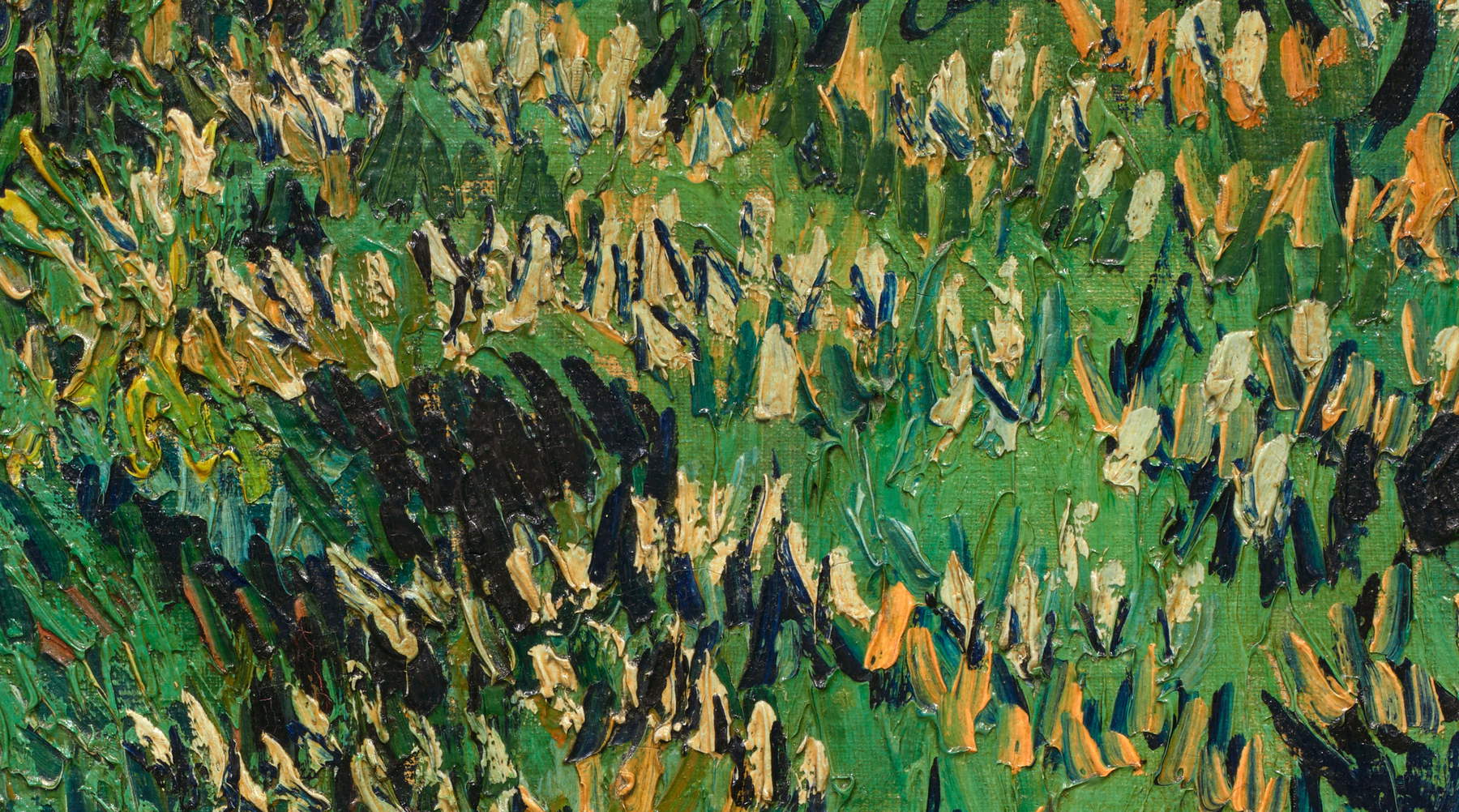
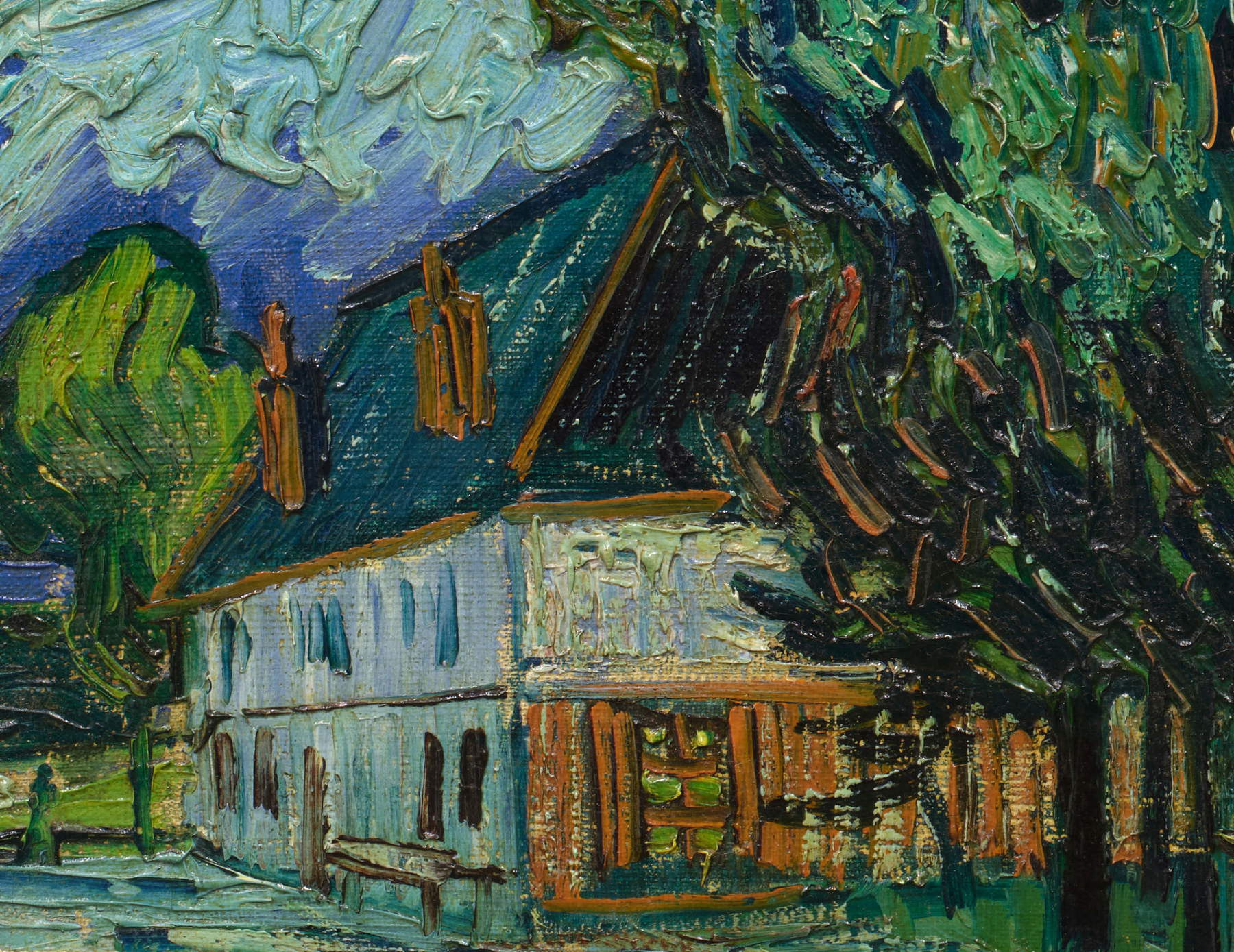
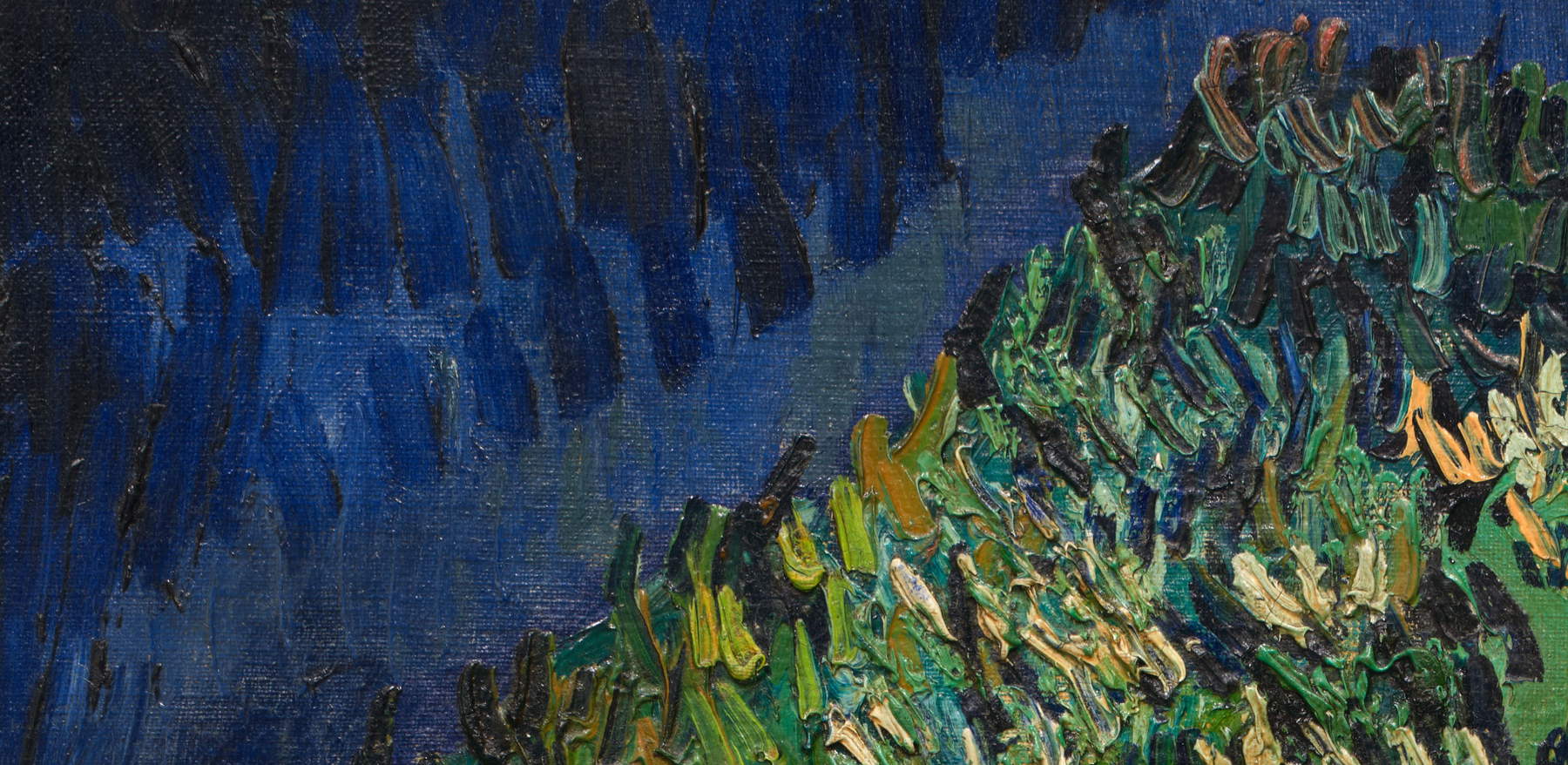
The painting, an oil on canvas measuring seventy by fifty-eight centimeters, depicts the large chestnut trees in bloom along the street now known as Avenue Charles de Gaulle, near City Hall and the inn where Van Gogh was staying. Beneath the trees, three women in brightly colored dresses converse, sheltered by open parasols, while a man in blue work clothes and a yellow straw hat walks along the street. The blossoms are rendered with dense, overlapping brushstrokes. The contrasts of complementary colors—green against orange and blue against pink—make the flowers seem to vibrate, and the shadows on the street are veiled in a pale pink. The deep blue sky frames the composition. The sharp shadows suggest a day of bright sunshine, while the darkness of the sky might foreshadow a change in the weather. After all, van Gogh wrote during those days: “Yesterday and today it’s raining and stormy, but it’s not unpleasant to see these effects again.”


Among the chestnut trees painted by van Gogh during those weeks, this is the only one in which human figures appear. Who are the three women? Art historian Cornelia Homburg has speculated that they are fictional and may be reminiscent of geishas in kimonos, perhaps inspired by an exhibition of Japanese prints held shortly before at the École des Beaux-Arts. Another possibility is that they are Parisian vacationers in festive attire. Homburg interprets the painting as the beginning of a new phase, tackled with “skill”: a mature work that synthesizes his previous work and looks to the colors and motifs of the North.


The chestnut tree was not a new subject for van Gogh. He had already depicted it in The Hague in 1882–1883, then in Paris in 1887—for example, in *The Rispal Restaurant in Asnières*, now at the Nelson-Atkins Museum—and in Arles in October 1888 with *The Public Garden*. An avenue of chestnut trees was still a work in progress in May 1889, shortly before he left Arles. In Auvers, the theme also reappears in *Père Pillon’s House* and in the still life *Branches of Chestnut Trees in Bloom*, from the Bührle Collection, on long-term loan to the Kunsthaus Zurich. In Provence, between 1888 and 1889, he painted orchards in bloom, including that very *Orchard with Cypress Trees* which, until yesterday, held the record. In the spring of 1890, in Saint-Rémy, he painted *Almond Tree in Bloom* to celebrate the birth of his nephew.
The choice of Auvers was no accident. The village was less than an hour by train from Paris and had a tradition of landscape painting linked to the names of Corot and Daubigny. It was Pissarro who had suggested it. Dr. Paul Ferdinand Gachet lived there—a physician, amateur painter, and collector of works by Pissarro and Cézanne—whose portraits van Gogh would go on to paint; one of these is now in the Musée d’Orsay. And it was close to Theo, an art dealer at the Montmartre branch of Goupil & Co., whose wife and newborn son Vincent met. “Auvers is truly beautiful [...] it is the heart of the countryside, distinctive and picturesque,” he wrote to his brother. In just over two months, until his death on July 29, 1890, he produced 74 paintings and more than 50 drawings there.
The painting’s subsequent history spans the 20th century in Europe. Upon Vincent’s death, it passed to Theo, then to Johanna van Gogh-Bonger (Theo’s wife and Vincent’s sister-in-law) and their son Vincent Willem. In 1905, it came into the possession of the Berlin art dealer Paul Cassirer, who sold it in 1906 to Alexandre Berthier, Prince of Wagram. It then passed to the Galerie Druet in Paris and, in January 1909, to Gustave Fayet. That same year, through the Bernheim-Jeune gallery, it was purchased by Samuel Fischer, the Jewish publisher and founder of S. Fischer Verlag, the publishing house of Thomas Mann, Hermann Hesse, and Alfred Döblin.
This is precisely where the controversy that dogged the sale until the very end originated. The Fischer heirs, who live in the United States, claimed that the family had been forced to sell the painting in 1936 due to the financial losses suffered by the publishing house under the Nazi regime. According to their account, after Samuel’s death in 1934, his son-in-law Gottfried Bermann Fischer had taken over the company while the regime was banning many of its authors. In 1936, the family moved the business to Vienna, and after the Anschluss in 1938, they were forced to flee again, while the Gestapo seized their Viennese home, their library, and what remained of their art collection. According to the heirs, the sale of the van Gogh took place three months after their departure from Berlin. On November 12, their lawyer, Berlin-based Gunnar Schnabel, asked Sotheby’s to prove beyond a doubt that the 1936 sale had taken place at a fair market price and that the family would have sold the painting even without Nazi pressure. Otherwise, he wrote, the auction could not have taken place.
Sotheby’s responded with the transaction documents. In 1932 or 1933, the family had entrusted the painting, along with two works by Cézanne, to the art dealer Walter Feilchenfeldt of the Paul Cassirer Gallery in Amsterdam. The painting remained in storage for nearly three years, during which time it was loaned to the Museum Boijmans in Rotterdam in 1933 and to the Kunsthalle in Bern in 1934. In June 1936, it was sold to Parisian collectors Henriette and Marcel Kapferer in the Netherlands, a country that was not under Nazi control at the time. The Cassirer archives record a price of 68,000 Swiss francs, approximately 22,000 dollars at the time. For Sotheby’s, this was a high price for a van Gogh, considering that *Orchard with Cypress Trees* had sold in 1935 for $15,000. The auction house’s attorney, Luke Nikas, also argued that the painting did not appear on the list of works that Bermann Fischer sought to recover after the war.
The matter was resolved a few hours before the auction, with an agreement between the Blaquier-Arrieta family, owners of the painting, and all the legitimate descendants of Hedwig and Samuel Fischer. The terms were not disclosed. According to Sotheby’s, the two families reached a mutually satisfactory solution that acknowledges the painting’s complex history during the war years and the suffering of the Fischer family during the Holocaust. The heirs expressed their gratitude “for the fair and trust-based negotiations and collaboration with Sotheby’s and the Blaquier-Arrieta family.” They explained that the agreement honors the commitment of Gisela Bermann Fischer, Gottfried’s daughter, who had handled the family’s claims until her death in 2014. The Blaquier-Arrieta family said they were satisfied to have reached “an amicable solution” and ready to entrust the masterpiece “to a new generation of collectors.”
After the 1936 sale, the painting began to travel once again. In 1939, it was consigned to Wildenstein & Co. in New York; in 1945, it was in Los Angeles with George “Buddy” Gard DeSylva and Marie DeSylva; and in 1953, it passed to Harriet Harris-Jonas in New York. In 1975, it was purchased by the Argentines Carlos Pedro Blaquier and Nelly Arrieta de Blaquier, heiress to the Ledesma sugar refinery, who passed away in 2020. It remained in their collection for half a century, and had not been exhibited in public for more than sixty years.
*Châtaigniers en fleurs* was the most important piece in *Legendary: The Blaquier-Arrieta Collection*, the auction evening that Sotheby’s dedicated to the Argentine collection, which began in the 1960s: twelve Impressionist and Post-Impressionist works, including paintings by Monet, Gauguin, and Degas, with an expected total of approximately $450 million. The pink chestnut tree alone was worth nearly half that amount.
 |
| The Most Expensive Van Gogh Ever Sold: $190 Million for "Chestnut Trees in Bloom" |
Warning: the translation into English of the original Italian article was created using automatic tools. We undertake to review all articles, but we do not guarantee the total absence of inaccuracies in the translation due to the program. You can find the original by clicking on the ITA button. If you find any mistake,please contact us.