



by Redazione 16/11/2026


Categories: Modern Art / Disclaimer
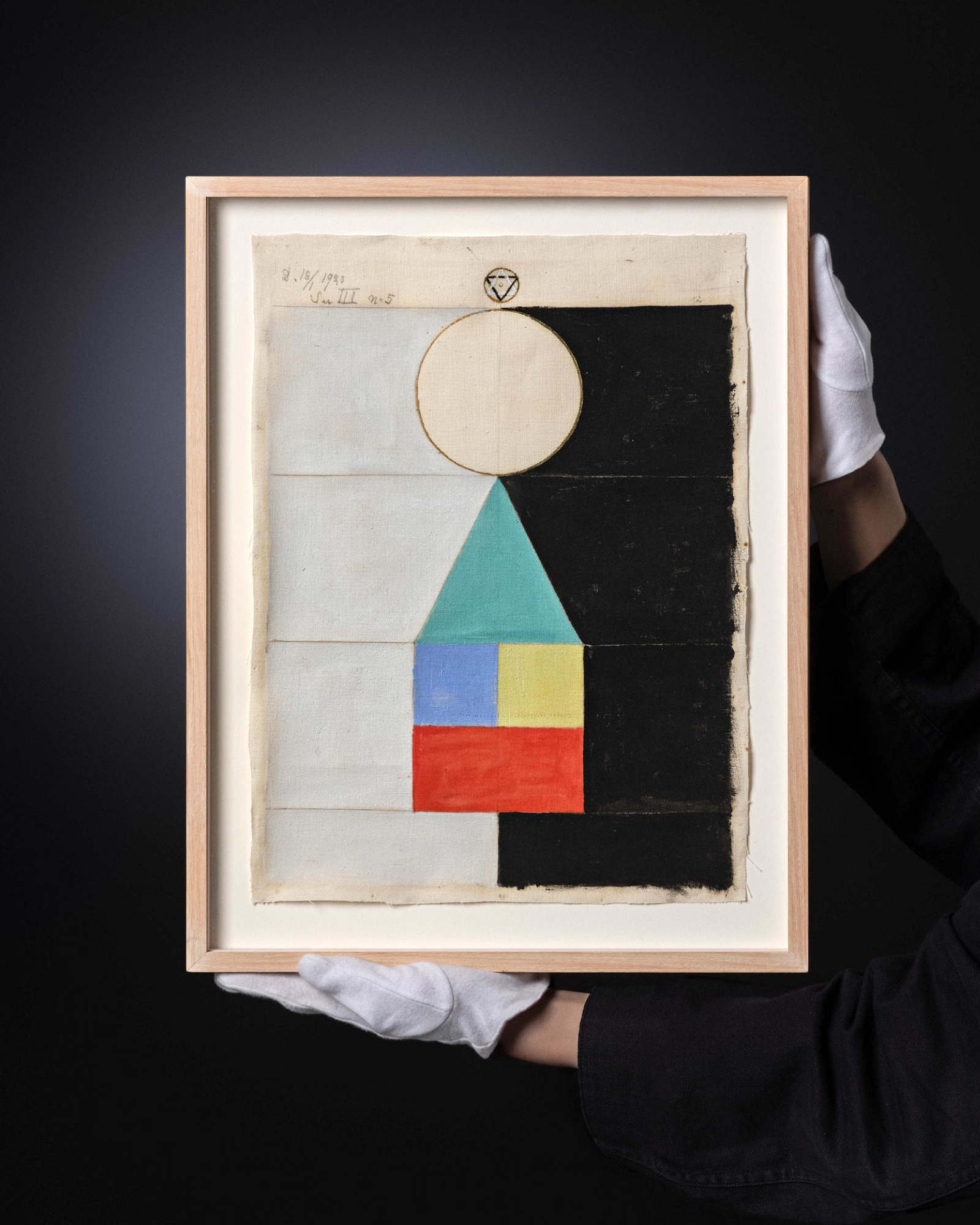
"Ser III No. 5," a small 1920 painting by Hilma af Klint that was exhibited in 1986 at LACMA as part of the exhibition *The Spiritual in Art*, is set to go up for auction at Bukowskis in Stockholm. To date, only two abstract paintings by the Swedish artist have ever been auctioned. Estimate: 6–8 million Swedish kronor (540,000–720,000 euros).


In 1986, the Los Angeles County Museum of Art opened *The Spiritual in Art: Abstract Painting 1890–1985*, an exhibition exploring the relationship between abstract art and the spiritual realm. Among the artists was a name that almost no one knew: Hilma af Klint (Solna, 1862 – Danderyd, 1944), who had died more than forty years earlier. It was the first time her abstract works had been presented to the public. Her paintings made a great impression, even though very little was known about her artistic practice. Since then, international interest in her life and work has grown exponentially. Among the works that the Hilma af Klint Foundation loaned to that exhibition was a small canvas, in oil and graphite, measuring 38.5 by 29 centimeters, dated January 18, 1920: Ser III No. 5. Now that painting is going up for auction: it will be offered by the Bukowskis auction house in Stockholm, as part of the Modern Art & Design auction to be held on November 18 and 19 at Arsenalsgatan 2, with an estimate of between 6 and 8 million Swedish kronor (540,000–720,000 euros).


For an abstract work by af Klint, this is a very rare event: according to Bukowskis, it hasn’t happened in over thirty years. The reason is linked to how the artist’s estate has been preserved: her non-figurative works are, in fact, held and managed by the Hilma af Klint Foundation, the Stiftelsen Hilma af Klints Verk, and for this reason have remained almost entirely off the market. To date, the auction house notes, only two of her abstract paintings had been sold at auction. Ser III No. 5 is part of a small group of works that the foundation sold in the early 1990s: it was purchased by a private collector in 1995 and has remained in the same family ever since.


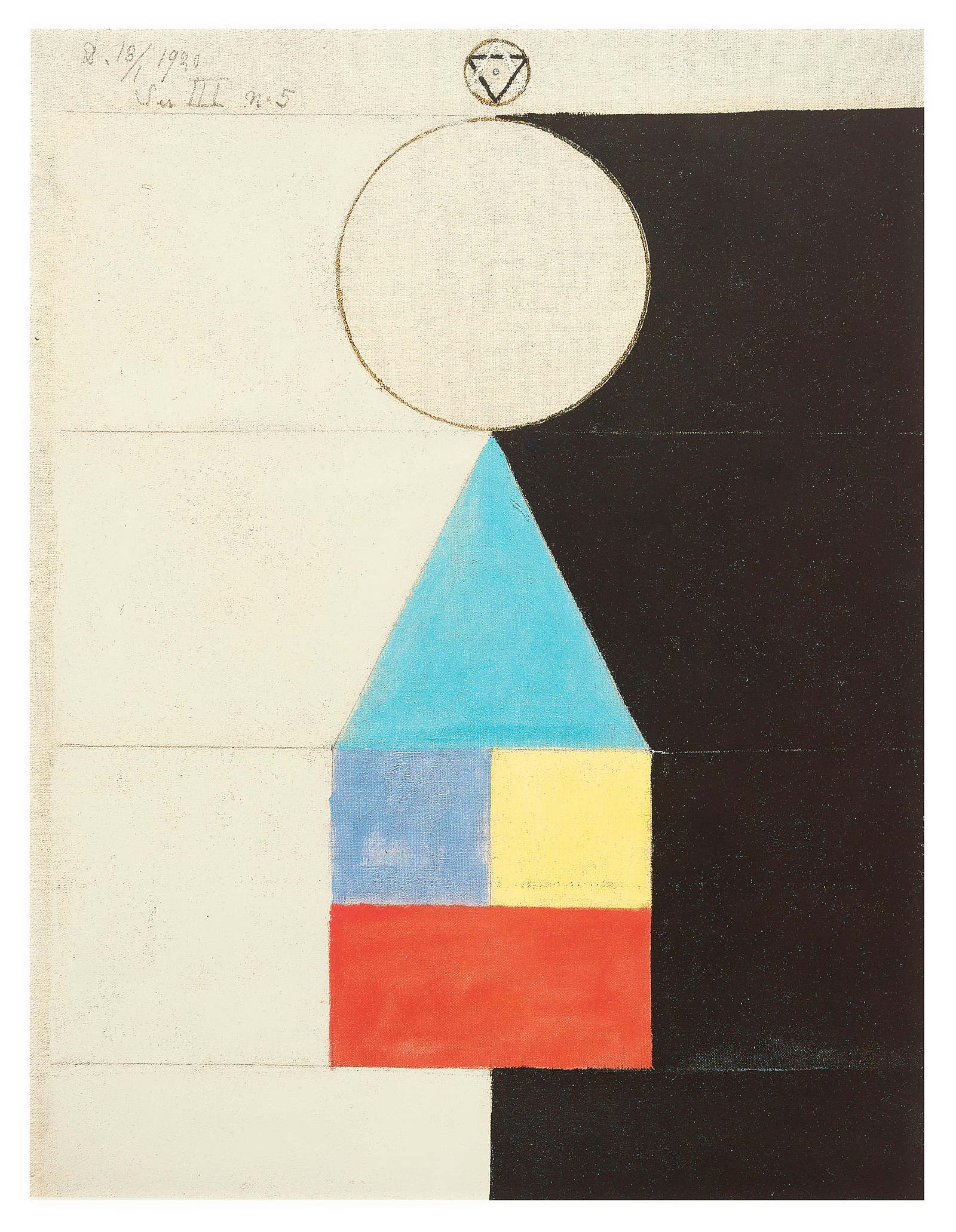
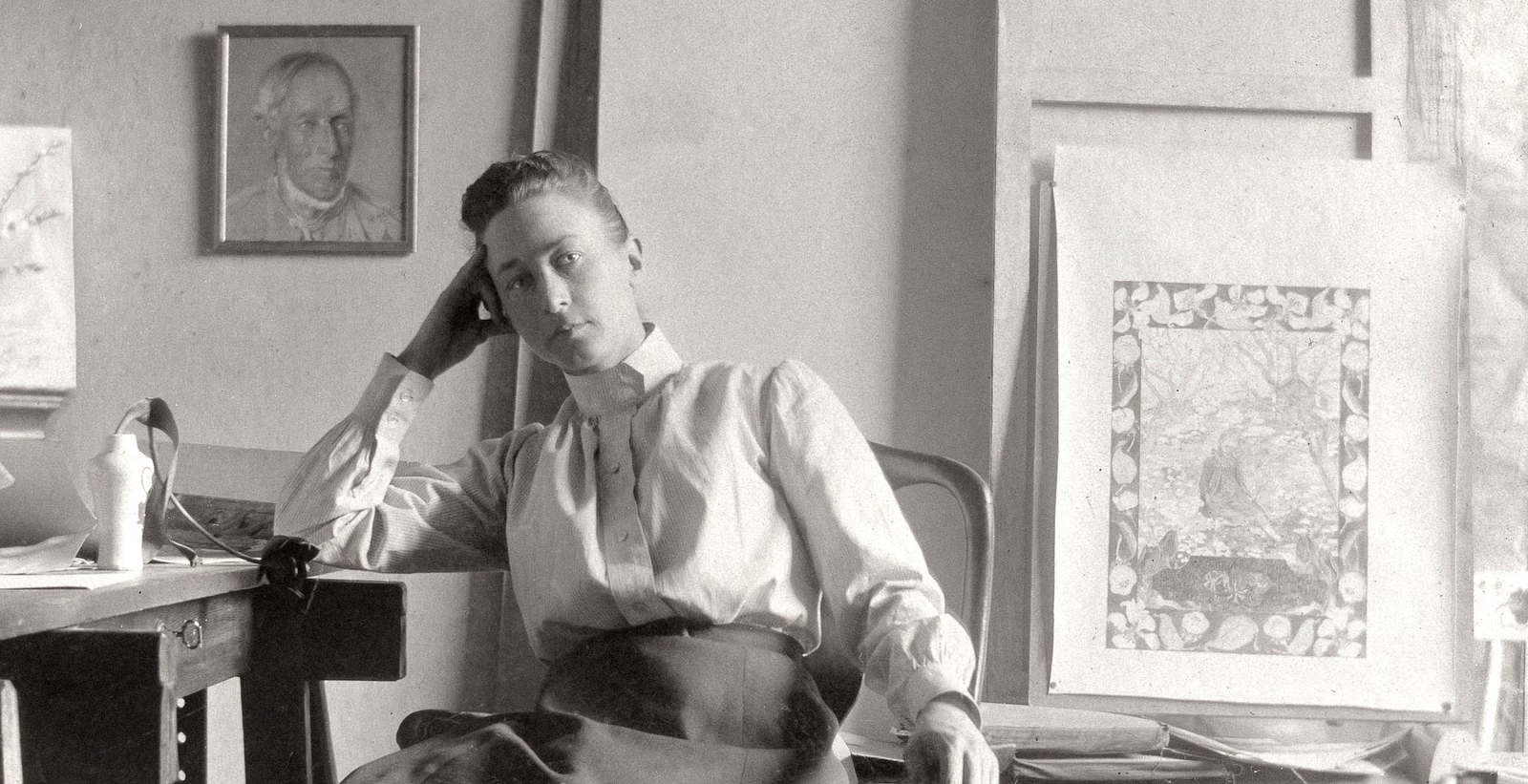
Hilma af Klint holds a special place in art history. Throughout her life, she remained largely on the margins of the official art scene, yet she developed a highly personal abstract language, with a style of painting that emerged from the intersection of spirituality, the natural sciences, philosophy, and formal exploration. Geometric forms, symbols, and fields of color served to express ideas that went beyond figurative representation. As Bukowskis points out, her abstract painting, which began in 1906, places her in a very early phase of modern abstract art. The history of 20th-century art, however, has been written largely through public exposure: exhibitions, manifestos, international networks, teaching, and published theories. Kandinsky exhibited, wrote, and taught. Af Klint, on the other hand, kept most of her abstract work out of the public eye.

Her training had been entirely traditional: she was part of one of the first generations of women admitted to the Royal Academy of Fine Arts in Stockholm, where she studied between 1882 and 1887 under August Malmström and Georg von Rosen, among others. At first, she painted mainly portraits, landscapes, botanical studies, and commissioned works. These were years of rapid industrialization and scientific progress, but also of new forms of spiritual exploration. Very early on, Af Klint became interested in the spirit world, in tune with the widespread European fascination with spiritualism, theosophy, and esoteric movements. Theosophy—a philosophical and spiritual movement based on the idea of a profound unity among different religions, on intuitive knowledge of the divine, and on cosmic and scientific principles—became an important part of her worldview.
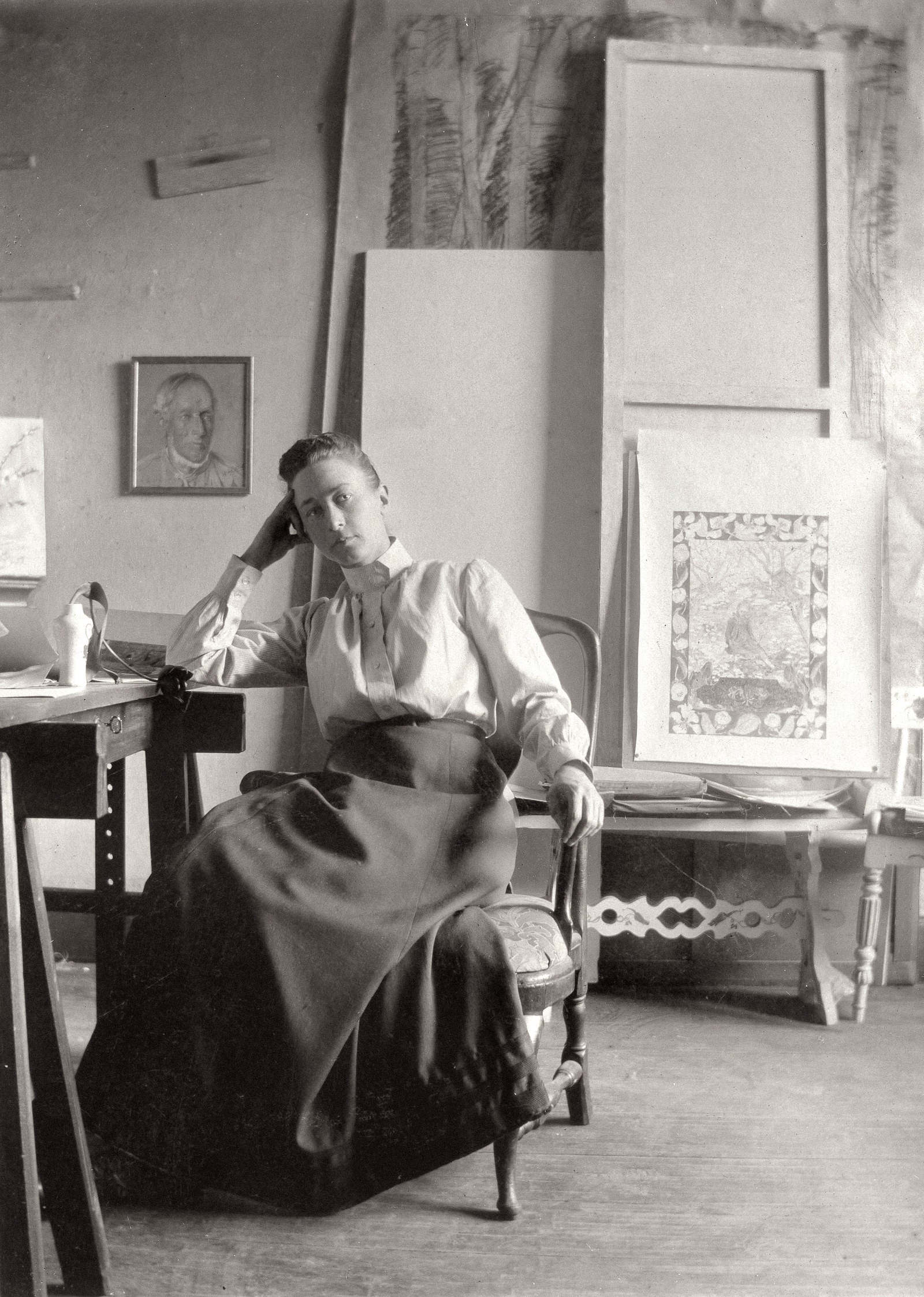
At the Academy, Hilma af Klint met Anna Cassel. In 1896, together with Sigrid Hedman, Cornelia Cederberg, and Mathilda Nilsson, they formed the group “The Five.” They met regularly for spiritual séances and were convinced they were in contact with spiritual entities they called “the High Ones.” Through this contact, Hilma af Klint believed she had been entrusted with a major artistic project: the Paintings for the Temple. When she began in 1906, her painting changed radically. She abandoned figurative art in favor of an entirely new abstract and symbolic language, and in the early phase of her work, she saw herself primarily as a mediator. Between 1906 and 1915, she painted 193 works, conceived as fragments of an ideal spiritual temple. Abstract forms, intense colors, inscriptions, and symbols were organized into complex visual systems. Af Klint worked methodically, in series divided into thematic and formal groups, exploring different aspects of cosmic and human development. The Paintings for the Temple, now famous throughout the world, were shown at the time to only a very few people.
Ser III No. 5, dated 1920, comes from the years following that cycle. For af Klint, abstraction was a way to investigate an invisible reality, and in this, Bukowskis notes, her work shares points of contact with that of Kandinsky, Malevich, and Mondrian, who, in different ways, sought to combine an abstract language with spiritual or philosophical ideas. After completing the Paintings for the Temple, af Klint continued to seek the meaning of the messages and symbolic systems she believed had been transmitted to her. She had a studio built on the island of Munsö, on Lake Mälaren, where she could view the various series of the cycle together. She repeatedly sought advice from Rudolf Steiner, the Austrian philosopher who would later found the anthroposophical movement, and her relationship with him played an important role in her artistic and spiritual journey.
The painting is on display through Tuesday, November 17, at Bukowskis’ location at Berzelii Park 1 in Stockholm, on weekdays from 11 a.m. to 6 p.m. The live auction will take place on November 18 and 19 at Arsenalsgatan 2.
 |
| A rare abstract painting by Hilma af Klint is up for auction: it was featured in the exhibition that introduced her to the world |
Warning: the translation into English of the original Italian article was created using automatic tools. We undertake to review all articles, but we do not guarantee the total absence of inaccuracies in the translation due to the program. You can find the original by clicking on the ITA button. If you find any mistake,please contact us.