





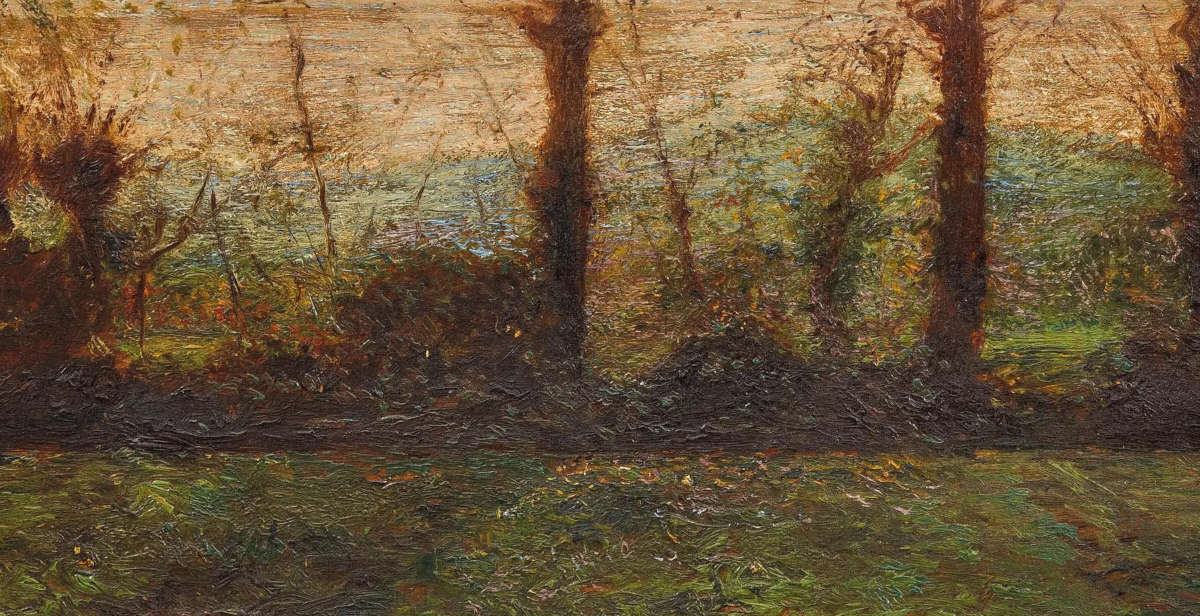
The location and even the time are noted on the back of the painting: “Meadow at San Rocco / 2:00 p.m. on November 14.” It is one of the rare autograph records left by Giuseppe Pellizza da Volpedo (Volpedo, 1868–1907) regarding *Meadows and Hills of the Curone Valley*, a small landscape painting from 1895 that remained hidden from the public for a long time and reappeared on the market only in 2025. Now the work is returning to an exhibition in Belgioioso (Pavia), where it will be on display from September 25 to 27 at the Belgioioso Castle as part of the BE ART 2026 event. The painting, presented by the Echampe Art Gallery in Alessandria, measures 29 by 71 centimeters and is an oil on panel. Its exhibition history is particularly long, though it is also marked by very long intervals during which the work was hidden away in private collections. Its first documented appearance dates back to 1904, in Genoa. Sixteen years later, it was exhibited at the Galleria Pesaro in Milan; it was then on view again in Turin in 1939, in Bergamo in 1947, and at the Pinacoteca Civica in Alessandria in 1954.
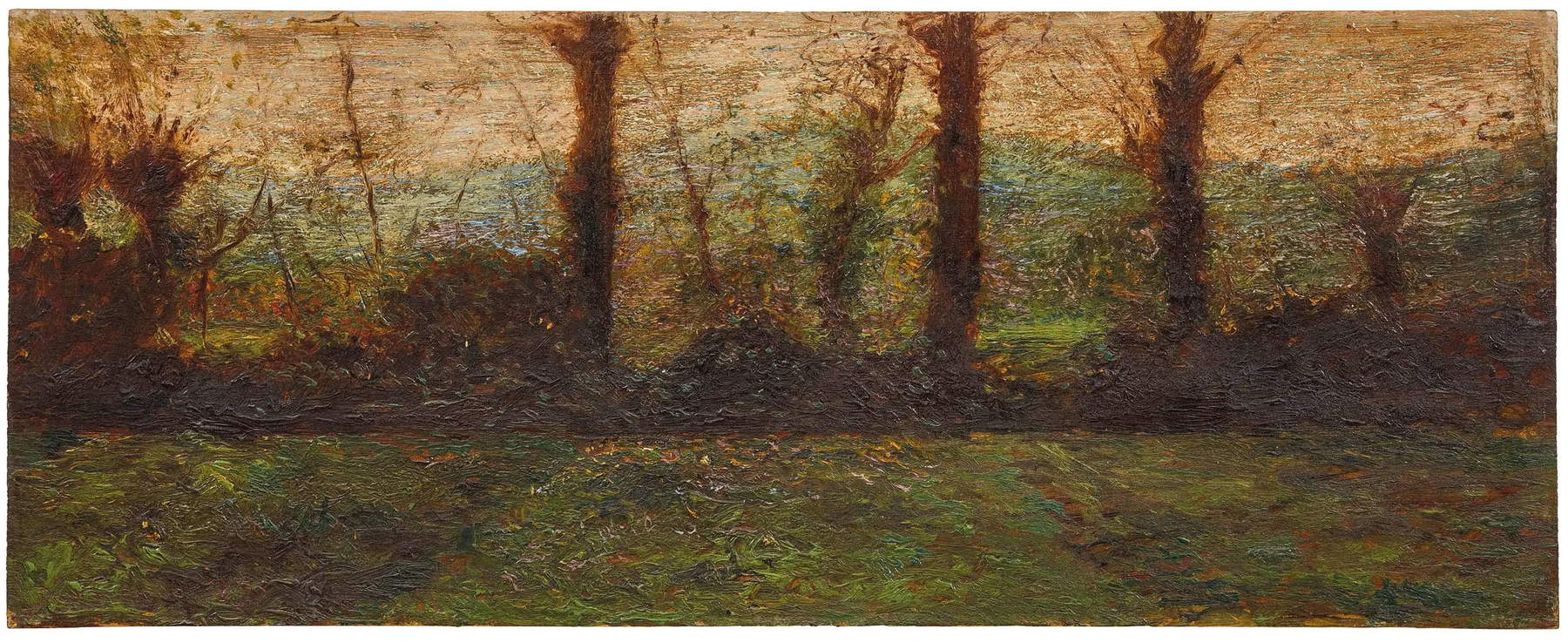
After that series of exhibitions, the painting disappeared from public view. Its absence was so complete that when art historian Aurora Scotti was working on the entry for the work in the general catalog of Pellizza da Volpedo in 1986, she was unable to locate the painting at all. The scholar was later able to examine it in person, and in 1999, *Meadows and Hills of the Val Curone* was exhibited once again, this time at the Civic Gallery of Modern and Contemporary Art in Turin. It would be several more decades before it reappeared. After spending additional time in a private collection, the landscape returned to the market in November 2025, when it was offered by Pandolfini in an auction dedicated to 19th-century painting. The estimate ranged from 40,000 to 60,000 euros, and the painting ultimately sold for 144,900 euros.
In Belgioioso, it will thus be the centerpiece of the Echampe Art Gallery’s exhibition, which, alongside Pellizza’s work, will feature pieces by Robert Rauschenberg, Jim Dine, Alighiero Boetti, Enrico Baj, and Mario Schifano, all part of the gallery’s collection. The presence of the 1895 landscape, however, also provides an opportunity to revisit Pellizza’s artistic development and, in particular, the role that the Volpedo area and the Val Curone played in his painting.
Born in Volpedo in 1868, Giuseppe Pellizza is one of the key figures of Italian Divisionism. After studying at the Brera Academy in Milan and undergoing further training, he gradually developed a personal artistic language based on the analysis of light and chromatic exploration, alongside a conception of painting capable of linking the observation of reality with a symbolic tension. His native region remained at the center of his artistic experience throughout his life. Volpedo and the surrounding countryside provided Pellizza with landscapes, people, and scenes of daily life that became the subject matter of a creative exploration increasingly oriented toward more universal meanings. It is within this artistic journey that *The Fourth Estate*—the artist’s most famous work, now housed at the Galleria d’Arte Moderna in Milan—takes its place, having become one of the iconic images of Italian social and artistic history.
Pellizza’s painting, however, is not limited to large-scale figurative compositions. Landscape painting, in fact, occupied an important place in his artistic exploration, especially as a field for experimentation with light, nature, and seasonal variations. The depiction of the countryside could thus become more than a mere description of a place: it became an independent realm of painterly exploration. *Meadows and Hills of the Curone Valley* belongs precisely to this period: created in 1895, the painting stems from the artist’s observation of a familiar place and transforms it into an exploration of light, color, and perception. This was a phase in which Pellizza was developing a conception of landscape that was destined to take on ever greater significance in his painting: the countryside is no longer merely the backdrop to a scene but becomes the very subject of his inquiry.
The composition is built on a balance of horizontal and vertical lines. As Aurora Scotti points out, the row of trees and the horizon line establish a system of horizontal relationships that contrasts with the verticality of the plants in the foreground. The structure of the painting thus also arises from the relationship between the elements of the landscape, organized into a composition in which nature is both observed and simultaneously constructed through painting.
What makes the work even more interesting is what Pellizza left on the back. The painting is signed “P. di Volpedo 1895” and retains the labels from the exhibitions in which it was presented. But it also contains two autograph notes by the artist, considered rare and exceptional: a label with the artist’s name, address, and subject, and, above all, the note “Meadow at San Rocco / 2:00 p.m. on November 14.” That brief phrase precisely records the place and time of observation. It is therefore not merely an indication of the subject depicted: on the reverse side is a sort of note recording the exact moment when Pellizza stood before the landscape he would later transform into a painting. The reference to the time, in addition to that of the place, provides concrete evidence of the observational process underlying the work.
The painting also preserves a further trace of the special attention Pellizza devoted to it. In fact, the artist had Davide Cicale photograph it inside his studio. The photograph serves as historical evidence of the work and its time in the artist’s studio, complementing the information the painting itself has preserved through the signature, labels, and handwritten note.
Now, one year after the sale, *Prati e colline della Val Curone* is once again on view. For Pellizza’s painting, this marks a new chapter in a story that began over a century ago, when the artist jotted down a few words on the back to record the place and time of that observation: San Rocco, 2:00 p.m., November 14.
 |
| Pellizza da Volpedo: A Rare Landscape from 1895 Returns to Public View |

Warning: the translation into English of the original Italian article was created using automatic tools. We undertake to review all articles, but we do not guarantee the total absence of inaccuracies in the translation due to the program. You can find the original by clicking on the ITA button. If you find any mistake,please contact us.
























 IT
IT FR
FR DE
DE ES
ES CN
CN


