



by Redazione 14/11/2026


Categories: Modern Art / Disclaimer
"Yellow River," a 1958 painting by Willem de Kooning, was donated to the Whitney Museum in New York by the family of David Solinger, the museum’s former president, and formally acquired in 2023. On Tuesday, November 17, it will go up for auction at Christie’s with an estimate of between $12 million and $18 million.


For a time, Willem de Kooning’s (Rotterdam, 1904–New York, 1997) painting *Yellow River* hung at the foot of the bed in David M. Solinger’s home: it was the first painting the collector saw every morning. This anecdote was recounted by Frank Robinson, former director of the Herbert F. Johnson Museum of Art at Cornell University, who brought the Solinger collection to his museum. Solinger, a lawyer and collector, had been one of the most influential trustees of the Whitney Museum of American Art in New York and the museum’s first president not to be a member of the Whitney family. His family donated the painting to the museum in his honor. Now, just three years after formally receiving it, the Whitney is putting it up for sale (in the United States, museums are allowed to sell works in their collections, provided the proceeds are used for investments in the museum itself).


*Yellow River*, from 1958, will be auctioned by Christie’s in New York on Tuesday, November 17, during the evening auction dedicated to the 20th century, with an estimate of between $12 million and $18 million ( €10.8–16.3 million). According to Artnet News, which first reported the story, the proceeds will be used to enrich the museum’s collection. The history of ownership, detailed in the auction catalog, helps shed light on the timeline. Solinger purchased the painting from the Sidney Janis Gallery on October 10, 1959. Upon his death in 1996, it passed to his wife, Betty Ann Besch Solinger. In 2011, the Whitney registered it as a promised gift, and the actual transfer of ownership took place in 2023.


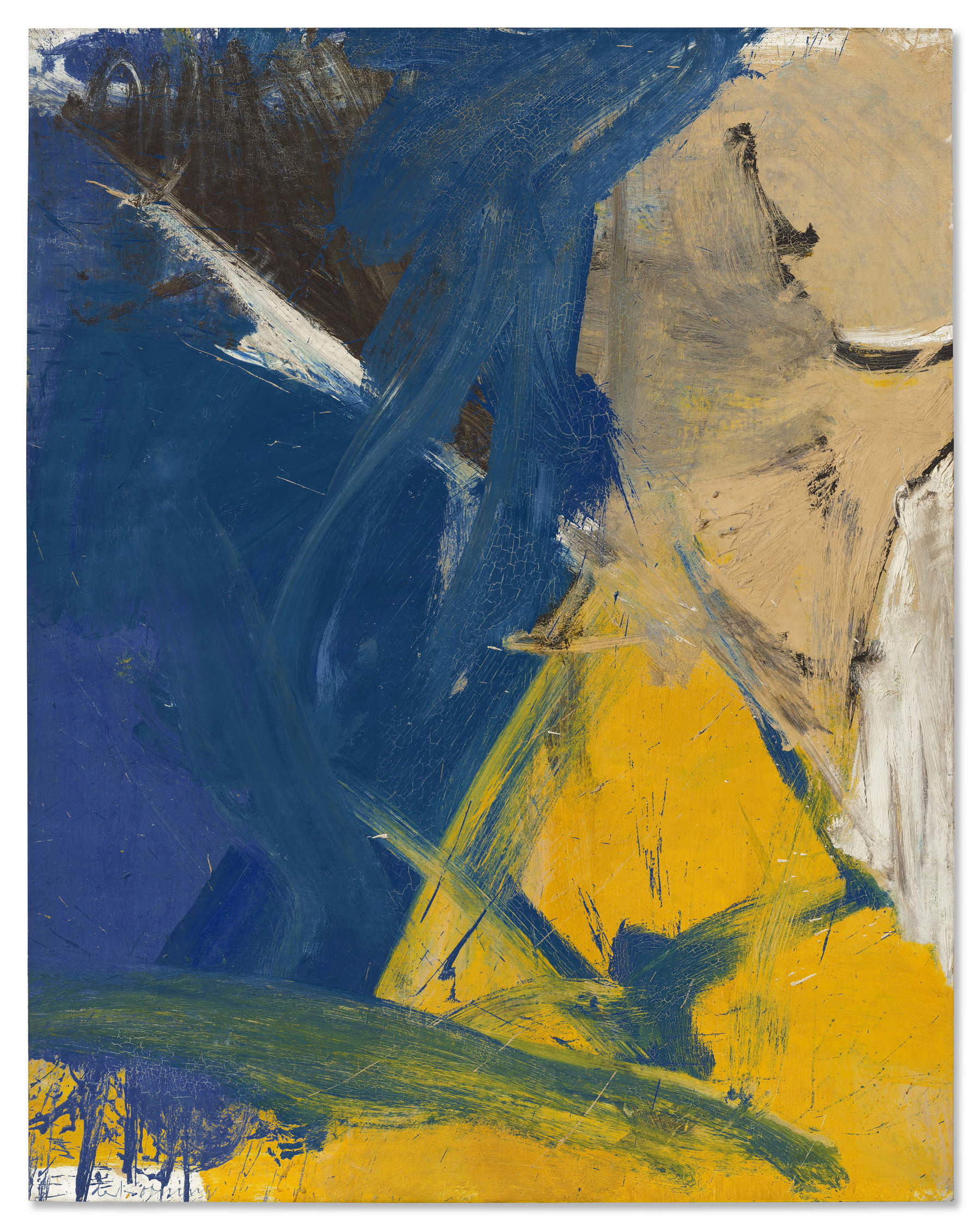
The painting is an oil on canvas measuring 159.7 by 126 centimeters, signed in the lower left corner, and is dominated by broad brushstrokes of blue and yellow. It belongs to one of the defining moments of De Kooning’s career. It was first exhibited in May 1959 in the artist’s third solo exhibition at the Sidney Janis Gallery, which brought together twenty-two new paintings and works on paper created between 1957 and 1959. The Christie’s catalog captures the excitement of those days. By 8:15 a.m., there was already a line outside the gallery. By noon, nineteen works had been sold, and the last three found buyers by the end of the week. Harriet Janis and Rudi Blesh wrote at the time that those paintings, more abstract than any of de Kooning’s previous works, seemed “even more intensely real.” Toward the end of the exhibition, photographer Arnold Newman took a portrait of the painter in front of *Yellow River*, next to *Ruth’s Zowie* (1957) and *Lisbeth’s Painting* (1958), now in the Virginia Museum of Fine Arts in Richmond. Those photographs have become an iconic image of the moment when de Kooning established himself as a leading figure of the New York School.


Critic Thomas B. Hess would later call these paintings “abstract parkway landscapes”—abstract landscapes of major expressways. They marked a turning point from the major “Woman” series, which had dominated the first half of the decade. In the second half of the 1950s, de Kooning’s focus shifted from New York to the countryside of the Hudson Valley and the eastern tip of Long Island. The painter never learned to drive, but he loved riding in the passenger seat and observing the landscape, the highways, the signs, and the billboards. He himself said that those paintings were mostly landscapes and roads, capturing the sensations of leaving the city or returning to it. He even named some of his paintings after specific roads, such as *Merritt Parkway* (1959), in the collection of the Detroit Institute of Arts, and *Montauk Highway* ( 1958), in the collection of the Los Angeles County Museum of Art. According to scholar Richard Shiff, however, the experience of the Merritt Parkway is evident throughout the 1958–1959 series, even in paintings with different titles, such as *Yellow River*.
De Kooning did not start with a plan. In an interview with David Sylvester, he recalled loving those roads, which were not beautiful but had perfect embankments, shoulders, and curves. He also said he hadn’t set out to do anything in particular: the connection to the Merritt Parkway had come to him while painting, as if he had unconsciously found a way to bring it onto the canvas. In an interview with Harold Rosenberg published in *ARTnews* in 1972, he explained that he had wanted to rediscover “a sense of light” in painting and to connect with nature, without depicting its landscapes. The success of the 1959 exhibition allowed him to make the change permanent: with the proceeds, he bought a plot of land just over four acres in Springs, on the southern coast of Long Island. Shortly thereafter, in 1960, he painted *Door to the River*, now in the Whitney’s collection. Water, the catalog notes, would become an increasingly prominent element in his painting, right up through the canvases of the 1970s.
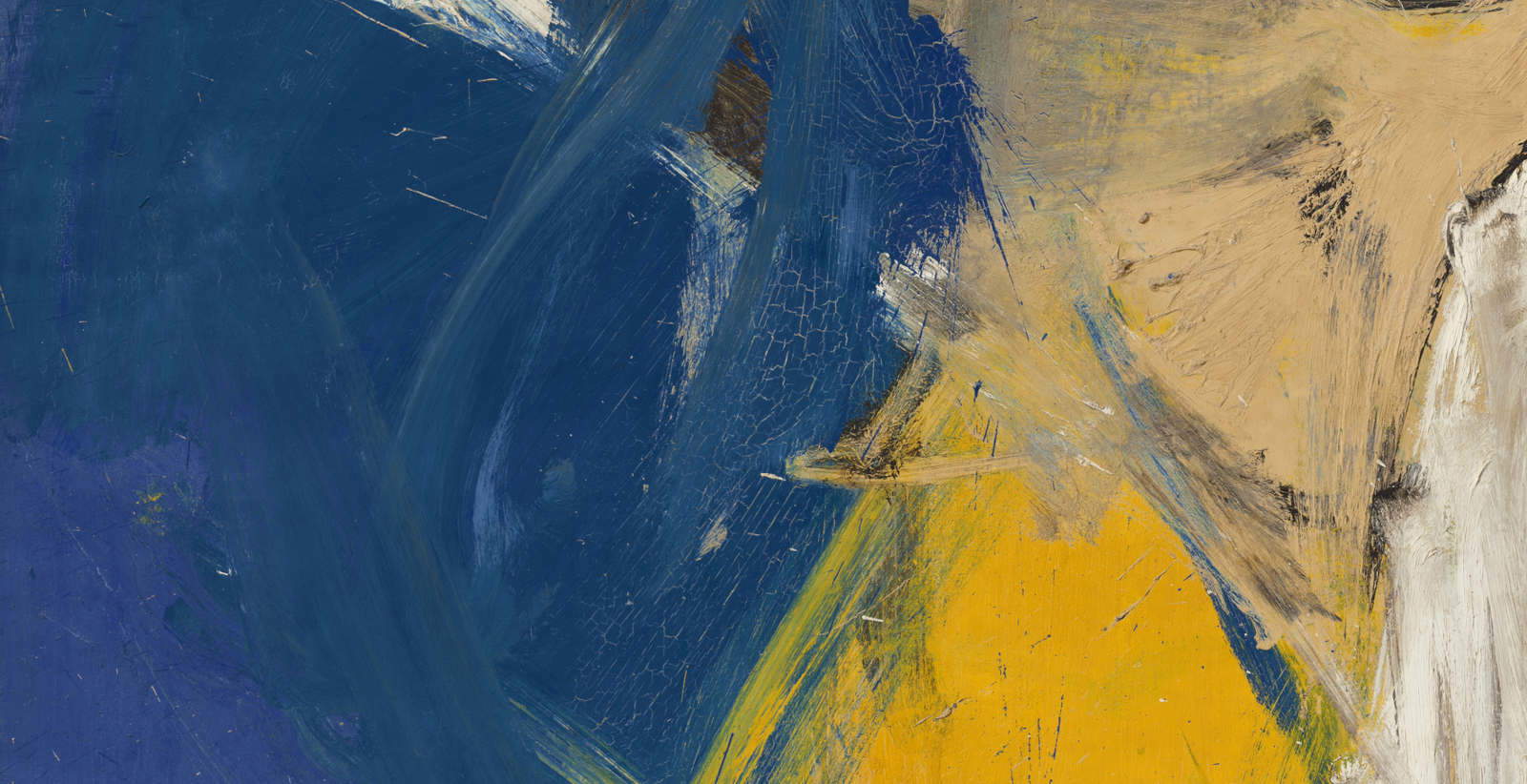
On the surface of the painting, we see large arcs and abrupt changes in direction, pale ochre and yellow giving way to expanses of blue, flashes of white, and darker earth tones. The paint is applied in layers, scraped away and reworked, so that individual brushstrokes seem to appear, disappear, and reappear on the canvas. According to Christie’s, beneath the apparent spontaneity lies remarkable control, as each brushstroke propels the next and guides the viewer’s eye through the painting. The catalog also offers a comparison with artists who, before De Kooning, had depicted the speed of modernity. There is William Turner’s *Rain, Steam, and Speed* (1844), at the National Gallery in London. There is Giacomo Balla’s *Abstract Speed + Noise* (1913–1914), now in the Peggy Guggenheim Collection in Venice, in which the passage of a car transforms the landscape. In this vein, the auction house also includes *Yellow River*. The painting was later exhibited in 1969 in de Kooning’s retrospective at the Museum of Modern Art in New York. Jasper Johns recalled those landscapes as marvelous paintings that made him want to go out and buy a large paintbrush.
For Solinger, de Kooning always held a special place. The collector had discovered the painter in 1948, at his first solo exhibition at the Charles Egan Gallery. He recounted being “struck by lightning” and staying in the gallery for hours. That passion never left him. In his collection—one of the most important collections of postwar art—works by Franz Kline, Jean Dubuffet, Alberto Giacometti, Pablo Picasso, and Joan Miró stood alongside those of de Kooning. On Tuesday, his favorite de Kooning painting will return to the market.
 |
| The Whitney Museum is selling a Willem de Kooning masterpiece three years after receiving it |
Warning: the translation into English of the original Italian article was created using automatic tools. We undertake to review all articles, but we do not guarantee the total absence of inaccuracies in the translation due to the program. You can find the original by clicking on the ITA button. If you find any mistake,please contact us.