





The National Archaeological Museum of Civitavecchia (MANC) is once again welcoming visitors following a major renovation project that involved the building, the exhibition halls, the collections, and the entire museum experience. The official opening is scheduled for September 25, 2026, while on September 25 and 26, at 5:00 p.m., the director and museum staff will guide the public through the new exhibition layout with guided tours included in the ticket price.
The transformation of the MANC is part of a broader project by the Lazio Regional Directorate of National Museums of the Ministry of Culture, aimed at reimagining museums as places for gathering and participation, as well as for the preservation of cultural heritage. Within this new framework, the Civitavecchia museum takes on the role of a key reference point for understanding the region. Its collections are, in fact, contextualized in relation to the area’s major archaeological sites, from the Roman port of Centumcellae to the Terme Taurine, from the Etruscan sanctuary of Punta della Vipera to the medieval city of Leopoli-Cencelle. The result is a narrative spanning more than three millennia of history, which uses a contemporary language to present to the public not only the artifacts but also the contexts in which they were discovered.
The project involved the 18th-century building that once housed the former headquarters of the Pontifical Guard, in the center of Civitavecchia, a short distance from the port and Fort Michelangelo. The spaces dedicated to the permanent collection have been doubled, while the areas reserved for research, conservation, educational activities, and cultural services have also been expanded. The exhibition now spans four levels and moves away from an exclusively chronological sequence to offer a more nuanced interpretation of local history. At the heart of the narrative are the landscapes, archaeological sites, and communities that have inhabited the area over the centuries. Artifacts and works of art are complemented by reconstructions, three-dimensional models, tactile dioramas, projections, digital content, and immersive experiences, all designed to provide a more immediate understanding of the places and events being recounted.
The renovation of the National Archaeological Museum of Civitavecchia was supported by a total investment of over 2 million euros, distributed over time through various public funding programs. These funds made it possible to address the building’s safety, the museum spaces, the display of the collections, the storage areas, and accessibility. In 2021, 140,000 euros were allocated for the reinforcement of the third- and fourth-floor slabs, and an additional 90,000 euros for the upgrade of the video surveillance, intrusion detection systems, and operations center. In addition to these funds, 600,000 euros were allocated as part of the 2021–2023 plan established by Law No. 190 of December 23, 2014, No. 190, for the renovation of the spaces, and an additional 500,000 euros from the 2022–2024 budget allocated to the new curatorial organization and the reinstallation.
The work program also allocated 130,000 euros for the renovation of storage facilities, as part of the 2024 Public Works Program, and 200,000 euros in PNRR funds from Mission 1, Investment 1.2, dedicated to the removal of physical and cognitive barriers in museums. This latest initiative has contributed to creating a more accessible and inclusive visitor experience. The work already completed has reached a total value of 1,660,000 euros. An additional allocation of 400,000 euros is also planned for the 2024–2026 budget cycle, earmarked for the renovation of the ticket office and restrooms.
“The reopening of the National Archaeological Museum of Civitavecchia is part of a broader transformation process that we are carrying out in the museums and cultural sites under the Lazio Regional Directorate of National Museums,” stated Director Elisabetta Scungio. “We want museums that are increasingly open to their local areas and communities, capable of combining the quality of scientific research with new forms of expression, cultural services, accessibility, and participation. Civitavecchia embodies this vision particularly well: the new exhibition not only showcases the museum’s collections but also forges an ongoing connection with the landscape, archaeological sites, and the history of the region. The MAN thus emerges as a modern regional museum, a cultural and social hub, and a gateway to the heritage of an extraordinarily rich area, in a city that welcomes millions of visitors from around the world through its port every year.”
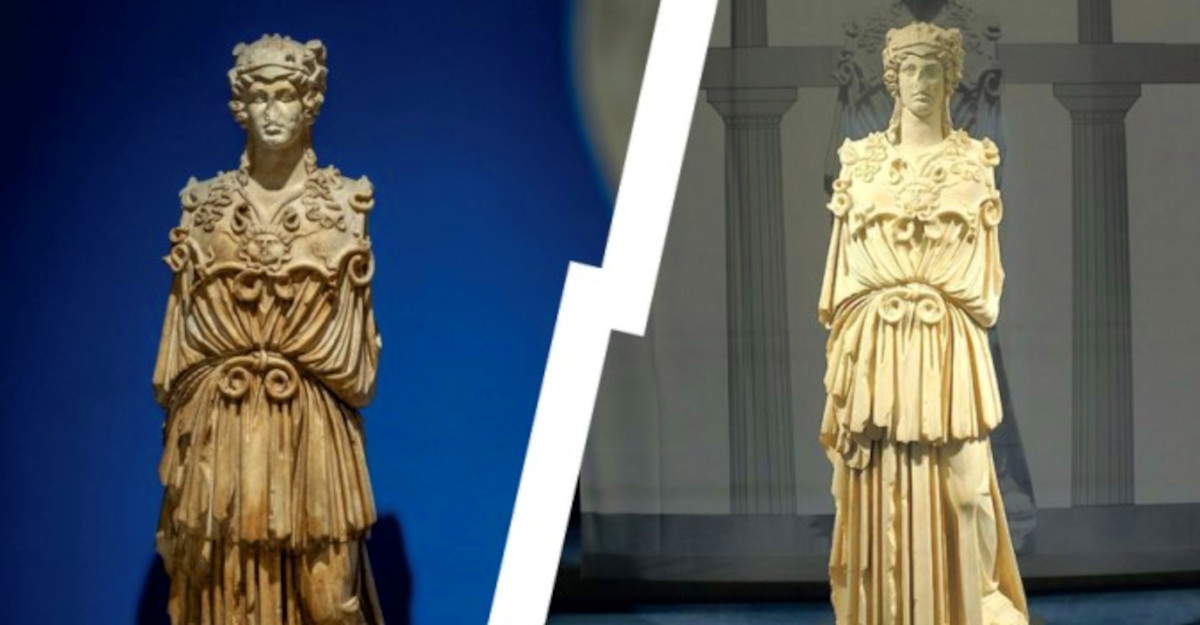
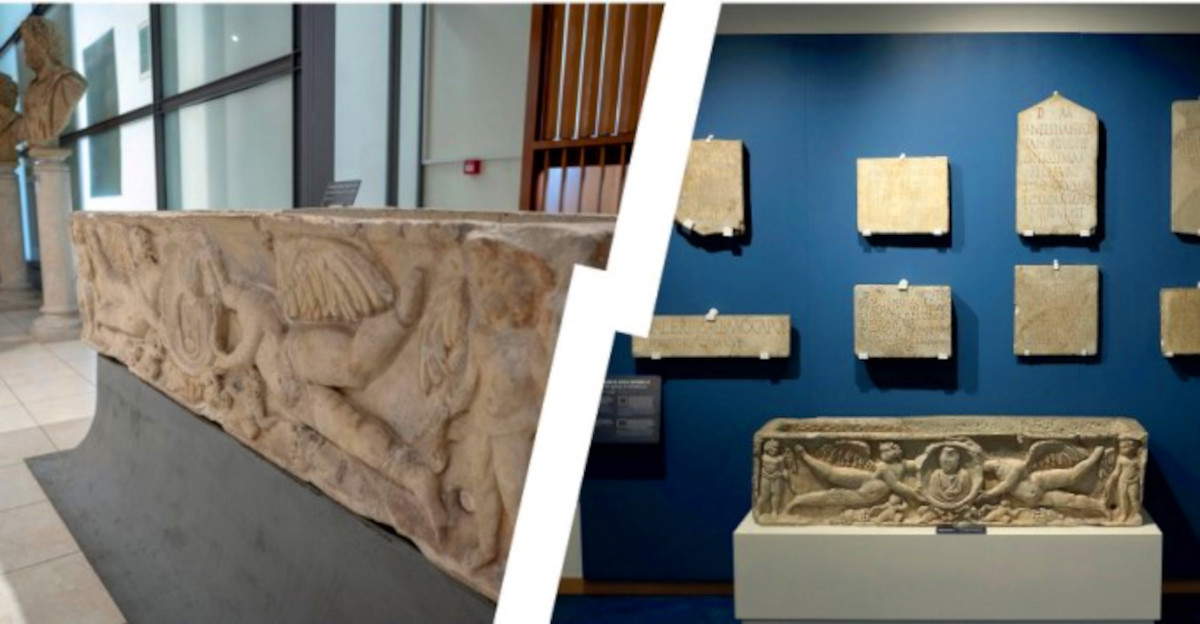
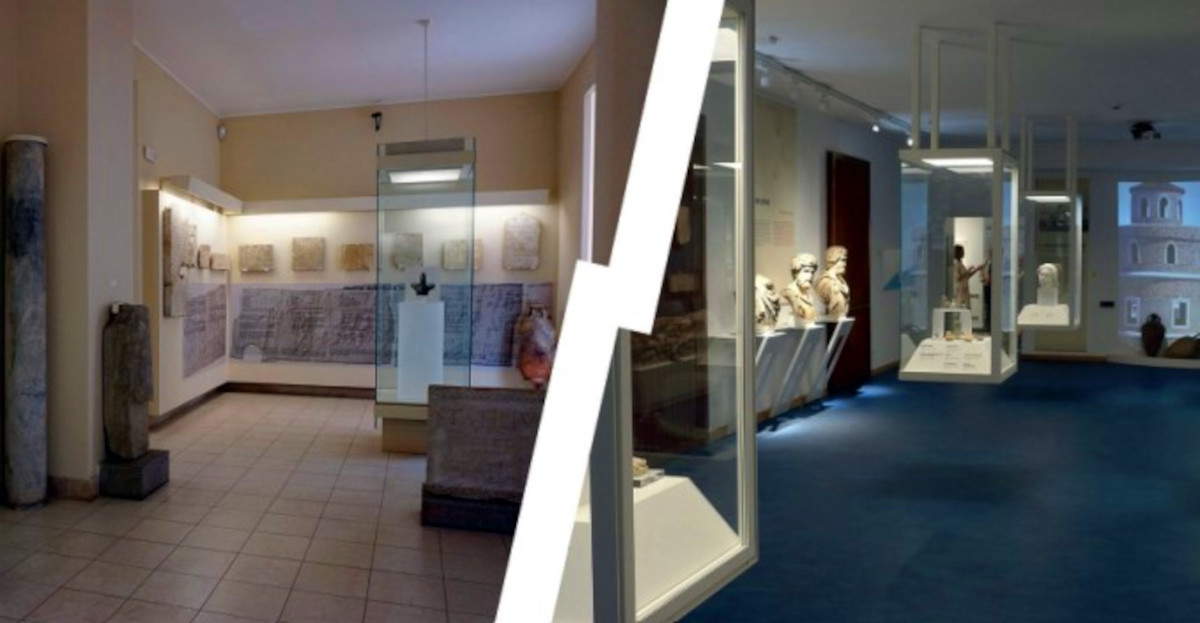
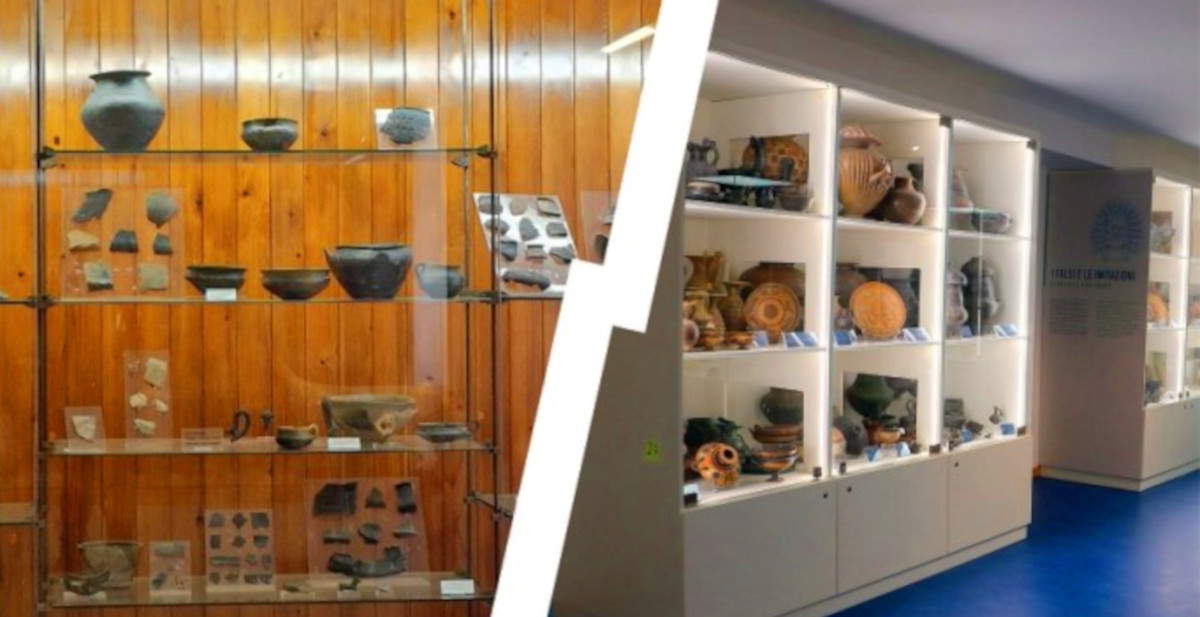
The journey through the museum begins on the ground floor, where two of the MANC’s most iconic works take center stage: the monumental statues of Athena Parthenos and Apollo-Helios. The latter, considered one of the most important large-scale reproductions of the famous Colossus of Rhodes, is displayed alongside Athena in an immersive setting. Lighting, projections, and soundscapes highlight their monumental scale and introduce visitors to the history of the region through a multisensory experience.
The first floor, on the other hand, takes visitors through the area’s earliest history, from prehistory to the Etruscan and Roman periods. The focus is primarily on the coastal strip between the Mignone River and Cerveteri and on the Monti della Tolfa region. The museum’s curatorial approach prioritizes the reconstruction of historical contexts over the simple display of individual objects: tactile models, digital tools, multimedia content, and immersive technologies help visitors understand the evolution of settlements and the work of archaeologists in reconstructing the past.
A specific section is dedicated to the Etruscan sanctuary at Punta della Vipera, whose history is reconstructed from the Archaic period through the Hellenistic phase. Artifacts, a life-size reconstruction of the temple’s decoration, a tactile model, and a three-dimensional model—which can also be explored using virtual reality headsets—allow visitors to engage with the site through various interactive experiences.
The second floor is primarily dedicated to Centumcellae, the large port built by Emperor Trajan based on a design by Apollodorus of Damascus. The narrative also includes the Terme Taurine and the seaside villas that dotted the ancient coastline. Through artifacts, architectural elements, reconstructions, and multimedia installations, the exhibition illustrates the port’s strategic function, along with the city’s commercial activities and daily life. Particular attention is given to the relationship between Centumcellae and the Mediterranean landscape, aided by aerial images of the region’s major archaeological sites. The exhibition then moves on to the Middle Ages with a section dedicated to Leopoli-Cencelle, founded by Pope Leo IV. Artifacts from the excavations, reconstructions, models, and digital tools illustrate the city’s origins, its urban structure, and the daily lives of its inhabitants. A large tactile model and immersive experiences allow visitors to explore the medieval city through alternative ways of engaging with the exhibits.
The third floor further expands the museum’s role as a center for research, conservation, and cultural production. On display here are the historical collections of the former Civic Museum, established in 1918 in the cloister of the convent of the Church of Santa Maria, which was later destroyed during the bombings of 1943. The new exhibition also brings to the public’s attention numerous artifacts that had remained in storage for years and showcases materials recovered through archaeological seizures, thereby documenting the government’s efforts to protect cultural heritage.
Among the most important pieces isan Etruscan cinerary urn from the Cereto area, considered a one-of-a-kind artifact and linked to the same artistic tradition as the famous Sarcophagus of the Bride and Groom. The artifact is accompanied by a three-dimensional digital reconstruction and immersive projections. The floor also houses a workshop for initial conservation work and a multipurpose room designed for meetings, conferences, and educational activities. The flexibility of the spaces will also allow for rotating the exhibited collections and offering new in-depth explorations.
One of the defining features of the new MANC is its focus onaccessibility, considered an integral part of the scientific and museographic project. The museum was conceived as a space for storytelling aimed at diverse audiences, with tools and levels of depth capable of adapting to different needs. The goal is not only to eliminate physical barriers but also sensory and cognitive ones. The exhibition route includes panels and captions in Braille, simplified texts, audio guides, videos in Italian Sign Language (LIS), tactile models, three-dimensional reconstructions, digital content, and immersive environments. Associations dedicated to inclusion were directly involved in designing these solutions. Accessibility thus becomes a structural element of the visit rather than a service added as an afterthought.
With its reopening on September 25, the National Archaeological Museum of Civitavecchia presents itself as a completely renovated institution. The collections serve as the starting point for exploring a region with a history spanning millennia, tracing the footsteps of the Etruscan and Roman civilizations, from the medieval city to contemporary Civitavecchia.
|
| Civitavecchia: The National Archaeological Museum Reopens—A Journey Through 3,000 Years of History |

Warning: the translation into English of the original Italian article was created using automatic tools. We undertake to review all articles, but we do not guarantee the total absence of inaccuracies in the translation due to the program. You can find the original by clicking on the ITA button. If you find any mistake,please contact us.
























 IT
IT FR
FR DE
DE ES
ES CN
CN


