



by Redazione 24/11/2026



Categories: Museums / Disclaimer
Closed in 2007, the Old Acropolis Museum—the 19th-century museum on the Acropolis in Athens—reopens with four exhibitions spanning archaeology, digital technology, and contemporary art. On the eastern esplanade—accessible for the first time—a path runs over the Mycenaean walls and leads to a Byzantine cistern.


In 2018, when restoration of the old Acropolis Museum in Athens began, the plan envisioned a modest future for the building: it was to become a storage facility for inscribed stones and the thousands of architectural fragments that had been scattered across the Acropolis for decades, and to house the offices of Greek Ministry of Culture staff working on the restoration of the monuments. In July 2019, the plan was overturned. “It was unthinkable to us—almost outrageous—that this historic building, with its unique location, would be turned into offices and storage spaces,” recalled Culture Minister Lina Mendoni. Thus, the “Mouseion,” as the minister calls it, has reopened in Athens—after nearly two decades of closure—as a space for exhibitions of archaeology, contemporary art, and technology. Prime Minister Kyriakos Mitsotakis, along with Minister Mendoni, inaugurated it yesterday. On the same occasion, the new walking path on the eastern esplanade of the Acropolis was opened to the public, making an area that had previously been largely inaccessible available for the first time, featuring remains dating from the Mycenaean era to the Ottoman period.


“Today marks a milestone for the Acropolis, for Athens, and for the Ministry of Culture,” said Mendoni. The building has always been linked to the history of Greek archaeology. It was built in the 19th century based on a design by architect Panagis Kalkos, who discreetly integrated it alongside the monuments on the Acropolis, and for over a century it housed the artifacts unearthed during excavations. In July 2007, it closed to prepare for the transfer of the collections to the new Acropolis Museum.


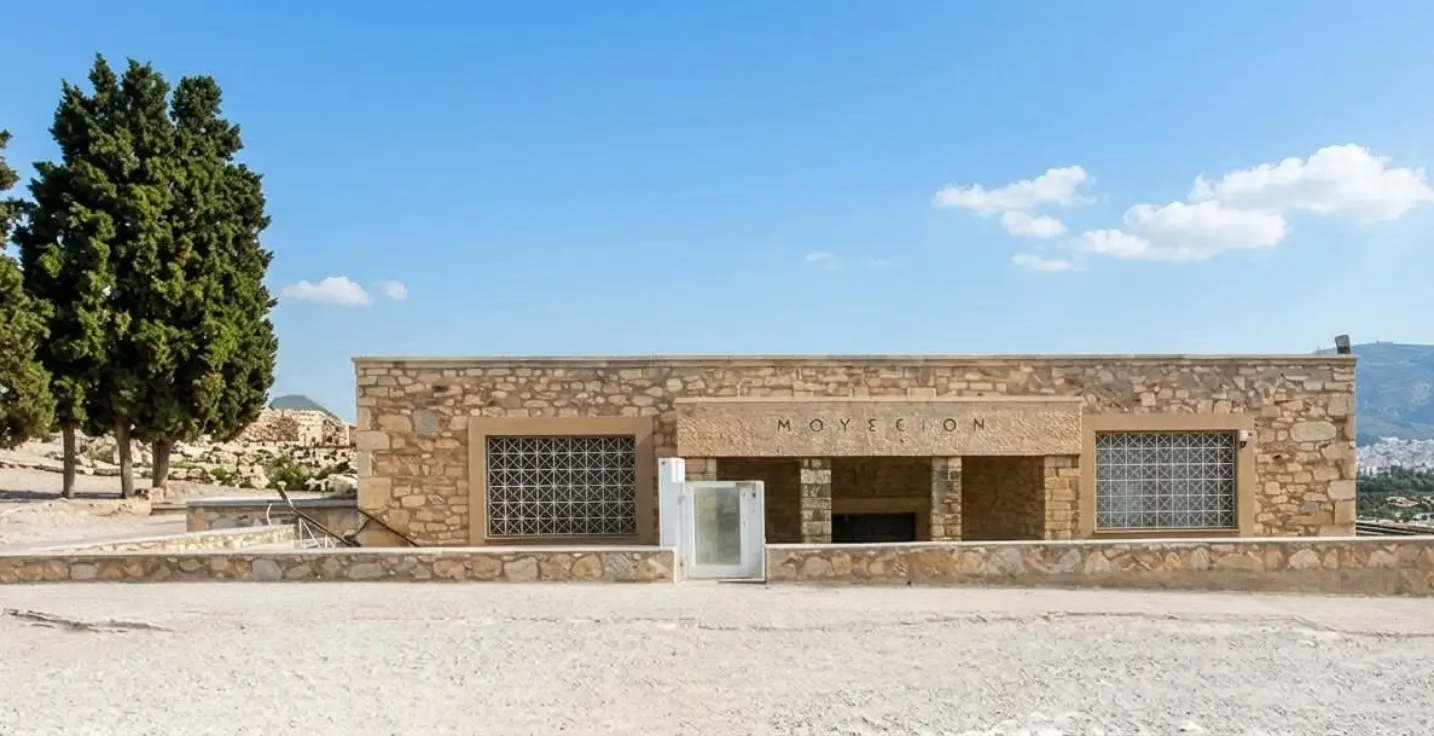
The new purpose, the minister explained, is not to be “just another traditional museum,” but a space that hosts exhibitions on the history, archaeology, and culture of Athens, contemporary art exhibitions inspired by Greek culture, and programs featuring advanced technology. The problem that had prompted the initial project, however, remained: a secure location was needed for the antiquities that had been exposed to the elements for decades. “The Mouseion had to continue protecting the antiquities, but also be at the cutting edge,” said Mendoni.


The solution was to combine storage and exhibition spaces. During the renovation, the storage areas and the restoration laboratory were modernized. In addition, facilities were created to permanently preserve and display architectural fragments, sculptures, and inscribed stones, many of which had been scattered across the archaeological site or temporarily stored in areas closed to the public. The artifacts are arranged on specially designed metal structures. Movable chain curtains allow certain antiquities to be highlighted from time to time using lighting and digital projections. In this way, the storage area is not hidden behind the exhibition halls but becomes part of the visit, showcasing the richness of the area’s heritage.
Alongside this permanent exhibition, the museum presents three temporary exhibitions. The first, ΑΘΗΝΑΙ ΠΟΛΙΣ ΙΔΕΑ (“Athenai,” “Polis,” “Idea,” or “Athens, City, Idea”), brings together over 750 artifacts from excavations conducted by the Ephorate of Antiquities of the City of Athens, most of which are on display for the first time. The narrative spans from the Neolithic period to the city’s golden age and its legacy through the centuries. The three words in the title represent three ways of viewing Athens. “Athenai” is the place: the natural and built landscape of Attica and the communities that inhabited it. “Polis” is organized society, with its institutions, religious practices, economy, social relations, and conflicts. “Idea” is the way Athens has been perceived over time, and the enduring nature of the political, artistic, and intellectual questions tied to its history. Across five galleries, inscriptions, sculptures, vases, coins, and everyday objects illustrate the city’s political, social, economic, religious, and artistic life. The exhibition will be updated every three years to include new discoveries and research findings.
The second exhibit, “Parthenon Alive,” is a digital experience that combines historical and archaeological documentation with artificial intelligence, 3D reconstruction, and immersive technologies. At its center is the Parthenon frieze depicting the Panathenaic Procession, in which religious worship intertwines with public life and the city’s collective identity. The exhibition consists of three sections. In “In the Footsteps of Democracy,” scenes and figures selected from different sections of the frieze are reassembled into a new digital narrative and brought to life in life-size form, preserving the appearance and texture of the marble. “The Acropolis Through Time” traces 3,500 years of history through a three-dimensional reconstruction of approximately one hundred monuments on the citadel and its slopes, divided into eight periods. Finally, “Parthenon Beyond” takes the experience outside the exhibition hall with a digital scavenger hunt inside the museum.
The third exhibition is dedicated to contemporary art. Artist Michael Rakowitz presents the third chapter of his trilogy *What Remains Behind Us Are Not Just Inscriptions*, produced by the Ephorate of Antiquities of the City of Athens in collaboration with the organization NEON. Rakowitz draws on stories of diaspora, cultural trajectories, and the memories embedded in objects, treating cultural heritage as a living tapestry of historical and human narratives. His work creates a dialogue between Greek antiquities, artifacts from other ancient civilizations, and contemporary art, bringing the present into a historical museum.
The reopening required approximately 6.2 million euros from the “Attica” Regional Operational Program, as part of the 2014–2020 and 2021–2027 Structural Funds, more than 2 million from the National Development Program and the Ministry’s regular budget, and 2 million from private sponsors. The Ministry of Culture’s departments participated in the project, the Directorate for Studies and the Execution of Works in Museums and Cultural Buildings, and the Ephorate of Antiquities of the City of Athens, which oversaw, among other things, the design of the exhibition spaces, the archaeological documentation, and the conservation of the materials housed and displayed.
Outside the museum, to the east and north of the building, lies the eastern esplanade of the Acropolis. Until now, this had been a largely inaccessible part of the citadel; however, a newly organized walking route now opens it up to visitors for the first time. The work has unearthed and restored a section of the Mycenaean fortification. Archaeological investigations have also uncovered parts of the Classical-period walls, traces of repairs made during the Ottoman era following the collapse of 1705, and a Proto-Byzantine cistern, which has been restored and made visible. The route also includes the Sanctuary of Pandion, where the boundaries have been marked and the western side of the enclosure has been restored.
The new itinerary includes a staircase, a walkable glass walkway above the top of the Mycenaean fortification, and a viewing platform overlooking the outer walls and the interior of the Byzantine cistern. Everything has been designed to allow visitors to view the ruins safely without compromising their preservation. The existing restrooms have been rebuilt, and new ones have been constructed, accessible to people with disabilities. The project is based on studies in architecture, archaeology, restoration, and topography, as well as a study on stormwater runoff.
An important part of the work involved organizing the materials scattered across the site. A total of 9,766 architectural marble fragments that do not belong to the Acropolis monuments were removed, along with approximately 6,000 irregularly shaped marble fragments. They were arranged on the southern slope, south of the Stoa of Eumenes, preserving the original composition of the groups and their numbering, so as not to lose the archaeological information. South of the museum, a metal structure was installed to house the sculptures that had been located along the eastern side of the walls, near the southeast corner. Moving them made it possible to uncover and highlight the Classical-era wall, while some architectural fragments were placed along the new visitor route.
There is also a project that touches on the history of archaeology itself. Embedded in the museum’s eastern wall was a section of the entablature from an ancient temple, the Hekatompedon, which had been reassembled in the 1950s using original elements and modern additions. That assembly was dismantled, and after carefully removing the modern parts and mortar, the ancient elements were transferred inside the museum, where they are now protected.
The work on the eastern esplanade was carried out by the Ephorate of Antiquities of the City of Athens, which coordinated the archaeological, technical, and restoration activities—from the documentation of the remains to the completion of the walkway. The total cost was 2.1 million euros, funded by the Recovery and Resilience Facility as part of the project “Restoration, Conservation, and Enhancement of the Acropolis Monuments.”
For Mendoni, the two projects are part of a broader vision that views culture not only as an asset to be protected but also as a resource with strong social and economic potential. The goal, he explained, is to connect monuments, archaeological sites, museums, and cultural infrastructure into a unified narrative of Greek history. On the Acropolis, where research, preservation, exhibition, and contemporary art now coexist in the same space, the old museum is once again fulfilling the purpose for which it was built more than a century ago: to safeguard what the citadel reveals and to display it to the public.
|
| It Was Supposed to Become a Warehouse: After Twenty Years, the Old Acropolis Museum in Athens Reopens |
Warning: the translation into English of the original Italian article was created using automatic tools. We undertake to review all articles, but we do not guarantee the total absence of inaccuracies in the translation due to the program. You can find the original by clicking on the ITA button. If you find any mistake,please contact us.