





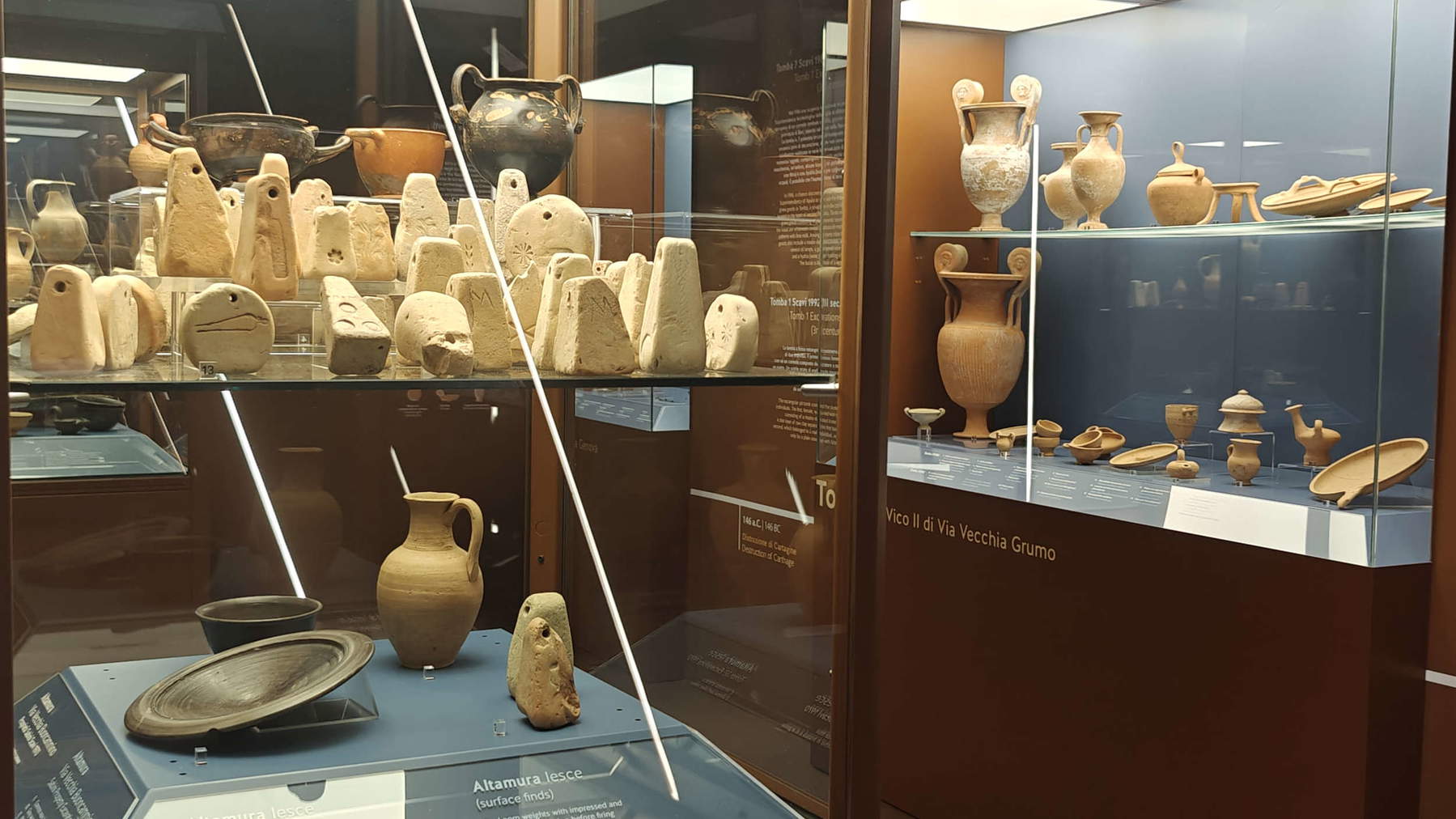
After three years of closure, the exhibition space on the first floor of the National Archaeological Museum of Altamura (Bari) reopens to the public, completely renovated thanks to an initial phase of restoration, modernization, and redesign funded in part by the National Recovery and Resilience Plan (PNRR) and in part by state funds. The new layout restores one of the museum’s most important sections—dedicated to the history of the Murge region of Bari from the Iron Age to the Early Middle Ages—to full public access, while also introducing new ways of communicating information and guiding visitors, including immersive experiences. With the reopening, numerous artifacts from Altamura and surrounding towns are once again on display to the public—crucial evidence for reconstructing the area’s history in ancient times. The exhibition features hoards of coins, bronze artifacts, jewelry, clay figurines, and figurative vases—artifacts that chronicle the development of the communities that inhabited the Murge region of Bari and constitute a significant portion of the museum’s collections.
This project represents the first phase of a broader enhancement program involving the National Archaeological Museum of Altamura, which will continue in the coming years with new construction projects and further exhibit redesigns. The goal is to progressively renew the exhibition layout, updating it both from a scientific standpoint and in terms of communication and accessibility, to make the museum increasingly open to diverse audiences.
The first-floor galleries guide visitors through the historical developments of the Murge region of Bari from the Iron Age to the Early Middle Ages, reconstructing the history of the peoples who inhabited this area and the role played by some of the major settlements of ancient Peucezia. At the heart of the narrative are the towns of Altamura, Gravina, Jesce, and Toritto, which played a central role in the historical, cultural, and economic processes that shaped this part of Puglia over the centuries.
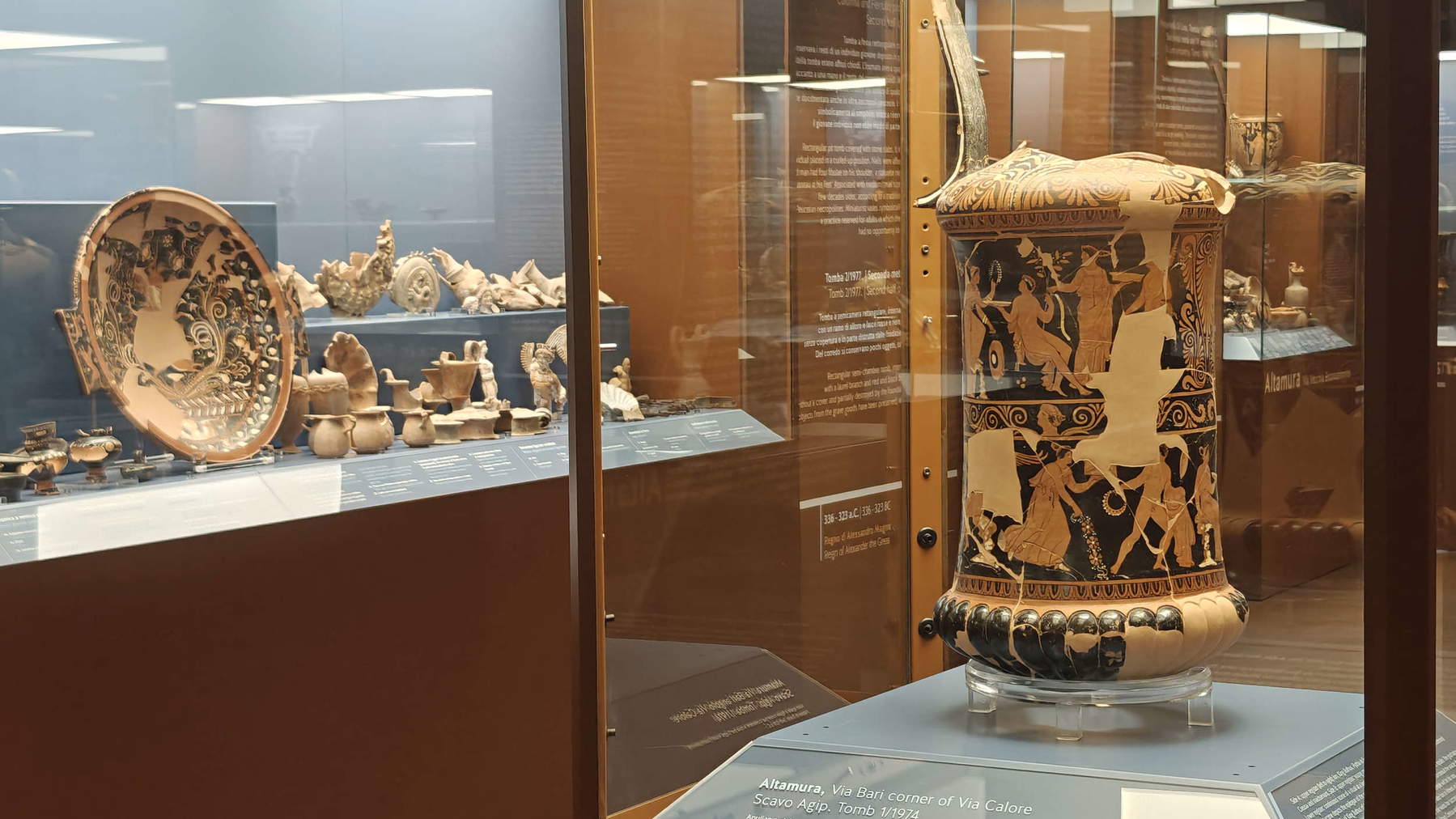
One of the project’s key focuses is on innovating outreach methods. The museum is expanding its scientific and educational offerings by introducing new communication tools: the goal is to provide a visit that engages diverse audiences, fostering a more immediate understanding of the archaeological heritage and the historical events it documents. Particular attention has also been paidto accessibility. The new exhibition layout includes tactile aids designed to promote a more inclusive experience, bilingual explanatory panels, and language crafted to be simple and clear, without compromising scientific rigor. This approach aims to foster a more direct dialogue with visitors and strengthen the connection with younger generations, identified as one of the primary target audiences for the museum’s renovation.
The visit begins with a new multimedia section that introduces the public to the history of the region, offering an overview of the long evolution of an area where archaeological, historical, and landscape values are closely intertwined. Through digital content and audiovisual tools, visitors can explore the key stages in the development of the Murge region of Bari, gaining an understanding of the context in which the artifacts displayed in the subsequent galleries are situated. The museum thus aims to tell the story not only of the objects preserved in its collections but also of the cultural landscape from which they originate, connecting ancient settlements, environmental changes, and the historical dynamics that have shaped the region over the millennia.
The redesign project is one of the main initiatives to promote cultural heritage carried out by the Castello Svevo in Bari—Regional Directorate of National Museums of Puglia. The project was carried out under the supervision of architect Francesco Longobardi, while the design was entrusted to architect Donatella Campanile, who also directed the construction work. The curatorial concept for the new exhibition itinerary was developed by archaeologist Carla Bagnulo, while overall coordination of the project was handled by Ebe Chiara Princigalli, director of the National Archaeological Museum of Altamura.
However, the reopening of the first floor represents only one stage in a broader program to transform the museum complex. In fact, additional projects are already in the planning phase, aimed at expanding the exhibition layout and highlighting new sections dedicated to the history of the region.
Among the projects already underway is the creation of a space dedicated to the city of Altamura and the archaeological site of La Croce, located in the immediate vicinity of the museum. Design solutions are currently being studied for this area, aimed at highlighting its archaeological potential and integrating it more fully into the narrative presented by the museum.
At the same time, work will continue inside the building with the complete redesign of the section dedicated to prehistory, which will trace the earliest phases of human settlement in the Murge region. The future exhibition itinerary will guide visitors from the earliest evidence of human presence through the Bronze Age, reconstructing the evolution of the communities that inhabited the region throughout prehistory.
Special emphasis will be placed onthe Altamura Man, one of Europe’s most significant paleoanthropological discoveries, which will be a central feature of the new section. The exhibition will also explore the origins of the Neolithic communities that developed in the area, illustrating the profound economic, social, and cultural changes brought about by the rise of agriculture and the shift to a sedentary lifestyle.
The redesign will also feature the Copper Age contexts uncovered at the sites of Laterza and Grotta Nisco, which provide essential insights into the transformations that shaped the region during a crucial phase of Italian prehistory. The narrative will conclude with an in-depth exploration of the rapid cultural developments that occurred between the Early and Late Bronze Ages, a period during which the communities of southern Italy consolidated trade networks, technological innovations, and new forms of social organization that paved the way for the subsequent transformations documented in the museum’s sections that have now reopened.
|
| The first floor of the National Archaeological Museum of Altamura reopens after three years of renovations |

Warning: the translation into English of the original Italian article was created using automatic tools. We undertake to review all articles, but we do not guarantee the total absence of inaccuracies in the translation due to the program. You can find the original by clicking on the ITA button. If you find any mistake,please contact us.





















 IT
IT FR
FR DE
DE ES
ES CN
CN


