




Three sculptures that tell the story of centuries of Nigerian history and artistic traditions are coming to the Metropolitan Museum of Art in New York thanks to a long-term loan agreement with the Nigerian National Commission for Museums and Monuments (NCMM). The works, dating from the 12th to the 18th centuries, will be on display starting in Septemberin the Michael C. Rockefeller Wing of the Met and will be incorporated into the African art exhibition. The agreement provides for a 25-year loan, with the possibility of extension. The sculptures come from the private collection of Ceil Pulitzer, a philanthropist, collector of African art, and longtime supporter of the New York museum’s African collections. The agreement marks a new chapter in the collaboration between the Met and Nigerian cultural institutions, with the goal of broadening access to the country’s artistic heritage, promoting research, and supporting the conservation of the collections.
The sculptures that will join the Met’s exhibition collections offer a glimpse into the artistic traditions and practices of representing power in the kingdoms of Ife and Benin.
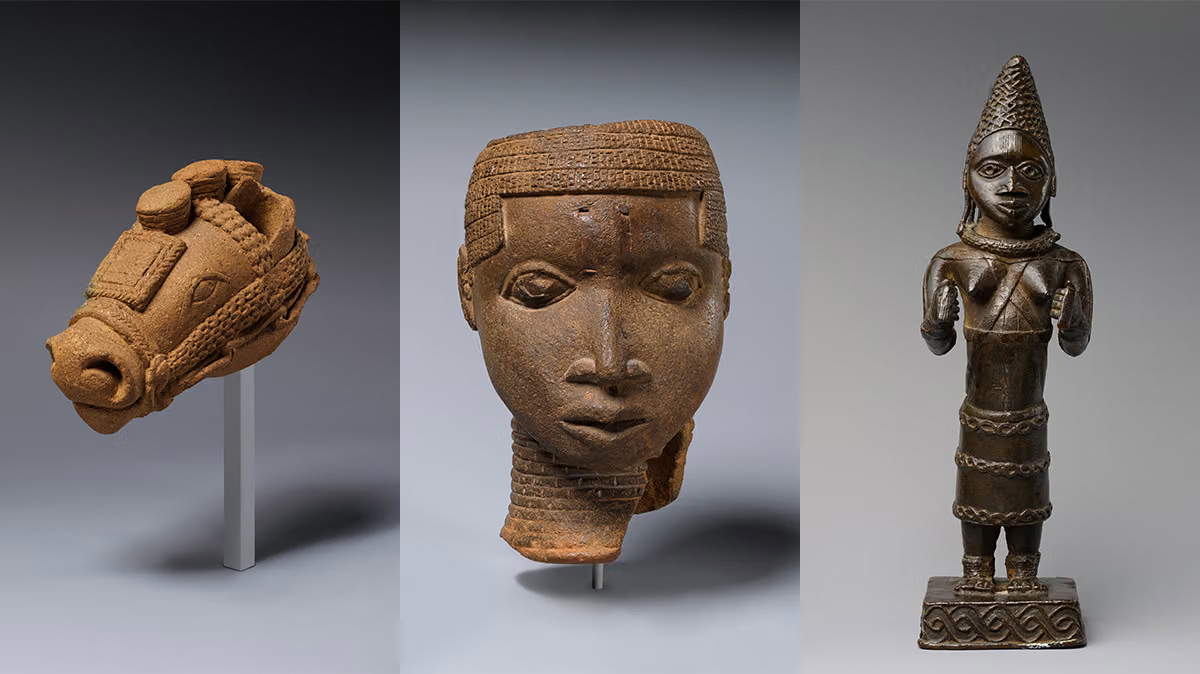
The first is a Yoruba terracotta horse head, dating from the 12th to the 15th century, from the Kingdom of Ife. The work stands out for the refinement of its details: the finely modeled bridle, the elaborate hairstyle, and the fluted frontal plate lend the sculpture a solemn and regal appearance. The artistic output of Ile-Ife—a medieval city-state considered a key center for the development of the Yoruba and Edo traditions of divine kingship—included numerous terracotta and brass sculptures. Between the 12th and 15th centuries, artists created hundreds of human, animal, and otherworldly figures, which were also intended to celebrate and reinforce the authority of rulers. In this context, the horse takes on special significance: as the mount of warriors and rulers, it represented a symbol of prestige and power. In this sculpture, the ornate halter and the rendering of the mane highlight the animal’s role and the technical skill of the artisans of Ife.
The second work is a commemorative terracotta portrait from the Kingdom of Benin, dating from around the 16th century. It bears witness to court practices related to the commemoration of high-ranking figures. These idealized portraits were hand-modeled by members of the royal guild of brass casters, Ìgùn Ẹ́rọ̀nwwọ̀n, and placed on altars dedicated to the guild’s deceased leaders. The tradition also included depictions of figures charged with purifying the land and of the early ọ́bà, the rulers of Benin who reigned before the 14th century.
The third sculpture is an 18th-century copper alloy statuette depicting a queen mother of Benin, a title referred to as iyọ́bà. This is a particularly rare type: in most cases, depictions of queen mothers were part of larger compositions placed on ùrhọ̀tọ̀ altars. The statuette’s standalone nature might suggest that it was intended to commemorate a particularly prominent iyọ́bà who lived between the late 17th and 18th centuries. During that period, five queen mothers succeeded one another: Imarhiaede, Ewebonoza, Ihasogie, Ede, and Oloi Ohogha II. Among the most influential figures were Ihasogie—who, according to oral traditions, is said to have used both physical and supernatural powers to facilitate her son Ọ́bà Ákẹ́nzùa I’s ascension to the throne— and Oloi Ohogha II, considered one of the wealthiest queen mothers. Her son, Ọ́bà Akẹngbẹdo, is remembered for having ruled during a long period of peace.
The transfer of the three works was made possible through a collaborative effort between the Metropolitan Museum of Art, the NCMM, and the Friends of Nigeria’s Cultural Heritage association, established by the Nigerian Commission and hosted by Myriad USA. The Met facilitated Ceil Pulitzer’s donation to the association, which enables international philanthropic contributions to be channeled to the NCMM to promote the conservation, study, and accessibility of Nigerian museum collections. The works, previously held in a private collection, will thus be accessible to the public and the international scholarly community. At the same time, the initiative will help support the Commission’s mission and the development of museum institutions in Nigeria.
The project is part of an established collaboration between the Met and Nigerian institutions, which includes a multi-year program dedicated to the digital documentation of the NCMM’s collections. Launched with a pilot project to catalog 100 works, the program involved curatorial staff from the National Museum of Lagos (NML), with training sessions at the Met and working meetings in New York and Lagos. Activities focused on cataloging standards, photographing the works, and strategies for engaging the public.
The collaboration also made it possible to install a new photography studio and digital archiving infrastructure at the Lagos National Museum—tools designed to facilitate the digitization of the collections and the creation of online educational resources. The activities continue with the exchange of expertise and the development of new tools for heritage management and documentation. The Met recently received, for the second time, funding from the Ambassadors Fund for Cultural Preservation (AFCP), a program of the U.S. Department of State, to support the next phase of the project.
With the arrival of these three works, the Met is expanding the presence of Nigerian art in its galleries and strengthening a collaboration that also encompasses research, education, and conservation. The 25-year loan will allow the sculptures to be studied and appreciated by an international audience, while support for digital documentation and museum infrastructure will help enhance the collections housed in Nigeria.
“The Met’s mission is to make exceptional works of art accessible to the public through engaging and rigorous exhibitions that reach the widest possible audience,” said Max Hollein, Director and CEO of the Met. “This agreement fits seamlessly into the Museum’s ambitious plan to promote this art in a meaningful way. We greatly value our partnership with the National Commission for Museums and Monuments, which continues to grow stronger. Nigerian art, both historical and contemporary, holds a prominent place in the Met’s collection and has taken on renewed significance following last year’s reopening of the Michael C. Rockefeller Wing. It was a pleasure to welcome NCMM Director General Olugbile Holloway to the wing’s opening, underscoring the close synergy between our institutions. This innovative collaboration will help broaden global appreciation of Nigerian art and deepen our understanding of Nigeria’s extraordinary cultural heritage, while supporting the NCMM’s objectives. We are deeply grateful to Ms. Pulitzer and Mr. Holloway for making this exhibition possible.”
“This initiative is very important to us because it allows Nigerian archaeological artifacts from private collections to be exhibited at the Met, making them visible to a broad and diverse audience,” said Olugbile Holloway, Director General of the National Commission for Museums and Monuments. “Our collaboration with the Met is of immense value, and we look forward to further opportunities to deepen and strengthen the relationship between our two institutions. The works are exceptional examples of sculpture from the ancient civilization of Ife and the Benin court. During their stay at the Met, they will be on display in the galleries dedicated to African art in the new Michael C. Rockefeller Wing and will be available for study. Their inclusion will expand the Met’s presentation of one of the world’s greatest artistic traditions, which flourished in Ife between the 9th and 16th centuries.”
|
| The Metropolitan Museum of Art in New York is hosting three Nigerian sculptures: a historic 25-year loan |

Warning: the translation into English of the original Italian article was created using automatic tools. We undertake to review all articles, but we do not guarantee the total absence of inaccuracies in the translation due to the program. You can find the original by clicking on the ITA button. If you find any mistake,please contact us.


















 IT
IT FR
FR DE
DE ES
ES CN
CN


