





Simone Forti, an Italian-American artist considered one of the most influential figures in the history of postmodern dance and contemporary performance, has passed away at the age of 91. The news of her passing marks the end of an artistic journey that, over the course of more than six decades, profoundly transformed the way we conceive of movement, the relationship between body and space, and the dialogue between dance, visual arts, music, and improvisation. Her work exerted a decisive influence not only on contemporary choreography but also on international performance art, to the extent that she was recognized as a major point of reference for entire generations of artists.
The Raffaella Cortese Gallery, which began representing her in 2026 following the closure of The Box L.A., honored the artist with a message of condolence, emphasizing that Forti’s legacy will be preserved by the Simone Forti Art Trust. “We remember Simone with affection, admiration, and deep gratitude, and we are committed to carrying on the legacy of his extraordinary work,” reads the statement released by the Milanese gallery.
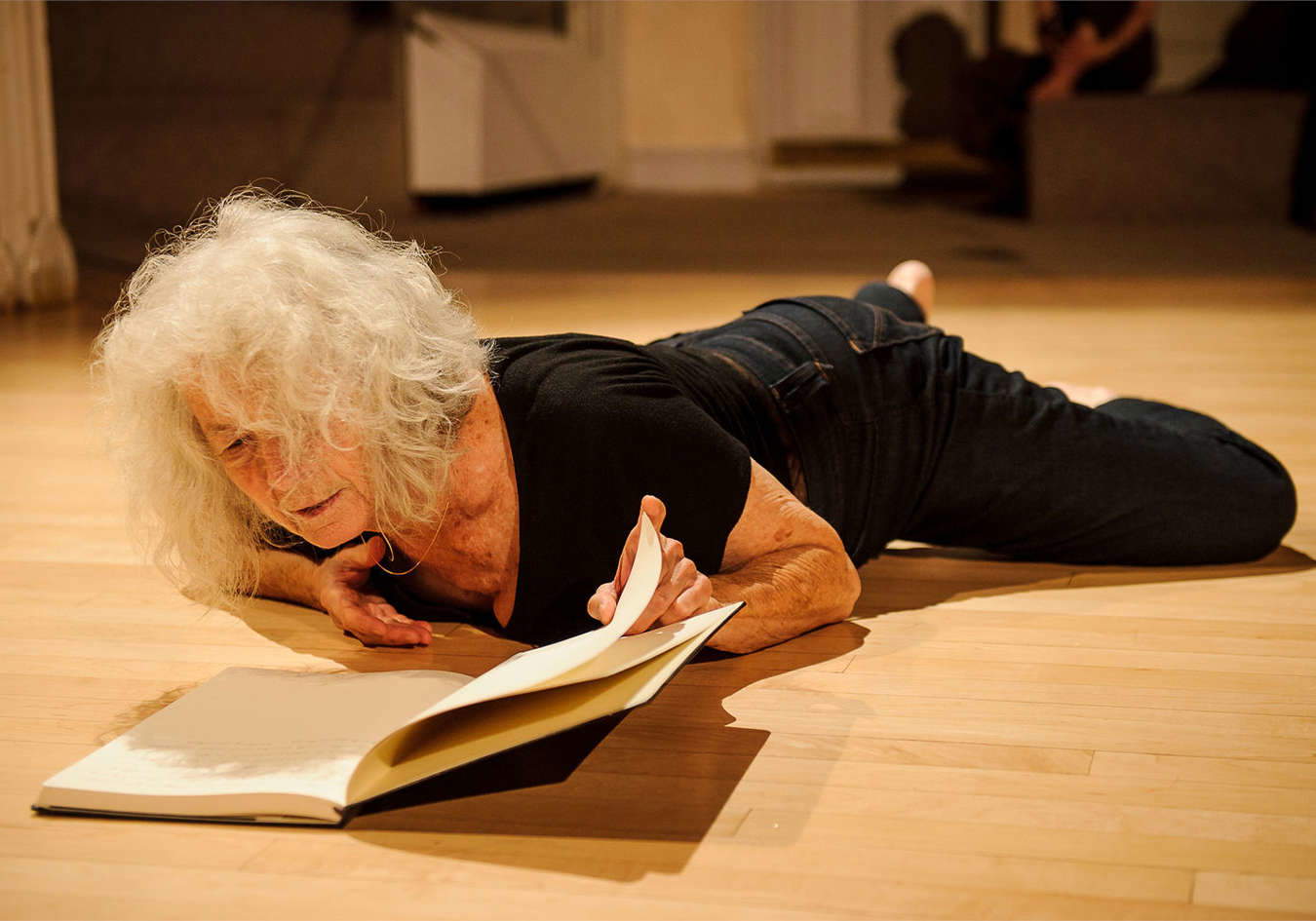
Born in Florence in 1935, Simone Forti moved to the United States while still young. After initially training in California, she moved to New York in 1959 with her first husband, Robert Morris, an artist who would go on to become one of the leading figures of Minimalism. To support herself, she worked as a teacher at a preschool while attending composition and improvisation classes taught by musicologist Robert Ellis Dunn at Merce Cunningham’s studio. Those lessons proved decisive: through Dunn, she came into contact with the ideas of John Cage and a new generation of dancers and choreographers—including Trisha Brown, Yvonne Rainer, and Steve Paxton—who would go on to redefine the history of American dance. It was precisely in New York during those years that Forti immersed herself in the downtown art scene, contributing to the emergence of that constellation of experiences that would later come to be identified with Fluxus. Between 1960 and 1961, he created the famous *Dance Constructions*, a series of works destined to radically change his own trajectory and that of contemporary dance. In the pages of his book *Handbook in Motion*, he would describe them as “a pilot concert for the works I would create in the years to come.” Those works introduced a completely new way of conceiving movement, based on essential actions, everyday gestures, and physical relationships between bodies and objects.
Critic Steve Paxton described the Dance Constructions as a small group of radical works that acted like a stone thrown into a still pond, generating ripples destined to spread far beyond the original event and encouraging the future founders of the Judson Dance Theater to launch their own venture. Forti’s influence on the Judson Dance Theater is now universally recognized. The collective—composed of dancers, composers, and visual artists who performed at Judson Memorial Church in Greenwich Village between 1962 and 1964—represented one of the founding moments of American postmodern dance. In December 2015, the Museum of Modern Art in New York acquired the *Dance Constructions* for the permanent collection of its Department of Media and Performance Art, definitively establishing their historical significance.
At the same time, Forti became deeply involved in the Happenings movement. After separating from Robert Morris in 1962, she began a relationship with the artist Robert Whitman, whom she married that same year. After joining Whitman’s performance group, she collaborated on numerous Happenings, including *American Moon*, *Hole*, *Flower*, *Water*, *Nighttime Sky *, and *Prune Flat*. During that period, she signed her work under the name Simone Whitman. After her divorce from Whitman, in 1968 she accompanied her parents to Italy and decided to settle in Rome. In the capital, she came into contact with gallery owner Fabio Sargentini and Galleria L’Attico, one of the main gathering places for Arte Povera artists. There she presented a retrospective of her “Dance Constructions” spread over two evenings, accompanied by the performances “Bottom ” and “Sleep Walkers,” also known as “Zoo Mantras.”
Her stay in Rome marked a decisive turning point in her artistic exploration. While regularly visiting the city’s zoo—now known as the Bioparco di Roma—Forti began to closely observe the behavior of animals in captivity. Those observations gave rise to *Animal Studies*, a series of performances and drawings inspired by the repetitive movements of polar bears, elephants, and other species. The artist described how she gradually identified with the animals, going so far as to characterize that experience as a form of anthropomorphism. Art historians Julia Bryan-Wilson and other scholars have emphasized how *Sleep Walkers* transformed the repetitive behaviors observed in animals into a choreographic structure based on pauses, intervals, and rhythms, bringing to light the relationship between movement, constraint, and adaptation.
During her time in Rome, Forti also helped strengthen ties between the Italian and American art scenes. In fact, he introduced Fabio Sargentini to numerous leading figures in postmodern dance whom he had met in New York, and together they organized the 1969 festival *Danza Volo Musica Dinamite*, which featured Steve Paxton, Yvonne Rainer, Trisha Brown, David Bradshaw, Deborah Hay, and other artists. He later took part in the 1972 Festival Music and Dance U.S. and the 1974 Musica e danza contemporanea festivals, which also featured Joan Jonas, Charlemagne Palestine, and La Monte Young.
In 1969, Forti returned to the United States to participate in the Woodstock festival. The experience turned into a stay of about a year in a community in a small town in New York, during which he also experimented with LSD—an experience he would later recount in *Handbook in Motion*, published in 1974. In 1970, she returned to California and joined the artistic community centered around the California Institute of the Arts. She shared a home with Nam June Paik, Alison Knowles, and musician Peter Van Riper, who would later become her third husband. Between 1970 and 1972, she occasionally substituted for Allan Kaprow as a teacher at CalArts, first at the Villa Cabrini campus in Burbank and then at the permanent Valencia campus. She also organized informal dance and musical improvisation workshops called Open Gardenia, began a Tai Chi practice—which would remain a lifelong pursuit—under the guidance of Master Marshall Ho’o, and initiated a long-standing collaboration with composer Charlemagne Palestine.
Their collaboration gave rise to *Illuminations*, a performative practice developed beginning in 1971 and subsequently presented at numerous international venues, including the Louvre in 2014, the Vleeshal Markt in 2016, and the Luigi Pecci Center for Contemporary Art in Prato in 2021 with *Illuminations Revisited*, performed by Sarah Swenson in the artist’s absence.
Between 1972 and 1974, he lived in Halifax, Canada, at the invitation of NSCAD University Press, where he wrote and edited *Handbook in Motion*. The volume brings together photographs, poems, drawings, pages from his notebooks, and reflections on pivotal moments in his artistic practice, as well as descriptions of works such as *Herding*, *Face Tunes*, *Cloths*, *Fallers*, and numerous *Dance Constructions*. The book was later translated into French and republished in several English editions.
In 1974, she returned to New York and married Peter Van Riper, with whom she lived in a loft at the Fluxhouse Cooperative organized by George Maciunas. Together they developed *Big Room*, a performative practice that combined Van Riper’s improvised saxophone playing with animal-inspired movements devised by Forti. Their performances were presented in the United States and France between 1975 and 1980. Her observations of animals in captivity continued at the Central Park and Bronx zoos, inspiring the large-scale collective performance *Planet* in 1976, presented at P.S.1 with approximately forty participants. The work transformed the repertoire of movements developed in her classes—directly inspired by behaviors observed in animals—into a choreographic language.
In the 1980s, Forti began a new chapter in her artistic exploration: she developed Logomotion, a performative form based onthe simultaneous improvisation of speech and movement, which she described as a way to access thoughts even before they took on rational form. This experience gave rise to the News Animations, improvisations built around current events, addressing political, social, and environmental themes through the fusion of verbal and bodily language. She continued to present them around the world, including a significant performance at the Hammer Museum in Los Angeles in 2012.
In 1986, she also founded Simone Forti & Troupe together with dancers K.J. Holmes, Lauri Nagel, David Rosenmiller, and David Zambrano, who were later joined by Eric Schoefer. The group developed collective performances based on so-called “landscape portraits,” often accompanied by live drawings as an integral part of the performance.
In the 2000s, she created numerous productions with the collective The Sleeves alongside Terrence Luke Johnson, Sarah Swenson, and Douglas Wadle, creating shows such as *Unbuttoned Sleeves*, *Civics 101*, *Turtles All The Way Down*, *To Borrow Salt*, and *Conversation Piece*. He also collaborated with Jeremiah Day and Fred Dewey on a series of performances and exhibitions dedicated to News Animations between 2009 and 2015. Also in 2009, he began working with The Box L.A. gallery, where he exhibited regularly until the space closed in June 2026. He subsequently joined the Raffaella Cortese Gallery in Milan.
Institutional recognition of her career has grown in recent years. In 2014, the Museum der Moderne in Salzburg dedicated its first major museum retrospective to her, titled *Thinking with the Body: A Retrospective in Motion*, accompanied by a comprehensive catalog featuring contributions by Yvonne Rainer, Steve Paxton, Fred Dewey, Robert Morris, Sabine Breitwieser, Meredith Morse, and Julia Bryan-Wilson. In 2018, the Museum of Modern Art in New York gave her a central role in the exhibition *Judson Dance Theater: The Work Is Never Done*. In 2023, the Museum of Contemporary Art in Los Angeles organized a major solo exhibition dedicated to her work, and that same year, the Venice Dance Biennale awarded her the Golden Lion for Lifetime Achievement.
Until her final years, Simone Forti continued to work tirelessly. In Los Angeles, she further developed *Logomotion* and the *News Animations*, improvisations based directly on daily newspaper headlines. At The Box L.A. gallery in 2016, she presented *Tea for Three* alongside Yvonne Rainer and Steve Paxton, a performance that celebrated, with lightness and profound intensity, a long friendship and a shared exploration of improvisation.
With Simone Forti’s passing, we have lost one of the figures who most profoundly contributed to redefining the very concept of dance in the second half of the 20th century. Her legacy spans choreography, performance, the visual arts, and teaching, continuing to influence artists and institutions around the world. The Simone Forti Art Trust will be tasked with preserving and promoting a creative legacy that has permanently transformed the relationship between the body, movement, and contemporary art.
|
| Farewell to Simone Forti, a pioneer of postmodern dance and contemporary performance |

Warning: the translation into English of the original Italian article was created using automatic tools. We undertake to review all articles, but we do not guarantee the total absence of inaccuracies in the translation due to the program. You can find the original by clicking on the ITA button. If you find any mistake,please contact us.
















 IT
IT FR
FR DE
DE ES
ES CN
CN


