





Two activists from the British group Youth Demand were found guilty of criminal damage after they targeted a painting by Pablo Picasso at the National Gallery in London in October 2024 as part of a protest in support of Palestine. According to The Telegraph, which has detailed every stage of the case, the verdict came at the conclusion of the trial held at Southwark Crown Court ( the first-instance criminal court), where a jury found Jai Halai, a 25-year-old employee of the British National Health Service (NHS), and Monday-Malachi Rosenfeld, a 23-year-old political science student. Both were charged with criminal damage, the British equivalent of property damage.
The incident took place on October 9, 2024, in one of the galleries of the National Gallery, where *Maternity*, a painting created by Pablo Picasso in 1901, is housed. During the protest, the two activists had placed a large poster on top of the artwork’s protective glass depicting a Palestinian mother with her child in the Gaza Strip. As Youth Demand later explained, the image was a photograph taken by Palestinian journalist Ali Jadallah, a photojournalist for the Turkish news agency Anadolu. The caption reads: “A mother holds her son, who was wounded in an Israeli attack, as Israeli airstrikes continue for the twelfth day at Al-Shifa Hospital in Gaza City.” Immediately afterward, they poured water-based red paint onto the gallery floor, shouting slogans in support of the Palestinian cause and demanding that the United Kingdom sever trade ties with Israel.
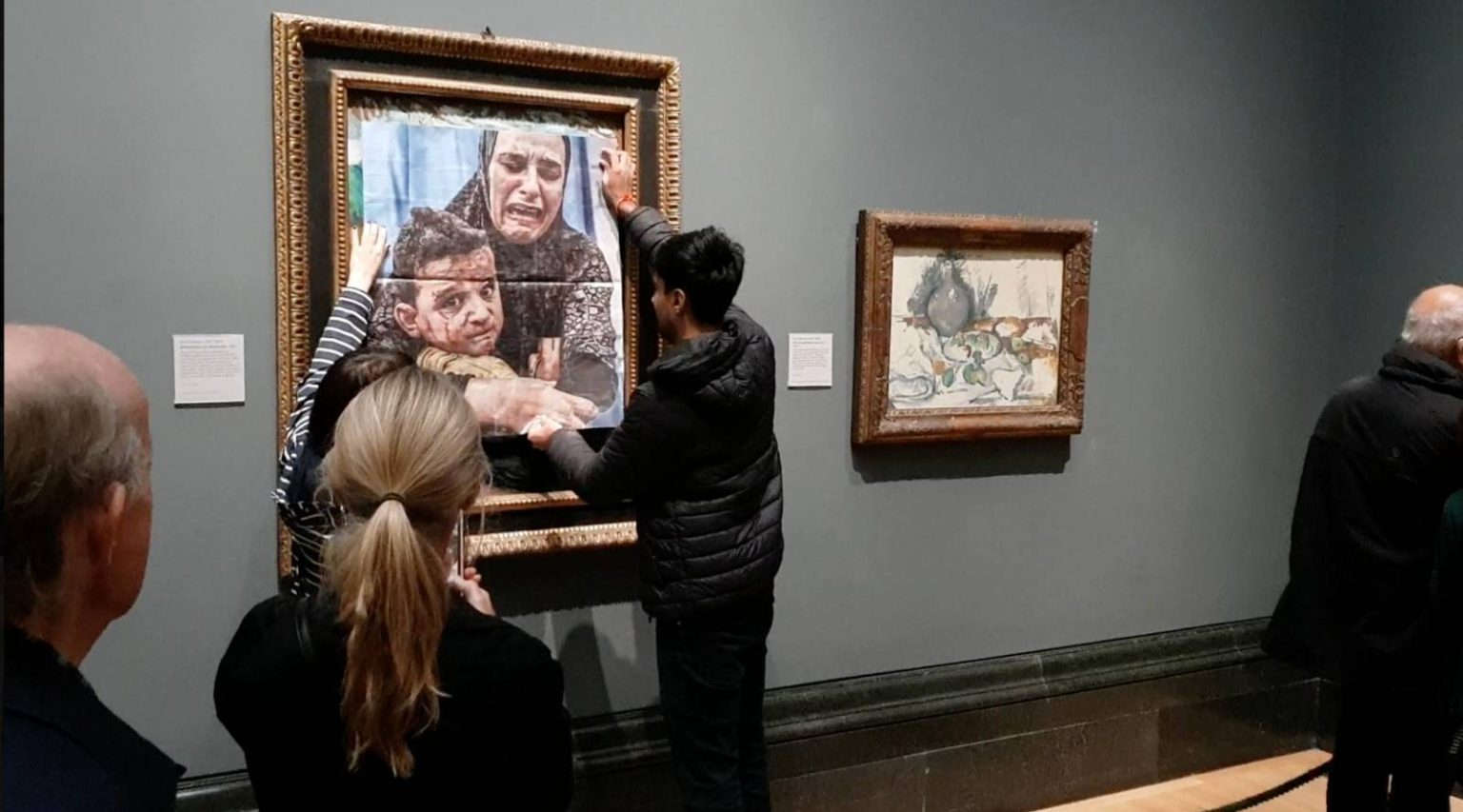
Youth Demand is a direct-action movement calling on the British government to end economic ties with Israel and to halt the issuance of new licenses for fossil fuel extraction. The protest at the National Gallery was intended as a symbolic act to draw attention to the war in the Gaza Strip and the United Kingdom’s role in the conflict.
Footage shown during the trial documented the various stages of the action. The footage shows National Gallery security guards unsuccessfully attempting to remove the two protesters as they affix the poster to the glass protecting the Picasso painting. The activists then pour red paint onto the museum’s wooden floor and continue chanting slogans as they are restrained by security personnel. In one of the videos included in the case file, according to The Telegraph, the two protesters can be heard stating that “the United Kingdom is complicit in genocide” and claiming that in Palestine “women give birth without any medical assistance.” The two concluded their protest by calling for a “democratic revolution.”
However, the trial did not center on damage to Picasso’s painting: *Maternity* suffered no damage thanks to the protective glass installed in front of the work. Instead, the charges brought by the prosecution concerned the damage caused by the paint spilled on the floor and surrounding elements of the gallery. Crucial to the reconstruction of the facts was the testimony of Michael Willie, head of security and facilities at the National Gallery. Before the jury, Willie explained that the paint had settled on the marble baseboards, the posts, and the barrier ropes, and had even begun to seep into the electrical outlets in the room.
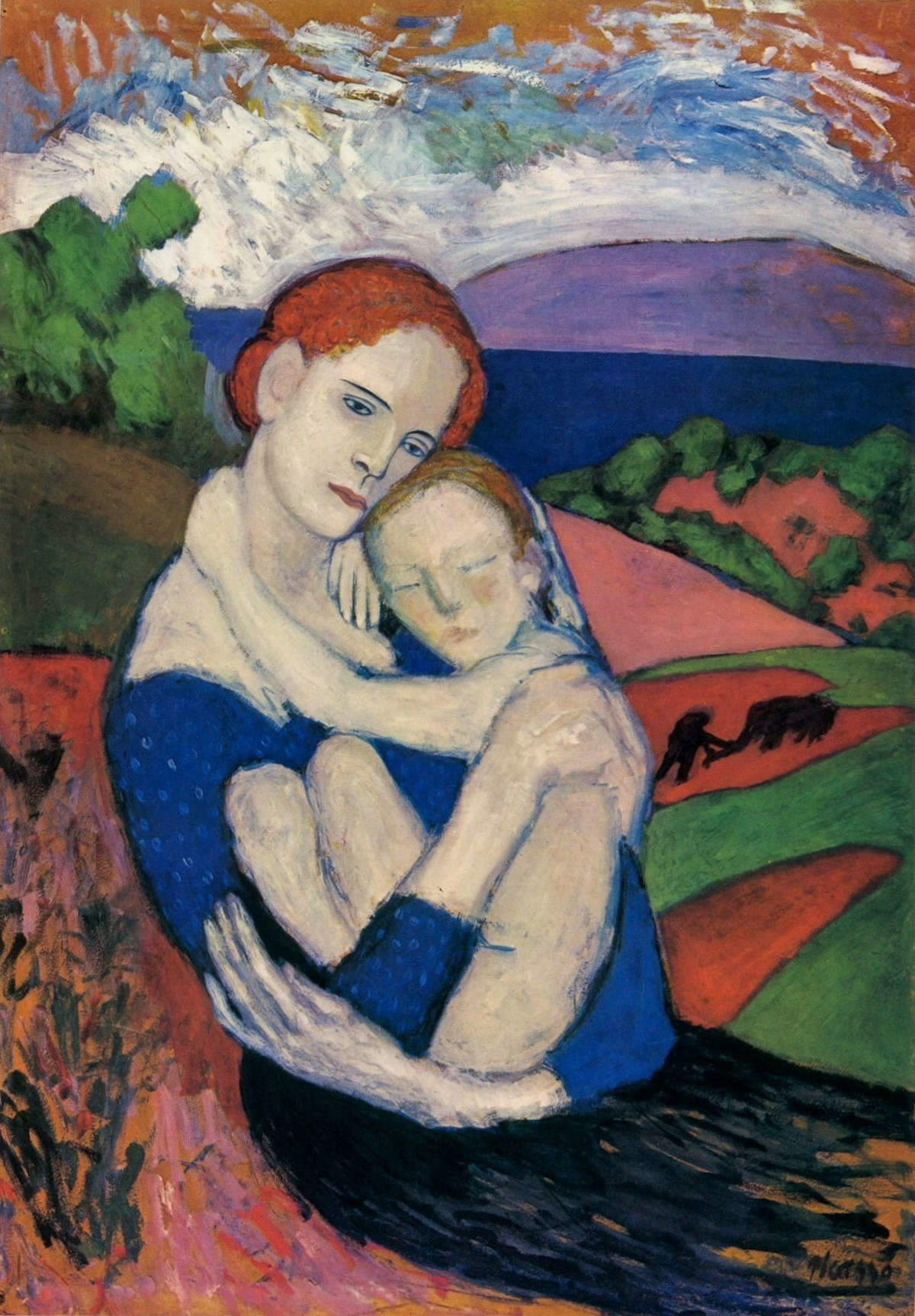
According to the National Gallery’s director, the most serious concern was the varnish’s ability to penetrate the marble’s veins and the mastic joints. For this reason, it had become necessary to completely replace certain sections of the material affected by the cleaning process. Willie clarified, however, that—at least for the time being—this could not be considered a clear case of permanent damage. When asked by the prosecution about the severity of the damage, he replied that it was not possible to assert that irreversible deterioration had occurred immediately. During the trial, it emerged that the National Gallery incurred a total expense of approximately 8,000 pounds (about 9,300 euros) to be able to reopen to the public as usual the very next day after the protest. A substantial portion of this amount, however, was not allocated directly to cleaning the paint.
Willie’s own testimony clarified that the cleaning operations alone cost 271.59 pounds. The remainder of the sum was used to restore the appearance of the floor and the gallery, in order to eliminate all traces of the incident and allow for a reopening without any visible aesthetic alterations to visitors. The work involved four workers paid 120 pounds per hour, who were tasked with restoring the wooden flooring. Specifically, it was necessary to sand the floor and apply a new surface finish to prevent areas with different shades from remaining due to the cleaning operations.
![Ali Jadallah, A mother holds [her] injured child after an Israeli attack, as Israeli airstrikes continue on the twelfth day, at Al-Shifa Hospital in Gaza City (2023)](https://cdn.finestresullarte.info/rivista/immagini/2026/fn/ali-jadallah-mother.jpg "Ali Jadallah, A mother holds [her] injured child after an Israeli attack, as Israeli airstrikes continue on the twelfth day, at Al-Shifa Hospital in Gaza City (2023)")
According to Willie, this work was essential to ensure the gallery was in proper condition for the opening the following morning. The decision to treat the entire affected surface was motivated by the need to avoid “stains” or color variations that would have been noticeable to the public. An additional 250.28 pounds was charged to the costs incurred by the National Gallery for managing the emergency and for the operations necessary to reopen the exhibition spaces.
The defense for the two defendants sought to challenge the very extent of the financial damage: the attorneys argued that a large portion of the expenses stemmed from an aesthetic choice by the National Gallery, aimed at keeping the museum “in impeccable condition,” rather than from a genuine technical necessity, and they pointed out that a museum that welcomes thousands of visitors every day must normally be prepared to handle minor incidents and extraordinary cleaning operations. In response to this observation, Michael Willie countered that, while accidental spills do occur occasionally, he had never before had to deal with an incident of the scale and nature of the one caused by the protest.
After more than nine hours of deliberation, the jury rejected the defense’s arguments and found both defendants guilty of the charged offense. Judge David Tomlinson ordered their release on bail pending sentencing. The sentence will be handed down in September. Until then, Jai Halai and Monday-Malachi Rosenfeld will remain free on bail.
|
| London: They attached a photo of a mother from Gaza to a Picasso and defaced the floor—the culprits |

Warning: the translation into English of the original Italian article was created using automatic tools. We undertake to review all articles, but we do not guarantee the total absence of inaccuracies in the translation due to the program. You can find the original by clicking on the ITA button. If you find any mistake,please contact us.













 IT
IT FR
FR DE
DE ES
ES CN
CN


