



by Redazione 17/11/2026


Categories: News / Disclaimer
Following the 2009 earthquake, the “Nazzareno De Angelis” Municipal Theater has reopened after a renovation project costing over 25 million euros. The decorative elements, historic structures, and the historic 19th-century curtain have been restored, while new technologies have been integrated into the original spaces.


Seventeen years after the 2009 earthquake, L’Aquila has regained one of the most important sites in its cultural history. The “Nazzareno De Angelis” Municipal Theater officially reopened on November 17, 2026, with an opening ceremony attended by Minister of Culture Alessandro Giuli, President of the Abruzzo Region Marco Marsilio, Mayor of L’Aquila Pierluigi Biondi, and Artistic Director of the Teatro Stabile d’Abruzzo (TSA) Giorgio Pasotti. Also in attendance were two restoration experts, TSA President Miska Ruggeri, Massimo Sericola, Superintendent of Archaeology, Fine Arts, and Landscape for the provinces of L’Aquila and Teramo; Salvo Provenzano, head of the Special Office for the Reconstruction of L’Aquila; Walter Rosa, owner of the contractor responsible for the final phase of construction; and Roberto Evangelisti, construction manager. The resumption of theatrical activities thus marks a new phase for one of the city’s most iconic public buildings, in the year that L’Aquila serves as the Italian Capital of Culture.


The reopening restores to the city a building that has been a part of the lives of generations of L’Aquila residents and has preserved an important part of the community’s artistic heritage. The project, carried out with a total investment of over 25 million euros, was supported by various funding sources. In addition to the initial allocations from the Interministerial Committee for Economic Planning and Sustainable Development (CIPESS), 5 million euros were allocated by the Ministry of Culture to complete the work, as announced by Prime Minister Giorgia Meloni in February 2024, on the occasion of the signing of the agreement on development and cohesion between the government and the Abruzzo Region. Finally, a further reallocation of funds by CIPESS secured the last 1 million euros needed to complete the stage technology, the systems, and the fire safety upgrades. Donations collected in the immediate aftermath of the earthquake during the RAI television program *Porta a porta*, hosted by L’Aquila-born journalist Bruno Vespa, also contributed to the restoration funding.


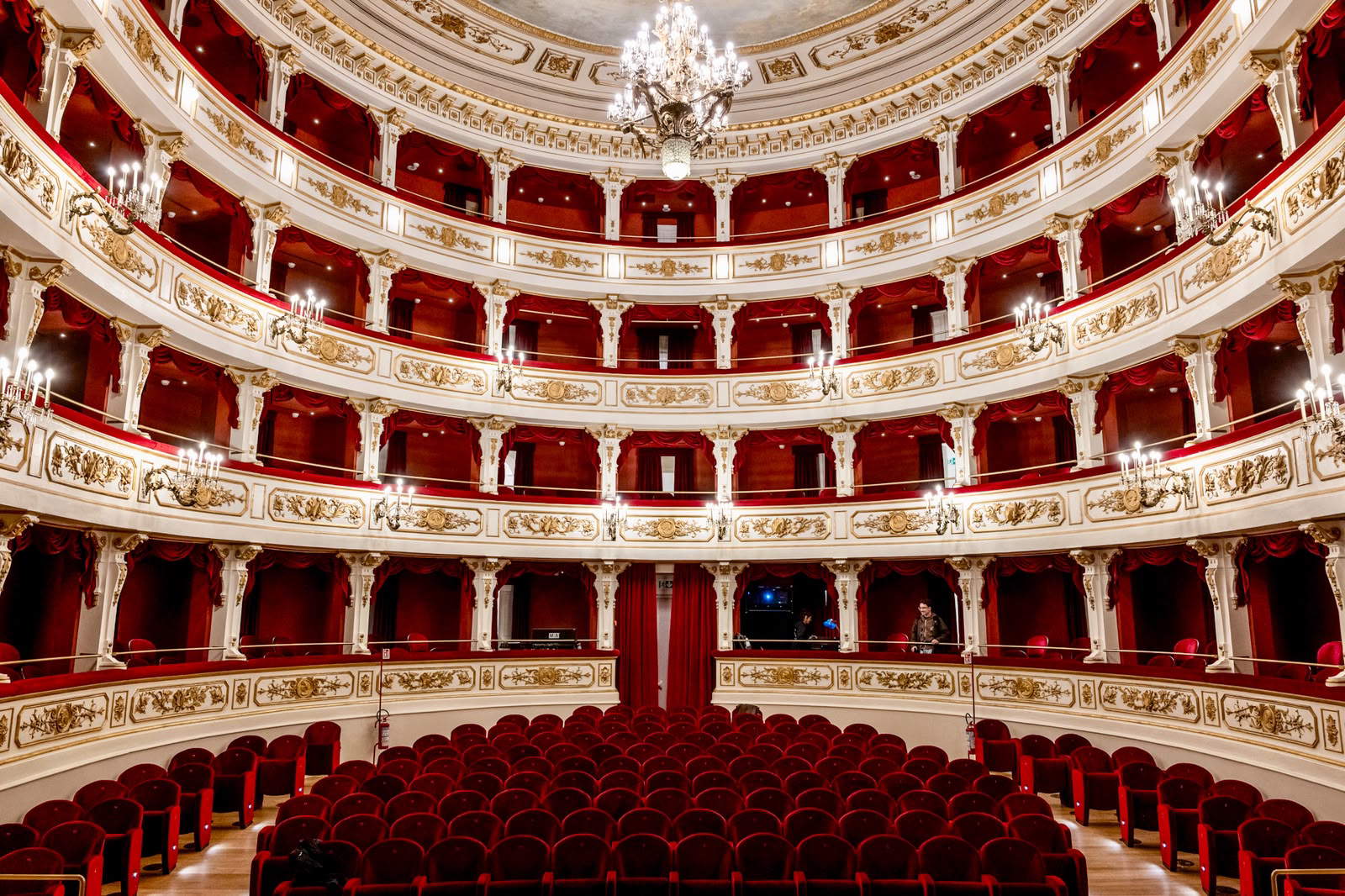
The reconstruction process was long and complex. After the initial urgent safety measures, carried out between 2011 and 2013, the project had to adapt to updated seismic safety regulations. A new detailed design was therefore approved in 2021. The turning point came in 2024, when Mayor Biondi transferred responsibility for the construction site back to the City, assuming the role of implementing entity through an agreement between the Regional Secretariat of the Ministry of Culture, the municipal administration, and the Special Office for the Reconstruction of L’Aquila (USRA), in agreement with the Mission Unit of the Prime Minister’s Office.


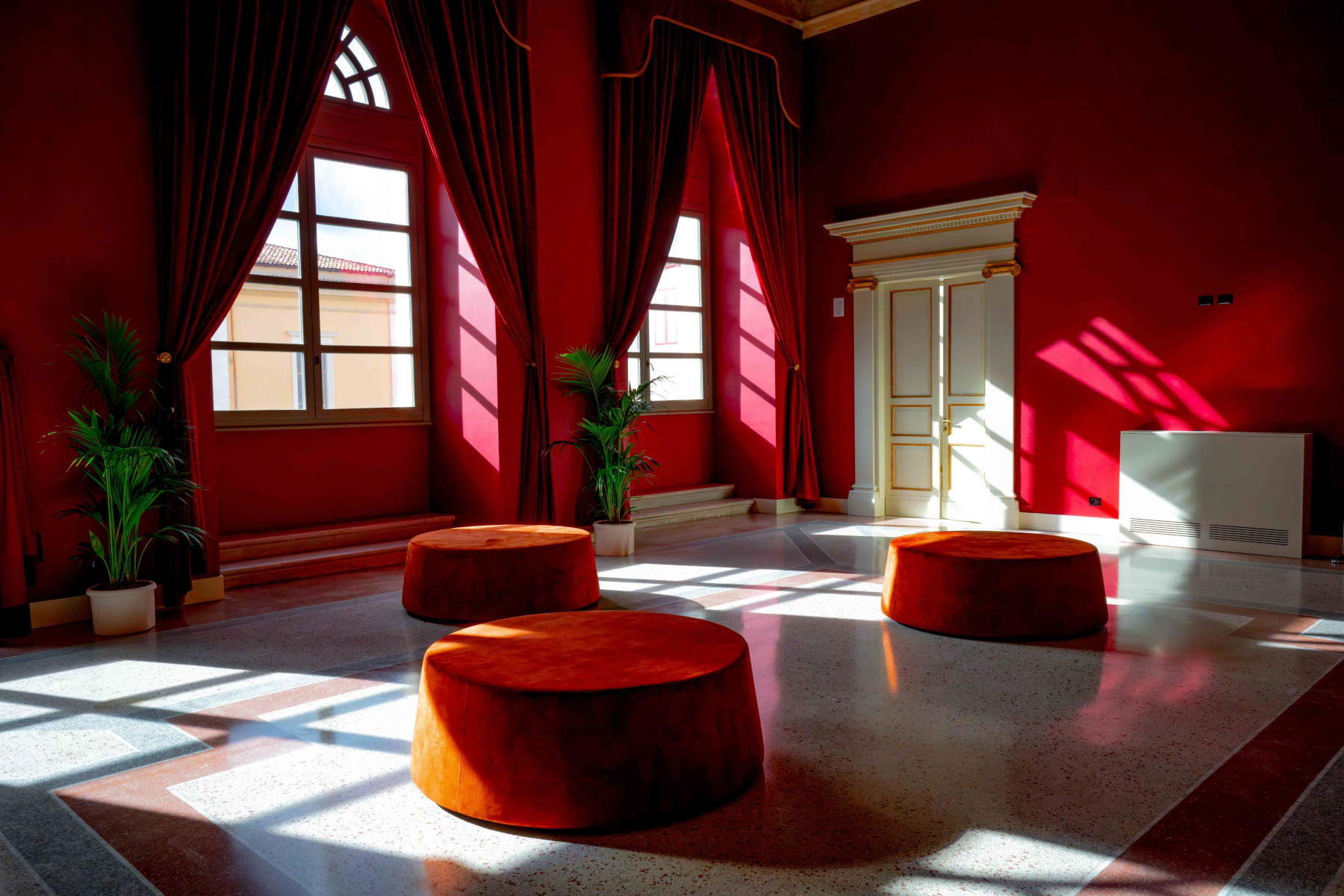
Construction began on March 31, 2025, and involved approximately 55 professionals on a daily basis. In just over a year and a half, work was carried out that required balancing the preservation of the building’s historical value with its adaptation to seismic safety standards and the technical requirements of a modern theater space. The work focused on the load-bearing walls, the wooden trusses, and the vault of the Sala Rossa, with the goal of strengthening the structure without altering its architectural identity.

In addition to the structural work, the conservation restoration focused on the decorative elements, allowing for the restoration of stucco work, gilding, terrazzo flooring, and painted surfaces. Particular attention was also paid to integrating new stage technologies into the 19th-century spaces. Automated trusses, concealed air-conditioning systems, and digital control rooms were incorporated into the structure to ensure the necessary equipment for contemporary productions without altering the audience’s perception of the historic spaces.
Preliminary surveys also led to the discovery, in the foyer area, of previously unknown decorations dating from the theater’s initial construction phase. The historic 19th-century curtain, now restored, also dates from that same period. The audience will be able to view it once the current set on stage has been dismantled. The Academy of Fine Arts in L’Aquila was also involved in the survey, experimental restoration, and museum-style display of the fragments of the Red Room’s vaulted ceiling.
Finally, the project included the creation of a three-dimensional H-BIM (Heritage Building Information Modeling) digital model, which provides a detailed mapping of the building’s architecture, structures, and systems. The database serves as the foundation for the development of a future virtual twin, or Digital Twin, through which it will be possible to monitor the theater’s condition, schedule maintenance work, track energy consumption, and prevent potential emergencies.
The ceremony was also attended by the Italian General Association of the Performing Arts (AGIS), represented by President Francesco Giambrone and Secretary General Domenico Barbuto, on behalf of the national live performing arts sector.
The reopening will be accompanied by a program of events for the public. The first performance is scheduled for Sunday, November 20, featuring Giuseppe Verdi’s *La Traviata*, with a libretto by Francesco Maria Piave based on Alexandre Dumas’s play *La dame aux camélias*, directed by Giorgio Pasotti. The resumption of theatrical activities thus marks a new phase for one of the city’s most iconic public buildings, in the year that L’Aquila serves as the Italian Capital of Culture.
Statements
“The reopening of the Teatro Comunale,” said Minister of Culture Alessandro Giuli, “is a promise kept. We are returning to the people of L’Aquila a place that symbolizes their history and identity. It is a second life for this extraordinary building and a new chapter in the rebirth of L’Aquila, one of Italy’s most beautiful cities. The Ministry of Culture has devoted all its commitment and support to achieving this result. It is one of the most brilliant examples of what collaboration among institutions can accomplish in the interest of citizens. The people of L’Aquila can see firsthand the concrete support of this government, which has contributed to the reconstruction and the rebirth of an authentic beauty that nothing can destroy. The protection of cultural heritage finds its fulfillment when what we have preserved is once again experienced and shared. In the year that L’Aquila serves as Italy’s Capital of Culture, we are returning to the community a place that will continue to offer art, opportunities for learning, creativity, and participation.”
“We are deeply proud to finally be able to return the Municipal Theater to the people of L’Aquila, a venue that, like the San Filippo and so many other places, preserves the identity of our community,” declared the mayor of L’Aquila, Pierluigi Biondi. “This administration’s commitment to reopening cultural spaces, seventeen years after the earthquake, has been tenacious, united, and unceasing. Today’s inauguration not only marks the conclusion of a complex restoration process but also represents a great legacy that L’Aquila, Italian Capital of Culture, will leave to the region. We have worked to ensure that the city does not merely rebuild its walls but returns to fully embracing its artistic calling, guaranteeing that new generations—and those who have waited for nearly two decades—have the spaces for social interaction, dialogue, and beauty that they deserve. I thank the Government, the Abruzzo Region, USRA, the municipal agencies, the 2009 Earthquake Task Force at the Prime Minister’s Office, and all those who, in various capacities, have taken part in this journey, for the milestone we have reached.”
“For many, the theater’s reopening means returning to a space cherished in their memory; for younger people, it will be the thrill of discovering it for the first time,” said Marco Marsilio, President of the Abruzzo Region. “This meeting of generations embodies the deepest meaning of reconstruction, which restores our heritage and returns it to the life of the community. The total investment reached fifteen million euros, comprising nine million from CIPE and CIPESS allocations, five million allocated by the Ministry of Culture in 2024, and an additional million for the final phase of work. This is a concrete commitment by the institutions that we can now see realized.”
“We’ve returned home—the shared home that the city loves and has been waiting for—and the emotion is immense,” adds Giorgio Pasotti, Director of the Teatro Stabile d’Abruzzo. “Today, a space that belongs to our collective memory and our deepest identity is being restored. The Teatro Comunale is a place where generations of L’Aquila residents have shared emotions, witnessed performances that have shaped the history of theater in Italy, and absorbed beauty—the very essence of this region, which I have come to recognize here. We have a great responsibility that goes beyond programming and management: we must look to the future and inspire the new generations to fall in love with this marvel.”
“Every time the doors of a theater reopen, a wound in a community’s civic life is healed,” stated Francesco Giambrone. “Even more so, in a city so severely affected by the 2009 earthquake, the reopening of the Teatro dell’Aquila takes on an even deeper significance: it is the symbol of a reconstruction that finally brings this prestigious venue back into the cultural and artistic life of our country and restores to that community a fundamental space for democracy. My thanks go to all the institutions that worked together to bring this long-awaited reopening to fruition, and my best wishes to the Fondazione Teatro Stabile d’Abruzzo, which has the task and responsibility of filling it once again with performances and restoring a vision to that space.”
 |
| Seventeen years after the earthquake, L’Aquila reopens its Municipal Theater |
Warning: the translation into English of the original Italian article was created using automatic tools. We undertake to review all articles, but we do not guarantee the total absence of inaccuracies in the translation due to the program. You can find the original by clicking on the ITA button. If you find any mistake,please contact us.